
Physicists Break the 'Lock-In Limit,' Solving a 60-Year-Old Flaw in Laser Navigation
By forcing light into a 'chiral state,' researchers have eliminated the dead band in ring laser gyroscopes, paving the way for ultra-precise, miniaturized navigation systems without moving parts.

In short
- Ring laser gyroscopes use counter-propagating light beams to measure rotation with extreme precision.
- At low speeds, backscattered light causes the beams to lock frequencies, creating a blind spot.
- Historically, this was solved by mechanically vibrating the gyroscope, which added bulk and moving parts.
Deep inside the avionics bay of nearly every modern commercial airliner, satellite, and nuclear submarine sits a device that measures rotation not by spinning a physical mass, but by spinning light. These devices, known as ring laser gyroscopes, are the gold standard for inertial navigation.
They are incredibly precise, allowing vehicles to track their exact position and orientation in three-dimensional space without relying on external signals like GPS. Yet, since their invention in 1963, these optical marvels have harbored a fundamental physical flaw that engineers have had to brute-force their way around.[2]
That flaw is known as the "lock-in effect." At very slow rotation rates, the physics of the laser cavity breaks down, creating a dead band where the gyroscope simply stops registering movement. For decades, the only reliable solution was to attach a mechanical motor to the gyroscope and physically shake it back and forth—a technique called dithering. This mechanical workaround added bulk, introduced wear and tear, and placed a hard limit on how small and efficient these sensors could become.
Now, a major breakthrough published in the journal Nature has finally solved the problem at its root. By manipulating the fundamental symmetries of light within the laser cavity, researchers have developed a "chiral laser gyroscope" that entirely eliminates the lock-in limit using pure optical physics. The achievement marks a paradigm shift in optical metrology, proving that the dead band can be bypassed without a single moving part.[1][2]
To understand the magnitude of this fix, we first have to understand how a ring laser gyroscope works. The device relies on a phenomenon called the Sagnac effect. Inside a closed, typically triangular or square cavity, a gas medium—often a mix of helium and neon—is excited to produce laser light. This light is split into two identical beams that travel around the ring in opposite directions: one clockwise, the other counter-clockwise.[2]
When the gyroscope is perfectly stationary, both beams travel the exact same distance around the ring and maintain the exact same frequency. But when the vehicle carrying the gyroscope rotates, the physics shift.
The beam traveling in the direction of the rotation has to travel slightly farther to complete its circuit, while the beam traveling against the rotation completes its circuit slightly faster. This creates a tiny frequency difference between the two beams, known as a beat frequency. By measuring this beat frequency, the system can calculate the vehicle's exact rate of rotation.[2]
The system works flawlessly at high speeds. But at near-zero rotation rates, a microscopic problem emerges. The highly polished mirrors at the corners of the cavity are not perfectly smooth at the atomic level. Tiny imperfections cause a minuscule amount of light from the clockwise beam to scatter backward into the path of the counter-clockwise beam, and vice versa. This backscattering acts as a bridge, coupling the two beams together.
When the rotation is very slow, the frequency difference between the two beams is exceptionally small. Because the beams are coupled by the backscattered light, their frequencies undergo a phenomenon called injection locking. They snap together, synchronizing to the exact same frequency. The beat frequency drops to zero, and the gyroscope essentially goes blind, falsely reporting that the vehicle is perfectly still.[1]
For sixty years, the aerospace industry's answer was mechanical dithering. By rapidly vibrating the entire gyroscope assembly back and forth on a piezoelectric mount, engineers ensured the device was never truly stationary, keeping the rotation rate artificially high enough to avoid the lock-in threshold. While effective, dithering motors consume power, generate acoustic noise, and prevent the gyroscope from being miniaturized onto microchips.[2]
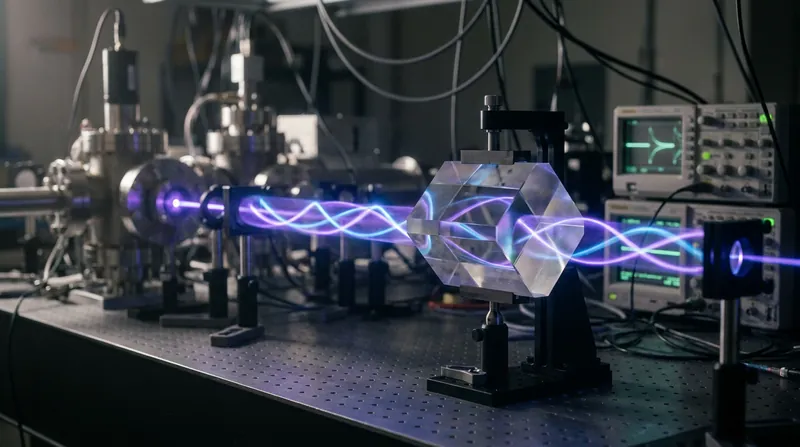
The new research discards the dithering motor entirely. Instead, the team utilized a concept called chiral spontaneous symmetry breaking. In physics, chirality refers to a system that cannot be superimposed on its mirror image—like a person's left and right hands. The researchers designed a highly stable, 0.375-meter triangular cavity filled with a specific single isotope of neon gas (He-20Ne), operating at a precise pressure of 8 Torr.[1]
By carefully tuning the cavity length at the nanoscale using piezoelectric ceramics, the team altered how the two light beams interact with the excited gas medium. They pushed the system into a non-linear regime where the perfect symmetry between the clockwise and counter-clockwise beams naturally collapses. The laser spontaneously chooses a "chiral state," where one direction's beam becomes slightly more intense than the other.[1][2]
This intensity imbalance triggers a secondary effect called non-linear frequency pulling. Because one beam is stronger, it interacts with the gas medium differently, naturally pulling its frequency away from its weaker counterpart. This optical wedge forces the two frequencies to remain distinct, even when the backscattered light tries to lock them together.[1]
The results are striking. In experimental trials, the chiral laser gyroscope maintained a perfectly linear response down to near-zero rotation speeds. Without any mechanical shaking, the device achieved an open-loop bias instability of just 0.02 degrees per hour—a level of precision that meets the rigorous demands of commercial and military navigation.[1][2]
Crucially, the chiral state is deterministic and robust. The researchers demonstrated that by applying a tiny initial rotation, they could reliably dictate which beam became dominant. The system remained stable against the random quantum fluctuations that normally introduce noise into optical sensors.[1]
The elimination of the lock-in limit opens a massive new frontier for integrated photonics. Without the need for bulky mechanical dithering assemblies or external magnetic components, the core architecture of the ring laser gyroscope can now be aggressively scaled down. Researchers are already looking toward translating this symmetry-breaking technique to solid-state, chip-scale optical circuits.[2]
If successful, this could democratize aerospace-grade navigation. Currently, high-end ring laser gyroscopes are expensive, hand-crafted instruments reserved for commercial jets, spacecraft, and advanced defense systems. A miniaturized, solid-state equivalent could bring that same dead-reckoning precision to autonomous cars, commercial drones, and underwater exploration vehicles.[2]
By solving a mechanical problem with elegant optical physics, the researchers have fundamentally upgraded one of the modern world's most invisible but essential technologies. The Sagnac effect has been freed from its oldest constraint, ensuring that the next generation of explorers—whether human or robotic—will always know exactly which way they are turning.[1][2]
Definitions
- Sagnac Effect
- A phenomenon where light traveling in a closed loop takes slightly different amounts of time to complete the circuit depending on whether it is traveling with or against the rotation of the loop.
- Lock-in Effect
- A flaw in optical gyroscopes where backscattered light causes counter-propagating laser beams to synchronize their frequencies, rendering the device blind to slow rotations.
- Mechanical Dithering
- The traditional workaround for the lock-in effect, which involves physically vibrating the gyroscope back and forth so it never experiences a true zero-rotation state.
- Chirality
- A property of asymmetry where a system or object cannot be superimposed onto its mirror image, much like a person's left and right hands.
- Spontaneous Symmetry Breaking
- A process where a system that is perfectly symmetrical naturally falls into an asymmetrical state due to microscopic fluctuations or specific tuning.
- Beat Frequency
- The measurable interference pattern created when two waves of slightly different frequencies are combined.
Questions & answers
What is a ring laser gyroscope?
It is a highly precise navigation instrument that measures rotation by sending two laser beams in opposite directions around a closed loop. It detects movement by measuring the frequency difference between the two beams.
What is the lock-in effect?
At very slow rotation speeds, tiny amounts of light scatter backward off the mirrors, causing the two laser beams to synchronize to the exact same frequency. This creates a 'dead band' where the gyroscope cannot detect rotation.
How did older gyroscopes fix the lock-in effect?
Engineers attached mechanical motors to the gyroscopes to rapidly vibrate, or 'dither,' them back and forth. This ensured the device was never truly stationary, but it added moving parts, bulk, and noise.
How does the new chiral gyroscope work?
It uses optical physics to break the symmetry between the two beams, making one slightly stronger than the other. This intensity difference naturally pulls their frequencies apart, preventing them from locking together even at near-zero speeds.
Analysis by camp
Quantum Optics Researchers
Focus on the fundamental physics achievement of using spontaneous symmetry breaking to control non-linear mode interactions.
For physicists, the triumph of the chiral laser gyroscope is fundamentally about mastering non-linear dynamics. The lock-in effect is a classic example of injection locking, a phenomenon seen across coupled oscillators where weak interactions force synchronization. By carefully tuning the cavity length and gas pressure, researchers managed to push the Helium-Neon system into a regime where symmetry spontaneously breaks. This creates a stable, deterministic chiral state where one beam dominates, proving that macroscopic optical systems can be engineered to bypass fundamental coupling limits through internal non-linear frequency pulling rather than external manipulation.
Aerospace Navigation Engineers
Value the practical elimination of mechanical dithering, which reduces wear, noise, and power consumption in inertial measurement units.
From an engineering standpoint, mechanical dithering has always been an inelegant, brute-force solution to a quantum-level problem. Dithering motors introduce acoustic noise, require power, and represent a mechanical point of failure in an otherwise solid-state device. For aerospace engineers designing the next generation of satellites, submarines, and autonomous aircraft, a purely optical solution to the lock-in effect is a holy grail. It promises to drastically increase the mean time between failures (MTBF) for inertial measurement units while simultaneously reducing their weight and power draw.
Integrated Photonics Developers
View the breakthrough as the critical missing step required to shrink high-precision optical gyroscopes down to the microchip level.
The most significant long-term impact of this research may be in miniaturization. While fiber-optic gyroscopes have seen success in smaller form factors, true ring laser gyroscopes have remained relatively bulky due to the necessity of the dithering assembly and the physics of the gas cavity. By demonstrating that the lock-in limit can be broken purely through cavity dynamics and symmetry breaking, this research provides a theoretical roadmap for translating these effects into solid-state, waveguide-based micro-ring resonators. This could eventually allow aerospace-grade dead-reckoning navigation to be printed directly onto silicon chips.
- Quantum Optics Researchers
- Focus on the fundamental physics achievement of using spontaneous symmetry breaking to control non-linear mode interactions.
- Aerospace Navigation Engineers
- Value the practical elimination of mechanical dithering, which reduces wear, noise, and power consumption in inertial measurement units.
- Integrated Photonics Developers
- View the breakthrough as the critical missing step required to shrink high-precision optical gyroscopes down to the microchip level.
Perspectives this story doesn't cover
- Commercial avionics manufacturers
- Autonomous vehicle sensor developers
Sources
Source coverage
2 outlets
3 viewpoints surfaced


- [1]NatureQuantum Optics Researchers
Chiral laser gyroscopes breaking the lock-in limit
Read on Nature → - [2]Factlen Editorial TeamQuantum Optics Researchers
Synthesis by Factlen editorial team
Read on Factlen Editorial Team →
More in Science
See all →Exoplanet Habitability
First-Ever Detection of Magnetic Field on Exoplanet Opens New Window to Habitability
8 sources

Time-Domain Astronomy
World's Largest Digital Camera Begins 10-Year Survey to Map the Dynamic Universe
5 sources

Dark Matter
Gravitational Wave Signal May Hold First Imprint of Dark Matter's Halo Around Black Holes
2 sources

Black Hole Physics
Gravitational Waves Reveal First 'Fingerprints' of a Black Hole's Event Horizon, Probing the 'Point of No Return'
4 sources

Comments
Every angle. Every day.
Get Science stories with full source coverage and perspective breakdowns, free every day.