
Minimalist vs. Maximalist Running Shoes: What the Clinical Evidence Actually Shows
Biomechanical research reveals that highly cushioned running shoes do not universally reduce impact forces, while minimalist shoes drastically increase the risk of Achilles injuries. Clinical evidence suggests runners should choose footwear based on their specific injury history to shift mechanical loads away from vulnerable joints.
By Factlen Editorial Team
- Biomechanical Researchers
- Point out that neither shoe prevents injury overall; they simply shift the mechanical load between the knee/hip and the ankle/calf depending on the shoe's geometry.
- Minimalist Advocates
- Argue that the human foot evolved to run without support, and that zero-drop shoes strengthen intrinsic foot muscles and promote a natural midfoot strike.
- Maximalist Proponents
- Emphasize that modern humans run on unnaturally hard surfaces, and that thick cushioning protects against repetitive impact fatigue during high-volume training.
What's not represented
- · Casual runners who choose footwear purely based on aesthetics and comfort rather than biomechanics.
- · Physical therapists who focus on strength training rather than footwear as the primary injury prevention tool.
Why this matters
Choosing the wrong running shoe geometry for your specific anatomy doesn't just waste money—it actively shifts mechanical stress to vulnerable joints, significantly increasing the risk of sidelined injuries like Achilles tendinitis or runner's knee.
Key points
- Highly cushioned maximalist shoes can increase leg stiffness and amplify impact loading rates.
- Maximalist shoes shift mechanical stress upward, increasing the load on the knees and hips.
- Minimalist shoes spare the knees but place intense strain on the Achilles tendon and calves.
- Runners weighing over 85kg are three times more likely to get injured in minimalist shoes.
- Transitioning to zero-drop shoes requires a minimum of 12 weeks to avoid bone stress injuries.
- Podiatrists recommend rotating both shoe types to vary the mechanical load on the body.
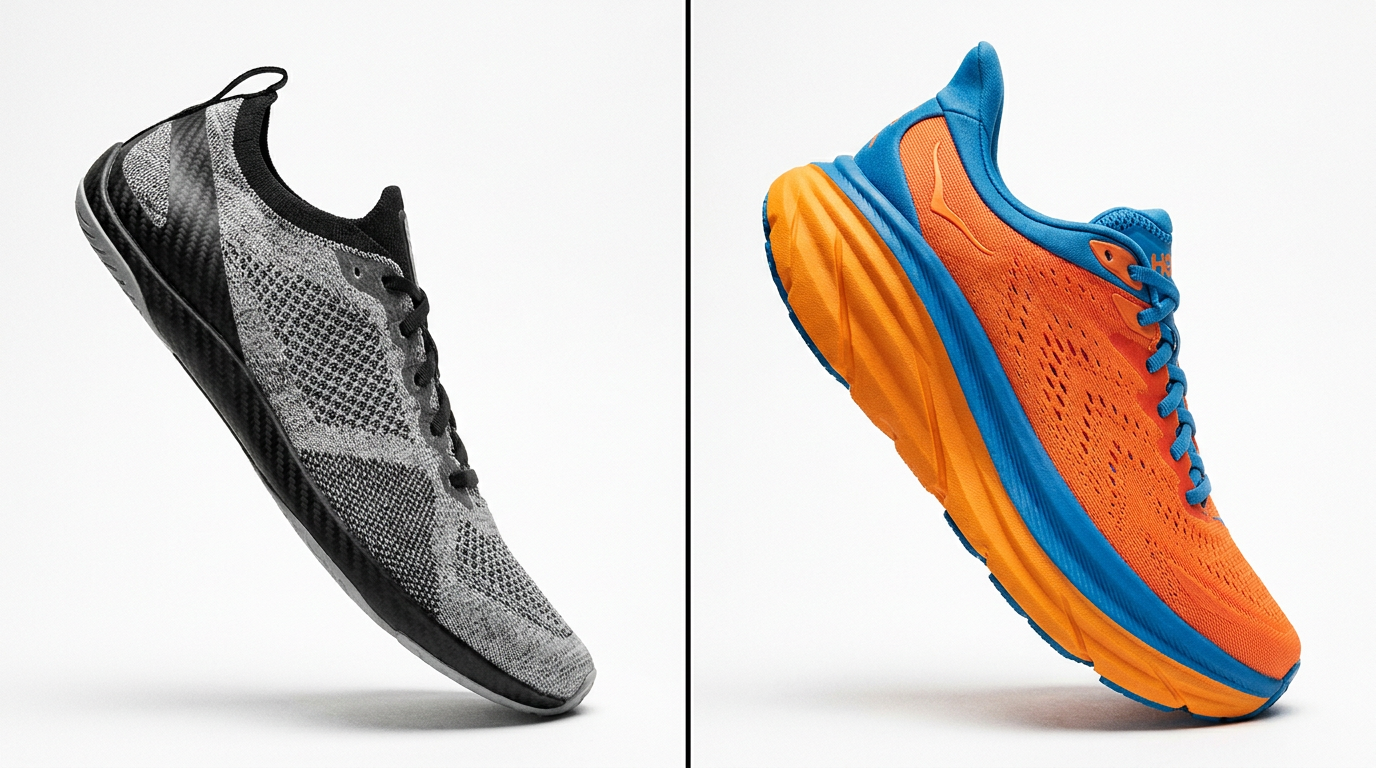
For the better part of a decade, the running world has been caught in a relentless pendulum swing between two extreme footwear philosophies. In the early 2010s, fueled by the barefoot running movement, millions of runners stripped away their supportive trainers in favor of minimalist, zero-drop shoes designed to mimic the biomechanics of the human foot. Today, the pendulum has swung entirely in the opposite direction. The market is now dominated by maximalist 'super shoes'—towering stacks of engineered foam promising unparalleled shock absorption and energy return. But as everyday runners navigate walls of brightly colored, thick-soled options at their local sporting goods stores, a critical question remains: does all this extra cushioning actually protect the body from injury? The intuitive answer is a resounding yes. However, a deep dive into the clinical biomechanics of running reveals a reality that is far more complicated, highly individualized, and often entirely counterintuitive.[6]
At the heart of the debate is what sports scientists call the 'cushioning paradox.' The prevailing consumer belief is that running on a thicker, softer bed of foam will naturally reduce the impact forces transmitted through the legs with every stride. To test this, a landmark 2018 study published in Scientific Reports analyzed the biomechanics of runners in highly cushioned maximalist shoes compared to those in conventional neutral trainers. The researchers expected to see a dampening effect. Instead, they found the exact opposite: runners in the maximalist shoes exhibited significantly increased leg stiffness and amplified impact loading rates. The highly cushioned shoes did not absorb the shock; they inadvertently caused the runners' bodies to absorb more of it.[1]
To understand why this happens, one must look at how the human central nervous system interacts with the ground. When a runner's foot lands on a highly compliant, squishy surface, the brain instantly recognizes a lack of stability. To compensate for this wobbly foundation and maintain balance, the nervous system subconsciously commands the muscles of the lower leg to contract and stiffen. According to research in the Journal of Applied Biomechanics, this increased leg stiffness means that the kinetic chain acts less like a fluid spring and more like a rigid rod. Consequently, the impact forces bypass the shoe's foam and travel directly up the skeletal system, resulting in a higher overall loading rate than if the runner had landed on a firmer surface.[1][2]

Minimalist shoes operate on the inverse principle. By stripping away the foam, these shoes force the body to act as its own primary shock absorber. Without a thick heel wedge to catch the ground, runners naturally shift away from a heel-strike and adopt a midfoot or forefoot landing pattern. This mechanical shift utilizes the foot's arch, the Achilles tendon, and the calf muscles as a biological suspension system. The Journal of Athletic Training confirms that running in minimalist footwear significantly reduces the impact forces experienced by the knees and hips. For a runner plagued by chronic 'runner's knee' or hip bursitis, stripping away the cushioning can feel like a miraculous cure, as the skeletal load is dramatically reduced.[5]
However, the laws of physics dictate that the mechanical energy of a footfall cannot be erased; it can only be redistributed. While minimalist shoes successfully spare the knees, they do so by placing immense, concentrated strain on the lower extremities. The same biomechanical shift that protects the patella forces the Achilles tendon and the calf muscles to absorb the entirety of the body's braking force. For runners who have spent their entire lives walking and running in shoes with elevated heels, these tissues are often shortened and unaccustomed to such violent eccentric loading. This redistribution of force explains why the minimalist movement, despite its evolutionary logic, resulted in a massive wave of lower-leg injuries.[5][8]
Beyond just the sheer volume of foam, the defining characteristic of a modern maximalist shoe is its 'rocker' geometry. Because an inch and a half of dense cushioning does not bend easily, manufacturers curve the sole upward at the heel and toe, creating a shape similar to the bottom of a rocking chair. This design is intended to roll the foot forward smoothly through the gait cycle, reducing the mechanical work required by the toes and ankles. While this rocker effect feels propulsive and effortless, it fundamentally alters the way the foot interacts with the ground, essentially doing the work that the foot's intrinsic muscles were designed to do. Over time, this constant offloading can lead to muscular atrophy in the feet and lower legs.[5][8]
Beyond just the sheer volume of foam, the defining characteristic of a modern maximalist shoe is its 'rocker' geometry.
This upward shift in force explains the specific injury profiles associated with maximalist footwear. Because the ankle and foot are locked into a rigid, highly cushioned rocker, the rotational and impact forces must find an escape route further up the kinetic chain. Consequently, runners who exclusively use maximalist shoes frequently present with patellofemoral pain syndrome (runner's knee), iliotibial (IT) band friction syndrome, and hip bursitis. The shoe successfully protects the foot from the harshness of the pavement, but it inadvertently turns the knee into the primary shock absorber for the entire body.[1][5]

Conversely, the injury profile of a minimalist runner looks entirely different. Because the knee is spared, the damage is almost exclusively concentrated below the calf. The sudden demand placed on the Achilles tendon to act as a primary braking mechanism often leads to severe tendinopathy. Furthermore, without a protective layer of foam to distribute the pressure of the footfall, the small bones of the forefoot are subjected to intense, concentrated impact. This lack of dispersion is why metatarsal stress fractures and severe bouts of plantar fasciitis are the hallmark injuries of runners who adopt minimalist footwear without adequate preparation.[4][5]
The transition period between these two extremes is the most dangerous window for any runner. A comprehensive study published in the American Journal of Sports Medicine tracked runners transitioning to zero-drop, low-cushion shoes over a 12-week period. The results were stark: the transitioning group experienced a massive spike in bone stress injuries compared to the control group. The researchers concluded that 12 weeks is simply not enough time for the body's dense connective tissues to remodel. Tendons and bones require months, if not a full year, of gradual, progressive loading to safely handle the demands of barefoot-style mechanics after a lifetime of wearing elevated heels.[4][7]
Beyond transition time, a runner's physical anatomy plays a massive role in determining whether minimalist shoes will be a tool for strength or a catalyst for injury. Body weight is the most critical variable in this equation. Research published in the British Journal of Sports Medicine analyzed injury rates among runners using minimalist footwear and found a drastic correlation with mass. Runners weighing over 85 kilograms (approximately 187 pounds) were three times more likely to sustain injuries in minimalist shoes compared to their lighter counterparts. For heavier runners, the sheer physics of the impact forces overwhelm the foot's natural shock-absorbing capacity, making external cushioning a structural necessity rather than a luxury.[3][8]

So, how does a runner apply this clinical evidence to their next shoe purchase? The modern consensus among sports podiatrists and biomechanical researchers points away from tribalism and toward a strategic 'shoe rotation.' Rather than pledging allegiance to the maximalist or minimalist camp, runners are encouraged to use different tools for different jobs. By varying the heel drop, stack height, and flexibility of their footwear throughout the week, runners can constantly shift the mechanical load, preventing any single joint or tendon from accumulating too much repetitive stress.[6][7]
Maximalist shoes, with their protective geometry and rocker bottoms, are highly effective for long, slow distance runs and recovery days. When a runner is logging their longest miles of the week, accumulated fatigue inevitably sets in, and running form begins to degrade. The nervous system becomes sluggish, and the foot strikes become heavier. In these specific scenarios, the thick foam and rigid rocker sole provide a necessary buffer against the repetitive micro-trauma of pavement pounding, allowing the runner to complete the necessary volume without completely destroying their lower legs.[7][8]

Conversely, minimalist shoes serve as exceptional training tools when used in small, controlled doses. Incorporating a zero-drop, low-cushion shoe for short, easy runs—perhaps one or two miles a week—acts as a form of resistance training for the feet. It strengthens the intrinsic muscles of the arch, improves proprioception (the body's awareness of its position in space), and reinforces a higher cadence with a lighter footfall. By treating minimalist shoes as gym equipment rather than daily drivers, runners can reap the biomechanical benefits of natural running without exposing their Achilles tendons to the risks of high-volume stress.[6][7]
Ultimately, the clinical evidence reveals a simple but profound truth: running shoes do not prevent injuries on their own. No amount of engineered foam or evolutionary design can magically erase the forces generated by human locomotion. Instead, shoes are tools that dictate which tissues absorb those inevitable forces. Runners with a history of knee and hip pain may find relief by gradually shifting toward firmer, lower-drop options that engage the calves. Those battling Achilles tendonitis or plantar fasciitis should lean toward the protective, load-shifting geometry of maximalist designs. By understanding their own biomechanical weak points, runners can finally stop chasing trends and start choosing the footwear that actually serves their anatomy.[5][6][8]
How we got here
Early 2010s
The publication of 'Born to Run' sparks a massive consumer shift toward minimalist, zero-drop footwear.
2013-2015
Clinical studies begin reporting a spike in Achilles and metatarsal injuries among runners transitioning too quickly to minimalist shoes.
2018
Landmark biomechanical studies reveal the 'cushioning paradox,' showing that highly cushioned shoes can actually increase impact loading rates.
2020-2026
Maximalist 'super shoes' dominate the market, shifting the common injury profile from the lower leg up to the knees and hips.
Viewpoints in depth
Minimalist Advocates
The belief that the human foot is evolutionarily designed to absorb impact without artificial support.
Proponents of minimalist footwear argue that the modern running shoe is a cast that weakens the foot. By stripping away arch support and heel elevation, minimalist shoes force the runner to land on their midfoot or forefoot. This engages the foot's intrinsic muscles and utilizes the Achilles tendon as a natural spring. Advocates point to the fact that humans ran for millennia without engineered foam, and argue that returning to this natural biomechanical state is the only long-term solution to chronic running injuries.
Maximalist Proponents
The argument that modern training volumes and hard surfaces require maximum external protection.
The maximalist camp acknowledges human evolution but points out a crucial modern reality: early humans did not run 40 miles a week on paved asphalt. Proponents argue that the sheer volume of repetitive impact experienced by modern recreational runners requires external shock absorption. By utilizing thick stacks of lightweight foam and rigid rocker soles, maximalist shoes protect the musculoskeletal system from the harshness of concrete, allowing runners to train longer, recover faster, and delay the onset of mechanical fatigue.
Biomechanical Consensus
The clinical view that shoes do not prevent injuries, but merely shift the mechanical load to different joints.
Sports scientists and biomechanical researchers view the debate not as a search for the 'perfect' shoe, but as an exercise in load management. The clinical consensus is that neither extreme prevents injury. Maximalist shoes protect the feet and calves but increase the mechanical load on the knees and hips. Minimalist shoes spare the knees but place immense strain on the Achilles and metatarsals. Therefore, the scientific recommendation is to choose footwear based on an individual's specific injury history, using the shoe's geometry to shift the load away from vulnerable tissues.
What we don't know
- Whether the long-term use of carbon-plated maximalist shoes permanently alters the structural integrity of the foot's intrinsic muscles.
- The exact threshold of weekly mileage where the benefits of minimalist foot-strengthening are outweighed by the risk of Achilles tendinopathy.
Key terms
- Loading Rate
- The speed at which impact forces are applied to the body during the foot strike. Higher loading rates are correlated with certain running injuries.
- Zero-Drop
- A shoe design where the heel and the forefoot are at the exact same height from the ground, mimicking the natural geometry of a bare foot.
- Kinetic Chain
- The interconnected system of joints, muscles, and connective tissues (from the foot up to the hips) that work together to produce movement and absorb force.
- Patellofemoral Pain
- Pain at the front of the knee, around the kneecap, often exacerbated by the altered biomechanics of running in highly cushioned shoes.
Frequently asked
Do maximalist shoes reduce running injuries?
No. Studies show they actually increase leg stiffness and impact loading, shifting the mechanical stress to the knees and hips rather than preventing it entirely.
Who should avoid minimalist running shoes?
Runners weighing over 85kg (187 lbs) and those with a history of Achilles tendonitis or calf strains are at a significantly higher risk of injury in minimalist footwear.
How long does it take to transition to zero-drop shoes?
Clinical evidence suggests a minimum of 12 weeks of very gradual adaptation, though full tissue remodeling in the Achilles and calves can take up to a year.
Can I use both types of shoes?
Yes. Many sports podiatrists recommend a 'shoe rotation,' using maximalist shoes for long recovery runs and minimalist shoes for short runs to build foot strength.
Sources
Source coverage
8 outlets
3 viewpoints surfaced








[1]Scientific ReportsBiomechanical Researchers
Running in highly cushioned shoes increases leg stiffness and amplifies impact loading
Read on Scientific Reports →[2]Journal of Applied BiomechanicsBiomechanical Researchers
Leg and Joint Stiffness Adaptations to Minimalist and Maximalist Running Shoes
Read on Journal of Applied Biomechanics →[3]British Journal of Sports MedicineBiomechanical Researchers
Body mass and weekly training distance influence the pain and injuries experienced by runners using minimalist shoes
Read on British Journal of Sports Medicine →[4]American Journal of Sports MedicineBiomechanical Researchers
Examining Injury Risk and Pain Perception in Runners Using Minimalist Footwear
Read on American Journal of Sports Medicine →[5]Journal of Athletic TrainingBiomechanical Researchers
Differences in Running Biomechanics Between a Maximal, Traditional, and Minimal Running Shoe
Read on Journal of Athletic Training →[6]Factlen Editorial TeamBiomechanical Researchers
Synthesis by Factlen editorial team
Read on Factlen Editorial Team →[7]Runners ConnectMaximalist Proponents
Minimalist vs Maximalist Running Shoes: What the Science Says
Read on Runners Connect →[8]Doc On The RunMinimalist Advocates
Minimalist vs Maximalist Running Shoes
Read on Doc On The Run →

Every angle. Every day.
Get shopping stories with full source coverage and perspective breakdowns delivered to your inbox.