
The Physics of Fast Charging: How 800-Volt Architectures Are Rewriting EV Design
By doubling the electrical pressure inside the battery, automakers are cutting charge times in half, shedding vehicle weight, and pushing electric mobility into a new era of efficiency.

Share this story
In short
- Most electric vehicles today use a 400-volt electrical architecture, which limits charging speeds to around 150-200 kilowatts.
- By doubling the voltage to 800 volts, automakers can deliver the same amount of power using half the electrical current.
- Lower current allows for thinner, lighter copper wiring inside the vehicle, reducing overall weight and manufacturing complexity.
The electric vehicle industry is hitting a physical bottleneck. For years, the focus has been on battery chemistry—finding the perfect mix of lithium, nickel, and cobalt to store more energy.
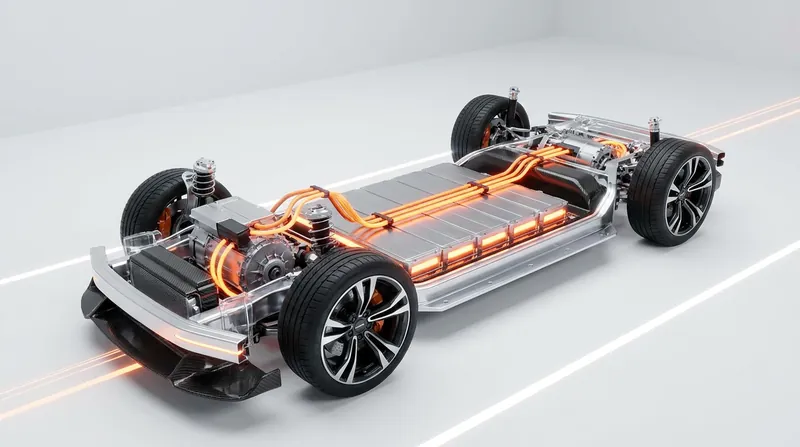
But as batteries have grown larger to satisfy range anxiety, a new problem has emerged: how to move massive amounts of electricity into the battery, and from the battery to the motors, without melting the car's internal wiring. The answer lies not in chemistry, but in a fundamental upgrade to the vehicle's electrical plumbing: the shift from 400-volt to 800-volt architectures.
To understand the 800-volt revolution, it helps to look at the 400-volt status quo. The vast majority of electric vehicles on the road today operate on a 400-volt system, which typically fluctuates between 300 and 500 volts depending on the battery's state of charge. This standard was adopted early on because the automotive supply chain was already equipped to handle it. Components were cheap, manufacturing processes were well-established, and 400 volts provided enough power for the first major wave of EV adoption.
However, the 400-volt standard hit a wall when consumers demanded faster charging. The physics of electrical power is dictated by a simple equation: Power equals Voltage multiplied by Current. To charge a battery faster, you must deliver more power. If the voltage is locked at 400 volts, the only way to increase power is to pump more current—measured in amps—through the system.[1]
Increasing current creates severe engineering headaches. High current generates massive amounts of heat due to electrical resistance. To prevent the cables from melting, automakers have to use incredibly thick, heavy copper wiring. At a certain point, the cables become so thick and rigid that they are nearly impossible to route through a vehicle chassis, and the liquid-cooled charging cables at public stations become too heavy for the average driver to comfortably lift.[2]
This is where the 800-volt architecture changes the math. By doubling the system's voltage, engineers can deliver the exact same amount of power using only half the current. This simple mathematical trick unlocks a cascade of physical benefits that fundamentally alter how an electric vehicle is built, how it performs, and how quickly it can return to the road.[2]
The most highly publicized benefit is charging speed. Because an 800-volt system operates with lower current, it can accept massive amounts of power without overheating the battery cells or the wiring. While a typical 400-volt EV maxes out at charging speeds of 150 to 200 kilowatts, an 800-volt system can comfortably accept 300 to 350 kilowatts. This drops the standard 10% to 80% fast-charge time from roughly 35 minutes down to under 15 minutes, bridging the convenience gap between EVs and gasoline cars.[1]
But the advantages extend far beyond the charging station. Inside the vehicle, cutting the current in half means the high-voltage cabling can be significantly thinner. This reduces the amount of expensive copper required, saving crucial weight and making the manufacturing process easier. In an industry where every kilogram affects range and handling, shedding the weight of heavy wiring harnesses is a major engineering victory.[2]
The higher voltage also improves the vehicle's overall efficiency. Because lower current results in less resistive heating, less energy is wasted as heat as electricity moves from the battery to the electric motors. More of the stored energy actually goes toward turning the wheels, which can incrementally improve the vehicle's real-world range and reduce the burden on the car's thermal management system.
To maximize these efficiency gains, 800-volt vehicles typically abandon traditional silicon transistors in favor of advanced Silicon Carbide (SiC) power electronics. Silicon carbide components can handle higher voltages and switch frequencies with incredibly low energy losses—often reducing switching losses from 5% down to just 2%. When paired with an 800-volt battery, SiC inverters can reduce a vehicle's overall energy consumption by up to 8%.
If the benefits are so clear, why isn't every new EV built on an 800-volt platform? The primary barrier is cost. Silicon carbide chips are significantly more expensive than standard silicon. Furthermore, doubling the voltage requires automakers to redesign nearly every high-voltage component in the car—from the air conditioning compressor to the battery management system—to ensure proper electrical insulation. Higher voltages increase the risk of electrical arcing, meaning components need greater physical spacing and more robust fail-safes.
The other major hurdle lies outside the vehicle: the public charging infrastructure. The vast majority of DC fast chargers deployed over the last decade were built specifically for 400-volt vehicles. In the United States and Europe, only a small single-digit percentage of public chargers are currently capable of outputting 800 volts, creating a mismatch between what the cars can accept and what the grid can deliver.
When an 800-volt vehicle plugs into a standard 400-volt charger, it cannot simply accept the power directly. The vehicle must use an onboard DC-DC boost converter to step the 400-volt supply up to 800 volts before it can enter the battery. This conversion process often bottlenecks the charging speed, meaning an owner of a premium 800-volt EV might find themselves charging at a sluggish 50 to 100 kilowatts on an older station, frustrating drivers who paid a premium for ultra-fast charging.[1]
Despite these infrastructure growing pains, the industry is moving decisively toward higher voltages. Porsche pioneered the technology with the Taycan in 2019, proving it in the luxury segment. Hyundai and Kia then democratized it with their E-GMP platform, bringing 800-volt charging to mainstream models like the Ioniq 5 and EV6. Today, a wave of Chinese automakers are aggressively adopting the standard, forcing legacy brands to accelerate their own 800-volt development programs.[2]
The voltage race is unlikely to stop at 800. Companies like Lucid Motors are already utilizing 900-volt-plus architectures to extract even more efficiency and performance. As charging networks upgrade their hardware to support 350-kilowatt outputs, the 800-volt architecture will transition from a premium feature to the baseline expectation, quietly solving the physics problem that once held electric vehicles back.[3]
Jargon, explained
- Voltage (V)
- The electrical 'pressure' pushing current through a circuit; higher voltage allows for more power delivery without increasing wire thickness.
- Current (Amps)
- The volume of electricity flowing through a circuit at a given moment; high current generates heat and requires thicker cables.
- Silicon Carbide (SiC)
- An advanced semiconductor material used in EV inverters that handles high voltages and temperatures much more efficiently than standard silicon.
- DC-DC Boost Converter
- An onboard device that steps up the voltage from a lower-power charging station to match the requirements of a high-voltage battery.
- Resistive Heating
- The energy lost as heat when electrical current encounters resistance while traveling through a wire.
Common questions
Can I plug an 800-volt EV into a standard 400-volt charger?
Yes. The vehicle will use an onboard DC-DC boost converter to step up the voltage from the charger to match the battery, though this often limits the maximum charging speed.
Does an 800-volt architecture make the car faster?
It can. Higher voltages allow the battery to deliver more sustained power to the electric motors without overheating, which improves acceleration and high-speed performance.
Are 800-volt cars more dangerous in a crash?
No. Automakers implement strict physical spacing requirements and robust electrical fail-safes to prevent arcing, ensuring 800-volt systems meet the same rigorous safety standards as 400-volt vehicles.
Which cars currently use 800-volt systems?
Early adopters include the Porsche Taycan, Audi e-tron GT, Hyundai Ioniq 5, and Kia EV6, with many more models from various manufacturers launching in 2026.
Competing readings
The Engineering Consensus
Automotive engineers view the transition to 800 volts as a necessary evolution to solve the physics of weight and heat.
For engineers, the 800-volt architecture is less about the charging station and more about vehicle dynamics. Pushing 400-volt systems to their limit required thick, rigid copper cables that were difficult to package and added significant weight to the chassis. By halving the current, engineers can use thinner wiring harnesses, shedding kilograms and making the vehicle easier to assemble. Furthermore, the reduction in resistive heating means the vehicle's thermal management system doesn't have to work as hard, preserving battery life and improving overall efficiency.
The Infrastructure Challenge
Charging network operators face a massive capital hurdle in upgrading existing stations to support the new standard.
While automakers can switch to 800-volt platforms relatively quickly, the public infrastructure lags behind. The vast majority of DC fast chargers installed over the past decade max out at 400 or 500 volts. Upgrading these stations to deliver 800 volts at 350 kilowatts requires entirely new hardware, thicker grid connections, and massive capital investment. Infrastructure providers are caught in a transition period where they must support millions of legacy 400-volt cars while simultaneously building out the ultra-fast network required by the newest models.
The Cost-Benefit Debate
Industry analysts question whether the premium price of 800-volt components is worth it for everyday drivers who charge at home.
While the benefits of 800-volt architectures are undeniable on a road trip, some analysts argue the technology is overkill for the average consumer. Because the transition requires expensive Silicon Carbide (SiC) inverters and upgraded insulation, it adds to the upfront cost of the vehicle. For drivers who charge their cars overnight in their garage on a standard Level 2 AC charger, the 800-volt system provides no charging speed benefit. The debate centers on whether automakers should reserve 800-volt systems for premium, long-range cruisers while keeping affordable city cars on cheaper 400-volt platforms.
- Automotive Engineers
- Focus on the physics benefits of higher voltage, specifically thinner cables, reduced heat generation, and better vehicle dynamics through weight reduction.
- Infrastructure Providers
- Concerned about the grid impact of 350kW chargers and the massive capital cost required to upgrade existing 400V stations to support the new standard.
- Cost-Conscious Consumers
- Appreciate the promise of fast charging but are wary of the higher upfront vehicle cost and the current lack of compatible 800V public chargers.
- Performance Enthusiasts
- Value the 800V architecture for its ability to deliver sustained high power to the motors without thermal throttling during aggressive driving.
Perspectives this story doesn't cover
- Independent EV repair shops facing new safety protocols for high-voltage systems
- Copper mining industry analysts tracking the reduction in per-vehicle material demand
Sources
Source coverage
3 outlets
4 viewpoints surfaced



- [1]CDX LearningCost-Conscious Consumers
The Transition from 400V to 800V Architecture
Read on CDX Learning → - [2]EV ZoneAutomotive Engineers
800-volt EV architecture explained
- [3]Factlen Editorial Team
Synthesis by Factlen editorial team
Read on Factlen Editorial Team →

More in Automotive & Transportation
See all →Auto Industry Shift
Why Volkswagen Plans to Close Four German Factories and Cut Up to 100,000 Jobs
5 sources

EV Tech
Why 800-Volt EV Systems Cut Heat and Weight to Enable Faster Charging
2 sources
Robotaxi Regulation
Trump Administration Moves to Eliminate Mandatory Brake Pedals in Federal Auto Safety Rules for Robotaxis
1 sources

EV Battery Tech
CATL Begins Mass Production of Sodium-Ion EV Batteries, Launching First Cold-Weather-Optimized Passenger Car
6 sources

Comments
Every angle. Every day.
Get Automotive & Transportation stories with full source coverage and perspective breakdowns, free every day.