
The 2026 Gaming Monitor Showdown: OLED vs. Mini-LED
As 4K 240Hz displays become the new standard, the choice between OLED and Mini-LED comes down to room lighting, workflow, and motion clarity. Here is the definitive breakdown of which panel technology wins in 2026.
By Factlen Editorial Team
- Cinematic HDR Enthusiasts
- Users who prioritize absolute image quality, perfect blacks, and immersive single-player experiences.
- Hybrid Remote Workers
- Professionals who use the same monitor for 40 hours of work and weekend gaming.
- Competitive Esports Players
- Gamers who prioritize motion clarity, input lag, and high refresh rates above all else.
What's not represented
- · Budget Gamers
- · Color-Critical Professional Graders
Why this matters
A high-end gaming monitor is a multi-year investment often exceeding $1,000. Choosing the wrong panel technology for your room lighting or daily habits can lead to frustrating glare, distracting visual artifacts, or permanent panel damage.
Key points
- OLED and Mini-LED are the two dominant premium monitor technologies in 2026.
- OLED offers perfect blacks and near-instant response times, ideal for dark rooms and competitive gaming.
- Mini-LED delivers blinding, sustained brightness and zero burn-in risk, making it superior for bright rooms and productivity.
- OLED panels can suffer from aggressive brightness dimming (ABL) and text fringing during office work.
- Mini-LED panels can exhibit 'blooming'—a glowing halo around bright objects on dark backgrounds.
- Room lighting and the balance of work-versus-gaming should dictate the final purchasing decision.
The golden age of gaming displays has arrived in 2026, with 4K resolution and 240Hz refresh rates becoming the baseline for premium setups. Yet, the most consequential decision for buyers is no longer about resolution or speed, but rather the fundamental panel technology illuminating the screen. The market has fractured into two dominant camps: OLED and Mini-LED. For consumers preparing to invest upwards of $1,000 in a display, choosing the wrong technology for their specific environment can lead to frustrating glare, distracting visual artifacts, or permanent panel damage.[1][2]
To understand the trade-offs, one must look at the underlying engineering. OLED (Organic Light Emitting Diode) is a self-emissive technology, meaning every single pixel generates its own light and color. A 4K OLED monitor effectively has 8.2 million independent dimming zones. Mini-LED, conversely, is an evolution of traditional LCD technology. It places a backlight array of thousands of microscopic LEDs behind the LCD layer, grouping them into hundreds or thousands of local dimming zones that can brighten or dim dynamically based on the image on screen.[3][6]
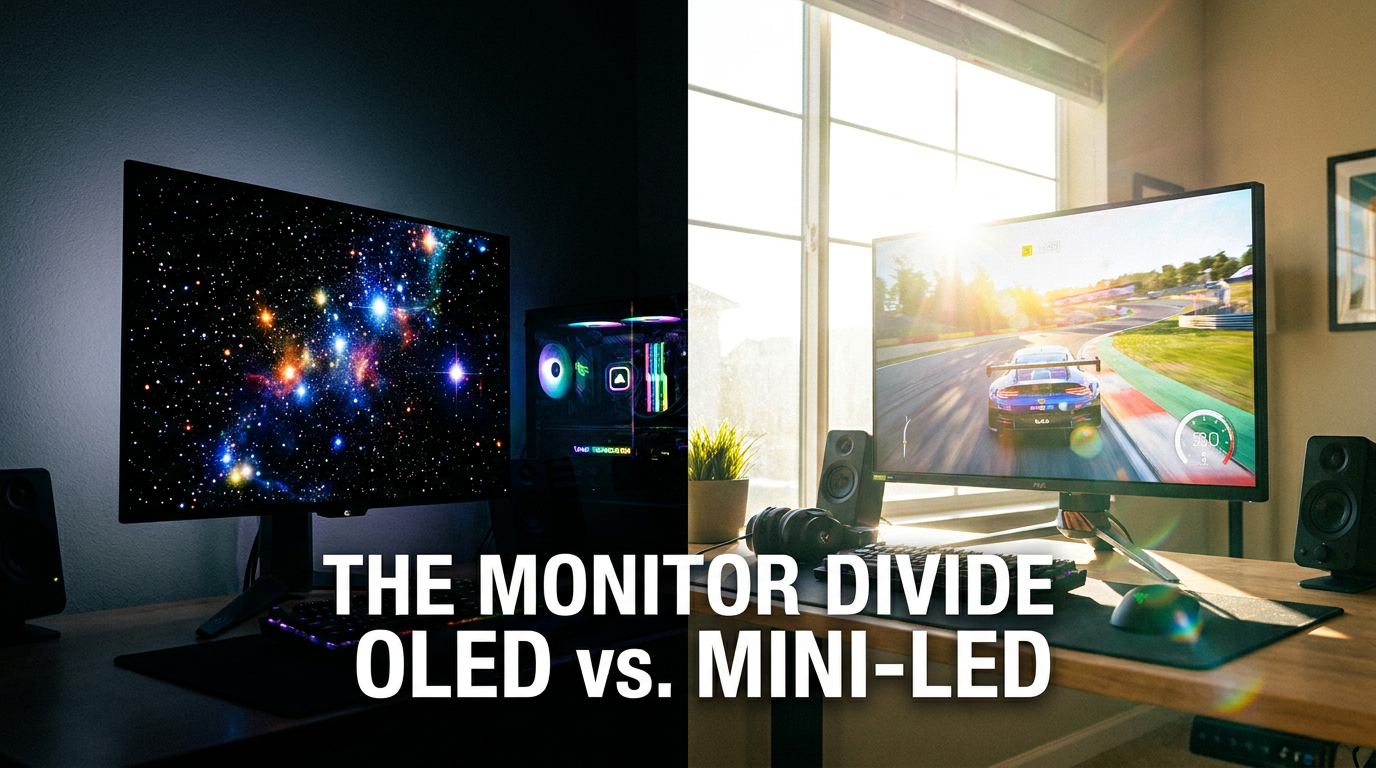
The strongest argument for OLED technology lies in its infinite contrast and perfect black levels. The evidence for this advantage is rooted in its self-emissive nature; because a pixel displaying black simply turns off completely, there is zero light bleed. When navigating a dark corridor in a horror game or flying through a starfield in a space simulator, the screen features pinpricks of brilliant light directly adjacent to absolute darkness. This creates a three-dimensional depth and a cinematic punch that traditional backlights fundamentally cannot replicate.[1][2]

The second major argument for OLED is unmatched motion clarity. The evidence is found in the pixel response times, which typically hover around a near-instantaneous 0.03 milliseconds gray-to-gray. Because the pixels transition colors without relying on liquid crystals shifting physical states, OLED panels eliminate the ghosting and smearing that can plague LCDs during fast camera pans. For competitive players in fast-paced shooters like Valorant or Counter-Strike 2, this zero-blur motion tracking provides a tangible gameplay advantage.[2][4]
However, the primary argument against OLED centers on sustained brightness limitations and workflow friction. The evidence for this drawback is the Auto Brightness Limiter (ABL), a protective mechanism that aggressively dims the screen when a large white window—like a web browser or spreadsheet—is opened. Furthermore, despite software mitigations and heatsinks, the risk of permanent burn-in remains a factor for users who display static user interface elements for eight hours a day. Additionally, non-standard subpixel layouts on some OLED panels can cause noticeable color fringing around text during office work.[1][5]
However, the primary argument against OLED centers on sustained brightness limitations and workflow friction.
The strongest argument for Mini-LED is its blinding, sustained brightness and HDR impact. The evidence is clear in VESA DisplayHDR 1400 certifications, with many Mini-LED panels easily pushing past 1,400 nits of peak brightness and maintaining 800 nits across the entire screen. When a player steps out into the sunlit streets of Cyberpunk 2077, the glare is genuinely intense, simulating the physical sensation of sunlight. This sheer luminance allows Mini-LED to punch through heavy ambient room lighting without the image washing out.[3][6]

The second argument for Mini-LED is its suitability for heavy productivity and peace of mind. The evidence lies in its immunity to burn-in; because it relies on an LCD layer rather than organic compounds, users can leave static taskbars, coding environments, or stock tickers on screen indefinitely without damaging the panel. Furthermore, Mini-LED panels utilize standard RGB subpixel layouts, ensuring that text renders with razor-sharp clarity, making them vastly superior for users who spend their days reading and writing before gaming at night.[4][5]
The primary argument against Mini-LED is the presence of blooming and slightly slower motion handling. The evidence for blooming—also known as haloing—is visible when a bright object, such as a white mouse cursor or movie subtitles, moves across a pitch-black background. Because the backlight zones are larger than individual pixels, excess light bleeds into the surrounding dark areas. Additionally, while Mini-LED response times have improved dramatically to the 1-to-5 millisecond range, they still rely on liquid crystals, meaning highly sensitive players may notice slight motion blur during rapid movement.[2][6]
Ultimately, the evidence suggests that room lighting dictates the winner more than raw specifications. In a sun-drenched home office or a living room with large windows, an OLED panel will struggle; its glossy coating will reflect the room, and its ABL will keep the image looking dim. In this environment, a Mini-LED's raw power is required to maintain a vibrant picture. Conversely, in a basement gaming den or a bedroom with blackout curtains, a Mini-LED's blooming becomes painfully obvious, while an OLED's perfect blacks shine.[1][2]

The hybrid use-case is where the decision becomes a strict trade-off analysis. A user who spends 40 hours a week working from home and 10 hours a week gaming must weigh the text clarity and burn-in immunity of Mini-LED against the cinematic perfection of OLED. In 2026, manufacturers have narrowed the gap—OLEDs have become brighter, and Mini-LEDs have added thousands of extra dimming zones—but the fundamental physics of the two technologies mean a perfect, compromise-free monitor does not yet exist.[5][6]
In summary, OLED fits well when your setup is in a light-controlled or dark room, you prioritize competitive motion clarity, and your primary use is consuming cinematic HDR games and movies. It does not fit well when you work all day with static windows, sit in a sunlit office, or are highly sensitive to aggressive brightness dimming during desktop use.[1][2][7]

Conversely, Mini-LED fits well when your monitor lives in a bright room, you use the display for heavy productivity and text-based work, and you want eye-searing HDR highlights without any burn-in anxiety. It does not fit well when you are easily distracted by blooming around subtitles in dark scenes, or when you demand the absolute zero-blur motion required for top-tier professional esports.[3][4][7]
How we got here
2021-2022
OLED begins its serious push into the PC monitor space, though early models are plagued by low brightness and high burn-in risk.
2023-2024
Mini-LED technology matures, offering a viable high-brightness alternative to OLED with thousands of dimming zones.
2025
Third-generation QD-OLED and WOLED panels launch, improving text clarity and peak brightness, while Mini-LED costs drop significantly.
2026
4K 240Hz becomes the premium standard for both OLED and Mini-LED, forcing buyers to choose based purely on panel characteristics rather than resolution or speed.
Viewpoints in depth
Cinematic HDR Enthusiasts
Users who prioritize absolute image quality, perfect blacks, and immersive single-player experiences.
For this camp, the presence of blooming on a Mini-LED is a dealbreaker. When watching a movie with letterboxing or playing a game with dark, moody lighting, any light bleed around bright objects shatters the immersion. They argue that OLED's pixel-perfect contrast provides a three-dimensional depth that raw brightness simply cannot match, making it the only acceptable choice for a premium dark-room setup.
Hybrid Remote Workers
Professionals who use the same monitor for 40 hours of work and weekend gaming.
This group views OLED as a liability. The constant presence of static taskbars, spreadsheets, and web browsers creates a genuine risk of permanent burn-in over a multi-year lifespan. Furthermore, they point to the Auto Brightness Limiter (ABL) as a major source of workflow friction, as the screen constantly dims when opening white documents. For them, Mini-LED offers the perfect compromise: stunning HDR for gaming without sacrificing text clarity or panel longevity during the workday.
Competitive Esports Players
Gamers who prioritize motion clarity, input lag, and high refresh rates above all else.
Competitive players focus entirely on motion handling. While Mini-LED panels have improved, the physical limitations of liquid crystals mean they still exhibit slight smearing during rapid camera movements. OLED's near-instantaneous 0.03ms response time ensures that fast-moving targets remain perfectly sharp, providing a tangible mechanical advantage in shooters like Counter-Strike 2 and Valorant. For this camp, motion clarity trumps brightness entirely.
What we don't know
- Whether future MicroLED technology will eventually combine the perfect blacks of OLED with the brightness of Mini-LED at a consumer-friendly price.
- Exactly how long third-generation OLED panels will last under heavy productivity workloads before burn-in becomes noticeable.
Key terms
- OLED (Organic Light Emitting Diode)
- A display technology where each individual pixel generates its own light and can turn off completely, resulting in perfect black levels and infinite contrast.
- Mini-LED
- A backlighting technology for LCD screens that uses thousands of microscopic LEDs grouped into dimming zones to provide high brightness and improved contrast.
- Auto Brightness Limiter (ABL)
- A protective mechanism in OLED displays that automatically dims the screen when a large portion of it displays bright colors, preventing overheating and burn-in.
- Gray-to-Gray (GtG) Response Time
- A measurement of how fast a pixel can change from one shade of gray to another, which determines how much motion blur is visible during fast movement.
- Local Dimming Zones
- Specific areas of a monitor's backlight that can independently dim or brighten based on the image being displayed, used in Mini-LED panels to improve contrast.
Frequently asked
Does Mini-LED suffer from burn-in?
No. Because Mini-LED relies on a traditional LCD layer rather than self-emissive organic compounds, it is immune to the permanent image retention that can affect OLED panels.
What is blooming or haloing on a monitor?
Blooming occurs when a bright object is displayed on a dark background, and the backlight zone illuminating it is larger than the object itself. This causes excess light to bleed into the surrounding dark pixels, creating a glowing halo.
Is OLED bright enough for a sunny room?
While modern OLEDs can hit high peak brightness for small highlights, their full-screen brightness is limited by an Auto Brightness Limiter (ABL). In a heavily sunlit room, an OLED may appear dim and washed out compared to a Mini-LED.
Why does text look blurry on some OLED monitors?
Many OLED panels use non-standard subpixel layouts (like WOLED or QD-OLED) rather than the standard RGB layout expected by operating systems. This can cause color fringing around text, though the issue is less noticeable on high-density 4K displays.
Sources
Source coverage
7 outlets
3 viewpoints surfaced







[1]RTINGS.comCinematic HDR Enthusiasts
Mini LED vs OLED: Which Panel Technology Is Better?
Read on RTINGS.com →[2]KTCCinematic HDR Enthusiasts
OLED vs Mini-LED Gaming Monitor: Which Should You Buy?
Read on KTC →[3]ASUSHybrid Remote Workers
Mini LED vs OLED: What's the difference?
Read on ASUS →[4]PC MonitorsHybrid Remote Workers
OLED vs MiniLED for gaming and productivity
Read on PC Monitors →[5]Reddit r/OLED_GamingHybrid Remote Workers
OLED vs Mini-Led -> is OLED that much better?
Read on Reddit r/OLED_Gaming →[6]Supreme ComputersCompetitive Esports Players
IPS vs OLED vs Mini-LED Monitors Explained: Complete Buying Guide for 2026
Read on Supreme Computers →[7]Factlen Editorial TeamCompetitive Esports Players
Synthesis by Factlen editorial team
Read on Factlen Editorial Team →
Every angle. Every day.
Get gaming esports stories with full source coverage and perspective breakdowns delivered to your inbox.