
The Evidence Pack: How Accelerated TMS and the SAINT Protocol Are Rewriting Treatment-Resistant Depression
By combining fMRI brain mapping with condensed magnetic stimulation, the FDA-cleared SAINT protocol is achieving up to 79% remission rates for severe depression in just five days.
By Factlen Editorial Team
- Clinical Psychiatrists
- A shift toward circuit-based, rapid-acting interventions.
- Neuroimaging Researchers
- Personalization through functional brain mapping.
- Health Economists & Advocates
- The insurance gap and equitable access.
What's not represented
- · Patients who relapsed after initial TMS success
- · Insurers evaluating the cost-benefit of 10-a-day billing codes
Why this matters
For the 30% of depression patients who do not respond to traditional medications, accelerated fMRI-guided TMS offers a highly effective, non-chemical alternative that can induce remission in just five days, fundamentally altering the timeline of psychiatric recovery.
Key points
- The FDA-cleared SAINT protocol compresses a standard six-week course of TMS into just five days.
- The treatment uses fMRI to map individual brain connectivity, allowing for millimeter-precise targeting of mood circuits.
- In clinical trials, nearly 80% of patients with severe, treatment-resistant depression achieved remission.
- A 2026 JAMA Psychiatry study confirmed that fMRI-guided targeting significantly outperforms traditional scalp-based targeting.
- Despite FDA clearance, insurance coverage remains a major barrier, with many providers only reimbursing two sessions per day.
For decades, psychiatry has relied primarily on systemic chemical interventions—antidepressants that flood the brain to alter neurotransmitter levels. But for the 30% to 40% of patients with major depressive disorder who do not respond to these medications, the standard pharmacological toolkit offers diminishing returns.[3][6]
This clinical bottleneck has driven the rise of "circuit-based psychiatry," which treats depression not as a chemical imbalance, but as an electrical routing problem. Transcranial magnetic stimulation (TMS), which uses targeted magnetic pulses to reset misfiring brain circuits, has been FDA-cleared and utilized since 2008.[2][4]
However, traditional TMS requires a grueling schedule: 36 daily sessions stretched over six to eight weeks. This time commitment costs patients their mornings, their commutes, and sometimes their jobs, placing the treatment out of reach for many who need it most.[4]
Now, a next-generation approach known as accelerated TMS is rewriting the timeline and efficacy of depression care. The most prominent of these, the SAINT protocol (Stanford Accelerated Intelligent Neuromodulation Therapy), compresses a full six-week course of brain stimulation into just five days.[2][6]

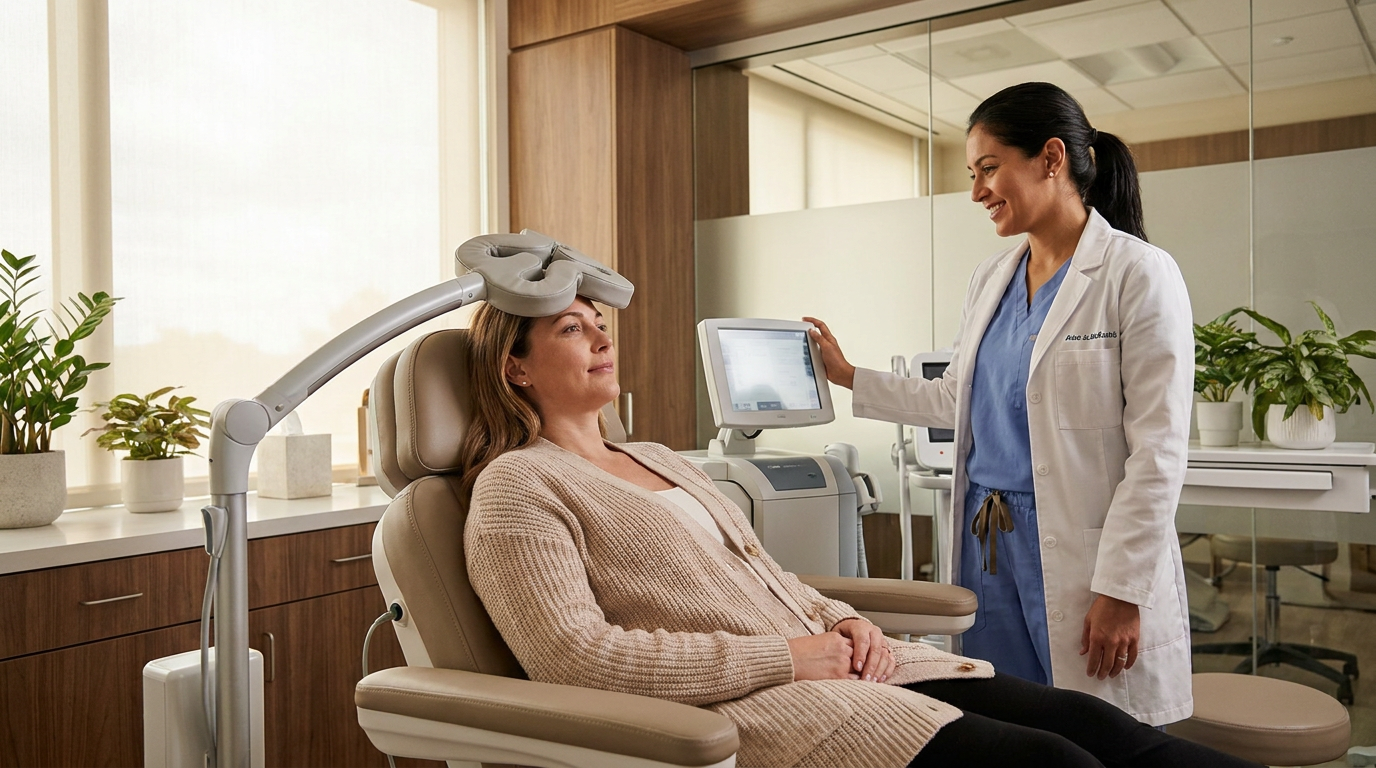
The FDA-cleared SAINT protocol delivers 10 stimulation sessions per day. Each session lasts roughly 10 minutes, followed by a 50-minute resting period, repeated over five consecutive days to leverage the brain's neuroplasticity.[2][3]
But speed is only half of the breakthrough. The defining innovation of SAINT is its use of functional magnetic resonance imaging (fMRI) to personalize the treatment to the patient's unique neuroanatomy.[1][3]
In traditional TMS, clinicians use generalized scalp measurements to guess the location of the dorsolateral prefrontal cortex—the brain's mood-regulating doorway. Because human brain anatomy varies significantly, this "one-size-fits-all" targeting often misses the optimal neural circuit.[1][2]
In traditional TMS, clinicians use generalized scalp measurements to guess the location of the dorsolateral prefrontal cortex—the brain's mood-regulating doorway.
SAINT uses an fMRI scan to map a patient's unique brain connectivity before treatment begins. By analyzing how different brain regions synchronize at rest, the system identifies the exact millimeter-level target that connects to the subgenual cingulate, a deep-brain structure that is hyperactive in depression.[1][3]
The clinical results of this precision targeting have been unprecedented in psychiatric care. In double-blind, randomized trials, nearly 80% of participants receiving the SAINT protocol achieved full remission from severe, treatment-resistant depression within five days.[2][3]

For context, patients in these trials had suffered from severe depression for years and failed multiple medication trials. The average time to remission under the accelerated fMRI-guided protocol was just 2.6 days.[3][6]
New data published in June 2026 in JAMA Psychiatry by investigators at Mass General Brigham further validates the fMRI approach. In a randomized trial comparing fMRI-guided accelerated TMS to conventional scalp-based targeting, the precision group achieved an 80% response rate, compared to 60% for the scalp-based group.[1]
"Because SAINT requires neuroimaging, this clearance marks the first official involvement of radiology in mental illness care," noted Dr. Nolan Williams, director of the Stanford Brain Stimulation Lab, highlighting the shift toward objective, biomarker-driven psychiatry.[3]

Other accelerated protocols are also showing promise. A 2026 retrospective analysis found that a "5x5" regimen—five sessions a day for five days—produced efficacy comparable to the conventional six-week course, even without fMRI guidance, offering a middle ground for clinics without imaging access.[4][5]
Despite the clinical triumphs, significant access barriers remain. While the hardware is FDA-cleared, insurance reimbursement has lagged behind the science. As of 2026, Medicare and many private insurers only reimburse up to two TMS sessions per day.[4]
How we got here
2008
The FDA clears the first traditional six-week TMS protocol for major depressive disorder.
2021
The FDA grants 'Breakthrough Therapy' designation to the SAINT protocol based on unprecedented remission rates.
2022
The SAINT neuromodulation system receives full FDA clearance for treatment-resistant depression.
April 2024
The SAINT system becomes commercially available in select psychiatric clinics.
June 2026
New clinical data confirms fMRI-guided targeting significantly outperforms conventional scalp-based targeting.
Viewpoints in depth
Clinical Psychiatrists
A shift toward circuit-based, rapid-acting interventions.
For decades, psychiatrists have relied on trial-and-error medication management that takes weeks to show effects. Clinicians view accelerated TMS as a paradigm shift, allowing them to treat depression as a correctable electrical routing issue rather than a permanent chemical imbalance. The ability to induce remission in days is particularly transformative for patients in acute crisis, offering a rapid stabilization tool that previously did not exist in outpatient psychiatry.
Neuroimaging Researchers
Personalization through functional brain mapping.
Researchers emphasize that the true breakthrough isn't just the speed of the magnetic pulses, but the precision of the targeting. Because human brain anatomy varies, standard scalp measurements often miss the optimal neural node. By using fMRI to map each patient's unique resting-state connectivity, researchers argue that psychiatry is finally adopting the precision-medicine standards long used in oncology and cardiology.
Health Economists & Advocates
The insurance gap and equitable access.
While the clinical data is overwhelming, advocates point out a severe structural barrier: insurance reimbursement. Because Medicare and many private insurers currently cap TMS coverage at two sessions per day, the 10-session-per-day accelerated protocol is often entirely out-of-pocket. Economists argue that insurers are failing to account for the massive cost savings of rapidly returning a patient to the workforce and preventing hospitalizations.
What we don't know
- Exactly how long the remission lasts for the average patient without maintenance stimulation sessions.
- Whether accelerated TMS protocols are safe and effective for bipolar depression, as current FDA clearance is limited to major depressive disorder.
- When Medicare and major private insurers will update their billing codes to cover 10 sessions per day, closing the current out-of-pocket access gap.
Key terms
- Transcranial Magnetic Stimulation (TMS)
- A non-invasive therapy that uses magnetic fields to stimulate nerve cells in the brain to improve symptoms of depression.
- SAINT Protocol
- Stanford Accelerated Intelligent Neuromodulation Therapy, a specific 5-day, fMRI-guided TMS treatment.
- fMRI (Functional Magnetic Resonance Imaging)
- A brain scan that measures and maps brain activity by detecting changes in blood flow, used to personalize TMS targeting.
- Treatment-Resistant Depression (TRD)
- Major depressive disorder that does not improve after trying multiple conventional antidepressant medications.
- Dorsolateral Prefrontal Cortex (DLPFC)
- The specific region on the surface of the brain targeted by TMS coils to regulate deeper mood circuits.
Frequently asked
What is treatment-resistant depression?
Major depressive disorder that has not responded adequately to at least two different antidepressant medications of adequate dose and duration.
How does the SAINT protocol differ from traditional TMS?
Traditional TMS relies on scalp measurements and takes six weeks. SAINT uses an fMRI scan to find the exact neural target and delivers 50 sessions over just five days.
Does accelerated TMS cause side effects?
It is generally well-tolerated. The most common side effects are temporary mild fatigue and slight headaches during the five-day treatment window.
Is the SAINT protocol covered by insurance?
While the hardware is FDA-cleared, many insurers currently cap reimbursement at two TMS sessions per day, meaning the 10-session-a-day protocol often requires out-of-pocket payment.
Sources
Source coverage
6 outlets
3 viewpoints surfaced





[1]JAMA PsychiatryNeuroimaging Researchers
Mass General Brigham study suggests that functional brain imaging can help guide accelerated transcranial magnetic stimulation for depression
Read on JAMA Psychiatry →[2]Stanford MedicineClinical Psychiatrists
Stanford Researchers Devise Treatment That Relieved Depression in 90% of Participants in Small Study
Read on Stanford Medicine →[3]Psychiatric NewsClinical Psychiatrists
FDA Clears SAINT Neuromodulation System for Treatment-Resistant Depression
Read on Psychiatric News →[4]HCPLiveHealth Economists & Advocates
What New TMS Protocols for Treatment-Resistant Depression Mean for Clinical Practice
Read on HCPLive →[5]Psychiatry ResearchHealth Economists & Advocates
Real world efficacy and safety of various accelerated deep TMS protocols for major depression
Read on Psychiatry Research →[6]Factlen Editorial TeamClinical Psychiatrists
Synthesis by Factlen editorial team
Read on Factlen Editorial Team →
Every angle. Every day.
Get health stories with full source coverage and perspective breakdowns delivered to your inbox.