
The Great Gas Phase-Out: Why Top Chefs Are Ditching Open Flames for Induction
Michelin-starred restaurants and mainstream chains alike are replacing traditional gas stoves with electric induction technology, driven by a desire for cooler kitchens, pinpoint precision, and lower emissions.
By Factlen Editorial Team
- Culinary Innovators
- Chefs who prioritize the precision, speed, and improved working conditions of induction cooking.
- Sustainability & Health Advocates
- Environmental groups and safety experts focused on eliminating indoor air pollution and decarbonizing the hospitality sector.
- Industry Pragmatists
- Consultants and equipment manufacturers weighing the upfront capital costs against long-term operational savings.
What's not represented
- · Traditionalist chefs who refuse to abandon gas
- · Small independent operators unable to afford the upfront transition costs
Why this matters
The shift away from gas stoves is transforming the restaurant industry, drastically improving working conditions for kitchen staff while reducing the massive carbon footprint and indoor air pollution associated with commercial dining.
Key points
- Michelin-starred restaurants and independent bistros are increasingly replacing traditional gas stoves with electric induction technology.
- Induction transfers roughly 90% of its energy directly to the pan, compared to just 30-40% for gas, drastically reducing ambient kitchen heat.
- The elimination of open flames improves indoor air quality for kitchen staff by removing nitrogen dioxide and carbon monoxide emissions.
- While upfront equipment costs are higher, restaurants can save hundreds of thousands of dollars by omitting massive gas ventilation hoods.
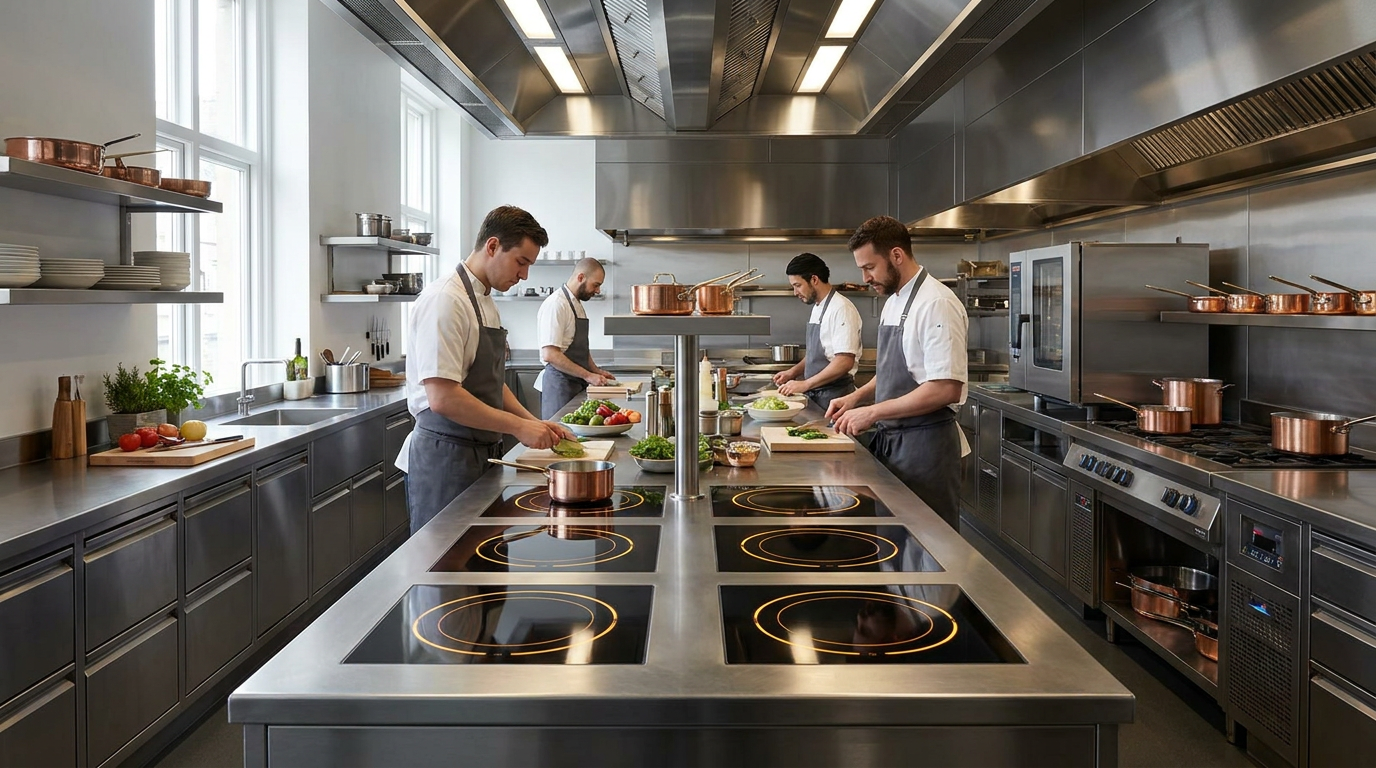
The romantic image of the professional kitchen—roaring open flames, clanging cast iron, and sweat-drenched chefs shouting over the roar of ventilation hoods—is undergoing a quiet, magnetic revolution. Across the globe, from Michelin-starred dining rooms in London to bustling noodle shops in Vancouver, the restaurant industry is rapidly phasing out natural gas in favor of electric induction technology. For decades, a heavy-duty gas range was considered the undisputed beating heart of any serious culinary operation. But a new generation of chefs and restaurateurs is challenging that dogma, discovering that the absence of fire actually elevates their craft. This shift is fundamentally rewiring how restaurants are designed, how cooks operate on the line, and how the hospitality industry approaches both environmental sustainability and occupational health.[1][5]
While the broader transition toward electrification is partly driven by municipal gas bans and corporate climate targets, chefs themselves are becoming the loudest advocates for the switch. The primary draw for culinary perfectionists isn't just environmental stewardship; it is the sheer, unyielding precision that induction affords. Unlike traditional gas burners, which fluctuate based on ambient airflow and require cooks to constantly monitor and adjust a flickering flame, induction provides absolute, quantifiable thermal control. This allows kitchens to standardize recipes with a level of scientific accuracy that was previously impossible, ensuring that every dish leaving the pass is identical to the one before it.[1][6]
At Ikoyi, a highly acclaimed two-Michelin-starred restaurant in London, head chef Jeremy Chan replaced his traditional burners with a sleek, four-ring induction suite. He notes that the technology completely eliminates the guesswork of interpreting subjective instructions like a "medium-low" or "high" flame. Instead, cooks can set a digital dial to an exact numerical value, ensuring that delicate sauces, temperamental emulsions, and complex proteins are executed flawlessly every single time. "There's less human error," Chan explained to reporters, noting that the foolproof nature of the equipment gives him total confidence in his staff's ability to replicate his exacting standards.[1]
The physics of induction—which uses electromagnetic fields to heat the magnetic cookware directly rather than heating the air around it—fundamentally changes the physical environment of the kitchen. Traditional commercial gas stoves are notoriously inefficient, wasting up to 70 percent of their thermal energy by radiating it out into the room. This wasted heat turns commercial kitchens into grueling, high-temperature sweatshops, where line cooks routinely endure ambient temperatures exceeding 100 degrees Fahrenheit during a busy dinner service. By eliminating the open flame, induction stops this ambient heat transfer at the source, fundamentally altering the physical toll of a culinary career.[3]

By contrast, induction transfers roughly 90 percent of its energy directly into the food and the pan. This drastic improvement in thermodynamic efficiency can reduce ambient kitchen temperatures by nearly half, transforming a notoriously hostile workplace into a cooler, safer, and vastly more comfortable environment for culinary staff. Without the constant threat of open flames, the risk of accidental burns and grease fires plummets, creating a calmer, more focused atmosphere during the chaotic peaks of a Friday night rush. Chefs report feeling significantly less physical exhaustion at the end of a shift, a crucial benefit in an industry currently battling severe labor shortages and burnout.[3][4]
By contrast, induction transfers roughly 90 percent of its energy directly into the food and the pan.
"One day in 2013, chef Christopher Galarza noticed that his coworkers all looked like him, drenched in sweat and heaving from the heat," reports Sierra Magazine, highlighting the toxic conditions created by gas broilers that spew pollutants into poorly ventilated spaces. Gas combustion releases nitrogen dioxide, carbon monoxide, and particulate matter—pollutants that would trigger regulatory action if emitted outdoors, yet are routinely inhaled by kitchen workers for ten hours a day. Today, Galarza and other industry veterans champion induction not just as a culinary tool, but as a vital matter of occupational health and human rights for back-of-house staff.[3]
The financial calculus of restaurant design is also undergoing a massive shift thanks to electrification. Installing commercial-grade gas lines and the massive, heavy-duty ventilation hoods required to extract smoke, grease, and combustion byproducts is exorbitantly expensive, often representing one of the largest single line items in a new restaurant's build-out budget. By eliminating the combustion of fossil fuels, restaurants can dramatically scale down their HVAC requirements, opening up new architectural possibilities for where a kitchen can be located. Spaces in historic buildings or dense urban centers that previously could not accommodate the ductwork for a commercial gas hood are suddenly viable real estate for ambitious chefs.[2][4]
In San Francisco, chef Bradley Kilgore recently designed an all-electric kitchen for Cafe Sebastian that completely omitted a traditional hood. By relying on high-powered induction burners and advanced electric convection ovens, Kilgore estimates the restaurant saved up to $400,000 in construction and equipment costs. This lean, hoodless design allowed the bistro to open in a footprint that could never have accommodated a standard gas-powered setup, proving that electrification can actually lower the barrier to entry for independent restaurateurs facing punishing real estate markets. The savings on the initial build-out can then be redirected toward better ingredients, higher staff wages, or more resilient business models.[2]

Despite the clear advantages, the transition is not without friction. Foodservice consultants point out that commercial induction equipment often carries a higher upfront capital cost than standard gas ranges, and the delicate glass-ceramic surfaces can sometimes have a shorter operational lifespan under the intense, pan-slamming wear-and-tear of a busy service. Furthermore, induction requires specific magnetic cookware—typically stainless steel or cast iron—meaning restaurants must often replace their entire inventory of cheap, conductive aluminum pots and pans, adding another layer of transition costs. For a low-margin business recovering from years of economic turbulence, these initial capital expenditures can be a difficult pill to swallow, even if the long-term operational savings on energy and cooling are substantial.[4]
There is also a steep cultural and tactile learning curve for cooks accustomed to the visual feedback of a flame. The culinary attachment to fire runs deep; it is romanticized in media and deeply ingrained in the muscle memory of classically trained chefs who rely on the sound and sight of gas to gauge heat. The concept of "wok hei"—the complex, smoky flavor imparted by a roaring gas burner in traditional Chinese cooking—is notoriously difficult to replicate on a flat glass surface, though manufacturers are now developing specialized, curved induction wok stations that cradle the pan in a magnetic field to bridge the gap. Some chefs have even resorted to using handheld propane torches to finish dishes, ensuring they capture that essential kiss of fire while keeping the bulk of the cooking electric.[1][5]

Yet, for the chefs who make the leap, the trade-offs are overwhelmingly positive. Angus An, who runs several acclaimed restaurants in British Columbia, transitioned his Fat Mao Noodles locations to 100 percent induction. He found that large pots of broth boil in half the time, and the rapid thermal recovery rate of the equipment easily keeps pace with the relentless demands of a high-volume lunch rush. "It's faster than gas and it's more efficient," An told local media, noting that the sheer firepower of modern commercial induction easily rivals the largest gas burners on the market. The ability to drop a basket of cold noodles into boiling water without the temperature plummeting allows his kitchen to turn tables faster and serve a more consistent product.[5]
As the technology matures and economies of scale gradually bring down equipment costs, the all-electric kitchen is moving from a niche luxury to an industry standard. Culinary schools are beginning to train the next generation of cooks on magnetic cooktops, ensuring that the workforce of tomorrow is fluent in the digital precision of electric heat rather than relying solely on the intuition of an open flame. For a profession historically defined by its grueling physical toll, toxic air quality, and chaotic environments, the quiet, cool hum of an induction stove represents a fundamental evolution in hospitality. It is a cleaner, safer, and more sustainable future that proves the world's best food doesn't always require playing with fire.[4][6]
How we got here
2008
Chef Amanda Cohen pioneers all-induction cooking at Dirt Candy in Manhattan, proving the concept for high-end dining.
2019
Berkeley, California passes the first municipal ban on natural gas in new buildings, sparking a wave of commercial electrification.
2022
High-profile Michelin-starred restaurants, including London's Ikoyi, begin publicizing their switch to induction for precision and safety.
2024
Advanced 'hoodless' electric kitchen designs begin saving restaurateurs hundreds of thousands of dollars in build-out costs.
Viewpoints in depth
Culinary Innovators
Chefs who prioritize the precision and speed of induction cooking.
For high-end chefs, the primary appeal of induction is absolute control. Because the technology relies on exact numerical settings rather than a fluctuating flame, recipes can be standardized with scientific accuracy. This eliminates human error on the line, ensuring that delicate sauces and proteins are cooked perfectly every time, regardless of which cook is working the station.
Sustainability & Health Advocates
Experts focused on eliminating indoor air pollution and decarbonizing hospitality.
Environmental and occupational health advocates view the phase-out of gas as a critical human rights issue for kitchen workers. Traditional gas stoves emit nitrogen dioxide, carbon monoxide, and particulate matter into poorly ventilated spaces, creating toxic working conditions. By switching to electric induction, restaurants instantly eliminate these point-source emissions, drastically improving the respiratory health of their staff while cutting the building's overall carbon footprint.
Industry Pragmatists
Consultants weighing the upfront capital costs against long-term operational savings.
While acknowledging the benefits, foodservice consultants point out that transitioning to induction requires significant upfront capital. Commercial induction units are often more expensive than their gas counterparts, and restaurants must also replace their entire inventory of non-magnetic aluminum cookware. However, these pragmatists note that the initial costs are frequently offset by massive savings on HVAC installation, as hoodless electric kitchens require far less ventilation infrastructure.
What we don't know
- How quickly the secondary market for used commercial induction equipment will develop to help lower-income restaurants afford the transition.
- Whether specialized induction wok stations can fully replicate the traditional 'wok hei' flavor profile to the satisfaction of master chefs.
Key terms
- Electromagnetic Induction
- A cooking method that uses magnetic currents to directly heat the cookware, rather than heating the air or a burner surface.
- Wok Hei
- The complex, smoky flavor imparted to food cooked in a wok over an extreme, open gas flame, often cited as the hardest technique to replicate with electric heat.
- Ambient Heat
- The temperature of the surrounding air in a kitchen, which is drastically reduced when using induction instead of gas.
- HVAC Hood
- The massive, expensive ventilation system required above gas stoves to extract smoke, grease, and toxic combustion byproducts.
Frequently asked
Does induction cooking save restaurants money?
While the initial equipment costs are often higher, restaurants save significantly on energy bills, HVAC cooling costs, and sometimes the massive expense of installing ventilation hoods.
Can chefs still use their old pots and pans?
Only if they are magnetic. Induction requires cookware made of cast iron or magnetic stainless steel; aluminum or copper pans will not work.
Is induction really faster than gas?
Yes. Because induction transfers energy directly to the pan with roughly 90% efficiency, it can boil water and heat ingredients significantly faster than a traditional gas flame.
Sources
Source coverage
6 outlets
3 viewpoints surfaced





[1]BloombergCulinary Innovators
Why High-End Kitchens Are Saying Goodbye to Gas
Read on Bloomberg →[2]The San Francisco StandardIndustry Pragmatists
Why chefs are ditching a kitchen essential: The $400,000 hood
Read on The San Francisco Standard →[3]Sierra MagazineSustainability & Health Advocates
The End of the Toxic Sweatshop: How Induction is Cooling Down Commercial Kitchens
Read on Sierra Magazine →[4]Foodservice ConsultantIndustry Pragmatists
Electric Dreams: The Shift to All-Electric Commercial Kitchens
Read on Foodservice Consultant →[5]Business in VancouverCulinary Innovators
Why Vancouver chefs are ditching gas stoves for induction
Read on Business in Vancouver →[6]The CooldownSustainability & Health Advocates
Michelin-starred chefs are ditching gas stoves for a surprising alternative
Read on The Cooldown →
Every angle. Every day.
Get food drink stories with full source coverage and perspective breakdowns delivered to your inbox.