
Heat Pump vs. Tankless Water Heaters: The 2026 Trade-Off Analysis
As homeowners move away from traditional standard-tank water heaters, the choice between ultra-efficient heat pumps and space-saving tankless systems has become the defining appliance decision of 2026.
By Factlen Editorial Team
- Electrification Advocates
- Prioritize grid efficiency, decarbonization, and utilizing appliances as thermal batteries to balance renewable energy loads.
- Plumbing Professionals
- Focus on installation feasibility, maintenance requirements, and the practical realities of retrofitting older homes.
- Consumer Advocates
- Evaluate the upfront costs, daily user experience, and long-term reliability of the appliances for the average homeowner.
What's not represented
- · Renters
- · Off-grid homeowners
Why this matters
Water heating accounts for roughly 20 percent of a home's energy use. Choosing the right next-generation system dictates not only your monthly utility bills and upfront electrical panel costs, but also how much space you sacrifice and whether you ever run out of hot water mid-shower.
Key points
- Heat pump water heaters offer the lowest operational costs and qualify for massive federal rebates, but require physical space and airflow.
- Tankless systems provide endless hot water and save space, but electric models require massive, often cost-prohibitive electrical panel upgrades.
- The rise of 120-volt plug-in heat pumps in 2026 has made retrofitting older gas tanks significantly easier and cheaper.
- Utilities heavily favor heat pumps because they act as thermal batteries, whereas electric tankless systems create severe peak-load strain on the grid.
- Tankless systems require strict annual descaling maintenance to survive, especially in areas with hard water.
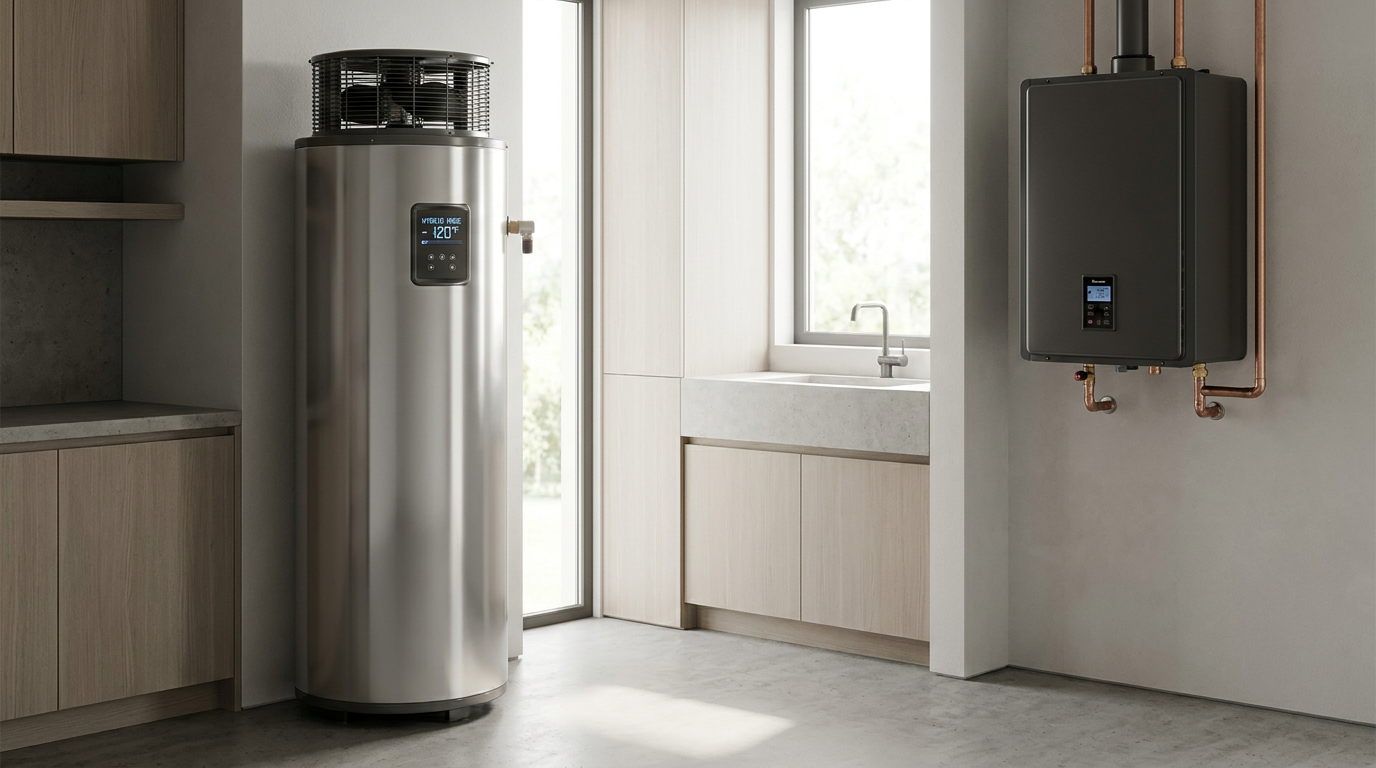
For decades, the basement water heater was a forgotten appliance—a massive steel cylinder that quietly burned gas or guzzled electricity to keep 50 gallons of water piping hot 24 hours a day. But in 2026, the traditional storage tank is rapidly becoming obsolete. Driven by aggressive federal rebates, rising energy costs, and a nationwide push toward home electrification, homeowners are upgrading to high-efficiency alternatives. The market has largely bifurcated into two distinct philosophies: the heat pump water heater (HPWH), which maximizes energy efficiency, and the tankless water heater, which maximizes space and delivers an endless supply of hot water.[1][6]
The case for the heat pump water heater centers entirely on its physics-defying efficiency. Rather than generating heat through electrical resistance or combustion, a HPWH acts like a refrigerator running in reverse. It pulls ambient heat from the surrounding air, compresses it to raise the temperature, and transfers that heat into the water tank. Because moving heat requires significantly less energy than creating it, these systems operate at 300 to 400 percent efficiency. For the average household, this translates to a reduction in water heating costs by up to 70 percent compared to a standard electric tank.[1][2]

The evidence supporting the financial dominance of heat pumps is heavily bolstered by 2026 policy incentives. Under the Inflation Reduction Act, homeowners can access up to $1,750 in point-of-sale rebates and a $2,000 tax credit for installing a HPWH. Furthermore, the maturation of 120-volt plug-in models has eliminated one of the technology's biggest historical hurdles. Previously, homeowners needed a dedicated 240-volt, 30-amp circuit to install a heat pump. Today, many models plug directly into a standard wall outlet, allowing for a seamless drop-in replacement for older gas tanks without triggering a costly electrical panel upgrade.[2][5]
However, the arguments against heat pump water heaters are rooted in their physical footprint and operational quirks. They require a tank—often larger than older models to compensate for slower recovery times—and they need breathing room. Because they pull heat from the air, they exhaust cool, dehumidified air. This makes them perfect for a damp, warm garage or unfinished basement, but highly problematic for a cramped utility closet inside a conditioned living space. If placed in a small closet, they require louvered doors or ducting to ensure adequate airflow, adding complexity to the installation.[3][4]

On the other side of the debate is the tankless water heater, a technology that prioritizes on-demand performance over baseline energy efficiency. The case for tankless systems is highly compelling for specific lifestyles. By eliminating the storage tank entirely, these units free up valuable square footage in the home. When a faucet is turned on, water flows through a heat exchanger where it is rapidly heated by high-powered gas burners or massive electrical elements. The result is a theoretically endless supply of hot water—a massive advantage for large families who want to run the dishwasher, washing machine, and two showers simultaneously without the water turning ice cold.[3][6]
On the other side of the debate is the tankless water heater, a technology that prioritizes on-demand performance over baseline energy efficiency.
The evidence against tankless systems, particularly electric models, lies in their staggering instantaneous power demands. While they save energy by not keeping a tank hot all day, heating freezing winter groundwater to 120 degrees in a fraction of a second requires a massive surge of electricity. A whole-home electric tankless heater typically requires three to four dedicated 40-amp breakers. For most older homes with 100-amp or even 200-amp electrical panels, installing an electric tankless system is physically impossible without a $3,000 to $5,000 heavy-up panel upgrade, entirely negating any long-term energy savings.[4][6]
Gas tankless heaters avoid this electrical bottleneck but introduce their own installation hurdles. Upgrading from a standard gas tank to a gas tankless unit usually requires upsizing the gas line from a half-inch to a three-quarter-inch pipe to handle the sudden demand of the burners. Additionally, they require specialized stainless steel or PVC venting that must be routed directly outside, which can complicate retrofits in older homes with masonry chimneys. While gas tankless units are highly efficient compared to older tanks, they still rely on fossil fuels, locking the homeowner out of the most lucrative electrification rebates.[2][4]

From a grid-level perspective, utility companies have a clear favorite. Electrification advocates and grid operators strongly prefer heat pump water heaters. Because a HPWH stores hot water in a heavily insulated tank, it acts as a thermal battery. Smart models can be programmed to heat water during the middle of the day when solar energy is abundant and cheap, and then coast through the evening peak-demand hours without drawing power. Conversely, electric tankless heaters are a grid operator's nightmare, creating massive, unpredictable spikes in electrical demand exactly when the grid is most stressed—typically on cold winter mornings when everyone showers before work.[2][6]
Maintenance requirements also present a clear trade-off. Tankless water heaters, with their narrow heat exchangers, are highly susceptible to mineral scale buildup. In areas with hard water, they require an annual flush with a descaling solution—a task that takes about an hour and requires a specialized pump kit. Failure to perform this maintenance will void the warranty and quickly destroy the unit. Heat pump water heaters require less intensive plumbing maintenance, though their air filters must be wiped down every few months to ensure the compressor can breathe efficiently.[3][4]

Ultimately, the decision comes down to a strict set of conditional trade-offs. A heat pump water heater fits well when you have an unfinished basement or garage, want to minimize your monthly utility bills, are looking to take advantage of federal tax credits, and have the physical space for a 50-to-80-gallon tank. It is the undisputed champion of total cost of ownership over a 10-year lifespan. However, it does not fit well when you live in a small condo, lack adequate airflow, or have a household of six people who take back-to-back showers every morning, which can outpace the unit's slower recovery time.[1][3][6]
Conversely, a tankless water heater fits well when space is at an absolute premium, you want to reclaim a utility closet for storage, or you have a massive soaking tub that would drain a standard tank before filling halfway. It is the luxury choice for endless hot water. But it does not fit well when you are trying to decarbonize your home on a budget, you have an older 100-amp electrical panel, or you live in a region with extremely cold groundwater, which severely reduces the flow rate of tankless units as they struggle to bridge the temperature gap.[4][6]
How we got here
Pre-2010s
Standard electric resistance and gas storage tanks dominate the residential market with minimal efficiency gains.
2015
The Department of Energy mandates higher efficiency standards, pushing manufacturers to develop early residential heat pump models.
2022
The US passes the Inflation Reduction Act, earmarking billions in tax credits and rebates specifically for heat pump appliances.
2023–2024
Major manufacturers release 120-volt plug-in heat pump water heaters, removing the 240-volt electrical barrier for retrofits.
2026
Heat pump water heaters become the default recommendation for home electrification, while tankless systems transition to a niche luxury or space-saving option.
Viewpoints in depth
Electrification Advocates
Focus on the macro-level benefits of decarbonization and grid stability.
For groups like Rewiring America and the Department of Energy, the water heater is a critical piece of national infrastructure. They argue that transitioning millions of homes to heat pump water heaters is essential for meeting climate goals. Because HPWHs are 300 to 400 percent efficient, they drastically reduce overall energy consumption. More importantly, these groups view the insulated tanks as decentralized 'thermal batteries.' By heating water during the day when solar power is abundant and turning off during the evening peak, heat pumps can actively stabilize the electrical grid. In contrast, they view electric tankless systems as a liability, as their massive instantaneous power draw exacerbates grid strain during peak morning hours.
Plumbing Professionals
Emphasize the practical realities of installation, retrofitting, and long-term maintenance.
Contractors and trade publications look past the spec sheets to focus on what it actually takes to install these systems in a 50-year-old house. They point out that while tankless systems sound great in theory, the electrical upgrades required for an electric tankless unit often kill the project instantly. Conversely, they highlight that gas tankless units require complex new venting that can be a nightmare to route. For plumbers, the recent advent of the 120-volt plug-in heat pump water heater is the true game-changer, allowing them to swap out an old gas tank for a highly efficient electric unit in an afternoon without ever calling an electrician.
Space-Constrained Homeowners
Prioritize physical footprint and lifestyle convenience over baseline energy efficiency.
For homeowners living in tight urban condos or homes without basements, the physical footprint of the appliance is the deciding factor. Heat pump water heaters are large, often requiring 80-gallon tanks to compensate for their slower heating speeds, and they need hundreds of cubic feet of unconditioned air to breathe. For this demographic, the tankless water heater remains the superior choice. By mounting a unit the size of a suitcase on the wall, they can reclaim an entire utility closet. Furthermore, for households with large soaking tubs or high simultaneous water demand, the endless supply of a tankless system provides a luxury experience that a slow-recovering heat pump simply cannot match.
What we don't know
- How quickly state-level energy offices will fully deploy the remaining point-of-sale IRA rebate funds for low- and moderate-income households.
- Whether the long-term lifespan of the newer 120-volt plug-in heat pump compressors will match the durability of traditional 240-volt models.
- If future smart-grid integrations will allow utilities to automatically manage residential heat pump water heaters en masse to prevent rolling blackouts.
Key terms
- Heat Pump Water Heater (HPWH)
- A highly efficient appliance that uses electricity to move ambient heat from the surrounding air into a water tank, rather than generating heat directly.
- Tankless Water Heater
- A system that heats water instantly as it flows through the unit, providing an endless supply of hot water without requiring a storage tank.
- Uniform Energy Factor (UEF)
- The standard metric used by the Department of Energy to measure the overall energy efficiency of water heaters; higher numbers indicate greater efficiency.
- Thermal Battery
- The concept of using an insulated water tank to store cheap, off-peak energy (in the form of hot water) for use during peak grid demand hours.
- 120-Volt Plug-In HPWH
- A newer class of heat pump water heaters designed to plug into a standard wall outlet, eliminating the need for dedicated 240-volt wiring.
Frequently asked
Do heat pump water heaters work in cold climates?
Yes. While they pull heat from the air, they are typically installed in basements or garages that remain above freezing. Most models also include backup electric resistance elements that automatically engage if the ambient air drops too low or if hot water demand spikes.
Can I replace my gas tank with an electric tankless heater?
It is usually cost-prohibitive. Moving from gas to electric tankless requires a massive amount of electricity—often necessitating a $3,000+ upgrade to a 200-amp or 320-amp electrical panel. A 120-volt plug-in heat pump is a much easier retrofit for former gas users.
How long do these systems last?
A heat pump water heater typically lasts 10 to 15 years, similar to a standard tank. A tankless water heater can last 20 years or more, but only if it is rigorously flushed and descaled every single year to prevent mineral buildup.
Do I qualify for the IRA rebates?
In the US, the Inflation Reduction Act provides a tax credit of up to $2,000 for heat pump water heaters. Additional point-of-sale rebates up to $1,750 are available depending on your state's rollout program and your household income.
Sources
Source coverage
6 outlets
3 viewpoints surfaced






[1]Department of EnergyElectrification Advocates
Heat Pump Water Heaters: Efficiency and Operations
Read on Department of Energy →[2]Rewiring AmericaElectrification Advocates
The Electrification Guide to Water Heating
Read on Rewiring America →[3]Consumer ReportsConsumer Advocates
Water Heater Buying Guide: Tankless vs. Heat Pump
Read on Consumer Reports →[4]This Old HousePlumbing Professionals
Choosing the Right High-Efficiency Water Heater
Read on This Old House →[5]ACHR NewsPlumbing Professionals
How 120V Plug-In Heat Pumps Are Changing Residential Plumbing
Read on ACHR News →[6]Factlen Editorial TeamConsumer Advocates
Synthesis by Factlen editorial team
Read on Factlen Editorial Team →


Every angle. Every day.
Get shopping stories with full source coverage and perspective breakdowns delivered to your inbox.