
The End of Docking Anxiety: How AI and Sensor Fusion Are Rewriting Marine Navigation
Marine manufacturers are adapting automotive ADAS technology to recreational boating, using stereoscopic cameras and AI to automate the most stressful part of being on the water.
By Factlen Editorial Team
- Marine Technology Developers
- Focused on adapting automotive AI to solve the unique physics of boating.
- Boat Manufacturers
- Viewing autonomy as the ultimate tool to attract new buyers to the lifestyle.
- Boating Enthusiasts
- Welcoming the stress reduction but wary of the high costs and cautious software.
What's not represented
- · Marina Operators managing the mix of autonomous and manual vessels.
- · Marine Insurance Actuaries calculating the risk reduction of virtual bumpers.
Why this matters
Docking is universally cited as the number one barrier preventing people from entering recreational boating. By automating close-quarters maneuvering, the marine industry is poised to dramatically expand its market while eliminating thousands of low-speed collisions.
Key points
- Docking anxiety is the primary reason consumers hesitate to purchase recreational boats.
- New marine ADAS systems use stereoscopic cameras and GPS to map the environment up to 50 meters away.
- 'Virtual Bumper' technology automatically fires engines to prevent low-speed collisions with pilings or other boats.
- Drive-by-wire propulsion allows onboard AI to independently vector engines, moving the boat sideways.
- Brunswick and Apex.AI are testing fully autonomous systems that park the boat with zero human input.
In consumer surveys conducted by the marine industry, prospective buyers consistently give the same answer when asked why they hesitate to purchase a boat. It is not the cost of fuel, nor the maintenance, nor the time commitment. It is the sheer anxiety of bringing a vessel back to the dock.[4]
Unlike a car, a boat has no brakes. It operates in a fluid environment where it is subjected to six degrees of freedom, constantly pushed by wind, tide, and current. A captain must mentally calculate these invisible vectors, applying counter-thrust while navigating tight marina slips surrounded by fragile, expensive fiberglass.[2]
The stakes in a marina are uniquely high. A minor miscalculation at two miles per hour can result in thousands of dollars in damage to multiple vessels. Furthermore, the highly public nature of a marina—often lined with onlookers—transforms a simple mechanical task into a high-pressure performance. The fear of becoming the subject of a viral docking-fail video is a genuine psychological barrier that keeps potential buyers on the sidelines.[4]
Now, the marine industry is borrowing heavily from the automotive sector's Advanced Driver Assistance Systems (ADAS) to solve the problem. By combining stereoscopic machine vision, aerospace-grade gyroscopes, and artificial intelligence, manufacturers are rolling out assisted and fully autonomous docking systems that effectively eliminate the stress of close-quarters maneuvering.[1][4]

The foundation of this technology is sensor fusion. Because a boat pitches and rolls on the water, standard single-lens automotive cameras are insufficient. Instead, systems utilize arrays of stereoscopic cameras—functioning much like human eyes—to perceive depth and distance in real-time. These cameras can map the environment up to 50 meters around the vessel, identifying pilings, sea walls, and other boats.[4]
Adapting machine vision to the water required overcoming severe environmental hurdles. Water reflects sunlight in unpredictable patterns, and wave action creates visual noise that easily confuses standard automotive algorithms. Engineers had to train the neural networks specifically on marine datasets, teaching the software to ignore sun glare and rippling water while accurately identifying the solid geometry of a wooden piling or a fiberglass hull.[3][7]
Adapting machine vision to the water required overcoming severe environmental hurdles.
Raymarine, in partnership with FLIR Systems, utilizes this machine vision to create what it calls a 'Virtual Bumper.' The DockSense system establishes an invisible geo-fence around the boat, typically set at three feet. If the wind pushes the vessel toward a piling, the system's processor instantly recognizes the impending collision and automatically fires the engines to hold the boat away from the hazard.[3][7]
Volvo Penta approaches the physics problem through its Dynamic Positioning System (DPS). Their Assisted Docking software integrates with the boat's GPS and Inboard Performance System (IPS) drives. When a captain pushes the helm joystick forward, the system calculates the exact thrust and steering angles required to move in a perfectly straight line, automatically compensating for crosswinds and tidal currents that would normally push the bow off course.[2][5]
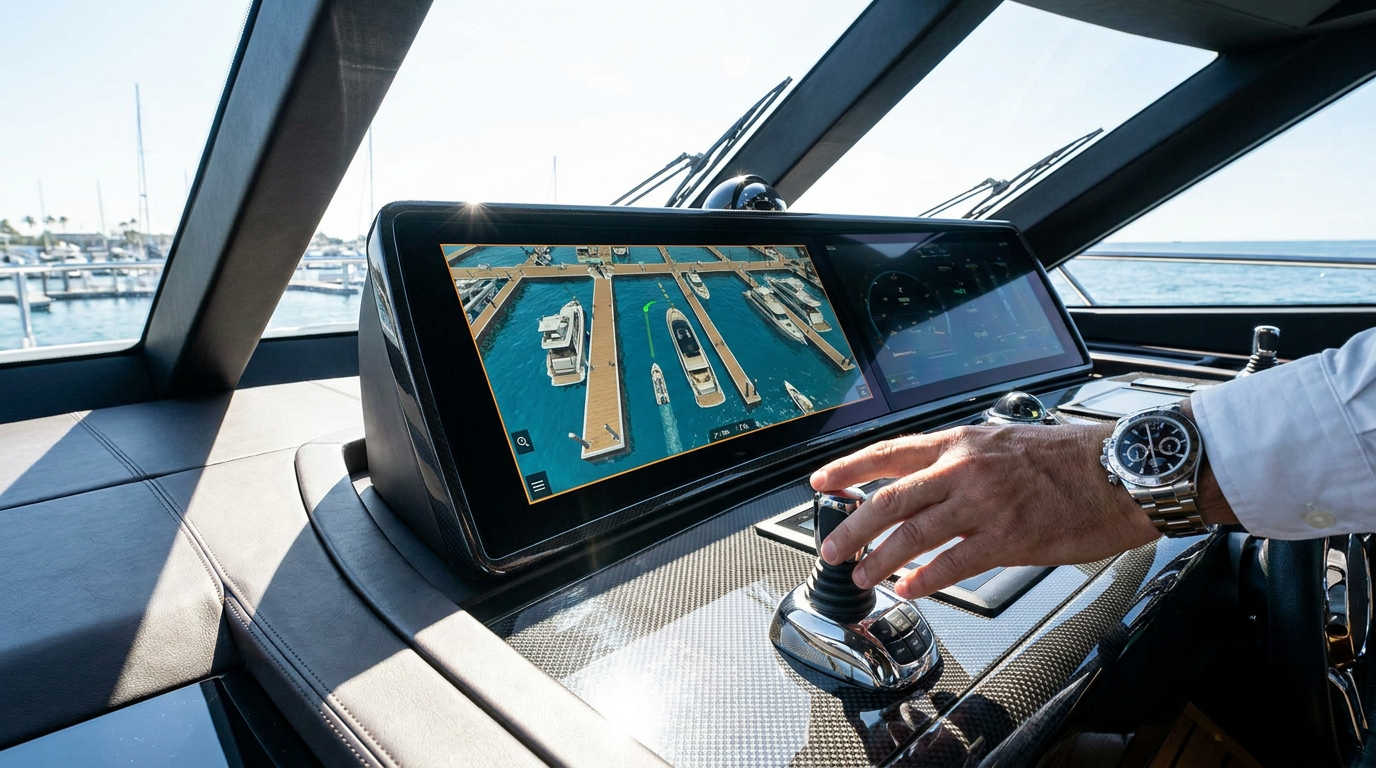
The captain's interaction with these systems has also been completely reimagined. Instead of frantically looking over their shoulder, the operator monitors a high-definition multifunction display at the helm. Systems like Raymarine's DockSense integrate live video feeds with augmented reality overlays, providing a real-time, birds-eye view of the vessel. Color-coded zones indicate proximity to hazards, while audible alerts increase in frequency as the boat approaches the dock.[3][7]

Brunswick Corporation, the world's largest boat builder, is pushing the technology toward full autonomy. Partnering with Carnegie Robotics and Silicon Valley-based Apex.AI, Brunswick has developed systems that allow a captain to simply select a slip on a digital map and step back. The vessel's onboard computer processes the stereoscopic camera data, calculates the safest trajectory, and independently vectors the engines to slide the boat into the slip without human intervention.[1][6]
During testing in New York Harbor—an environment notorious for complex currents and heavy ferry traffic—Brunswick's prototype successfully navigated around floating debris and other vessels before autonomously backing a Boston Whaler into a slip. The software utilizes machine learning algorithms to continuously refine its decision-making for course and speed.[1][4]
None of this software would work without the mechanical evolution of drive-by-wire propulsion. Traditional cable-steered outboards have been replaced by independently articulating engines and pod drives. Because the AI can command the port engine to thrust forward while the starboard engine reverses and the bow thruster pushes sideways, the boat can literally walk sideways or rotate on its own axis.[3][5]

Despite the rapid advancement, the technology faces hurdles. The software is inherently cautious; in crowded marinas, experienced captains may find the autonomous systems slow and tentative compared to manual operation. Furthermore, the systems require pristine sensor data. Heavy sea spray, blinding sun glare, or fouled camera lenses can degrade the machine vision, forcing the captain to retake manual control.[3][4]
Nevertheless, the integration of AI into marine navigation marks the most significant shift in boat handling since the invention of the joystick. By transforming docking from a high-stakes test of skill into a frictionless, push-button experience, the industry is not just preventing fiberglass damage—it is fundamentally opening the water to a new generation of boaters.[1][4]
How we got here
2019
Raymarine introduces DockSense, the industry's first object-recognition assisted docking solution.
2021
Volvo Penta launches its Assisted Docking system, integrating dynamic positioning with IPS drives.
2024
Brunswick partners with Apex.AI to integrate safety-certified automotive software into marine autonomy.
2026
Fully autonomous, push-button docking systems begin appearing on production recreational vessels.
Viewpoints in depth
Marine Manufacturers
Viewing autonomy as the key to unlocking market growth.
For boat builders, the primary hurdle to selling a vessel is the buyer's fear of operating it. Manufacturers view assisted docking not just as a premium feature, but as a fundamental market-expansion tool. By lowering the barrier to entry, they hope to attract consumers who have the capital for a boat but lack the generational experience of handling one.
Traditional Captains
Skeptical of over-reliance on digital systems in harsh marine environments.
Experienced mariners often express concern that automated systems will erode fundamental seamanship skills. They argue that electronics inevitably fail in the corrosive, wet marine environment, and a captain who relies entirely on a 'Virtual Bumper' may panic when forced to dock manually in a 20-knot crosswind. They advocate for these systems to remain 'assists' rather than replacements for training.
Marine Insurance Providers
Anticipating a drastic reduction in low-speed claims.
The vast majority of boating accidents and insurance claims do not occur at high speeds on open water; they happen at less than five miles per hour inside marinas. Insurers are closely monitoring the rollout of spatial-awareness and auto-docking tech, anticipating that widespread adoption could significantly reduce the frequency of fiberglass repairs and liability claims.
What we don't know
- How marine insurance premiums will adjust for vessels equipped with autonomous docking systems.
- Whether heavy reliance on AI docking will lead to a decline in basic seamanship skills among new boaters.
- How the optical sensors will perform long-term against salt buildup, sea spray, and harsh marine degradation.
Key terms
- Sensor Fusion
- The process of combining data from multiple sensors (cameras, GPS, gyroscopes) to create a highly accurate model of the environment.
- Stereoscopic Cameras
- Dual-lens cameras that mimic human binocular vision to accurately perceive depth and distance.
- Drive-by-Wire
- Electronic systems that replace mechanical steering cables, allowing computers to independently control engine thrust and direction.
- Dynamic Positioning
- A computer-controlled system that automatically maintains a vessel's position and heading by using its own propellers and thrusters.
Frequently asked
Can the boat dock itself completely?
Yes, the newest systems from companies like Brunswick allow the captain to select a slip on a screen and let the boat autonomously navigate and park, though the captain can intervene at any time.
What happens if the wind is blowing hard?
The systems use GPS and gyroscopes to detect wind and current, automatically applying counter-thrust to keep the boat moving in a perfectly straight line.
Can this be added to an older boat?
Retrofitting is difficult and expensive. It generally requires modern drive-by-wire engines, joystick controls, and the installation of multiple camera arrays and processors.
Sources
Source coverage
8 outlets
3 viewpoints surfaced







[1]Cruising OdysseyMarine Technology Developers
Brunswick Using AI for Autonomous Docking
Read on Cruising Odyssey →[2]SoundingsBoating Enthusiasts
Volvo Penta Assisted Docking
Read on Soundings →[3]Power & MotoryachtBoating Enthusiasts
Dock Like A Boss: Raymarine DockSense
Read on Power & Motoryacht →[4]Boat BlurbBoat Manufacturers
First Look: Brunswick's Autonomous Docking System
Read on Boat Blurb →[5]MarineMaxBoating Enthusiasts
Volvo's Assisted Docking System
Read on MarineMax →[6]Carnegie RoboticsMarine Technology Developers
Autonomous Boat Docking
Read on Carnegie Robotics →[7]FLIR SystemsMarine Technology Developers
FLIR Announces Raymarine DockSense Alert
Read on FLIR Systems →[8]CESBoat Manufacturers
Brunswick at CES 2026: Leading the Next Era of Marine Technology
Read on CES →
Every angle. Every day.
Get automotive stories with full source coverage and perspective breakdowns delivered to your inbox.