
The End of the 'Always-On' Office: Why Asynchronous Work is the Future of Remote Collaboration
As remote work matures, leading companies are abandoning constant real-time messaging in favor of 'asynchronous' workflows. By decoupling communication from immediate responses, organizations are reclaiming deep focus, reducing burnout, and unlocking true global collaboration.
By Factlen Editorial Team
- Async-First Pioneers
- Companies that have completely decoupled time from collaboration to prioritize deep work.
- Productivity Researchers
- Academics focused on the neurological costs of constant connectivity and context switching.
- Hybrid Realists
- Advocates for a balanced approach that preserves synchronous moments for relationship building.
What's not represented
- · Junior Employees & New Hires
- · Client-Facing Roles
Why this matters
As the initial novelty of remote work fades, the 'always-on' digital office is driving record levels of burnout. Transitioning to asynchronous workflows allows professionals to reclaim their focus, protect their mental health, and collaborate globally without sacrificing their personal lives.
Key points
- The shift to remote work initially replicated the physical office's interruptions through constant digital pings and meetings.
- Asynchronous work decouples communication from immediate responses, allowing employees to control their own schedules.
- Research shows professionals are interrupted every 6 to 12 minutes, requiring 23 minutes to fully refocus each time.
- Teams adopting asynchronous workflows report a 61% reduction in burnout and save over two hours daily by eliminating status meetings.
- Successful implementation requires a 'handbook-first' culture and exceptionally clear, context-rich written communication.
- Synchronous meetings are not eliminated but are strictly reserved for complex problem-solving and team bonding.
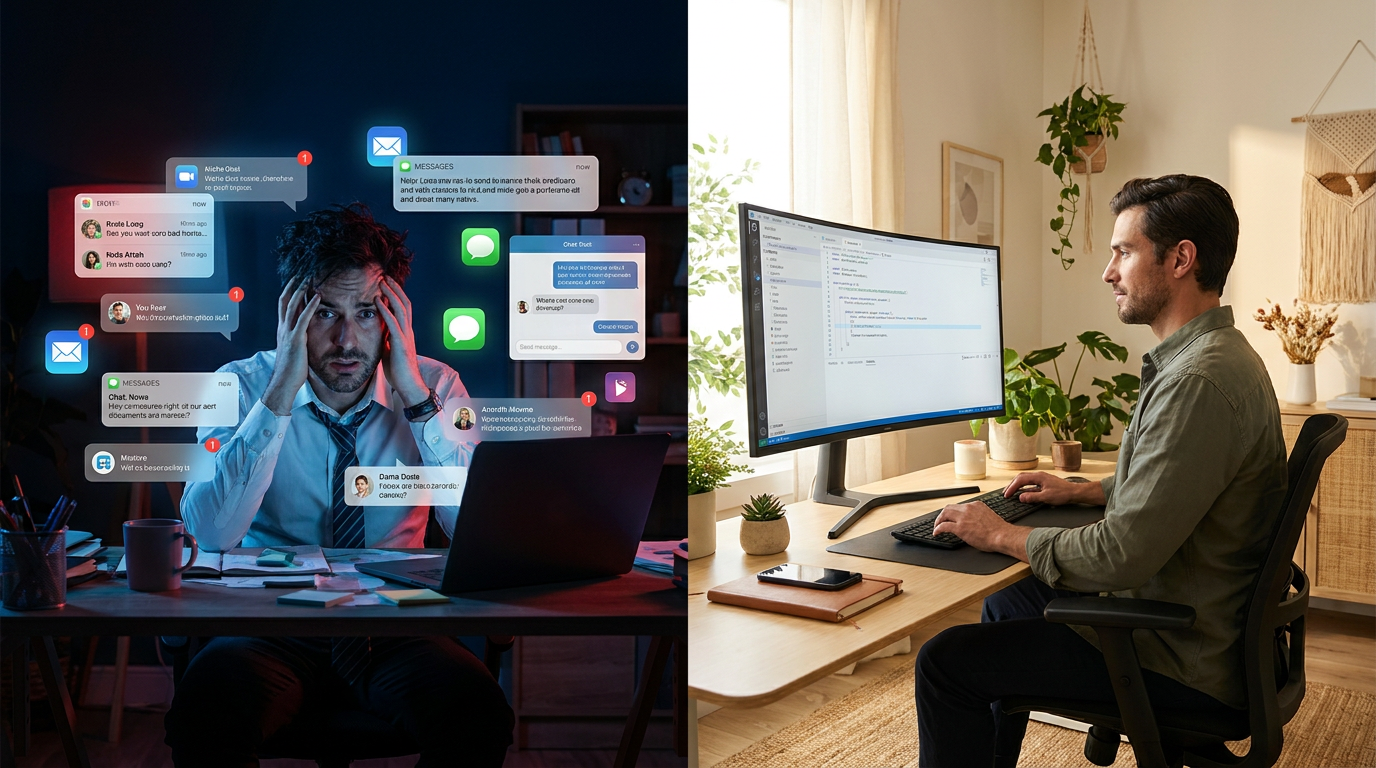
The remote work revolution successfully eliminated the daily commute, but it accidentally birthed a new, insidious monster: the "always-on" digital office. When companies first transitioned away from physical headquarters, most simply digitized their existing synchronous habits. Instead of a colleague dropping by a cubicle, workers now face a relentless, multi-channel barrage of Slack pings, Microsoft Teams notifications, and back-to-back Zoom calls. The physical exhaustion of the highway has been replaced by the cognitive exhaustion of the screen. Employees find themselves tethered to their keyboards, terrified to step away for a coffee lest they miss a crucial update or appear unproductive to a green status dot. This hyper-responsive environment has created a paradox where people are communicating more than ever, yet finding it increasingly difficult to actually get their core work done.[7]
To solve this crisis of attention, leading organizations are drawing a hard line between remote work and asynchronous work. The distinction is fundamental. Remote work simply dictates where a person works, offering location flexibility. Asynchronous work, however, dictates when a person works, offering time flexibility. In a purely remote but synchronous company, a team member in London must still log on at 9:00 PM to attend a status meeting hosted in San Francisco. In an asynchronous company, that same team member logs off at 5:00 PM, confident that the project will move forward through documented handoffs and that their input can be provided the following morning. It is the decoupling of communication from the expectation of an immediate response.[6][7]
The cognitive cost of the synchronous digital office is staggering, and researchers are increasingly quantifying the damage. A study highlighted by the Harvard Business Review found that modern professionals are being interrupted every six to twelve minutes during their workday. These constant micro-interruptions—a quick question in a chat channel, a calendar reminder for an impromptu huddle—shatter concentration. The human brain is not designed to instantly pivot between drafting a complex strategic document and answering a rapid-fire logistical query.[1][3]
The fallout from these interruptions extends far beyond the few seconds it takes to read a message. Research from the University of California, Irvine, demonstrates that it takes an average of 23 minutes for a worker to fully refocus and return to their original task after a single interruption. When a professional is interrupted every ten minutes, they spend their entire day in a state of cognitive recovery, never reaching the deep concentration required for high-value output. This constant state of fractured attention is a primary driver of the exhaustion and burnout that plagues modern knowledge workers.[3]

Enter the asynchronous solution. At its core, asynchronous communication is the practice of exchanging information without demanding real-time engagement. It treats communication as a relay race rather than a three-legged race. One team member completes their portion of a task, documents their progress, outlines the next steps, and passes the baton. The receiving team member picks up that baton whenever they begin their workday, equipped with all the context they need to proceed. This methodology shifts the organizational default from "urgent" to "important," allowing employees to prioritize their tasks based on strategic value rather than the volume of the notification chime.[5][6]
Implementing this shift requires a radical overhaul of company culture, best exemplified by the "handbook-first" approach championed by all-remote pioneers like GitLab. In an asynchronous organization, knowledge cannot live in the minds of a few key individuals or get buried in ephemeral chat threads. It must be externalized. GitLab maintains a massive, publicly accessible handbook that documents every process, decision, and protocol. Before a team member asks a question, they are expected to consult the documentation. If the answer is not there, the resulting solution is added to the handbook. This creates a self-serve knowledge ecosystem where progress is never bottlenecked by waiting for a specific person to come online.[2]
This philosophy also demands a fundamental rethinking of how chat applications are used. Companies like Basecamp advocate for treating real-time chat like a physical water cooler—a place for ephemeral, non-binding conversation and social bonding. Actual work, strategic decisions, and complex debates are moved to long-form, threaded discussions on dedicated project management platforms. By removing the pressure to monitor chat channels constantly, employees are freed from the anxiety of missing out. If a decision is important, it will be documented formally; if it is just chatter, it is safe to ignore.[4]

This philosophy also demands a fundamental rethinking of how chat applications are used.
The ultimate goal of asynchronous work is to protect what productivity expert Cal Newport calls "Deep Work." Deep work is defined as the ability to focus without distraction on a cognitively demanding task. It is the state of flow where true innovation, complex problem-solving, and high-quality writing occur. Asynchronous communication acts as a protective moat around this flow state. By batching communication into dedicated windows—perhaps checking messages once in the morning and once in the afternoon—professionals can carve out three to four hours of uninterrupted time, producing better results with significantly less stress.[5]
The data supporting this transition is compelling. Organizations that have successfully adopted asynchronous workflows report dramatic improvements in employee well-being. Studies indicate that teams practicing async communication experience a 61% reduction in burnout rates. When employees control their own time, they can align their most demanding tasks with their natural energy peaks, take breaks when they actually need them, and step away from their screens without guilt. They control their schedules, rather than allowing their schedules to control them.[6]
Beyond well-being, the efficiency gains are massive. Companies operating asynchronously report saving upwards of two hours per day simply by eliminating unnecessary status meetings and synchronous check-ins. When updates are provided via written summaries or recorded video briefs, team members can consume the information at 1.5x speed, skip irrelevant sections, and refer back to the material later. This reclaimed time is then reinvested into actual production, leading to faster project completion times and higher overall output.[6]

Asynchronous work is also a powerful engine for global inclusivity. When a company relies on real-time meetings, its talent pool is effectively restricted to a handful of overlapping time zones. By decoupling work from the clock, organizations can hire the best talent regardless of geography. A brilliant engineer in Tokyo can seamlessly collaborate with a product manager in New York and a designer in Berlin. The work follows the sun, moving forward continuously without requiring anyone to sacrifice their sleep or personal life to attend a midnight sync.[2][6]
This inclusivity extends beyond geography. Asynchronous workflows are inherently more accommodating for working parents, who may need to step away during the afternoon for school pickups, or for neurodivergent employees who find the rapid-fire nature of real-time meetings overwhelming. By evaluating employees strictly on their documented output rather than their visible presence at a desk, companies create a more equitable environment where results matter more than performative busyness.[2]
However, the transition to asynchronous work is not without significant friction. The most glaring challenge is the demand for extreme clarity in written communication. In a synchronous meeting, if a directive is vague, a colleague can immediately ask for clarification. In an asynchronous environment, a vague message might not be read for eight hours, and a request for clarification adds another eight-hour delay. This requires employees to develop robust writing skills, learning to anticipate questions and provide comprehensive context upfront.[2][5]
To succeed, every asynchronous message must be treated as a complete package. It must include the background context, links to relevant documents, clear deadlines, and explicit calls to action. Instead of sending a message that says, "Can you look at this?", an async-trained professional writes, "Please review section three of the attached document for factual accuracy by Thursday, so I can finalize the client presentation on Friday." This level of intentionality slows down the initial communication but drastically speeds up the actual execution.[2]

Another common pitfall is the risk of isolation. When teams stop talking in real-time, the organic social bonds that form before and after meetings can wither. To combat this, successful asynchronous companies do not eliminate synchronous communication entirely; they simply repurpose it. Real-time video calls are fiercely protected and reserved specifically for complex, emotionally nuanced conversations—like performance reviews or conflict resolution—and for deliberate team bonding. Virtual coffee chats, non-work-related hangouts, and periodic in-person retreats become essential tools for building the trust that makes asynchronous collaboration possible.[3][5]
As the global workforce moves past the initial, reactive phase of remote work, the limitations of the synchronous digital office are becoming impossible to ignore. The companies that will define the next decade of work are those that recognize time as their employees' most valuable asset. By mastering the asynchronous handoff, organizations can offer true flexibility, protect the mental health of their teams, and unlock a level of deep, focused productivity that the traditional office could never achieve.[7]
How we got here
Pre-2020
Remote work is a niche perk, mostly operating synchronously to mimic the traditional office environment.
Early 2020
The global pandemic forces a massive shift to remote work, leading to a surge in 'Zoom fatigue' and always-on chat expectations.
2021-2022
Productivity researchers highlight the severe burnout caused by constant digital interruptions, prompting a search for better models.
2023-2024
Tech pioneers like GitLab and Doist publish extensive guides on asynchronous workflows, shifting the industry focus from location to time flexibility.
2026
Asynchronous communication becomes a standardized best practice for global enterprises seeking to protect employee focus and scale across time zones.
Viewpoints in depth
Async-First Pioneers
Companies that have completely decoupled time from collaboration.
Organizations like GitLab and Doist argue that real-time communication should be the exception, not the rule. By defaulting to written, searchable documentation, they eliminate knowledge silos and allow employees to structure their days around their natural energy peaks. They view meetings as a last resort for complex problem-solving rather than a primary tool for status updates.
Productivity & Cognitive Researchers
Academics focused on the neurological costs of constant connectivity.
Researchers studying workplace habits emphasize the severe cognitive toll of 'context switching.' Drawing on concepts like Cal Newport's 'Deep Work,' this camp highlights that the human brain cannot instantly pivot between a strategic planning task and a rapid-fire Slack thread. They advocate for asynchronous workflows primarily as a defense mechanism to protect flow states and high-value cognitive output.
Hybrid Realists
Advocates for a balanced approach that preserves synchronous moments.
While acknowledging the burnout associated with constant pings, this perspective cautions against eliminating real-time interaction entirely. They argue that synchronous communication remains irreplaceable for rapid brainstorming, crisis management, and, crucially, relationship building. For these advocates, the goal is not to kill the meeting, but to reserve it strictly for moments that require emotional nuance and immediate collaborative energy.
What we don't know
- How the widespread adoption of asynchronous work will impact the career progression of junior employees who traditionally learn through real-time observation.
- Whether AI-driven meeting summarization tools will eventually bridge the gap between synchronous conversations and asynchronous documentation.
- The long-term impact of reduced real-time socialization on corporate loyalty and employee retention over multiple decades.
Key terms
- Asynchronous Communication
- Exchanging information without the expectation of an immediate response, allowing participants to reply on their own schedule.
- Synchronous Communication
- Real-time interaction where all participants are present and responding immediately, such as a video call or an active chat thread.
- Deep Work
- A state of distraction-free concentration that pushes cognitive capabilities to their limit, necessary for complex problem-solving.
- Context Switching
- The mental process of jumping between different tasks or apps, which significantly drains cognitive energy and reduces overall productivity.
- Handbook-First Approach
- A management philosophy where all company processes, decisions, and updates are documented in a central, searchable repository before being discussed.
Frequently asked
What is the difference between remote work and asynchronous work?
Remote work provides location flexibility, allowing you to work from anywhere. Asynchronous work provides time flexibility, allowing you to work whenever you are most productive without needing to be online at the same time as your colleagues.
Does an asynchronous workplace mean there are no meetings?
No. Successful asynchronous teams still hold meetings, but they reserve them strictly for complex problem-solving, emotional conversations, and team bonding, rather than routine status updates.
How do asynchronous teams handle urgent emergencies?
Async companies establish clear protocols for genuine emergencies, often using a dedicated channel or a phone call that bypasses normal notification filters, ensuring that urgent issues are addressed immediately while protecting routine focus time.
Is asynchronous communication isolating for employees?
It can be if not managed correctly. To prevent isolation, async-first companies intentionally schedule synchronous social events, virtual coffee chats, and periodic in-person retreats to build trust and rapport.
Sources
Source coverage
7 outlets
3 viewpoints surfaced







[1]Harvard Business ReviewProductivity Researchers
Assessing Information: The Content of Asynchronous Communication in Hybrid Work
Read on Harvard Business Review →[2]GitLabAsync-First Pioneers
How to embrace asynchronous communication for remote work
Read on GitLab →[3]ForbesHybrid Realists
The Future Of Work Is Asynchronous
Read on Forbes →[4]BasecampAsync-First Pioneers
Sanity at work and the power of asynchronous communication
Read on Basecamp →[5]DoistAsync-First Pioneers
Asynchronous Communication: The Complete Guide
Read on Doist →[6]Remote.comAsync-First Pioneers
The benefits of asynchronous work for global teams
Read on Remote.com →[7]Factlen Editorial TeamProductivity Researchers
Synthesis by Factlen editorial team
Read on Factlen Editorial Team →
Every angle. Every day.
Get careers work stories with full source coverage and perspective breakdowns delivered to your inbox.