
The Asynchronous Revolution: Why the Best Remote Companies Are Killing the 9-to-5
Pioneered by tech giants like Dropbox and GitLab, asynchronous work is replacing Zoom-heavy remote models with flexible, documentation-first workflows that boost productivity and reduce burnout.
By Factlen Editorial Team

- Async Pioneers
- Argue that decoupling work from rigid schedules maximizes deep work, autonomy, and global talent acquisition.
- Organizational Researchers
- Focus on the empirical data showing that autonomy reduces fatigue and asynchronous workflows boost creativity and equity.
- Hybrid Pragmatists
- Emphasize that while async focus time is critical, it must be balanced with intentional synchronous moments to prevent isolation.
What's not represented
- · Frontline and service workers whose roles require physical synchronicity
- · Junior employees who rely on real-time shadowing for mentorship
Why this matters
As the initial novelty of remote work fades into meeting fatigue, mastering asynchronous workflows is becoming the defining factor in which companies retain top talent and which employees avoid burnout. For the average worker, it offers a blueprint to reclaim focus, reduce stress, and finally separate professional output from the rigid 9-to-5 clock.
Key points
- Asynchronous work decouples collaboration from real-time presence, allowing employees to manage their own schedules.
- Research shows it takes 23 minutes to regain focus after a synchronous interruption.
- Harvard Business Review found that async workflows boost creative output, particularly for women and marginalized groups.
- Companies like Dropbox use the '3D rule' to limit meetings to Decisions, Discussions, and Debates.
- GitLab relies on a massive, publicly accessible handbook to serve as a single source of truth for all employees.
The great remote work experiment of 2020 had a fatal flaw: it simply digitized the traditional office. Companies took the 9-to-5 schedule, the constant shoulder-tapping, and the endless conference room gatherings, and transplanted them directly onto video calls and instant messaging platforms.[7]
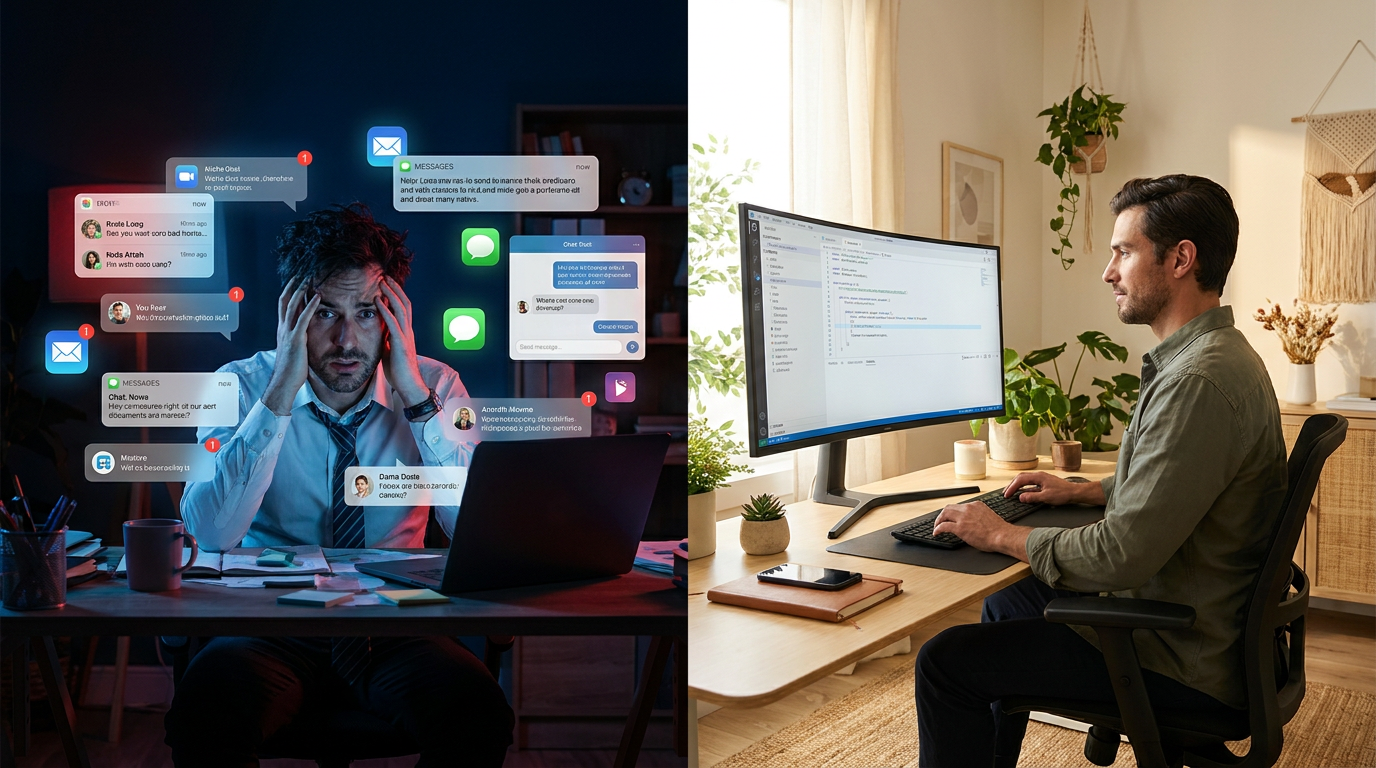
The result was a phenomenon widely recognized as "Zoom fatigue." Employees found themselves tethered to their screens, enduring back-to-back virtual meetings that left little room for actual execution. The corporate world had successfully eliminated the commute, but it had accidentally created a hyper-responsive digital environment that was arguably more exhausting than the physical cubicle.[6][7]
Now, a second wave of workplace evolution is quietly replacing that chaotic first draft. It is called asynchronous work—a model where team members collaborate without the expectation of real-time interaction. In an async-by-default culture, a message sent at 9:00 AM in New York might be thoughtfully answered at 3:00 PM in London, and neither employee has to compromise their peak focus hours to make the exchange happen.[7]
The shift is not merely a perk for digital nomads; it is a structural redesign of knowledge work backed by compelling cognitive science. Researchers at the University of California, Irvine, have long documented the severe cognitive tax of synchronous interruptions, finding that it takes the average knowledge worker approximately 23 minutes to fully regain their concentration after a single disruption.[3]

When employees are expected to monitor chat channels all day, they suffer from what organizational psychologists call "attention residual"—a state where the brain is constantly half-focused on the last ping and half-bracing for the next one. By removing the expectation of an immediate reply, asynchronous work protects deep, uninterrupted focus.[3][7]
The productivity gains from this protected time are substantial. A comprehensive survey by Gartner found that 43% of workers cited flexibility in their working hours as the single biggest booster to their productivity. Furthermore, Gartner's data revealed that employees who are granted the autonomy to manage their own time experience a twofold reduction in work-related fatigue.[2]
These autonomous workers are also 2.3 times more likely to stay with their current employer, a critical metric in an era of high turnover. Microsoft's own workplace research corroborates this, showing that when employees are provided with meeting-free calendar blocks, they report a 15% increase in perceived productivity and overwhelmingly high satisfaction with the intervention.[2][6]
These autonomous workers are also 2.3 times more likely to stay with their current employer, a critical metric in an era of high turnover.
But perhaps the most surprising benefit of asynchronous work is its impact on innovation and equity. A landmark 2023 study published in the Harvard Business Review investigated the effects of synchronous versus asynchronous collaboration on creative tasks. The findings challenged the long-held corporate belief that the best ideas only happen when people brainstorm together in a room.[1]
The HBR research revealed that synchronous ecosystems often ignore variations in social status, where women and marginalized individuals are frequently interrupted or given fewer opportunities to speak. When the researchers tested an asynchronous workflow—where individuals developed ideas independently before merging them—the quality of the output soared. Notably, women in the study were rated 17% higher when they contributed asynchronously rather than in a live group setting.[1]

Several major technology companies have already proven that this model scales. GitLab, a pioneer in the space, operates a fully remote, globally distributed workforce almost entirely asynchronously. Their secret weapon is a "handbook-first" approach to communication.[5]
Instead of holding a meeting to share information, GitLab employees document everything in a massive, publicly accessible corporate handbook that serves as a single source of truth. The company operates on the principle of measuring impact rather than activity, explicitly telling employees that holding a meeting simply to document what will eventually need to be written down is a waste of organizational energy.[5]
Dropbox has taken a similarly radical approach with its "Virtual First" model. In late 2020, the company took a massive financial charge to exit traditional real estate leases, declaring that office space would no longer be used for solo desk work. Instead, Dropbox shifted to "non-linear workdays," establishing core collaboration hours for necessary overlap while leaving the rest of the day entirely up to the individual.[4]
To prevent old habits from creeping back in, Dropbox instituted the "3D rule" for meetings. Under this framework, a synchronous meeting is only scheduled if it involves a Decision, a Discussion, or a Debate. Everything else—status updates, informational readouts, and basic check-ins—is relegated to written, asynchronous formats.[4][7]

The cultural impact at Dropbox has been profound. According to the company's internal metrics, 92% of employees cite the Virtual First model as a key reason they choose to stay with the organization. By decoupling work from a specific time zone, they have also unlocked a truly global talent pool, hiring top-tier professionals who no longer have to work "vampire shifts" to overlap with California headquarters.[4]
Transitioning to an asynchronous culture is not without friction. It requires a massive shift in management philosophy, moving away from "management by walking around" to a system built entirely on trust and clear documentation. It also demands that companies intentionally design in-person moments—like quarterly offsites or regional hub gatherings—to build the social capital that sustains remote teams.[7]

Yet, as the data increasingly shows, the companies that master this transition are building more resilient, creative, and inclusive organizations. By killing the 9-to-5 and embracing the asynchronous revolution, they are finally delivering on the true promise of remote work: not just changing where we work, but fundamentally improving how we work.[7]
How we got here
Pre-2020
Remote work remains a niche perk, and distributed teams largely attempt to mirror synchronous office hours.
March 2020
The pandemic forces a global shift to remote work, leading to a surge in 'Zoom fatigue' as companies digitize the 9-to-5.
October 2020
Dropbox officially announces its permanent 'Virtual First' model, shifting to 'async by default'.
April 2023
Harvard Business Review publishes landmark research demonstrating that asynchronous work significantly boosts creativity and workplace equity.
2026
Asynchronous workflows become the gold standard for global enterprises seeking to retain talent and protect deep work.
Viewpoints in depth
The Deep Work Proponents
Advocates who believe that protecting uninterrupted focus time is the ultimate competitive advantage.
Pioneers like GitLab and Dropbox argue that the modern corporate obsession with real-time responsiveness destroys actual productivity. By shifting to an 'async by default' model, they prioritize deep, uninterrupted cognitive work over the performative busyness of answering chat messages. This camp relies heavily on the concept of 'non-linear workdays,' asserting that employees produce their best work when they can align their tasks with their natural energy peaks, rather than an arbitrary 9-to-5 schedule.
The Equity Researchers
Academics and sociologists focusing on how asynchronous work levels the playing field.
Researchers highlighted by the Harvard Business Review point out that synchronous meetings inherently favor the loudest voices in the room, often marginalizing women, minorities, and introverts. Asynchronous work removes the pressure of real-time performance and the social dynamics of interruption. By allowing individuals to formulate their ideas independently and submit them in writing, this perspective argues that async workflows create a more meritocratic and inclusive environment where the best ideas win, regardless of who presents them.
The Corporate Pragmatists
Leaders who balance the efficiency of async work with the human need for connection.
While acknowledging the massive productivity gains of asynchronous workflows, this camp warns against taking the concept to an extreme where employees feel isolated. Organizations like Microsoft emphasize that while deep work should be protected, teams still require intentional, synchronous moments to build trust and social capital. They advocate for a hybrid approach: ruthless asynchronicity for daily execution, paired with highly intentional, high-quality synchronous gatherings for team building, complex debates, and strategic alignment.
What we don't know
- How fully asynchronous models impact the onboarding and rapid upskilling of entry-level employees who traditionally learn via observation.
- Whether the long-term social isolation of extreme asynchronous work will eventually offset its productivity gains.
Key terms
- Asynchronous Work
- A collaborative work model where team members complete tasks and communicate on their own schedules, without the expectation of immediate, real-time responses.
- Attention Residual
- The cognitive phenomenon where a person's brain remains partially focused on a previous task or interruption, reducing their capacity to concentrate on the current task.
- Non-linear Workday
- A flexible schedule where an employee breaks up their working hours throughout the day to suit their personal peak productivity times, rather than working a continuous 9-to-5 block.
- Single Source of Truth (SSOT)
- A centralized, constantly updated documentation system (like a company wiki) where all organizational knowledge is stored, preventing information from being lost in chat channels.
Frequently asked
Does asynchronous work mean we never have meetings?
No. Meetings are still used, but they are reserved strictly for complex discussions, debates, and critical decision-making, rather than routine status updates.
How do teams handle urgent emergencies asynchronously?
Most async teams establish clear communication SLAs (Service Level Agreements), defining specific channels—like a phone call or a dedicated pager system—exclusively for true emergencies.
Is asynchronous work only for software engineers?
While pioneered by tech companies, async principles are increasingly applied across marketing, finance, legal, and design teams by focusing on written documentation and clear handoffs.
How does async work affect employee burnout?
Research shows that giving employees the autonomy to manage their own schedules and protecting their focus time can reduce work-related fatigue by up to 50%.
Sources
Source coverage
7 outlets
3 viewpoints surfaced







[1]Harvard Business ReviewOrganizational Researchers
Research: Asynchronous Work Can Fuel Creativity
Read on Harvard Business Review →[2]GartnerOrganizational Researchers
Gartner Says 43% of Workers Say Flexibility in Working Hours Helped Them Achieve Greater Productivity
Read on Gartner →[3]University of California, IrvineOrganizational Researchers
The Cost of Interrupted Work: More Speed and Stress
Read on University of California, Irvine →[4]DropboxAsync Pioneers
Virtual First: Work, reimagined
Read on Dropbox →[5]GitLabAsync Pioneers
How to embrace asynchronous communication for remote work
Read on GitLab →[6]MicrosoftHybrid Pragmatists
Work Trend Index: Brain research shows the stress of video meetings
Read on Microsoft →[7]Factlen Editorial Team
Synthesis by Factlen editorial team
Read on Factlen Editorial Team →


Every angle. Every day.
Get careers work stories with full source coverage and perspective breakdowns delivered to your inbox.