
The 2026 Guide to Local AI: Running Powerful Models on Your Own Laptop
Advances in neural processing hardware and highly efficient open-weight models have made it possible to run frontier-class AI entirely offline, guaranteeing privacy and zero latency.
By Factlen Editorial Team
- Open-Source Developers
- Prioritize model accessibility, offline tinkering, and bypassing corporate API costs.
- Privacy & Enterprise Advocates
- Value data sovereignty and view local AI as the only secure way to deploy generative models.
- Hardware Ecosystem
- Push the narrative that dedicated NPUs are essential, driving a new PC upgrade cycle.
- Industry Analysts
- Acknowledge local AI's utility but note that frontier reasoning will still require cloud scale.
What's not represented
- · Cloud Infrastructure Providers
- · Everyday Non-Technical Consumers
Why this matters
Running AI locally gives you absolute control over your data, eliminates monthly subscription fees, and allows you to use powerful intelligence entirely offline. As open-weight models rival cloud flagships, your laptop is transforming from a simple terminal into a private, self-contained AI server.
Key points
- Local AI allows users to run powerful language models entirely on their own devices without internet access.
- Modern NPUs in 2026 deliver up to 85 TOPS, enabling laptops to process AI tasks efficiently.
- Tools like LM Studio and Ollama have transformed local AI from a developer niche into a 1-click consumer experience.
- Open-weight models like Gemma 4 and Qwen 3.5 now rival the performance of last year's cloud flagships.
- Running models locally guarantees absolute data privacy and eliminates the network latency of cloud APIs.
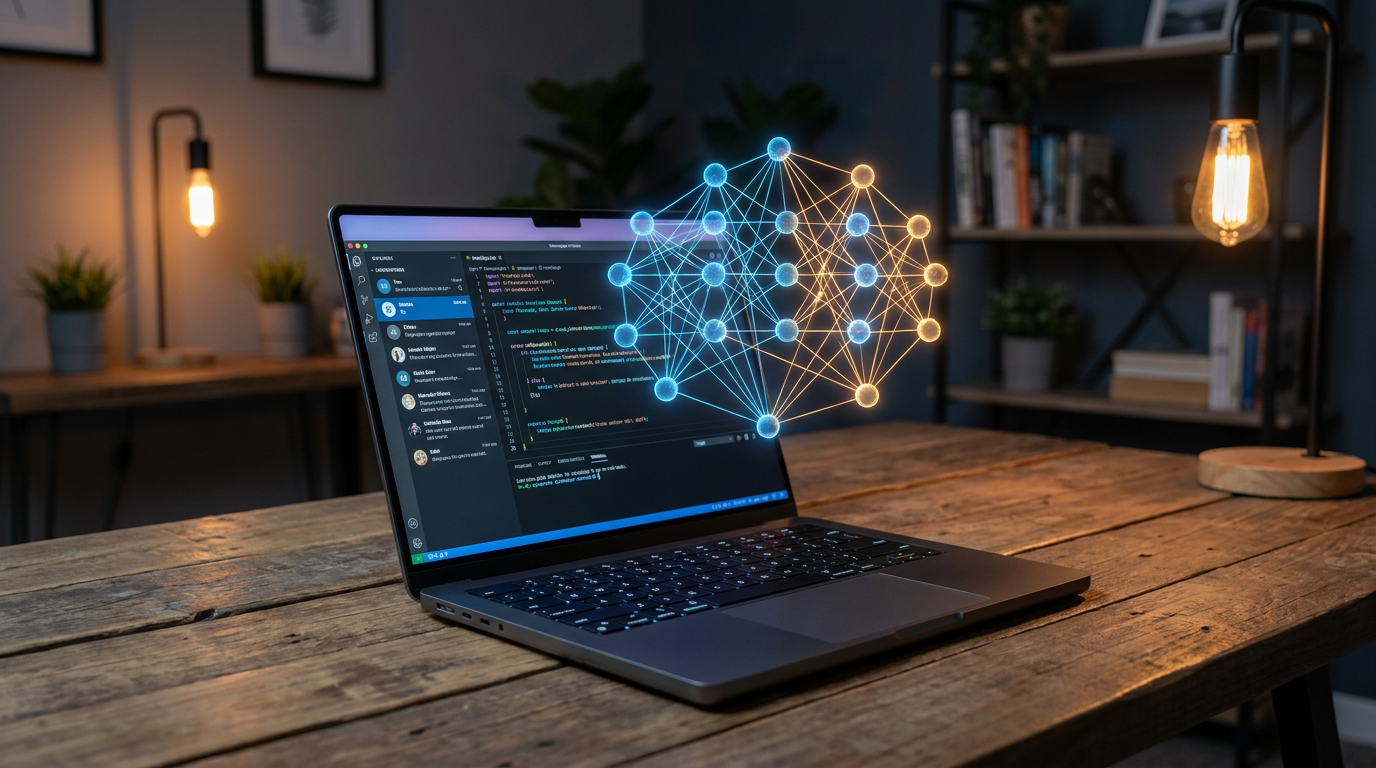
The era of sending every keystroke, thought, and proprietary document to a distant cloud server is beginning to fracture. In 2026, the most exciting frontier in artificial intelligence isn't happening inside a billion-dollar data center—it is happening quietly on the laptop sitting on your desk.[10]
This shift is known as "local AI," or on-device inference. It means running large language models (LLMs) entirely on hardware you own and control. When you type a prompt, the computation happens on your local processor, and the data never leaves your machine. There are no API calls to external providers, no internet connection required, and no monthly subscription fees.[1][7]
Just a year or two ago, running a capable AI model locally was an exercise in frustration, reserved for hobbyists willing to compile code and debug command-line errors. Today, the ecosystem has matured into a seamless consumer experience. Anyone can download an app, click a button, and have a frontier-class AI assistant running offline in under five minutes.[1][3]
The catalyst for this revolution is a fundamental shift in computer hardware, specifically the rise of the Neural Processing Unit (NPU). While CPUs are built for general tasks and GPUs are designed for parallel processing like graphics, NPUs are specialized chips hardwired for the specific matrix math that AI models require.[2][9]
In 2026, NPUs have moved from experimental add-ons to mandatory components. Qualcomm's Snapdragon X Elite, Intel's Lunar Lake, and AMD's Ryzen AI 300 series are now delivering between 45 and 85 TOPS (Tera Operations Per Second) of dedicated AI compute. This allows laptops to run complex models while drawing a fraction of the power a traditional GPU would require.[2]

Apple has also maintained a massive advantage in the local AI space through its unified memory architecture. On Apple Silicon (M3 and M4 chips), the GPU can directly access the system's total RAM. Because AI models are incredibly memory-hungry, a Mac with 64GB of unified memory can load massive models that would otherwise require multiple expensive desktop graphics cards.[3]
Hardware is only half the story; the software layer has also undergone a radical simplification. Tools like LM Studio have transformed the user experience. LM Studio provides a polished, user-friendly graphical interface that looks and feels exactly like a premium cloud chatbot, but it serves as a local hub to search, download, and run open-weight models with zero configuration.[3][7]
Hardware is only half the story; the software layer has also undergone a radical simplification.
For developers and power users, Ollama has become the industry standard. Running quietly in the background, Ollama allows users to pull models via simple terminal commands and provides a local API. This means developers can build applications that use AI without ever paying for cloud API access, treating their local machine as a free, private server.[4][7]
Of course, powerful hardware and slick software are useless without capable models. The open-weight ecosystem—where companies release the underlying parameters of their AI models for public use—has exploded. Models have become significantly smaller and vastly more efficient, requiring less RAM while delivering better reasoning.[4][9]
Google's Gemma 4 and Alibaba's Qwen 3.5 are prime examples of this efficiency. In 2026, a 12-billion parameter version of Gemma 4 can run comfortably in just 16GB of RAM. Meanwhile, models like Qwen3-Coder are scoring near 80% on rigorous software engineering benchmarks, matching the performance of proprietary cloud flagships from just a year ago.[5][8]

The primary driver pushing users toward local AI is absolute privacy. For heavily regulated industries like healthcare, finance, and legal services, sending sensitive client data or proprietary source code to a third-party cloud provider is a massive compliance risk. Local AI solves this instantly: if the model runs on an air-gapped laptop, data sovereignty is mathematically guaranteed.[1][6]
Latency is another critical factor. Cloud AI inherently suffers from network delay—often 200 to 800 milliseconds of lag before the first word is generated. On-device inference eliminates this round-trip entirely. For real-time applications like live voice translation, coding autocomplete, or augmented reality, that instant response time is the difference between a magical experience and a frustrating one.[6]
Then there is the sheer utility of offline capability. Cloud AI is entirely useless on an airplane, in a remote field location, or during a network outage. Local models provide persistent, reliable intelligence regardless of connectivity, empowering field workers, researchers, and travelers to maintain their workflows anywhere on Earth.[6][7]

Cost at scale also heavily favors local deployment. While individual users might balk at a monthly subscription, enterprise teams building AI-heavy applications can spend hundreds of thousands of dollars on API fees. Once a company invests in NPU-equipped hardware, local inference is effectively free, capping operational costs permanently.[6][7]
However, the local AI ecosystem is not without its compromises. The most significant is the "frontier gap." While open-weight models are incredibly capable, they generally lag three to six months behind the absolute bleeding edge of cloud models in raw, complex reasoning and massive multi-agent orchestration.[1]
Furthermore, while NPUs are highly efficient, running a 27-billion parameter model locally is still a computationally intense task. Users who run continuous local inference will notice their laptop batteries draining significantly faster than they would during standard web browsing, and thermal management remains a challenge for thin-and-light devices.[2][9]
Despite these hurdles, the trajectory is clear. The future of AI is not exclusively in the cloud, nor is it entirely on-device—it is a hybrid approach. We are moving toward an ecosystem where our devices handle the vast majority of daily tasks locally for speed and privacy, only calling out to massive cloud models for the most demanding cognitive heavy lifting.[1][6][10]
How we got here
2023
llama.cpp is released, proving that large language models can run efficiently on consumer hardware.
2024
Ollama and LM Studio launch, providing user-friendly interfaces that eliminate the need for complex command-line setups.
2025
Microsoft introduces the Copilot+ PC standard, mandating a minimum of 40 TOPS of NPU performance for AI laptops.
Early 2026
Highly efficient open-weight models like Gemma 4 and Qwen 3.5 are released, matching the performance of older cloud flagships on local hardware.
Viewpoints in depth
Privacy & Enterprise Advocates
For heavily regulated industries, local AI is the only viable path forward.
Organizations handling healthcare data, financial records, or proprietary source code cannot legally or strategically send their data to third-party cloud APIs. For these groups, the 2026 boom in local AI isn't just a convenience—it's a fundamental requirement that allows them to deploy generative AI while maintaining absolute data sovereignty.
Hardware Ecosystem
Silicon vendors are leveraging local AI to drive a massive hardware upgrade cycle.
Companies like Qualcomm, Intel, and AMD view on-device AI as the ultimate catalyst for PC sales. By establishing 40+ TOPS as the new baseline for a 'capable' machine, they are pushing consumers and enterprises to replace older hardware, framing the NPU as the most critical component of a modern computer.
Open-Source Developers
Local AI democratizes access to intelligence and bypasses corporate gatekeepers.
The open-source community values the ability to inspect, modify, and run models without paying per-token API fees to massive tech conglomerates. By building tools like Ollama and optimizing models for consumer hardware, they ensure that the future of AI remains accessible to independent developers and researchers.
Industry Analysts
Frontier reasoning will always require data-center scale compute.
Despite the impressive gains of local models, proponents of cloud-first AI argue that the absolute bleeding edge of reasoning—such as complex scientific problem-solving or massive multi-agent simulations—will always live in the cloud. They view local AI as a highly efficient filter for basic tasks, but maintain that true artificial general intelligence will require server farms, not laptops.
What we don't know
- Whether open-weight models will ever fully close the 3-to-6 month performance gap with proprietary cloud flagships.
- How quickly software developers will transition to building local-first AI applications rather than defaulting to cloud APIs.
- The long-term impact of continuous local AI inference on the battery lifespan and thermal degradation of consumer laptops.
Key terms
- Local AI
- The practice of running artificial intelligence models entirely on your own device, without relying on internet connectivity or cloud servers.
- NPU (Neural Processing Unit)
- A specialized hardware component designed to accelerate AI tasks efficiently, preserving battery life while delivering high performance.
- Open-weight model
- An AI model whose underlying parameters (weights) are publicly available to download, allowing anyone to run or modify it on their own hardware.
- TOPS
- Tera Operations Per Second, a metric used to measure the maximum theoretical processing power of an NPU.
- Inference
- The process of a trained AI model generating a response or prediction based on user input.
Frequently asked
What is an NPU and why do I need one?
An NPU, or Neural Processing Unit, is a specialized chip designed specifically to handle the matrix math required by AI models. It runs these tasks much faster and with significantly less battery drain than a standard CPU or GPU.
Can I run local AI on my current computer?
Yes, though performance varies. Tools like LM Studio and Ollama can run smaller models on older CPUs, but for fast, responsive generation, a modern machine with at least 16GB of RAM and either an NPU or an Apple Silicon chip is recommended.
Are local models as smart as ChatGPT?
The best open-weight models of 2026 are roughly equivalent to the flagship cloud models from 12 to 18 months ago. They are highly capable for coding, drafting, and summarizing, but may fall short on the most complex logical reasoning tasks compared to the absolute newest cloud models.
Is local AI completely free to use?
Yes. Once you own the hardware, running open-weight models locally costs nothing. There are no subscription fees or per-token API charges, making it highly cost-effective for heavy users.
Sources
Source coverage
10 outlets
4 viewpoints surfaced










[1]MindStudioPrivacy & Enterprise Advocates
What 'Local AI' Actually Means in 2026
Read on MindStudio →[2]Ordinary TechHardware Ecosystem
On-Device AI in 2026: How NPUs Are Transforming AI PCs
Read on Ordinary Tech →[3]Atomic ChatOpen-Source Developers
Mac benchmarks: LM Studio vs Ollama, March 2026
Read on Atomic Chat →[4]PinggyOpen-Source Developers
Top 5 Local LLM Tools in 2026
Read on Pinggy →[5]Hugging FaceOpen-Source Developers
The Best Open Source LLM Models to Run Locally in 2026
Read on Hugging Face →[6]AI MagicxPrivacy & Enterprise Advocates
Why On-Device AI Is Having Its Moment
Read on AI Magicx →[7]Yuv AIOpen-Source Developers
What is Run AI Locally?
Read on Yuv AI →[8]Morph LLMOpen-Source Developers
The Best Open Source LLMs (2026): Ranked by Benchmark
Read on Morph LLM →[9]Google Developers BlogHardware Ecosystem
Building real-world on-device AI with LiteRT and NPU
Read on Google Developers Blog →[10]Factlen Editorial TeamIndustry Analysts
Synthesis by Factlen editorial team
Read on Factlen Editorial Team →
More in ai
See all 6 stories →Bioelectronics
Northwestern Engineers Print Artificial Neurons That Communicate Directly With Living Brain Cells
6 sources
On-Device AI
How Small Language Models Are Moving AI From the Cloud to Your Pocket
7 sources

Local AI
The Shift to Local AI: How Small Language Models Are Running Offline in 2026
6 sources
On-Device AI
How Small Language Models Are Putting Private, Offline AI on Your Phone
6 sources

Every angle. Every day.
Get ai stories with full source coverage and perspective breakdowns delivered to your inbox.