
The 2026 Guide to Electric Motorcycles: Range, Charging, and Total Cost of Ownership
As battery costs fall and charging standards unify around NACS, electric motorcycles are reaching cost parity with gas-powered bikes. This explainer breaks down how modern e-motos work, the reality of their range, and the math behind their total cost of ownership.
By Factlen Editorial Team
- Urban Commuters & Budget Buyers
- Riders focused on daily utility, low operating costs, and maneuverability in city traffic.
- Performance & Touring Riders
- Enthusiasts who demand highway capability, long range, and premium riding dynamics.
- Infrastructure & Standards Analysts
- Researchers and engineers focused on the systemic integration of electric vehicles.
What's not represented
- · Traditional Dealerships
- · Used Motorcycle Market Buyers
Why this matters
Understanding the true cost and charging capabilities of electric motorcycles allows buyers to make informed financial decisions. For many commuters, the higher upfront price is now offset by thousands of dollars in fuel and maintenance savings over the vehicle's lifespan.
Key points
- Electric motorcycles offer instantaneous torque and require roughly 70% less routine maintenance than gas-powered equivalents.
- The battery pack accounts for 25% to 40% of the vehicle's total cost, making upfront prices higher but long-term operating costs significantly lower.
- Aerodynamic drag heavily impacts range; a motorcycle might achieve 150 miles in stop-and-go city traffic but only 75 miles at sustained highway speeds.
- The industry is rapidly adopting the NACS (SAE J3400) charging standard, which unlocks access to high-speed DC fast charging networks.
- Total Cost of Ownership (TCO) models show that electric motorcycles typically reach cost parity with gas bikes within one to three years.
The electric motorcycle market in 2026 has crossed a critical threshold, evolving from a niche curiosity into a pragmatic choice for a broad spectrum of riders. For years, the conversation surrounding electric two-wheelers was dominated by their premium price tags and the persistent specter of range anxiety. However, a convergence of falling battery costs, unified charging standards, and expanding manufacturer lineups has fundamentally altered the landscape. Today, the decision to purchase an electric motorcycle is less about early adoption and more about calculated utility, with options ranging from lightweight urban commuters to 100-horsepower adventure bikes.[1][5]
To understand the value proposition of an electric motorcycle, one must first examine its core mechanism. Unlike an internal combustion engine (ICE) that relies on thousands of moving parts, controlled explosions, and complex multi-speed transmissions, an electric motorcycle is defined by its simplicity. A high-voltage battery pack feeds direct current to an inverter, which translates the energy into alternating current to drive an electric motor. This direct-drive architecture eliminates the need for a clutch or gear shifter, delivering 100% of the motor's torque the moment the rider twists the throttle.[1][6]
The defining component of any electric motorcycle—and the primary driver of its retail price—is the battery pack. In 2026, lithium-ion technology remains the industry standard, though manufacturers are increasingly optimizing cell chemistry for the unique demands of two-wheeled vehicles. Because motorcycles lack the physical space of an electric car, energy density is paramount. The battery typically accounts for 25% to 40% of the vehicle's total cost. Consequently, buyers are essentially paying for their fuel upfront, investing in a high-capacity energy reservoir that will dictate both their range and their initial financial outlay.[1][7]
Range remains the most scrutinized metric for prospective buyers, but understanding how it is calculated requires untangling the difference between city and highway riding. In an electric car, aerodynamic drag is mitigated by a sleek chassis; on a motorcycle, the rider acts as a human parachute. At highway speeds above 65 mph, aerodynamic resistance increases exponentially, draining the battery rapidly. Conversely, in stop-and-go city traffic, electric motorcycles excel. Regenerative braking captures kinetic energy during deceleration and feeds it back into the battery, often extending urban range by 15% to 20%.[5][6]

This dichotomy means that a motorcycle boasting a 150-mile city range might only achieve 75 miles at sustained highway speeds. For urban commuters, this is rarely an issue, as their daily routes fall well within the vehicle's capabilities. However, for touring riders, this aerodynamic reality makes the availability of rapid charging infrastructure the single most important factor in their purchasing decision. The industry has long struggled with a fragmented charging ecosystem, but 2026 has brought a decisive shift toward standardization.[1][8]
Historically, most electric motorcycles relied on the J1772 standard, a plug designed exclusively for alternating current (AC) charging. While J1772 is ubiquitous at shopping centers and office parks, it is fundamentally limited by the motorcycle's onboard charger, which must convert the AC power from the grid into DC power for the battery. This conversion process is slow, typically adding only 10 to 20 miles of range per hour. For overnight charging in a residential garage, J1772 is perfectly adequate, but it is entirely impractical for a mid-ride top-up on a cross-country tour.[3][4]
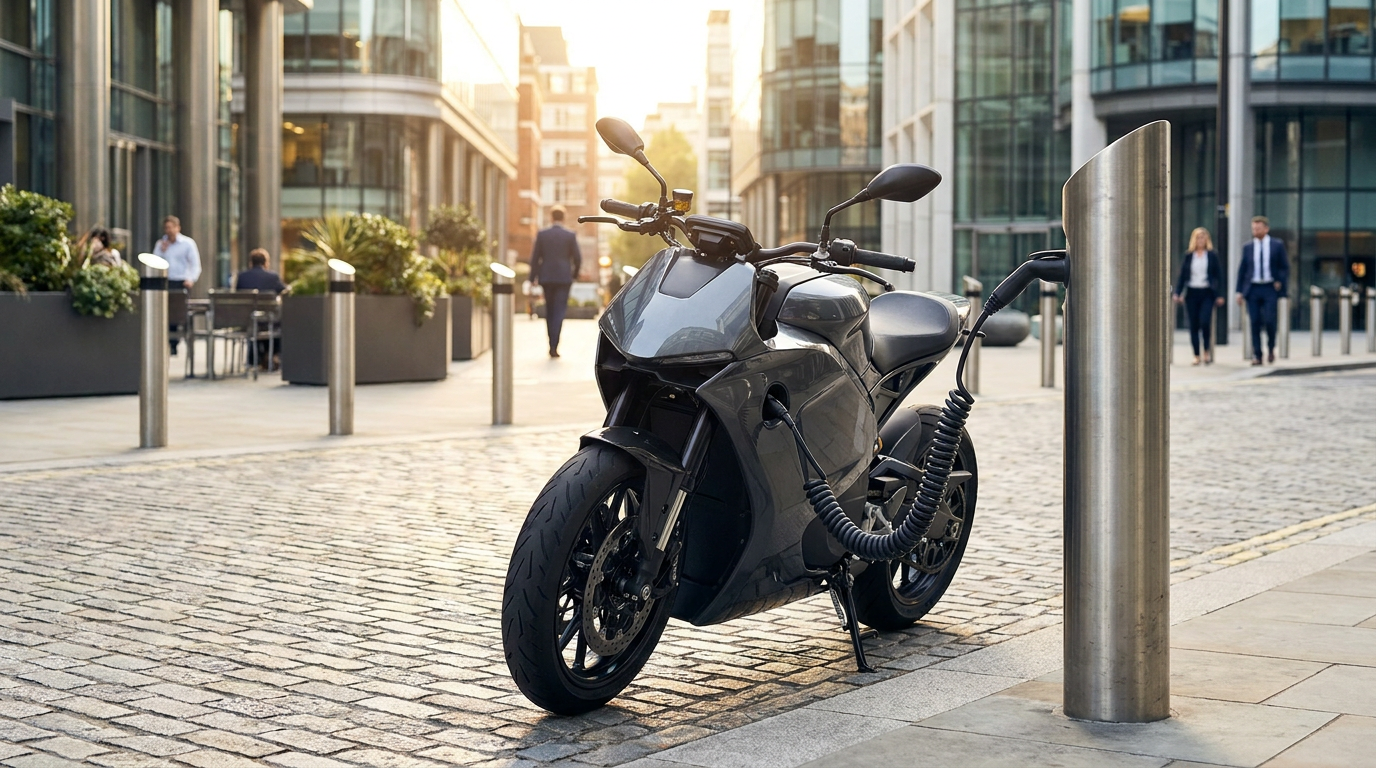
The solution is Level 3 DC fast charging, which bypasses the onboard converter and feeds high-voltage direct current straight into the battery. Until recently, accommodating DC fast charging on a motorcycle required the Combined Charging System (CCS1), a bulky connector that was difficult to integrate into a slim motorcycle chassis. The breakthrough has been the widespread adoption of the North American Charging Standard (NACS), officially designated as SAE J3400.[3][4]
The solution is Level 3 DC fast charging, which bypasses the onboard converter and feeds high-voltage direct current straight into the battery.
Originally developed by Tesla and opened to the broader industry, NACS combines AC and DC charging capabilities into a single, highly compact plug. For motorcycle engineers, this compact geometry is a revelation, allowing them to fit high-power charging ports into the limited real estate of a bike frame. By aligning with the NACS standard, new electric motorcycles can natively access the vast network of Tesla Superchargers and other NACS-equipped stations, radically reducing charge times from several hours to roughly 30 to 40 minutes.[1][4]

Beyond the mechanics of charging, the most compelling argument for electric motorcycles in 2026 is the Total Cost of Ownership (TCO). While the Manufacturer's Suggested Retail Price (MSRP) of an electric bike often exceeds that of a comparable gas model, academic and industry TCO models demonstrate that this upfront premium is rapidly offset by operational savings. The most immediate financial benefit is the dramatic reduction in fuel costs.[2][7]
The mathematics of electric propulsion are highly favorable. A traditional gasoline motorcycle averaging 50 miles per gallon costs approximately $0.09 per mile to operate, depending on regional fuel prices. In contrast, charging an electric motorcycle at residential electricity rates costs roughly $0.01 to $0.02 per mile. For a rider commuting 10,000 miles annually, the transition to electric power yields hundreds of dollars in direct fuel savings each year, insulating the owner from the volatility of global oil markets.[6][7]
Maintenance savings further accelerate the TCO break-even point. Internal combustion engines require a strict regimen of preventative maintenance: oil changes, spark plug replacements, air filter swaps, and complex valve clearance adjustments. Electric drivetrains eliminate these requirements entirely. With roughly 70% fewer moving parts, the primary maintenance tasks on an electric motorcycle are reduced to replacing consumable items like tires, brake pads, and drive belts. Furthermore, because regenerative braking handles much of the deceleration, brake pads on electric motorcycles last significantly longer than those on gas bikes.[2][6]
When factoring in fuel savings, reduced maintenance, and available government tax incentives, the TCO break-even point for an electric motorcycle typically occurs between one and three years of ownership. After this threshold, the electric motorcycle becomes demonstrably cheaper to operate. This economic reality has spurred massive growth in the entry-level and mid-range markets, where budget-conscious commuters are calculating the long-term value of their transportation investments.[2][7]

The 2026 market reflects this maturation, offering distinct tiers of electric motorcycles tailored to specific use cases. In the sub-$5,000 category, lightweight urban runabouts and moped-style hybrids dominate. These machines prioritize agility and approachability, often featuring removable batteries that apartment dwellers can carry inside to charge at a standard wall outlet. They are not designed for the highway, but they excel at navigating congested city centers with zero emissions and minimal running costs.[5][8]
In the mid-range and premium segments, traditional motorcycle manufacturers and dedicated electric startups are producing highly capable machines. Bikes like the Honda WN7 and the LiveWire S2 Del Mar offer highway-legal top speeds, advanced traction control systems, and ranges that easily accommodate aggressive weekend riding. At the top of the market, flagship adventure bikes like the Zero DSR/X and touring models like the Energica Experia boast massive battery packs exceeding 15 kWh, proving that electric motorcycles can handle sustained, high-speed travel.[5][6]
The electric disruption has also extended off the pavement. The off-road and motocross segments have seen a surge in electric adoption, led by high-performance dirt bikes like the Stark VARG. For off-road enthusiasts, the electric drivetrain offers distinct advantages: instantaneous torque for clearing obstacles, customizable power maps that can be adjusted via smartphone, and near-silent operation that allows riders to access trails where noise ordinances have banned gas-powered bikes.[5][6]

Despite these advancements, the transition to electric motorcycles is not without its uncertainties. The long-term degradation of high-capacity batteries over a 10-to-15-year lifespan remains a concern for the secondary market, as replacement packs can cost thousands of dollars. Additionally, while the NACS rollout is accelerating, riders in rural or highly remote areas may still face infrastructure gaps that make long-distance touring a logistical challenge.[1][2]
Ultimately, the 2026 electric motorcycle landscape is defined by pragmatic capability. The technology has moved past the experimental phase, offering tangible benefits in performance, maintenance, and total cost of ownership. For riders willing to analyze their actual daily mileage and charging access, the electric motorcycle is no longer just an environmental statement; it is a highly efficient, economically sound transportation solution.[1][8]
How we got here
2009
SAE standardizes the J1772 connector for AC charging, which becomes the default for early electric motorcycles.
2012
Tesla introduces its proprietary charging connector, which would later become the foundation for NACS.
2023
Major automotive and motorcycle manufacturers begin committing to the NACS standard, signaling an end to the fragmented charging ecosystem.
2024
SAE International formally standardizes NACS as SAE J3400, paving the way for universal adoption.
2026
Major traditional OEMs like Honda release their first full-size electric motorcycles, marking a shift from niche startups to mainstream production.
Viewpoints in depth
Urban Commuters & Budget Buyers
Riders focused on daily utility, low operating costs, and maneuverability in city traffic.
For this camp, the electric motorcycle is primarily a tool for urban efficiency. They prioritize lightweight chassis designs and removable batteries that can be carried into an apartment for charging. Because their daily mileage rarely exceeds 30 miles, they are less concerned with DC fast charging or massive battery packs, focusing instead on the immediate financial benefits of bypassing gas stations and avoiding costly mechanical maintenance.
Performance & Touring Riders
Enthusiasts who demand highway capability, long range, and premium riding dynamics.
Touring riders view the electric transition with cautious optimism, heavily dependent on the rollout of reliable fast-charging infrastructure. They advocate for larger battery capacities—often exceeding 15 kWh—and universal adoption of the NACS standard to unlock cross-country travel. For this group, the appeal lies in the massive, instantaneous torque and the smooth, vibration-free power delivery that reduces rider fatigue on long journeys, provided the charging network can support their routes.
Infrastructure & Standards Analysts
Researchers and engineers focused on the systemic integration of electric vehicles.
Analysts look beyond the individual motorcycle to the broader ecosystem. They emphasize Total Cost of Ownership (TCO) models, noting that while battery packs account for up to 40% of the upfront manufacturing cost, the long-term macroeconomic benefits of reduced emissions and grid integration are substantial. This camp strongly advocates for the standardization of charging hardware, arguing that a fragmented plug ecosystem is the primary bottleneck preventing mass adoption of electric two-wheelers.
What we don't know
- How well the secondary market will price 10-year-old electric motorcycles with degraded battery packs.
- The exact timeline for when rural and highly remote charging infrastructure will be dense enough to support cross-country electric motorcycle touring without extensive planning.
- Whether solid-state battery technology will reach commercial viability for motorcycles before the end of the decade, potentially doubling current range metrics.
Key terms
- NACS (SAE J3400)
- The North American Charging Standard, originally developed by Tesla, which combines AC and DC fast charging into a single compact plug.
- J1772
- The traditional standard connector for Level 1 and Level 2 AC charging in North America.
- Total Cost of Ownership (TCO)
- A financial estimate that includes the purchase price plus all operating, maintenance, and fuel expenses over the vehicle's lifespan.
- Regenerative Braking
- A system that recovers kinetic energy during deceleration, converting it back into electricity to recharge the battery.
- Level 3 DC Fast Charging
- High-power charging that bypasses the motorcycle's onboard inverter to supply direct current straight to the battery, rapidly reducing charge times.
Frequently asked
Do I need a special license to ride an electric motorcycle?
Yes, any electric motorcycle capable of highway speeds requires a standard motorcycle endorsement (M1) on your driver's license.
How long do electric motorcycle batteries last?
Most modern lithium-ion motorcycle batteries are rated for 500 to 1,000 full charge cycles, typically translating to 5 to 10 years of riding before significant capacity loss occurs.
Can I charge an electric motorcycle at a regular wall outlet?
Yes, almost all electric motorcycles include a Level 1 charging cable that plugs into a standard 120V household outlet, which is ideal for overnight residential charging.
Are electric motorcycles cheaper to maintain?
Significantly. Because they lack oil, spark plugs, air filters, and complex transmissions, electric motorcycles require about 70% less routine maintenance than gas-powered equivalents.
Sources
Source coverage
8 outlets
3 viewpoints surfaced








[1]Factlen Editorial TeamInfrastructure & Standards Analysts
Synthesis by Factlen editorial team
Read on Factlen Editorial Team →[2]ResearchGateInfrastructure & Standards Analysts
A sustainability-oriented total cost of ownership model for electric motorcycles
Read on ResearchGate →[3]WikipediaInfrastructure & Standards Analysts
North American Charging Standard (SAE J3400)
Read on Wikipedia →[4]SAE InternationalInfrastructure & Standards Analysts
SAE J3400: North American Charging System
Read on SAE International →[5]MotorWattPerformance & Touring Riders
Best electric motorcycles 2026: street and dirt buying guide
Read on MotorWatt →[6]BikeBoundPerformance & Touring Riders
Best Electric Motorcycles of 2026
Read on BikeBound →[7]TopSpeedUrban Commuters & Budget Buyers
The True Cost Of Ownership For Electric Motorcycles
Read on TopSpeed →[8]DazeUrban Commuters & Budget Buyers
Electric motorcycle prices 2026: what they really cost
Read on Daze →

Every angle. Every day.
Get shopping stories with full source coverage and perspective breakdowns delivered to your inbox.