
SpaceX's Initial IPO Frenzy Cools, But a Trillion-Dollar Passive Wave Looms
Following its record-breaking $75 billion IPO, SpaceX is preparing for fast-track inclusion in major stock indexes, a move expected to trigger massive mandatory buying from passive funds.
By Factlen Editorial Team
- Passive Flow Analysts
- Focus on the mechanical buying pressure from index funds that must acquire SPCX regardless of its fundamental valuation.
- Index Purists
- Argue that strict seasoning rules are necessary to protect everyday index investors from the volatility of newly public companies.
- Active Growth Investors
- Look past the index mechanics to focus on fundamental catalysts like the Cursor AI acquisition and Starlink's revenue trajectory.
What's not represented
- · Retail investors who bought at the peak of the 67% intraday surge and are now navigating the post-IPO volatility.
- · Competitors in the aerospace and satellite internet sectors adjusting their capital strategies in the wake of SpaceX's massive cash infusion.
Why this matters
Trillions of dollars in retirement accounts and passive ETFs automatically track major stock indexes. When a mega-cap company like SpaceX is added, these funds are forced to buy the stock regardless of its price, fundamentally altering the market's supply and demand mechanics.
Key points
- SpaceX's historic $75 billion IPO initially sent shares soaring 67%, though retail momentum has since cooled.
- The stock is now preparing for fast-track inclusion in CRSP, Nasdaq, and MSCI indexes.
- An estimated $8.9 trillion in passive funds track these indexes and will be forced to buy SPCX shares.
- S&P Global refused to fast-track SpaceX into the S&P 500, enforcing its 12-month trading history rule.
- SpaceX is also planning a $20 billion bond sale to refinance debt and lower its cost of capital.
- Analysts cite the company's planned acquisition of AI firm Cursor as a major fundamental catalyst.
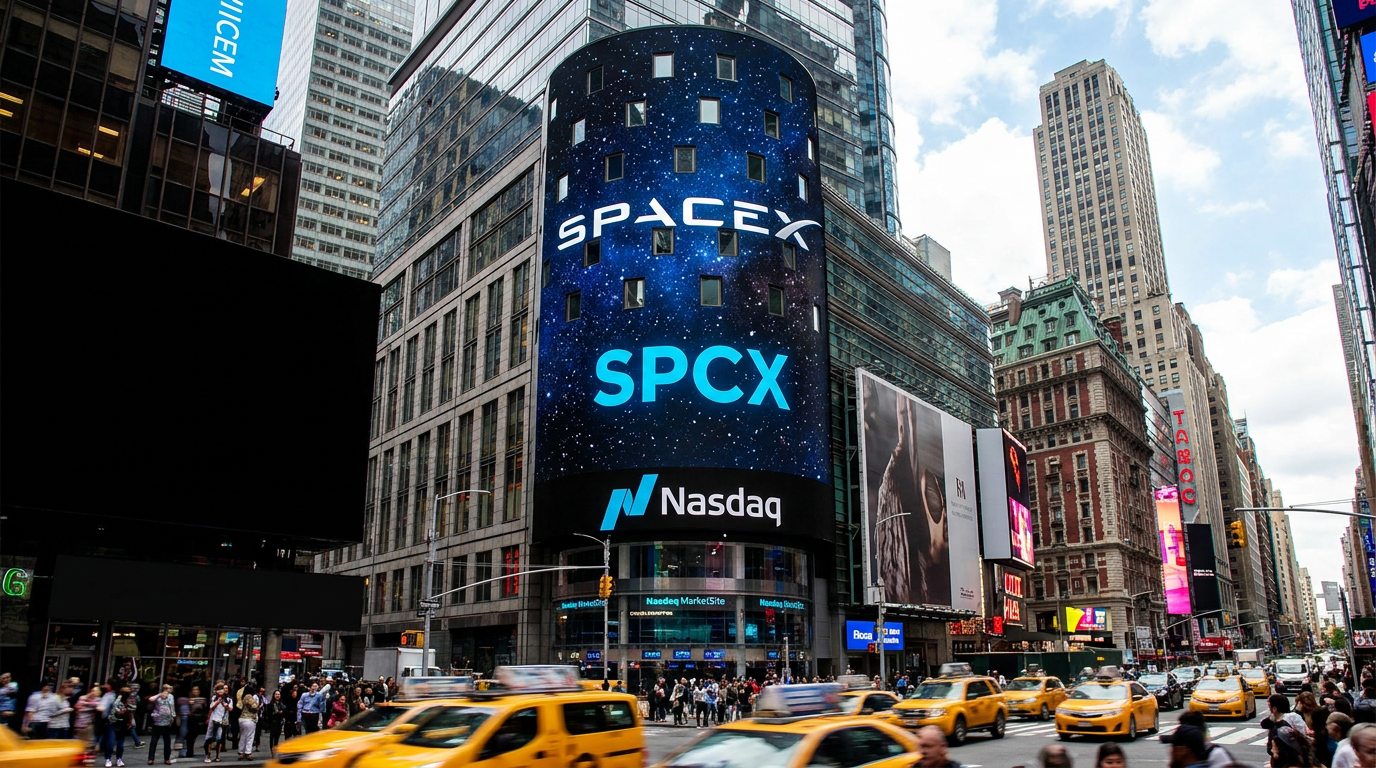
When SpaceX executed the largest initial public offering in history on June 12, 2026, the market response was immediate and ferocious. Pricing its shares at a fixed $135 to achieve a staggering $1.77 trillion valuation, the aerospace giant raised $75 billion in a debut that eclipsed even Saudi Aramco's historic listing. Retail investors and active institutional managers scrambled for allocations, driving the stock up 67% at its intraday peak.[4]
Now, just over a week later, the initial frenzy is beginning to cool. Shares of SpaceX (trading under the ticker SPCX) have settled back to earth slightly, currently hovering around a 33% premium over their IPO price. But as the active trading momentum stabilizes, Wall Street is bracing for a second, potentially more powerful catalyst: the mechanical, price-agnostic buying wave of passive index inclusion.[1][2]
To understand the sheer scale of this impending capital flow, one must look at the plumbing of modern financial markets. Trillions of dollars are parked in passive mutual funds and exchange-traded funds (ETFs) that do not employ stock pickers. Instead, they strictly mirror the composition of benchmarks like the Nasdaq-100 or the MSCI World Index. When a new company is added to these benchmarks, every fund tracking them is forced to buy the stock to maintain parity.[6]
Historically, index providers required newly public companies to trade for months before being considered for inclusion. However, the sheer size of the SpaceX offering has triggered fast-track rules across several major platforms. The Center for Research in Securities Prices (CRSP) allows newly public mega-caps to join its indexes after just five trading days. Nasdaq and MSCI maintain similar accelerated pathways, making SpaceX eligible for inclusion after 10 and 15 trading days, respectively.[2]

Combined, an estimated $8.9 trillion worth of assets are benchmarked to these specific index providers. When SPCX is officially added to these rosters in the coming days and weeks, it will unlock a massive new source of institutional demand. Analysts at Zephirin, who recently initiated coverage on SpaceX with a $310 price target, noted that this combination of passive flows and limited public float is creating an "underappreciated supply-demand imbalance."[2][3]
Combined, an estimated $8.9 trillion worth of assets are benchmarked to these specific index providers.
Not every index provider is bending to the gravity of the $1.77 trillion aerospace firm. S&P Global has firmly declined requests from market participants to fast-track SpaceX into the prestigious S&P 500. Reaffirming its long-standing rules, the benchmark committee stated that newly public companies must demonstrate sustained GAAP profitability and a minimum 12-month trading history before entry.[5]

This strict adherence to the rules is designed to protect the millions of retail investors whose 401(k)s track the S&P 500 from the inherent volatility of newly minted IPOs. By forcing SpaceX to undergo a year of public market seasoning, S&P Global is prioritizing stability over capturing the immediate upside of the market's hottest equity. Consequently, the estimated $14 billion in mandatory buying from S&P 500 trackers will remain sidelined until at least mid-2027.[4][5][6]
Beyond the mechanics of index inclusion, SpaceX is aggressively positioning its balance sheet and technological capabilities for its new public era. The company is reportedly preparing to launch a $20 billion bond sale to refinance a bridge loan maturing in September 2027. This debt restructuring, coming immediately on the heels of the $75 billion equity raise, will significantly lower the company's cost of capital.[2]

Simultaneously, fundamental growth drivers continue to attract active investors. Starlink, the company's satellite internet constellation, has grown from zero to over $11 billion in annual revenue within a decade, now accounting for nearly 70% of SpaceX's total revenue. Furthermore, Oppenheimer analysts recently raised their price target on SPCX to $250, citing the company's planned acquisition of the artificial-intelligence firm Cursor, a move expected to cement SpaceX's capabilities in agentic coding and autonomous systems.[2][4]
The ultimate test for SpaceX's stock price will be the collision of these passive buying flows with the eventual expiration of insider lock-up periods. Typically, 90 to 180 days post-IPO, early investors and employees are permitted to sell their shares, introducing a flood of new supply to the market. For now, however, the fast-track index inclusions represent a powerful tailwind, ensuring that the next wave of capital to hit SpaceX won't be driven by hype, but by mathematical mandate.[3][4][6]
How we got here
June 12, 2026
SpaceX executes the largest IPO in history, raising $75 billion at a $1.77 trillion valuation.
June 16, 2026
SPCX shares hit an intraday high of 67% above their $135 offering price before momentum begins to cool.
Late June 2026
SpaceX becomes eligible for fast-track inclusion in CRSP, Nasdaq, and MSCI indexes, triggering passive buying.
Mid-2027
The earliest window for SpaceX to become eligible for inclusion in the S&P 500, pending profitability requirements.
Viewpoints in depth
Passive Flow Analysts
Focus on the mechanical buying pressure from index funds that must acquire SPCX regardless of its fundamental valuation.
Market strategists focused on capital flows view the upcoming index inclusions as a pure supply-and-demand equation. Because $8.9 trillion is benchmarked to the indexes that SpaceX is about to join, a mathematically predetermined amount of capital must be deployed to buy SPCX shares. These analysts argue that because the public float is currently limited by insider lock-ups, this forced buying will hit a constrained supply of available shares, potentially driving the price up regardless of broader macroeconomic conditions or traditional valuation metrics.
Index Purists
Argue that strict seasoning rules are necessary to protect everyday index investors from the volatility of newly public companies.
Governance experts and index purists strongly support S&P Global's decision to deny SpaceX fast-track entry into the S&P 500. They argue that benchmark indexes serve as the bedrock for millions of everyday retirement accounts, which rely on stability rather than speculative growth. By enforcing a strict 12-month trading history and demanding sustained GAAP profitability, S&P shields passive investors from the notorious volatility and price discovery phases that follow even the most successful mega-IPOs.
Active Growth Investors
Look past the index mechanics to focus on fundamental catalysts like the Cursor AI acquisition and Starlink's revenue trajectory.
For active portfolio managers, the mechanical flows of index inclusion are secondary to the underlying business fundamentals justifying SpaceX's $1.77 trillion price tag. These investors are focused on the rapid scaling of the Starlink satellite internet business, which now commands the majority of the company's revenue. Furthermore, they are closely watching strategic moves like the planned $20 billion bond refinancing and the acquisition of AI coding firm Cursor, viewing them as the true long-term drivers of shareholder value.
What we don't know
- It remains unclear exactly how much the mandatory passive buying will inflate SPCX's share price given the currently limited public float.
- The market does not yet know how the stock will react when insider lock-up periods expire in 90 to 180 days, which will flood the market with new supply.
Key terms
- Passive Funds
- Investment vehicles, such as index mutual funds or ETFs, that automatically track a market benchmark rather than relying on a human manager to pick stocks.
- Index Inclusion
- The event where a company's stock is officially added to a market index, triggering mandatory purchases by all funds that track that specific index.
- Public Float
- The portion of a company's total outstanding shares that are freely available to be traded by the general public, excluding locked-up insider shares.
- Lock-up Period
- A predetermined window of time following an IPO during which company founders, employees, and early private investors are legally restricted from selling their shares.
Frequently asked
What does it mean for a stock to secure index entry?
Index entry means a stock is officially added to a market benchmark, such as the Nasdaq-100. Once added, any passive mutual fund or ETF that tracks that index is mathematically required to buy the stock.
Why isn't SpaceX being added to the S&P 500 immediately?
S&P Global enforces strict rules requiring newly public companies to have a 12-month trading history and sustained GAAP profitability before they can be included in the S&P 500, protecting the index from initial IPO volatility.
What is the Cursor acquisition?
SpaceX is reportedly acquiring the artificial intelligence firm Cursor to enhance its capabilities in agentic coding, a move that has prompted some analysts to raise their price targets for the aerospace company.
When will SpaceX insiders be able to sell their shares?
Insider shares are subject to a lock-up period, which typically expires 90 to 180 days after the IPO. This event often introduces new selling pressure to the market.
Sources
Source coverage
6 outlets
3 viewpoints surfaced






[1]MarketWatchActive Growth Investors
The initial SpaceX frenzy is cooling off — but a new wave of cash is waiting to strike
Read on MarketWatch →[2]MorningstarPassive Flow Analysts
SpaceX is expected to secure index entry in the coming days and weeks
Read on Morningstar →[3]EulerpoolPassive Flow Analysts
SpaceX's Index Entry: A New Dawn for Investor Demand
Read on Eulerpool →[4]BlofinActive Growth Investors
SpaceX IPO Sparks Anticipation... IPO price and valuation
Read on Blofin →[5]S&P GlobalIndex Purists
S&P Global declines requests for fast-track index inclusion for mega IPOs
Read on S&P Global →[6]Factlen Editorial Team
Synthesis by Factlen editorial team
Read on Factlen Editorial Team →

Every angle. Every day.
Get finance stories with full source coverage and perspective breakdowns delivered to your inbox.