
SpaceX Completes Record $75 Billion IPO, Valuing Space Giant at $2.2 Trillion
SpaceX has officially entered the public markets with the largest initial public offering in history, raising $75 billion and pushing founder Elon Musk's net worth past the $1 trillion mark. The capital injection is earmarked to accelerate Starship development and expand the Starlink satellite network.
By Factlen Editorial Team
- Space Economy Optimists
- View the IPO as the dawn of a multi-trillion dollar commercial space economy driven by reusable rockets and global satellite internet.
- Deep Tech Skeptics
- Warn that the $2.2 trillion valuation prices in decades of flawless execution and ignores the high-risk, capital-intensive nature of spaceflight.
- Aerospace Competitors
- Welcome the IPO for validating the sector's financial viability but fear SpaceX's monopolistic dominance in launch services.
- Scientific Advocates
- Focus on how public funding accelerates the timeline for Mars and lunar missions, viewing the financial returns as secondary to the engineering milestones.
What's not represented
- · Environmental advocacy groups concerned about launch emissions
- · Astronomers impacted by Starlink light pollution
Why this matters
SpaceX's transition to a public company democratizes investment in the space economy, allowing retail investors to directly back interplanetary exploration. The unprecedented $75 billion capital injection fundamentally accelerates the timeline for Mars infrastructure and global satellite internet expansion.
Key points
- SpaceX executed the largest IPO in history, raising $75 billion and achieving a $2.2 trillion valuation.
- The public debut made founder Elon Musk the world's first trillionaire.
- The massive capital injection will fund the mass production of Starship and the expansion of the Starlink network.
- Starlink's profitability as a global telecom utility is the primary driver of the company's high valuation.
- The IPO validates the commercial space sector, creating a 'halo effect' for other aerospace startups.
- Skeptics warn that the valuation requires flawless execution in a highly volatile, capital-intensive industry.
SpaceX has officially transitioned from a closely guarded private enterprise into a publicly traded juggernaut, executing the largest initial public offering in global financial history. By raising $75 billion on its first day of trading, the aerospace manufacturer achieved a staggering market capitalization of approximately $2.2 trillion. The debut not only shattered previous IPO records held by state-backed oil giants and e-commerce conglomerates but also fundamentally rewired how Wall Street interacts with deep-tech hardware companies. Shares surged 19% in their first hours of trading, reflecting immense retail and institutional appetite for a direct stake in the commercialization of space.[1][5]
The sheer scale of the offering has triggered historical milestones beyond the corporate ledger. The immediate spike in SpaceX's valuation propelled founder and CEO Elon Musk's personal net worth past the $1 trillion threshold, making him the world's first documented trillionaire. Financial historians have drawn parallels to John D. Rockefeller, who became America's first billionaire in 1916 during the Gilded Age oil boom. However, while Rockefeller built his fortune extracting resources from the Earth, Musk's valuation is entirely predicated on the promise of leaving it, marking a profound shift in where the global economy assigns terminal value.[3][4]
Understanding why SpaceX chose this specific moment to go public requires looking at the intersection of artificial intelligence and capital markets. For years, Musk maintained that SpaceX would only IPO once regular flights to Mars were underway. However, the recent explosion in AI infrastructure investment demonstrated that public markets are currently willing to fund massive, capital-intensive technological leaps with long-term horizons. Realizing that the capital required to build a self-sustaining city on Mars would stretch even private equity to its limits, SpaceX leadership opted to tap into the unprecedented liquidity of the public markets to fund their next decade of research and development.[1][7]

The financial engine driving this $2.2 trillion valuation is Starlink, SpaceX's constellation of thousands of satellites operating in Low Earth Orbit (LEO). Unlike traditional geostationary satellites, LEO networks provide high-speed, low-latency internet to virtually any point on the globe. Starlink has quietly transformed from a beta project into a highly profitable telecommunications utility, securing lucrative contracts with maritime fleets, commercial airlines, and rural municipalities. Analysts view Starlink as the primary cash-flow generator that justifies the company's astronomical market cap, providing the steady revenue needed to subsidize the company's more experimental aerospace ambitions.[5][7]
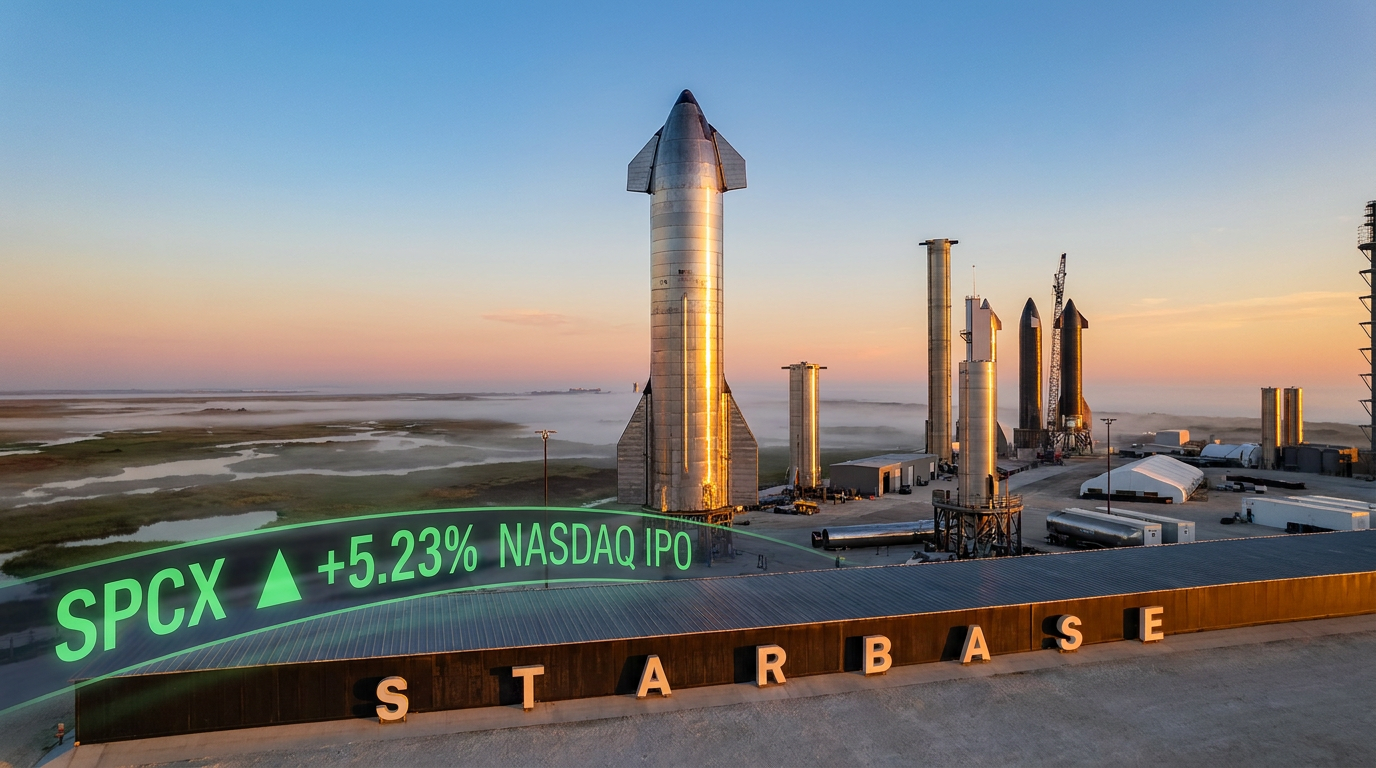
If Starlink is the cash cow, Starship is the deep-tech bet that captured retail investors' imaginations. Starship is a fully reusable, super-heavy-lift launch vehicle designed to carry unprecedented payloads—and eventually human crews—to the Moon and Mars. The physics and economics of spaceflight dictate that reusability is the only viable path to reducing the cost per kilogram to orbit. By proving that orbital-class rockets can be landed, refurbished, and flown again rapidly, SpaceX has already collapsed launch costs by an order of magnitude. The $75 billion IPO war chest is largely earmarked for scaling Starship's manufacturing capabilities at the company's Starbase facility in Texas.[1][8]
The public debut has also triggered a "halo effect" across the broader aerospace sector. Industry advocates note that SpaceX's successful listing validates the commercial space industry as a maturing, investable asset class rather than a playground for billionaires. Venture capital firms that have spent the last five years incubating smaller satellite manufacturers, orbital logistics startups, and space-debris removal companies are now seeing a clear pathway to liquidity. The IPO proves that if a space company can demonstrate a viable path to profitability—whether through communications, launch services, or navigation—the public markets will reward them with premium multiples.[1][5]

Despite the euphoric market reception, the offering tests the limits of how public markets value deep-tech hardware. Traditional financial models struggle to price a company whose ultimate stated goal is making humanity multi-planetary. Skeptics point out that a $2.2 trillion valuation prices in decades of flawless execution, assuming Starship achieves airline-like reliability and Starlink captures a dominant share of the global telecom market. Furthermore, unlike software companies that enjoy near-infinite margins once code is written, aerospace manufacturing is bound by the unforgiving laws of physics, supply chain bottlenecks, and the immense capital expenditure required to build physical infrastructure.[6]
Despite the euphoric market reception, the offering tests the limits of how public markets value deep-tech hardware.
SpaceX's deep integration with the United States government adds another layer of complexity to its public market profile. The company is the primary launch provider for NASA's commercial crew program and holds highly classified contracts with the Department of Defense and the Space Force. While these government contracts provide a reliable revenue floor, they also expose the newly public company to intense regulatory scrutiny and geopolitical crosshairs. As a publicly traded entity, SpaceX will now have to balance the transparency required by the Securities and Exchange Commission with the strict confidentiality demanded by its military partners.[5][8]
Retail investors, who were previously locked out of SpaceX's private funding rounds, drove much of the first-day trading volume. Financial commentators have advised retail buyers to view the stock not as a short-term trade, but as a generational hold. The volatility inherent in spaceflight—where a single anomaly can result in the loss of a vehicle and its payload—means the stock will likely experience dramatic swings tied to launch outcomes. Investors are essentially buying into a binary outcome: either SpaceX successfully commercializes the solar system, or it encounters insurmountable engineering and regulatory walls.[2][6]

Regulatory hurdles remain one of the most significant headwinds for the newly public giant. The Federal Aviation Administration (FAA) tightly controls launch licenses, and SpaceX has frequently clashed with regulators over the pace of approvals. Additionally, environmental groups have raised concerns about the ecological impact of high-frequency launches on local wildlife habitats near the Texas launch sites. As a public company, SpaceX will face increased pressure from ESG (Environmental, Social, and Governance) funds to quantify and mitigate the carbon footprint of its methane-fueled rockets.[5][6]
Another looming challenge is the management of orbital space itself. With Starlink planning to deploy tens of thousands of additional satellites, astronomers have warned about light pollution interfering with deep-space observations. Furthermore, the sheer density of objects in Low Earth Orbit increases the risk of the Kessler Syndrome—a theoretical scenario where collisions create a cascading field of space debris, rendering orbit unusable. SpaceX has implemented automated collision avoidance systems, but the public markets will now be pricing in the systemic risk of orbital congestion.[7][8]
Despite these risks, the capital unlocked by this IPO fundamentally alters the timeline for human exploration of the solar system. Prior to the offering, the development of a lunar base and the initial uncrewed cargo missions to Mars were constrained by the cash flow generated by Falcon 9 launches and Starlink subscriptions. With $75 billion in fresh capital, SpaceX can simultaneously fund the mass production of Starships, the development of orbital refueling depots, and the life-support systems required for deep-space transit.[1][8]
The competitive landscape is also shifting in response to the IPO. Legacy aerospace contractors and international space agencies are now forced to compete with a publicly funded entity that possesses more capital than the annual space budgets of most sovereign nations. European and Asian launch providers are accelerating their own reusable rocket programs to prevent SpaceX from establishing a permanent monopoly on heavy-lift capabilities. This influx of capital into the sector is expected to trigger a new, commercial space race, driving down costs and accelerating innovation across the board.[5][7]

Looking ahead, the next 24 months will be critical for justifying the company's historic valuation. Wall Street will be closely monitoring the cadence of Starship orbital test flights, the successful demonstration of in-orbit propellant transfer, and the continued subscriber growth of the Starlink network. Any significant delays in the Artemis lunar program—for which Starship is the designated human lander—could test the patience of institutional investors who are unaccustomed to the unpredictable timelines of aerospace engineering.[6][8]
Ultimately, the SpaceX IPO represents a paradigm shift in how humanity funds its most ambitious endeavors. By bridging the gap between visionary deep-tech engineering and global capital markets, the company has created a mechanism for the public to directly finance the expansion of human presence beyond Earth. Whether the $2.2 trillion valuation holds steady or fluctuates with the volatile nature of spaceflight, the $75 billion raised ensures that the infrastructure for the next era of space exploration will be built.[1][7]
How we got here
2002
Elon Musk founds SpaceX with the ultimate goal of reducing space transportation costs to enable the colonization of Mars.
2008
Falcon 1 becomes the first privately developed liquid-fueled launch vehicle to reach Earth orbit, saving the company from bankruptcy.
2015
SpaceX successfully lands the first stage of a Falcon 9 rocket back on Earth, proving orbital reusability is possible.
2020
SpaceX launches NASA astronauts to the International Space Station, becoming the first private company to achieve human spaceflight.
2024
Starship completes its first fully successful orbital test flight and controlled splashdown.
June 2026
SpaceX goes public in a record-breaking $75 billion IPO, valuing the company at $2.2 trillion.
Viewpoints in depth
Space Economy Optimists
Investors and industry advocates who see the IPO as the financial foundation for a multi-planetary future.
This camp argues that traditional valuation metrics fail to capture SpaceX's true potential. By achieving rapid reusability with Falcon 9 and scaling it with Starship, SpaceX has effectively monopolized access to orbit. Optimists point to Starlink not just as an internet provider, but as a global utility that will eventually capture a significant percentage of the multi-trillion-dollar telecommunications market. They view the $75 billion raised not as an end goal, but as the necessary seed capital to build a self-sustaining Martian economy, which will create entirely new industries ranging from asteroid mining to orbital manufacturing.
Deep Tech Skeptics
Financial analysts who warn that the $2.2 trillion valuation ignores the severe risks inherent in aerospace engineering.
Skeptics caution that public markets are currently caught in a speculative frenzy, pricing SpaceX as if it were a high-margin software company rather than a heavy-manufacturing firm bound by physics. They argue that a $2.2 trillion market cap assumes Starship will fly hundreds of times a year without catastrophic failures—an unprecedented feat in aerospace history. Furthermore, they highlight that the company's reliance on government contracts makes it vulnerable to political shifts, and that any significant delay in the Mars timeline could trigger a massive correction in the stock price as impatient retail investors exit.
Aerospace Competitors
Legacy contractors and international space agencies reacting to SpaceX's massive new capital advantage.
For legacy aerospace giants and international space agencies, the SpaceX IPO is a double-edged sword. On one hand, it validates the commercial space sector, making it easier for competitors to raise their own capital. On the other hand, SpaceX now possesses a $75 billion war chest, allowing it to outspend entire sovereign nations on research and development. Competitors fear this capital advantage will allow SpaceX to permanently corner the heavy-lift market, forcing other launch providers to rely on government subsidies just to survive in an increasingly monopolized sector.
What we don't know
- How the public markets will react to the inevitable setbacks and vehicle losses that occur during deep-tech aerospace testing.
- Whether the FAA and environmental regulators will permit the high-frequency launch cadence required to justify the company's valuation.
- How quickly the $75 billion capital injection will actually accelerate the timeline for the first crewed missions to Mars.
Key terms
- Initial Public Offering (IPO)
- The process by which a private company offers shares of its stock to the public for the first time, allowing anyone to invest.
- Market Capitalization
- The total dollar market value of a company's outstanding shares of stock, calculated by multiplying the current stock price by the total number of shares.
- Low Earth Orbit (LEO)
- An Earth-centered orbit with an altitude of 2,000 km or less, where SpaceX's Starlink satellites operate to provide low-latency internet.
- Deep Tech
- Companies founded on significant scientific or engineering breakthroughs that require lengthy research and development and high capital investment before commercialization.
- Kessler Syndrome
- A theoretical scenario in which the density of objects in Low Earth Orbit is high enough that collisions between objects could cause a cascade, generating debris that makes spaceflight impossible.
Frequently asked
Can retail investors buy SpaceX stock now?
Yes. Following the IPO, SpaceX shares are available for purchase by the general public through standard brokerage accounts, ending its era as a private company accessible only to accredited investors.
What is the $75 billion being used for?
The capital is primarily earmarked for scaling the mass production of the Starship rocket system, expanding the Starlink satellite network, and developing the infrastructure needed for future lunar and Martian missions.
How did this affect Elon Musk's net worth?
The massive $2.2 trillion valuation of the company upon its public debut pushed Elon Musk's personal net worth past the $1 trillion mark, making him the world's first trillionaire.
Is Starlink part of the public company?
Yes. While there was previous speculation that Starlink might be spun off into its own IPO, the satellite internet constellation remains fully integrated within SpaceX and is its primary revenue driver.
Sources
Source coverage
8 outlets
4 viewpoints surfaced








[1]BloombergSpace Economy Optimists
What to Know About SpaceX’s Record-Breaking IPO
Read on Bloomberg →[2]CNBCSpace Economy Optimists
Jim Cramer says it's not too late to buy SpaceX — under one condition
Read on CNBC →[3]NYTDeep Tech Skeptics
Musk Is the World’s First Trillionaire. Who Was the First Billionaire?
Read on NYT →[4]ForbesSpace Economy Optimists
How Elon Musk Just Became The World's First Trillionaire
Read on Forbes →[5]ReutersAerospace Competitors
SpaceX prices IPO at record valuation, signaling new era for commercial spaceflight
Read on Reuters →[6]The Wall Street JournalDeep Tech Skeptics
SpaceX's Public Debut Tests Market Appetite for Deep Tech
Read on The Wall Street Journal →[7]Financial TimesAerospace Competitors
Global investors flock to SpaceX's $75bn public offering
Read on Financial Times →[8]Ars TechnicaScientific Advocates
What SpaceX's IPO means for the future of Starship and Mars colonization
Read on Ars Technica →
Every angle. Every day.
Get business stories with full source coverage and perspective breakdowns delivered to your inbox.