
Snap Unveils Standalone AR 'Specs' for $2,195, Beating Rivals to True Augmented Reality
Snap has officially opened pre-orders for its fifth-generation AR glasses, delivering a fully untethered augmented reality experience powered by dual Snapdragon chips and generative AI. The 132-gram device represents a major technical milestone, though its premium price tag signals it is aimed primarily at early adopters and developers.
By Factlen Editorial Team
- AR Enthusiasts & Developers
- View the Specs as a massive technical achievement that finally delivers untethered, true augmented reality.
- Consumer Skeptics
- Focus on the prohibitive price tag and physical compromises, arguing the device is not ready for mainstream adoption.
- Industry Watchers
- See the launch as a strategic flag-planting by Snap to beat trillion-dollar rivals to the standalone AR market.
What's not represented
- · Privacy advocates concerned about always-on cameras in public spaces
- · Everyday consumers priced out of the current iteration
Why this matters
For years, the tech industry has promised lightweight glasses that can seamlessly blend digital objects into the real world without requiring a tethered battery pack or phone. Snap's new Specs prove the hardware is finally possible, setting the baseline for the next major computing platform before giants like Apple and Meta release their own standalone AR devices.
Key points
- Snap has opened pre-orders for its new standalone AR Specs, priced at $2,195.
- The glasses feature a 51-degree field of view and weigh just 132 grams.
- Dual Snapdragon chips process AR lenses and computer vision without a tethered puck.
- The device relies on hand tracking, voice commands, and generative AI integrations.
Snap has officially entered the consumer augmented reality race, unveiling a fully standalone pair of AR glasses simply called "Specs." Announced by CEO Evan Spiegel at the Augmented World Expo, the device is available for pre-order with a $200 deposit and will ship this fall in the US, UK, and France for $2,195.[1][3][4]
The hardware represents a significant engineering leap. Unlike previous smart glasses that rely on a tethered computing puck or merely display a small heads-up notification in the corner of the user's eye, the new Specs house all processing power directly in the frames. The glasses feature a dual-chip architecture utilizing Qualcomm Snapdragon processors—one dedicated to running AR lenses and the other handling computer vision to map the physical environment.[1][2][4]
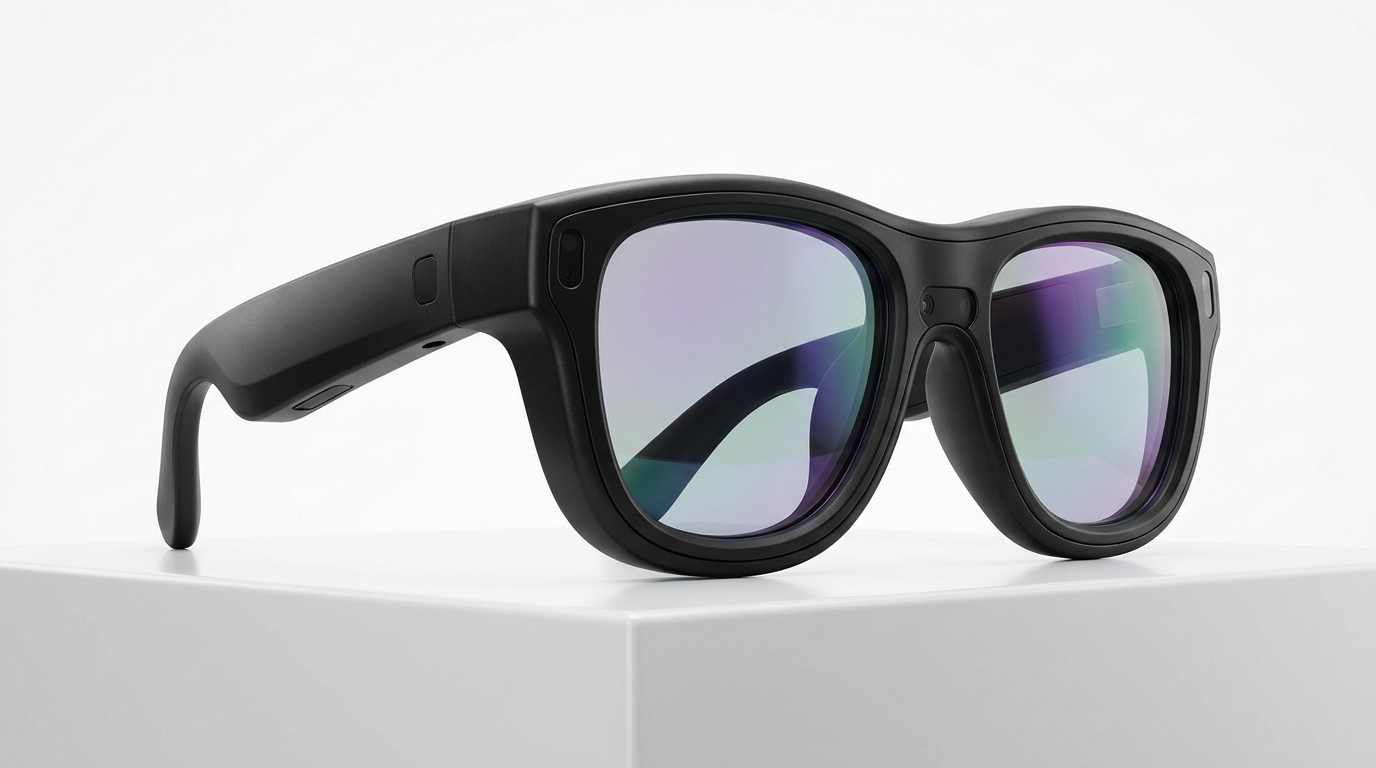
Despite packing in two high-resolution color cameras, two infrared cameras, and a custom liquid crystal on silicon (LCoS) display system, the glasses weigh just 132 grams for the smaller 47mm frame. Snap achieved this by utilizing a Swiss TR90 polymer, which the company describes as a "plastic titanium" that balances durability with a lightweight profile.[1][2]

The visual experience offers a 51-degree field of view, matching enterprise headsets like Microsoft's HoloLens 2 but in a much smaller form factor. The lenses also feature electrochromic technology—similar to the windows on a Boeing 787 Dreamliner—allowing them to automatically shift from clear to tinted in under 10 seconds based on ambient lighting conditions.[1][2][3]
The visual experience offers a 51-degree field of view, matching enterprise headsets like Microsoft's HoloLens 2 but in a much smaller form factor.
Interaction with the Specs relies entirely on hand tracking and voice commands, eliminating the need for physical controllers. Snap has integrated generative AI deeply into the operating system, utilizing APIs from OpenAI and Google's Gemini to power contextual AI assistants that can understand what the user is looking at, translate text in real-time, or identify physical objects.[1][2][3]
However, the standalone design comes with inherent compromises. The glasses offer only four hours of continuous mixed-use battery life, though they ship with a charging case that provides an additional 16 hours of power on the go. The thick frames have also drawn mixed reactions, with some critics noting the goggle-like appearance necessary to house the internal components.[1][2][4]

The $2,195 price point places the Specs firmly in the premium category, drawing skepticism from market analysts who question its mainstream appeal. Following the announcement, Snap's stock dipped by roughly 10%, reflecting Wall Street's hesitation over the company's ability to sell a high-priced gadget while navigating broader cost-cutting measures.[5][6]
Despite the financial hurdles, the launch positions Snap as a first-mover in the "true AR" space. While Meta currently dominates the smart glasses market with its audio-and-camera Ray-Ban frames, and Apple's standalone AR glasses are reportedly not expected until 2027, Snap has successfully delivered a fully untethered spatial computer that developers can start building for today.[1][3][5]
How we got here
2021
Snap releases its first true AR Spectacles to a select group of developers, featuring a 26-degree field of view and 30 minutes of battery.
2024
Snap introduces its second-generation AR developer kit, expanding the field of view to 46 degrees but weighing a bulky 226 grams.
April 2026
Snap cuts 16% of its workforce in a bid to reduce costs ahead of major hardware investments.
June 2026
Snap unveils the consumer-ready Specs at the Augmented World Expo, offering a 51-degree field of view in a standalone 132-gram frame.
Viewpoints in depth
AR Enthusiasts & Developers
A massive technical achievement that finally delivers untethered, true augmented reality.
For developers who have spent years building spatial applications on bulky headsets or tethered glasses, the new Specs represent the hardware baseline they have been waiting for. Enthusiasts highlight the 51-degree field of view and the dual Snapdragon architecture as major wins, proving that a fully standalone AR experience can be compressed into a 132-gram frame. The deep integration of generative AI APIs also opens the door for context-aware applications that can "see" and interact with the physical world in real-time.
Consumer Skeptics
Prohibitive pricing and physical compromises limit mainstream appeal.
Market analysts and consumer tech critics argue that while the technology is impressive, the Specs are not ready for everyday users. The $2,195 price tag places the glasses out of reach for most consumers, effectively making them a paid developer kit rather than a mass-market product. Skeptics also point to the four-hour battery life and the thick, goggle-like design as significant hurdles that Snap must overcome before AR glasses can replace smartphones.
Industry Watchers
A strategic first-mover advantage against trillion-dollar rivals.
From a broader industry perspective, Snap's launch is seen as a strategic flag-planting exercise. Meta currently dominates the smart glasses market, but its popular Ray-Ban frames lack AR displays. Meanwhile, Apple's standalone AR glasses are reportedly years away from production. By shipping a fully untethered spatial computer today, Snap is proving it can compete with trillion-dollar tech giants in hardware engineering, securing its position as a serious player in the next generation of computing.
What we don't know
- How many units Snap expects to sell to consumers versus enterprise developers.
- Whether the four-hour battery life will degrade significantly when running intensive generative AI tasks.
Key terms
- Augmented Reality (AR)
- Technology that overlays digital imagery and information onto the real physical world, typically through transparent lenses.
- Waveguide Display
- A specialized optical technology used in AR glasses that bounces light through a thin piece of glass to project images directly into the user's eye.
- Field of View (FOV)
- The extent of the observable world that can be seen at any given moment through a display; a wider FOV means digital objects can appear larger and more immersive.
- Liquid Crystal on Silicon (LCoS)
- A miniaturized display technology that uses liquid crystals applied to a reflective silicon backplane, often used in high-resolution AR headsets.
Frequently asked
Do the Snap Specs require a phone to work?
No. The new Specs are fully standalone and feature dual built-in processors, meaning they do not need to be tethered to a phone or a separate computing puck.
Can I get prescription lenses for them?
Yes. Snap designed the glasses with removable inserts that support a wide range of optical prescriptions.
When will they be available?
Pre-orders are open now with a $200 deposit, and the glasses are expected to ship in the fall of 2026 in the US, UK, and France.
Sources
Source coverage
6 outlets
3 viewpoints surfaced






[1]MacRumorsIndustry Watchers
Snap Launches $2,195 'Specs' Augmented Reality Glasses
Read on MacRumors →[2]SnapAR Enthusiasts & Developers
Introducing SPECS Augmented Reality Glasses
Read on Snap →[3]UploadVRAR Enthusiasts & Developers
Snap Opens Preorders For Standalone AR Specs, Shipping This Fall For $2195
Read on UploadVR →[4]9to5GoogleConsumer Skeptics
Snap Specs are AR glasses that look like that and cost $2,195
Read on 9to5Google →[5]LA TimesConsumer Skeptics
Snap unveils $2,195 AR glasses in race against Meta, Apple
Read on LA Times →[6]TechCrunchConsumer Skeptics
After unveiling ridiculously expensive AR glasses, Snap’s stock takes a dive
Read on TechCrunch →
Every angle. Every day.
Get technology stories with full source coverage and perspective breakdowns delivered to your inbox.