
Scientists Identify 166,000 Square Kilometers of Coral Reefs Capable of Surviving Climate Change
A landmark global study has mapped vast networks of climate-resilient coral reefs, tripling previous estimates and offering a roadmap for targeted marine conservation.
By Factlen Editorial Team
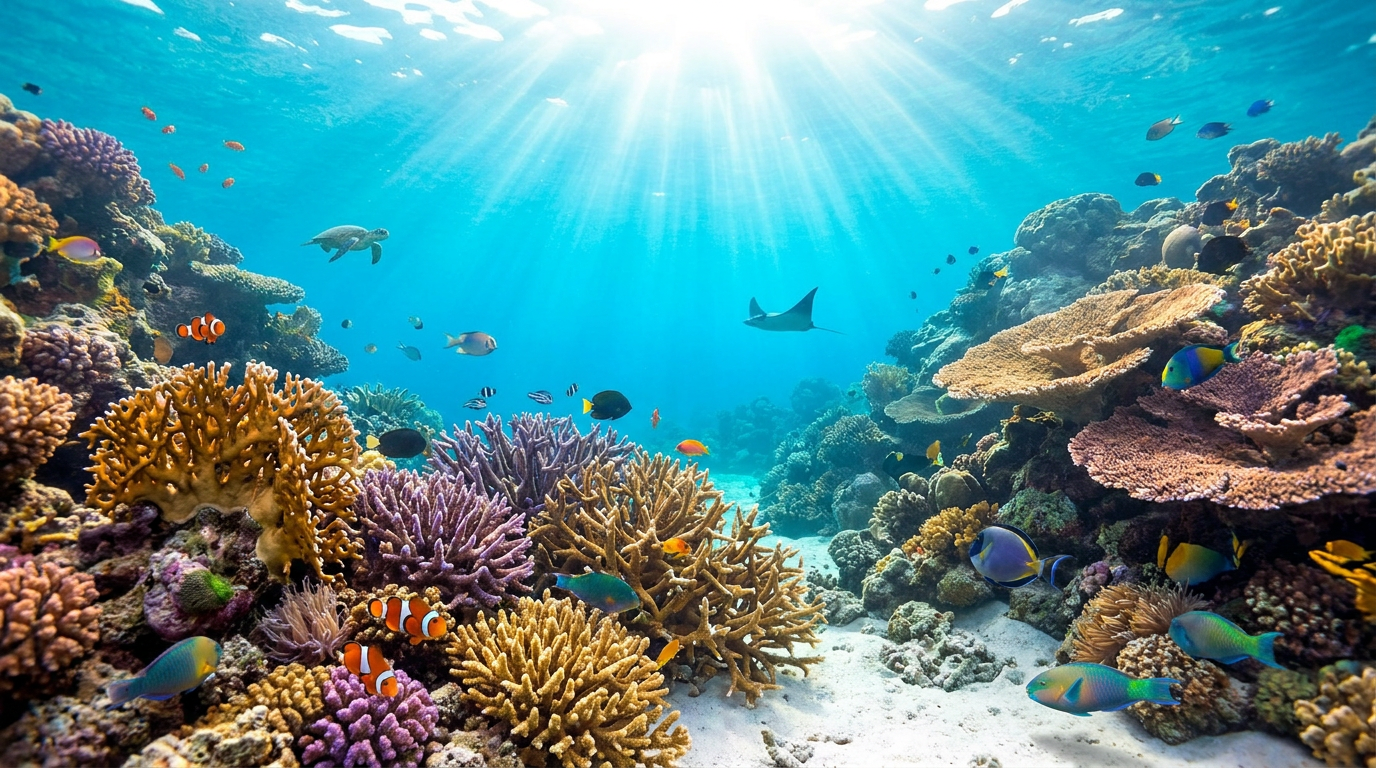
- Marine Conservationists
- Advocate for immediate legal protection of identified resilient zones to serve as seed banks for future reef recovery.
- Climate Modellers
- Focus on updating historical mortality projections with new machine-learning data on thermal refuges.
- Coastal Communities
- Emphasize the need to reduce local stressors like pollution and overfishing to support natural resilience.
What's not represented
- · Commercial Fishing Industry
- · Coastal Tourism Operators
Why this matters
Coral reefs support a quarter of all marine life and the livelihoods of half a billion people. Discovering that one-third of the world's reefs can withstand global warming shifts the narrative from inevitable loss to actionable conservation.
Key points
- Scientists have identified 166,000 square kilometers of coral reefs capable of surviving climate change.
- This represents roughly one-third of the world's total coral ecosystems, tripling previous estimates.
- Resilience is driven by cooler ocean currents, deep-water upwelling, and genetic heat tolerance.
- 60% of these resilient reefs are located in Australia, the Bahamas, Cuba, Indonesia, and the Philippines.
- Only 28% of these identified strongholds are currently protected from local human threats.
For years, the scientific consensus surrounding coral reefs has been overwhelmingly grim. The Intergovernmental Panel on Climate Change (IPCC) previously estimated that 70 to 90 percent of the world's coral reefs would die if global temperatures rose by 1.5 degrees Celsius above pre-industrial levels, with 99 percent facing eradication at 2 degrees.[3]
But a landmark study presented at the Our Ocean Conference in Mombasa, Kenya, in June 2026 is fundamentally challenging that narrative. Researchers have identified 166,000 square kilometers of coral reefs that possess the capacity to withstand or recover from the severe impacts of global warming.[2][3][4]
This newly mapped network of 'climate-resilient' reefs represents roughly one-third of the world's total coral ecosystems—an area three times larger than previous estimates. The findings offer a rare injection of optimism into marine biology, shifting the focus from mourning inevitable losses to actively protecting viable strongholds.[2][4]
"Coral reefs are often framed as ecosystems beyond saving," said Emily Darling, director of coral conservation at the Wildlife Conservation Society (WCS) and a co-author of the study. "This research shows otherwise: we know where the hope is and what we need now is political will."[2][3][4]

The evidence pack behind this discovery is unprecedented in its scale. Researchers from the WCS and Macquarie University utilized machine-learning models trained on more than 45,000 coral field observations collected between 1960 and 2025.[3][4]
By cross-referencing decades of biological surveys with localized climate, oceanographic, and human-impact data, the models pinpointed specific geographic pockets where corals are successfully dodging the worst of the heat.[4]
What makes these specific reefs resilient? The data points to a combination of oceanographic luck and evolutionary adaptation. In many of the identified refuges, local bathymetry and cooler ocean currents act as a thermal shield.[1][5]
The data points to a combination of oceanographic luck and evolutionary adaptation.
Deep-water upwelling—where cold, nutrient-rich water from the ocean floor is pushed toward the surface—can physically lower the temperature of the surrounding reef, buffering the corals from the marine heatwaves that trigger mass bleaching.[6]

In other areas, the resilience is biological. Scientists have documented 'super corals' that have genetically adapted to endure extreme heat over successive generations. When these heat-adapted corals reproduce, ocean currents carry their larvae to neighboring reef systems, effectively exporting thermal tolerance across a wider oceanic network.[5]
The geographic distribution of these resilient reefs is highly concentrated. The study reveals that approximately 60 percent of these climate-resilient zones are located within the waters of just five countries: Australia, the Bahamas, Cuba, Indonesia, and the Philippines.[3][4]
However, the data also highlights a critical vulnerability gap. Currently, only 28 percent of these identified climate-resilient reefs fall within formally protected or conserved marine areas.[2][4]
This leaves more than 119,000 square kilometers of vital reef ecosystems exposed to immediate, localized threats. While these corals may be equipped to survive a warming ocean, their resilience is heavily compromised if they are simultaneously battling agricultural runoff, sewage pollution, or destructive overfishing.[1][5]

"The world's coral reefs are facing an unprecedented crisis," noted Kyle Zawada, the study's lead author from Macquarie University. "But there is still hope. Our work identifies pockets of resilience where reefs may withstand and recover from disturbance."[4]
Conservationists argue that these resilient zones must become the immediate priority for the '30 by 30' initiative—a global agreement aiming to protect 30 percent of the planet's land and oceans by the end of the decade.[2][4]
If legally protected from human stressors, these strongholds can serve as living 'seed banks.' By maintaining healthy populations of heat-resistant corals, these reefs can continuously supply larvae to repopulate and restore degraded ecosystems across the broader ocean.[4][5]

The researchers maintain transparent uncertainty regarding the future. The models are based on historical patterns and project survival up to a 2.1-degree Celsius temperature increase; novel future climate states or exceptionally violent El Niño events could still push these resilient reefs past their breaking points.[3]
How we got here
2018
An initial '50 Reefs' study identifies a small network of potentially resilient coral ecosystems around the globe.
2023–2024
Record-breaking marine heatwaves trigger severe global coral bleaching events, heightening fears of imminent ecosystem collapse.
June 2026
Researchers present new data identifying 166,000 sq km of resilient reefs at the Our Ocean Conference in Mombasa, Kenya.
Viewpoints in depth
Marine Conservationists
Advocate for immediate legal protection of identified resilient zones to serve as seed banks for future reef recovery.
For conservation groups, the identification of 166,000 square kilometers of resilient coral is a mandate for immediate policy action. Organizations like the Wildlife Conservation Society emphasize that these thermal refuges cannot save the broader ocean if they are destroyed by local human activities. They are pushing governments to integrate these specific coordinates into their '30 by 30' national action plans, arguing that protecting these strongholds is the most cost-effective way to ensure the ocean retains a 'seed bank' capable of repopulating degraded reefs once global temperatures stabilize.
Climate Modellers
Focus on updating historical mortality projections with new machine-learning data on thermal refuges.
The scientific community is using this massive dataset of 45,000 field observations to refine global climate models. Previously, the IPCC's broad-brush projections suggested a near-total wipeout of coral reefs at 2 degrees Celsius of warming. Modellers are now incorporating localized oceanographic variables—such as deep-water upwelling and micro-currents—into their forecasts. While they caution that historical resilience does not guarantee survival under unprecedented future heat anomalies, they acknowledge that the ocean's thermal dynamics are far more nuanced than early models suggested.
Coastal Communities
Emphasize the need to reduce local stressors like pollution and overfishing to support natural resilience.
For the half-billion people who rely on coral reefs for food security and coastal defense, global climate targets can feel abstract and out of their control. Instead, local stakeholders focus on the immediate, manageable threats that compromise a reef's natural resilience. Research shows that corals stressed by agricultural runoff, untreated sewage, or destructive fishing practices lose their ability to withstand marine heatwaves. By establishing local beach management units and enforcing sustainable fishing zones, coastal communities aim to give these naturally resilient reefs the healthiest possible baseline to fight off thermal stress.
What we don't know
- Whether these resilient reefs can survive warming scenarios that exceed the projected 2.1-degree Celsius threshold.
- How quickly these 'seed bank' reefs can actually repopulate neighboring degraded ecosystems under real-world conditions.
- Whether governments will successfully integrate these newly mapped coordinates into their immediate conservation policies.
Key terms
- Coral Bleaching
- A stress response where corals expel the symbiotic algae living in their tissues, turning them white and leaving them vulnerable to starvation.
- Thermal Refugia
- Specific geographic areas where local oceanographic conditions, such as upwelling or cooler currents, protect marine life from broader regional warming.
- Deep-Water Upwelling
- An oceanographic process where deeper, colder, and nutrient-rich water rises to the surface, often buffering coastal reefs from extreme heatwaves.
- 30 by 30
- A global conservation initiative aiming to formally protect 30 percent of the Earth's land and oceans by the year 2030.
Frequently asked
What makes a coral reef 'climate-resilient'?
A reef is considered resilient if it can withstand or quickly recover from marine heatwaves. This is often due to cooler ocean currents, deep-water upwelling, or genetic adaptations that allow the corals to tolerate higher temperatures.
Where are these resilient reefs located?
Approximately 60 percent of the 166,000 square kilometers of resilient reefs are located in the waters of Australia, the Bahamas, Cuba, Indonesia, and the Philippines.
Does this mean climate change isn't a threat to corals?
No. Global warming remains the primary existential threat to coral ecosystems. However, this study proves that targeted conservation of these specific 'refuge' areas could prevent total eradication and provide a foundation for future recovery.
Sources
Source coverage
6 outlets
3 viewpoints surfaced






[1]The New York TimesClimate Modellers
New Coral Study Identifies Areas Where Reefs Are Hanging On
Read on The New York Times →[2]The IndependentMarine Conservationists
Scientists just identified 166,000 sq km of coral reef capable of surviving climate change
Read on The Independent →[3]The Straits TimesClimate Modellers
Scientists found some coral reefs can survive climate change
Read on The Straits Times →[4]Oceanographic MagazineMarine Conservationists
Reef relief: Scientists map 165,000km² of climate resilient coral
Read on Oceanographic Magazine →[5]Inside Climate NewsCoastal Communities
As Global Warming Threatens Corals Worldwide, Woods Hole Scientists Search for 'Super Reefs' That Can Take the Heat
Read on Inside Climate News →[6]Frontiers in Marine ScienceCoastal Communities
Quantifying Coral Reef Resilience to Climate Change and Human Development: An Evaluation of Multiple Empirical Frameworks
Read on Frontiers in Marine Science →

More in science
See all 6 stories →Quantum Physics
A Quantum State That Lasts Forever: The Science of Time Crystals
6 sources

Neural Implants
Brain Implant Allows Man With ALS to Speak and Work Independently From Home
7 sources

Brain-Computer Interfaces
Brain Implant Enables ALS Patient to Speak and Work Independently at Home for Two Years
7 sources

Cognitive Longevity
The Science of SuperAgers: How Some 80-Year-Olds Maintain the Brains of 50-Year-Olds
9 sources

Every angle. Every day.
Get science stories with full source coverage and perspective breakdowns delivered to your inbox.