
OLED vs. Mini-LED in 2026: The Definitive TV Buying Guide
Massive engineering leaps in 2026 have blurred the lines between OLED and Mini-LED televisions. Here is how to choose the right display technology for your room, lighting, and viewing habits.
By Factlen Editorial Team
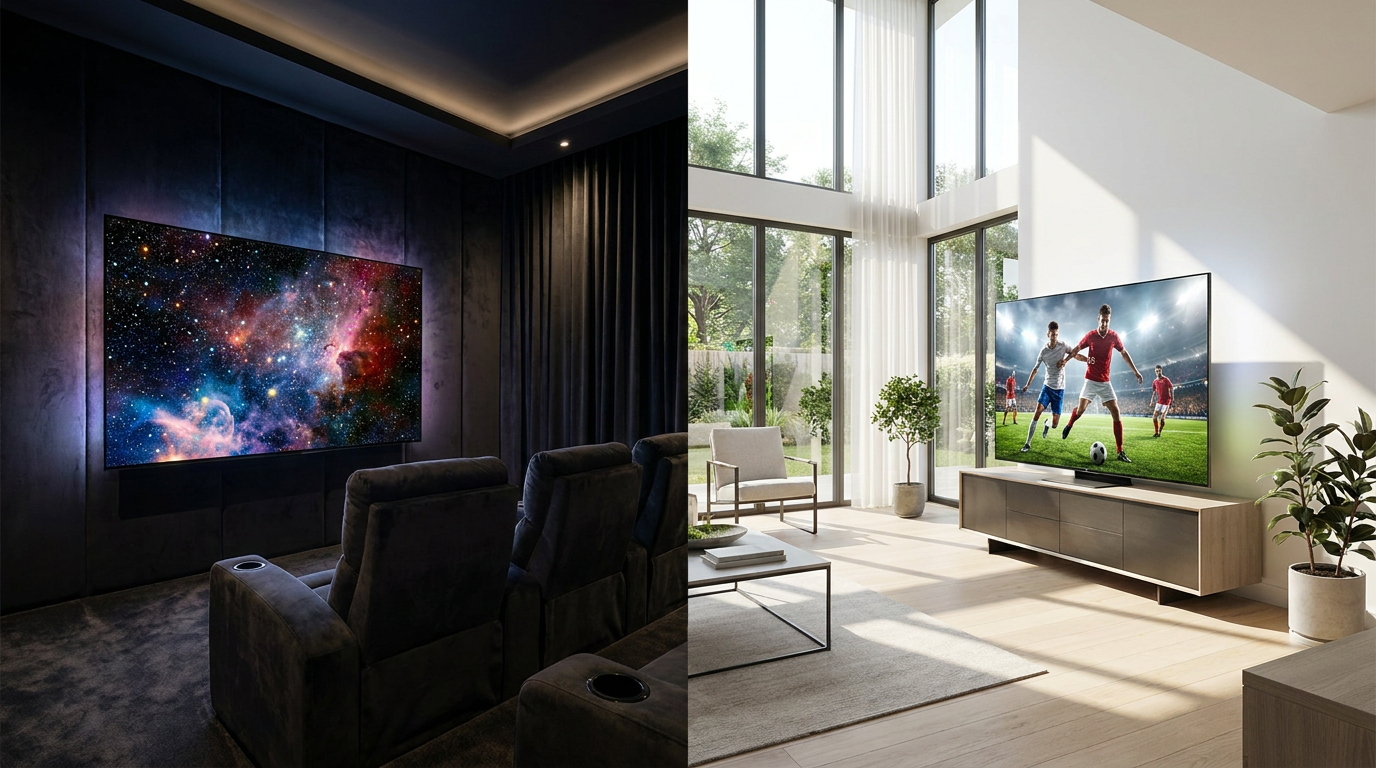
- Home Theater Purists
- Advocates for OLED's infinite contrast and perfect black levels in dark viewing environments.
- Bright-Room Maximizers
- Prioritizes sheer luminance and glare reduction for daytime viewing and sports.
- Productivity Power Users
- Focuses on static UI longevity, burn-in immunity, and high refresh rates for PC use.
- Value & Scale Buyers
- Prioritizes massive screen sizes and overall price-to-performance ratio.
What's not represented
- · Environmental Regulators
- · Independent Repair Technicians
Why this matters
Buying the wrong TV panel for your specific room lighting and viewing habits can lead to thousands of dollars wasted on washed-out pictures or burn-in anxiety. Understanding the 2026 gap between OLED and Mini-LED ensures you get the perfect display for your space.
Key points
- OLED technology in 2026 utilizes MLA 3.0 and Tandem architectures to reach 3,000 nits peak brightness while maintaining perfect pixel-level blacks.
- Mini-LED displays now feature over 20,000 local dimming zones and can hit 10,000 nits, making them the ultimate choice for bright, sun-drenched rooms.
- OLED remains the superior choice for dedicated dark-room home theaters and competitive gamers who need near-instant 0.03ms response times.
- Mini-LED offers complete immunity to burn-in, making it the safer long-term investment for heavy PC productivity and static news channels.
- The price gap has widened at massive screen sizes, with 85-inch Mini-LEDs offering significantly better value than their OLED counterparts.
The 2026 television market has reached a spectacular inflection point. For years, the buying advice was simple: purchase an OLED for a dark home theater, or an LED for a bright living room. But massive engineering leaps have blurred those rigid boundaries. Today's flagship televisions are engaged in an arms race of luminance and contrast, utilizing microscopic lenses, quantum dots, and inorganic semiconductors to push display physics to its limits. Buyers are no longer choosing between a "good" and "bad" technology; they are choosing between two distinct, highly refined engineering philosophies.[8][9]
On one side of the aisle is OLED, the reigning champion of cinematic contrast. In 2026, OLED technology has evolved far beyond its early iterations. Manufacturers have introduced Micro Lens Array (MLA) 3.0, fourth-generation QD-OLED panels, and Tandem OLED architectures. Tandem OLED, in particular, stacks multiple light-emitting layers to deliver a massive brightness jump without sacrificing the pixel-level black control that made the technology famous. These advancements allow modern OLEDs to reach peak highlight brightness between 2,000 and 3,000 nits, a staggering improvement over the 1,000-nit ceiling of previous generations.[1][7]
The fundamental magic of OLED remains its self-emissive nature. Every single pixel on the screen generates its own light and can turn itself completely off. This creates infinite contrast. When displaying a starfield in a sci-fi film, an OLED panel can place a blindingly bright star directly next to the pitch-black vacuum of space with zero light bleed. This pixel-level precision also translates to motion clarity. With response times hovering around 0.03 milliseconds, OLED panels eliminate ghosting and motion blur, making them a holy grail for competitive gamers and sports enthusiasts.[2][3]
However, OLED is not without its physical limitations. Because the pixels rely on organic carbon-based materials, they are susceptible to heat degradation. To protect the panel, OLED TVs employ an Auto Brightness Limiter (ABL). If a bright, full-screen image—like a hockey rink or a snowy landscape—stays on screen too long, the TV automatically dims the picture to prevent the pixels from overheating. Additionally, while 2026 models use deuterium stabilization and advanced pixel-shifting algorithms to mitigate wear, the risk of permanent burn-in from static elements like news tickers or gaming health bars still lingers for heavy users.[4][6]

On the other side of the aisle is Mini-LED, a technology that has rapidly closed the performance gap. Unlike OLED, Mini-LED uses a traditional LCD panel illuminated by a backlight. But instead of a few dozen large LEDs, it utilizes thousands of microscopic, inorganic Gallium Nitride (GaN) LEDs. In 2026, the industry has largely shifted to RGB Mini-LED designs that remove traditional color filters, drastically improving light efficiency and color volume. Because these diodes are inorganic, they do not decay in a biological sense, allowing them to withstand massive amounts of heat and current for decades without any risk of burn-in.[5][8]
This thermal resilience has sparked the "nit war." Current-generation flagship Mini-LED displays routinely achieve peak brightness levels of 5,000 to 10,000 nits for small highlights, while sustaining full-screen brightness well over 1,500 nits. This sheer luminance is a critical differentiator. In a sun-drenched living room with massive, uncovered windows, a Mini-LED panel can punch through the ambient glare effortlessly, delivering vibrant HDR impact where an OLED might look washed out.[2][4]
Historically, the major weakness of any backlit TV was "blooming" or "haloing"—a distracting glow around bright objects on dark backgrounds. But 2026 engineering has largely solved this through sheer density. Top-tier Mini-LED televisions now feature upwards of 20,000 local dimming zones. The TV's processor can independently dim or brighten these microscopic zones with such precision that blooming is nearly invisible to the naked eye in standard viewing conditions. While a lab instrument can still detect the difference, perceived contrast in a normal living room is virtually identical to OLED.[3][8]

Historically, the major weakness of any backlit TV was "blooming" or "haloing"—a distracting glow around bright objects on dark backgrounds.
When conducting a side-by-side trade-off analysis for picture quality, the conditions dictate the winner. For OLED, the evidence points to absolute superiority in controlled lighting. In rooms where ambient light stays below 10 lux, OLED consistently delivers more impactful HDR with perfect shadow gradation. Against OLED, the technology struggles with sustained full-screen brightness, making it less ideal for daytime viewing. For Mini-LED, the primary advantage is uncompromised luminance and color volume in bright environments. Against Mini-LED, minor haloing can still be detected when viewing the screen from an extreme off-axis angle or in a pitch-black dedicated home theater.[4][7]
The trade-off analysis for gaming and productivity reveals a similar split. For OLED, the near-instantaneous pixel response time provides unmatched motion clarity for fast-paced esports. Against OLED, the anxiety of burn-in remains a psychological friction point for users who play the same game with static HUDs for thousands of hours, or who use the TV as a PC monitor with static taskbars. For Mini-LED, the complete immunity to burn-in allows for 12-hour productivity sessions with bright white windows without a single worry. Against Mini-LED, the pixel response time, while excellent at 1 millisecond, is technically slower than OLED, and dark-mode PC interfaces can occasionally reveal the zone dimming algorithms at work.[5][6]
Size and value present the final major trade-off. Mini-LED technology scales to massive dimensions much more affordably than organic panels. In 2026, an 85-inch or 98-inch Mini-LED often costs the same as a 65-inch or 77-inch OLED. For buyers prioritizing sheer cinematic scale and immersion at a 10-foot viewing distance, the massive size of a Mini-LED almost always outweighs the microscopic contrast advantages of a smaller OLED. OLED remains a premium-priced technology, particularly as screen sizes push past 83 inches.[1][7]

Ultimately, choosing the right television in 2026 requires matching the engineering to your specific environment. OLED fits perfectly when you are building a dedicated home theater, primarily watch movies at night with the lights off, play competitive games that demand perfect motion clarity, and value absolute image precision over raw brightness. It is the undisputed choice for cinematic purists who want to see a film exactly as the director mastered it in a dark grading suite.[4][8][9]
Conversely, OLED does not fit well when your primary viewing area is a bright, sun-drenched room, or if you plan to leave a 24-hour news channel running all day. It is also less suited for heavy PC productivity where static white windows dominate the screen for hours on end. In these scenarios, the panel's protective dimming features will actively fight against your usage habits.[2][6]

Mini-LED fits perfectly when your living room has large windows that you cannot easily cover, you want a massive 85-inch or larger screen on a reasonable budget, or you want the absolute peace of mind that comes with zero burn-in risk. It is the ultimate mixed-use family television, capable of delivering blindingly bright sports broadcasts during the day and excellent, high-contrast movie performance at night.[7][8]
However, Mini-LED does not fit well when you are a perfectionist building a pitch-black viewing room where even the slightest hint of blooming around movie subtitles would break your immersion. While the gap has closed significantly, the organic, self-emissive nature of OLED still holds the crown for absolute pixel-level perfection. By understanding these specific trade-offs, buyers can confidently invest in a 2026 display that perfectly complements their lifestyle and living space.[2][3]
How we got here
2013
LG releases the first commercially viable large-screen OLED TVs, establishing a new standard for contrast.
2021
Mini-LED technology enters the mainstream consumer TV market, offering a brighter alternative to OLED.
2024
MLA and QD-OLED technologies push OLED brightness past the 1,000-nit barrier for the first time.
2026
Mini-LEDs reach 20,000+ dimming zones, while Tandem OLEDs hit 3,000 nits peak brightness, blurring the lines between the technologies.
Viewpoints in depth
Home Theater Purists
Advocates for OLED's infinite contrast and perfect black levels in dark viewing environments.
For cinematic purists, the television is a window into the director's grading suite. This camp argues that raw brightness is secondary to image precision. Because OLED pixels are self-emissive, they can completely turn off, creating a true black that no backlit TV can match. They point to the fact that in a light-controlled room (under 10 lux), a 2,000-nit OLED provides more perceived dynamic range and shadow detail than a 5,000-nit Mini-LED, making it the undisputed champion for film enthusiasts.
Bright-Room Maximizers
Prioritizes sheer luminance and glare reduction for daytime viewing and sports.
This perspective focuses on the reality of modern open-concept homes. Living rooms often feature massive windows and uncontrolled ambient light, which can easily wash out a traditional OLED panel. Advocates for Mini-LED argue that the technology's ability to sustain full-screen brightness over 1,500 nits makes it the only viable choice for daytime sports and mixed-use family viewing. They emphasize that 2026's advanced local dimming algorithms have made blooming a non-issue for the vast majority of casual viewers.
Productivity Power Users
Focuses on static UI longevity, burn-in immunity, and high refresh rates for PC use.
For developers, traders, and heavy PC users, a television often serves as a massive monitor. This camp heavily favors Mini-LED due to its inorganic GaN structure, which completely eliminates the risk of burn-in. They argue that OLED's Auto Brightness Limiter (ABL) makes it frustrating to use with bright white applications like spreadsheets or web browsers, as the screen constantly dims to protect itself. For 12-hour daily grinds with static taskbars, Mini-LED is viewed as the only zero-anxiety option.
Value & Scale Buyers
Prioritizes massive screen sizes and overall price-to-performance ratio.
This camp argues that immersion is driven primarily by screen size, not microscopic contrast differences. They point out that in 2026, the cost of manufacturing OLED panels larger than 83 inches remains prohibitively expensive. In contrast, Mini-LED technology scales efficiently to 85, 98, and even 115 inches. For buyers looking to recreate a true cinema scale in their home without spending five figures, this perspective champions Mini-LED as the ultimate value proposition.
What we don't know
- How the long-term degradation curve of 2026 Tandem OLED panels compares to traditional single-layer OLEDs over a 10-year lifespan.
- Whether Micro-LED technology will become affordable enough by the end of the decade to render both OLED and Mini-LED obsolete.
Key terms
- OLED
- Organic Light-Emitting Diode; a display technology where each individual pixel generates its own light and can turn completely off for perfect blacks.
- Mini-LED
- A display technology that uses thousands of microscopic, inorganic LEDs as a backlight behind an LCD panel to achieve extreme brightness.
- Nits
- A unit of measurement for screen brightness; one nit is roughly equivalent to the light of one candle per square meter.
- ABL
- Auto Brightness Limiter; a software feature in OLED TVs that automatically dims the screen when displaying large, bright images to prevent overheating.
- Local Dimming Zones
- Specific areas of a Mini-LED backlight that can independently dim or brighten to improve contrast and reduce light bleed.
- Burn-in
- Permanent image retention caused by uneven degradation of organic pixels when static images are displayed for extended periods.
Frequently asked
Does OLED still suffer from burn-in in 2026?
While the risk is significantly lower thanks to deuterium stabilization and advanced pixel-shifting, permanent burn-in is still possible if you display static elements (like news tickers or PC taskbars) for thousands of hours.
What is blooming on a Mini-LED TV?
Blooming, or haloing, is a faint glow around bright objects on a dark background. However, 2026 Mini-LEDs with over 20,000 dimming zones have made this nearly invisible to the naked eye.
Is Mini-LED better for bright rooms?
Yes. Mini-LEDs can reach peak brightness levels up to 10,000 nits and sustain full-screen brightness over 1,500 nits, allowing them to punch through heavy ambient glare effortlessly.
Which TV is better for competitive gaming?
OLED is generally preferred for competitive esports due to its near-instantaneous 0.03ms pixel response time, which eliminates motion blur and ghosting.
Sources
Source coverage
9 outlets
4 viewpoints surfaced








[1]What Hi-Fi?Value & Scale Buyers
MLA vs QD-OLED: which is better? And how does Mini LED compare in 2026?
Read on What Hi-Fi? →[2]Pocket-lintHome Theater Purists
OLED vs QLED vs Mini-LED: Which TV tech is best for you?
Read on Pocket-lint →[3]RTINGSHome Theater Purists
Mini LED vs OLED: Which TV Technology Is Better?
Read on RTINGS →[4]SunulBright-Room Maximizers
Brightness and HDR Performance: The Critical Differentiator
Read on Sunul →[5]Ordinary TechProductivity Power Users
Choosing between RGB Mini LED and OLED display technology
Read on Ordinary Tech →[6]KTC PlayProductivity Power Users
Workflow Friction Comparison: OLED vs Mini-LED
Read on KTC Play →[7]EcoPicksGoValue & Scale Buyers
OLED vs Mini LED TVs: 2026 Buyer's Guide
Read on EcoPicksGo →[8]Data Wire SolutionsBright-Room Maximizers
Best TVs for 2026: 10 OLED and Mini-LED Picks by Room, Brightness, and Install Reality
Read on Data Wire Solutions →[9]Factlen Editorial TeamBright-Room Maximizers
Synthesis by Factlen editorial team
Read on Factlen Editorial Team →

Every angle. Every day.
Get guides stories with full source coverage and perspective breakdowns delivered to your inbox.