
Kintsugi: The Japanese Art of Finding Beauty in Broken Things
The centuries-old Japanese tradition of repairing ceramics with gold has evolved from a meticulous artisanal craft into a global philosophy for mental health and sustainability.
By Tara Reddy

In short
- Kintsugi is the 15th-century Japanese art of repairing broken pottery using urushi lacquer dusted with powdered gold, silver, or platinum.
- The technique originated when Shogun Ashikaga Yoshimasa rejected a functional but ugly metal-staple repair on his favorite tea bowl.
- Rooted in Zen Buddhism, the practice embodies wabi-sabi—the philosophy of finding beauty in imperfection and impermanence.
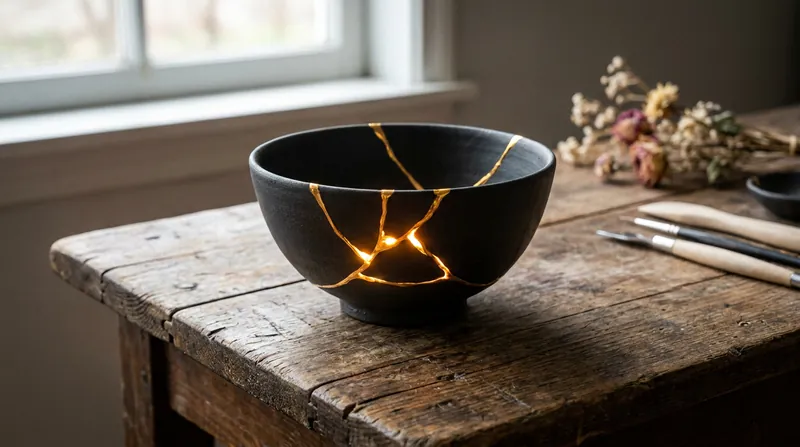
A shattered ceramic bowl, once destined for the trash, is pieced back together. But instead of hiding the cracks with invisible glue, the seams are illuminated with brilliant, powdered gold. This is kintsugi, the centuries-old Japanese art of "golden joinery." It is a meticulous repair technique that transforms a broken vessel into something entirely new, drawing the eye directly to the fault lines rather than attempting to conceal them. By treating the breakage as a feature rather than a bug, the artisan ensures the object's history is honored.[1]
In an era defined by mass production, planned obsolescence, and disposable goods, this ancient practice has captured the global imagination. But kintsugi is far more than a specialized craft; it is a profound philosophical framework.
It argues that breakage and repair are not the end of an object's life, but a vital, beautiful part of its history. By highlighting the damage, the object's survival is celebrated, offering a stark contrast to the modern instinct to discard anything that is slightly blemished. It teaches us that true value lies in longevity and resilience.[1]
The origins of kintsugi trace back to the Muromachi period in 15th-century Japan, a time of significant cultural and artistic development. According to popular historical legend, the military ruler Shogun Ashikaga Yoshimasa accidentally broke his absolute favorite Chinese celadon tea bowl. Desperate to save the cherished vessel, he sent it back to China, hoping their artisans could restore it to its former glory. The shogun's attachment to this single object set the stage for a revolution in how the Japanese approached damaged goods.[1]
When the bowl finally returned to Japan, the shogun was deeply dismayed by the result. The Chinese artisans had used standard metal staples to clamp the ceramic pieces together—a highly functional but aesthetically jarring repair method known as juci. Unwilling to accept the ugly, utilitarian fix for his prized possession, Yoshimasa challenged his own Japanese craftsmen to find a more elegant and visually pleasing solution.[2]
The local craftsmen responded by elevating the act of repair itself into a high art form. Instead of metal staples, they utilized urushi, a highly durable natural lacquer, mixed with finely powdered gold, silver, or platinum. The result was a bowl that was not only fully functional again but arguably more beautiful and unique than the original pristine piece. This innovative approach birthed the tradition of kintsugi.[1]
The technique quickly became deeply intertwined with the Japanese tea ceremony (chanoyu), which was flourishing and evolving during the same era. Tea masters, who valued rustic simplicity and profound meaning in their utensils, began to deliberately seek out and elevate repaired bowls. The golden seams added a layer of visual interest and historical weight that a newly fired, perfect bowl simply could not match.[1][2]
By the 17th century, the cultural cachet of kintsugi had grown so immense that it began to influence the ceramics market. Historical accounts suggest that the practice became a victim of its own success; some ambitious collectors and warriors were accused of intentionally breaking valuable, plain tea bowls just so they could have them mended with gold seams, thereby increasing their aesthetic and financial value.[2]
To truly understand kintsugi, one must look past the gold and understand the underlying materials. The true structural backbone of the process is the urushi lacquer. Harvested from the toxic sap of the Chinese lacquer tree, urushi has been used in Japan for thousands of years as a formidable adhesive and a protective, waterproof coating for armor, tableware, and furniture.
The process of traditional kintsugi is notoriously slow, grueling, and requires immense patience from the artisan. Urushi does not "dry" in the conventional sense of evaporation; rather, it cures by absorbing moisture from the air in a highly controlled, humid environment called a muro. A single repair can take weeks or even months to fully harden, requiring multiple painstaking layers of lacquer to be applied, cured, and sanded before the final dusting of precious metal.
Beyond the physical demands of the craft, kintsugi is deeply rooted in Zen Buddhist philosophy, particularly the foundational concept of wabi-sabi. Wabi-sabi is an aesthetic and worldview that actively embraces the flawed, the impermanent, and the incomplete. It finds profound beauty in the natural cycle of growth and decay, rejecting the Western ideal of eternal, symmetrical perfection.[1][3]
While wabi-sabi and kintsugi are intimately related, they serve different functions. As cultural historians note, wabi-sabi is the passive lens through which we view a cracked bowl as beautiful, accepting it as it is. Kintsugi, on the other hand, is the deliberate, active choice to intervene. It is the decision to mend the object with extreme care, transforming a passive acceptance of damage into an active celebration of survival.
The philosophy also intersects heavily with mushin, a Zen concept translating roughly to "no mind." In the context of kintsugi, mushin represents a state of non-attachment and a peaceful acceptance of fate. It encourages individuals to accept sudden changes, accidents, and the inevitable wear and tear of life without resistance or anger, recognizing that nothing can remain pristine forever.[1]
In recent years, kintsugi has transcended its origins in ceramic repair to become a powerful, globally recognized metaphor for mental health and trauma recovery. Psychologists, therapists, and wellness advocates increasingly use the concept to help patients reframe how they view their own emotional and physical scars, shifting the narrative from one of permanent damage to one of profound resilience.[3]
The traditional Western approach to trauma and illness often centers on the desire to "get back to normal" or to completely erase the visible signs of damage. Kintsugi offers a radical, comforting alternative: the idea that healing is not about hiding our fractures, but illuminating them. The struggles we survive, and the work we do to heal, add immense value, depth, and unique beauty to our character.
This metaphorical application has spawned a massive cottage industry of self-help literature, clinical therapy frameworks, and wellness workshops. From cancer survivors viewing their surgical scars as their own personal golden seams, to individuals rebuilding their lives and identities after profound grief or loss, the imagery of kintsugi provides a highly tangible, visual framework for post-traumatic growth.[2]
Simultaneously, kintsugi has found a passionate new audience among environmentalists and sustainability advocates. As the catastrophic ecological toll of "fast fashion" and throwaway consumerism becomes undeniable, the traditional ethos of repairing rather than replacing is experiencing a vital renaissance. Kintsugi stands as a direct philosophical counterweight to planned obsolescence.
Modern artists and industrial designers are aggressively experimenting with the technique, applying the concept of golden joinery to entirely new mediums. Today, you can find the kintsugi aesthetic applied to everything from broken concrete sidewalks and fractured wooden furniture to torn textiles and ripped clothing. This modern interpretation promotes a circular economy built on long-term care and longevity.[1]
There are even historical variations of the technique that push this collaborative ethos further. Yobitsugi, for example, is a form of kintsugi where a missing fragment of a vessel is replaced with a piece from an entirely different, unrelated object. Historically, this striking patchwork technique was occasionally used as a powerful symbol of peace and reconciliation between warring factions during Japan's turbulent Sengoku period.
Today, the enduring legacy of kintsugi serves as a quiet, beautiful rebellion against the exhausting pursuit of flawless perfection. Whether applied to a shattered porcelain teacup, a fractured human relationship, or a global culture grappling with unsustainable waste, the core message remains the same: there is immense, undeniable value in what has been broken, provided we are willing to do the hard work of repair.[4]
Key terms
- Urushi
- A highly durable, natural lacquer derived from tree sap, used as the primary adhesive in traditional kintsugi.
- Wabi-sabi
- A Japanese aesthetic and philosophy that finds profound beauty in imperfection, impermanence, and the natural cycle of decay.
- Juci
- A traditional Chinese repair method that uses metal staples to clamp broken ceramics together.
- Mushin
- A Zen Buddhist concept translating to 'no mind,' representing non-attachment and the peaceful acceptance of change.
- Yobitsugi
- A variation of kintsugi where a missing piece of a vessel is replaced with a fragment from a completely different object.
Frequently asked
Is real gold used in traditional kintsugi?
Yes, traditional kintsugi uses finely powdered gold, silver, or platinum dusted over the urushi lacquer, though modern hobbyist kits often substitute this with synthetic gold mica powder.
Can you eat or drink from kintsugi-repaired items?
Items repaired with traditional, pure urushi and genuine gold are generally food-safe once fully cured. However, those repaired with modern synthetic epoxies are often for decorative use only.
How long does the repair process take?
Traditional kintsugi is a slow process that can take weeks or even months, as the urushi lacquer requires specific humidity levels to cure properly between multiple layers.
Viewpoints in depth
The Artisan's View
Focuses on the meticulous, historical craft of urushi lacquer and the preservation of Japanese heritage.
For traditional craftsmen, kintsugi is fundamentally about the mastery of urushi—a toxic, temperamental tree sap that requires years of apprenticeship to handle safely and effectively. Artisans view the sudden global obsession with kintsugi with a mix of pride and caution. They emphasize that true kintsugi is a grueling, months-long process of curing and sanding, not a quick weekend craft project using synthetic epoxy and gold glitter. To the artisan, the value lies in the immense patience and technical precision required to honor the broken object properly.
The Psychological View
Views kintsugi as a powerful psychological framework for trauma recovery and building emotional resilience.
Mental health professionals and wellness advocates have embraced kintsugi as a radical departure from Western models of healing, which often prioritize returning a patient to their 'pre-trauma' state. In this view, emotional scars are not shameful defects to be hidden, but evidence of survival and growth. Therapists use the golden seams as a visual metaphor to help patients integrate their traumatic experiences into their identities, arguing that the process of healing makes a person more complex, empathetic, and uniquely beautiful.
The Environmental View
Champions the practice as an antidote to throwaway consumer culture and a model for the circular economy.
Sustainability advocates look to kintsugi as a philosophical blueprint for combating the ecological devastation of planned obsolescence. In a global economy that encourages consumers to immediately replace anything with a minor flaw, kintsugi demands that we slow down and invest labor into extending an object's lifespan. Environmentalists argue that adopting a 'kintsugi mindset'—whether applied to electronics, clothing, or furniture—is essential for transitioning to a circular economy where resources are cherished and waste is minimized.
- Traditional Artisans
- Focuses on the meticulous, historical craft of urushi lacquer and the preservation of Japanese heritage.
- Mental Health Advocates
- Views kintsugi as a powerful psychological framework for trauma recovery and building emotional resilience.
- Sustainability Proponents
- Champions the practice as an antidote to throwaway consumer culture and a model for the circular economy.
Perspectives this story doesn't cover
- Modern synthetic epoxy manufacturers
- Traditional Chinese Juci artisans
Sources
Source coverage
4 outlets
3 viewpoints surfaced




- [1]WikipediaTraditional Artisans
Kintsugi
Read on Wikipedia → - [2]ArtsyTraditional Artisans
The Centuries-Old Japanese Tradition of Mending Broken Ceramics with Gold
Read on Artsy → - [3]Forest HealingMental Health Advocates
Kintsugi and Wabi-Sabi
Read on Forest Healing → - [4]Factlen Editorial TeamSustainability Proponents
Synthesis by Factlen editorial team
Read on Factlen Editorial Team →

More in Culture
See all →Heritage Protection
Israeli Airstrike Damages Tyre's World Heritage Site, Triggering Global Heritage Protection Protocols
4 sources

Cultural Heritage
The Global Revival of Kintsugi: How the Ancient Art of Repair Became a Modern Movement
6 sources
Midsummer
The Magic of Midsummer: How the Nordic World Celebrates the Longest Day of the Year
4 sources

Solstice Traditions
The Science and History of Midsummer: How Ancient Solstice Traditions Thrive Today
3 sources

Comments
Every angle. Every day.
Get Culture stories with full source coverage and perspective breakdowns, free every day.