
Israeli Strikes on Beirut Trigger Iranian Retaliation, Threatening U.S.-Iran Peace Deal
Israel launched deadly airstrikes on Beirut's southern suburbs on Sunday, prompting retaliatory missile fire from Iran and jeopardizing a U.S.-Iran peace agreement hours before its expected signing.
By Factlen Editorial Team
- Israeli Government
- Argues that military strikes are a necessary response to Hezbollah's attacks and cannot be constrained by U.S.-Iran talks.
- Iranian Negotiators
- Maintains that a regional ceasefire must include Lebanon, viewing the Beirut strikes as proof the U.S. cannot control its ally.
- U.S. Administration
- Seeks to isolate the U.S.-Iran peace deal from the Israel-Hezbollah conflict, expressing frustration over uncoordinated Israeli actions.
- Lebanese Civilians
- Focuses on the devastating civilian toll and displacement caused by strikes on densely populated residential areas.
What's not represented
- · Residents of northern Israel displaced by Hezbollah fire
- · Pakistani mediators brokering the U.S.-Iran talks
Why this matters
A collapse of the U.S.-Iran peace deal would plunge the Middle East back into a full-scale regional war, directly impacting global energy markets, international shipping, and the deployment of U.S. military personnel.
Key points
- Israel launched airstrikes on Beirut's southern suburbs in response to Hezbollah drone attacks on northern Israel.
- Iran retaliated by launching missiles at Israel, breaking a fragile two-month ceasefire.
- The escalation occurred hours before the U.S. and Iran were scheduled to sign a treaty ending their war.
- Iranian negotiators stated there is 'no point' in continuing talks, demanding Lebanon be included in any ceasefire.
- U.S. officials expressed frustration, noting the Israeli strikes were not coordinated with Washington.
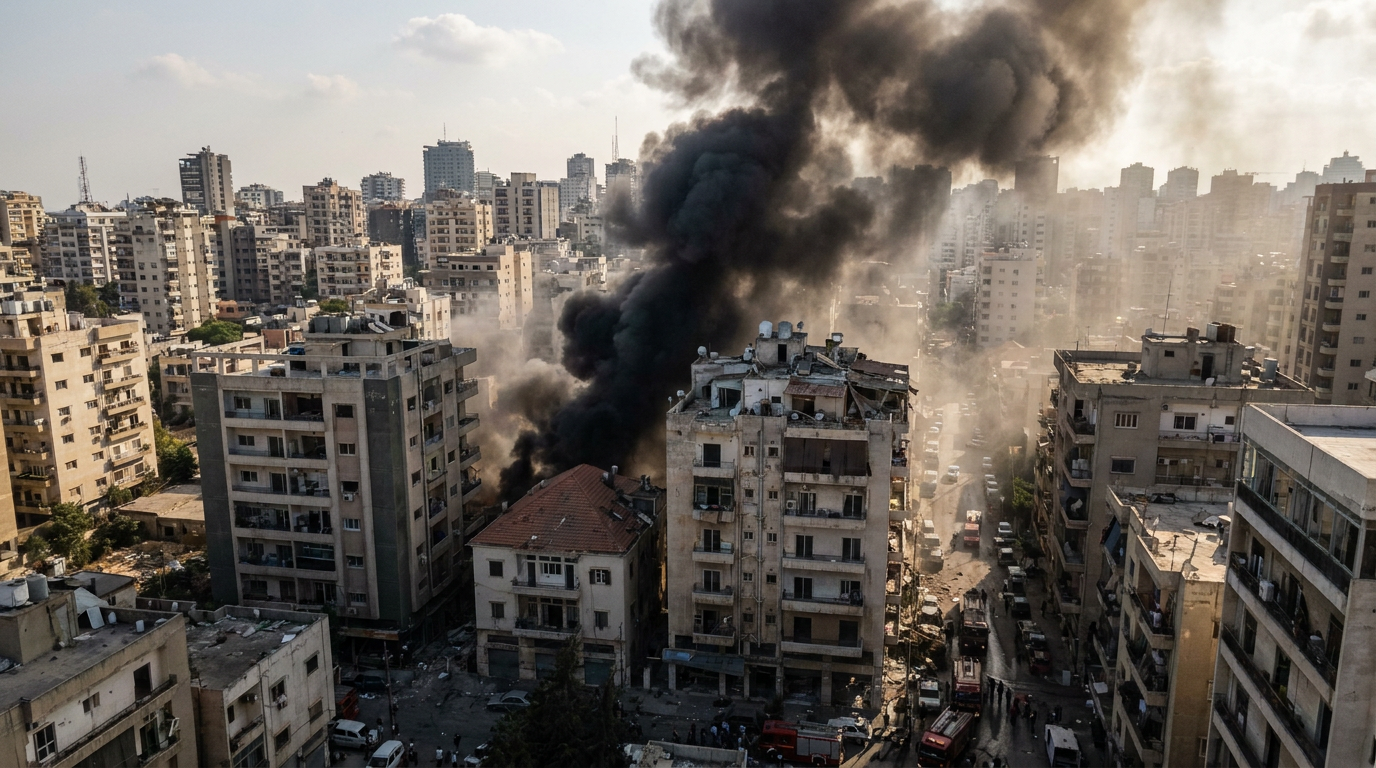
A sudden and severe military escalation has jeopardized a historic peace agreement between the United States and Iran just hours before its anticipated signing. On Sunday, Israeli forces launched a wave of deadly airstrikes against Hezbollah targets in the densely populated southern suburbs of Beirut. The bombardment triggered immediate retaliatory missile fire from Iran into Israeli territory, shattering a fragile two-month ceasefire and threatening to plunge the region back into full-scale war at a moment when diplomatic resolution seemed finally within reach.[1][2]
The strikes centered on Dahiyeh, a Hezbollah stronghold south of the Lebanese capital, where an Associated Press photographer witnessed a five-story apartment building heavily damaged by the blasts. Plumes of black smoke towered over the seaside city as panicked residents, many of whom had only recently returned home during a period of relative calm, fled the commercial and residential districts. Lebanon’s civil defense agency reported at least three people were killed and six wounded in the initial strikes, with emergency responders scrambling to search charred vehicles and debris for survivors.[3][4]
Israeli officials defended the bombardment as a necessary and proportionate response to unprovoked aggression. According to the office of Israeli Prime Minister Benjamin Netanyahu, the military targeted Hezbollah infrastructure after the Iran-backed militant group launched three suspected drones and multiple projectiles into northern Israel earlier in the day. "Israel will not tolerate firing into its territory," a joint statement from Netanyahu and Defense Minister Israel Katz read, emphasizing that the military would continue to protect its northern communities regardless of broader regional negotiations.[3][6]

However, the timing of the strikes has sent shockwaves through the international diplomatic community. The escalation occurred precisely as U.S. and Iranian delegations, mediated by Pakistan, were finalizing the details of a treaty to formally end the war that erupted between Washington and Tehran in late February. The sudden violence in Lebanon has fundamentally altered the calculus at the negotiating table, with Iranian officials signaling that the uncoordinated Israeli offensive could scuttle the entire agreement and force a return to open hostilities.[1][2]
Iran’s chief negotiator, Mohammad Bagher Ghalibaf, stated bluntly on Sunday that there was "no point" in continuing peace talks with Washington in the wake of the Beirut strikes. Tehran has consistently maintained that any comprehensive peace deal must include a cessation of hostilities in Lebanon. Iranian leadership views the bombardment of Beirut as evidence that the United States either lacks the political will to restrain its closest regional ally or is entirely incapable of doing so.[1][3]
Tehran has consistently maintained that any comprehensive peace deal must include a cessation of hostilities in Lebanon.
Making good on previous warnings that an attack on the Lebanese capital would cross a red line, Iran’s Islamic Revolutionary Guard Corps launched a barrage of missiles at Israel late Sunday. The bombardment marked the first direct Iranian strike on Israeli soil since the tenuous April 7 ceasefire took effect. While the Israeli military reported that its air defense systems successfully intercepted the incoming missiles, air raid sirens echoed across northern Israel, sending civilians rushing back into bomb shelters.[2][4]

The rapid deterioration of the security situation has deeply frustrated the U.S. administration, which had been pushing aggressively for a diplomatic victory. In an interview with Fox News, President Donald Trump expressed his displeasure, confirming that the Israeli strikes were not coordinated with Washington. The administration had reportedly urged Israel to stand down just days prior to avoid derailing the delicate U.S.-Iran talks, highlighting a growing rift between Washington and Jerusalem over the management of the multi-front conflict.[2][5]
The current crisis traces its roots back to February 28, 2026, when a joint U.S.-Israeli military operation against Iran sparked a cascading regional war. Hezbollah entered the fray on March 2, firing rockets into Israel to avenge the killing of Iranian leadership, which in turn prompted a sweeping Israeli ground invasion of southern Lebanon. While the U.S. and Iran managed to halt direct hostilities in April, the Lebanese front has remained a volatile flashpoint, with Hezbollah refusing to disarm or retreat from the border.[2][4]

Mediators from Pakistan and other neutral nations are now scrambling to salvage the diplomatic framework. The U.S. Central Command has placed its forces across the Middle East on high alert, warning that the situation remains highly fluid. If the U.S.-Iran talks collapse entirely, military analysts warn that the localized exchanges of fire could rapidly metastasize, drawing American forces back into direct confrontation and destabilizing the broader region's security architecture.[2][6]
For the civilians caught in the crossfire, the geopolitical maneuvering offers little comfort. In Beirut, the sudden return of airstrikes to the city center has shattered the illusion of safety, while in northern Israel, the resumption of missile sirens signals an indefinite delay to the return of displaced families. As diplomats weigh their next moves, the window for a negotiated settlement appears to be closing rapidly, overshadowed by the smoke rising over the Mediterranean.[3][4]
How we got here
Feb 28, 2026
The U.S. and Israel attack Iran, sparking a broader regional war.
Mar 2, 2026
Hezbollah fires rockets into Israel, opening the Lebanese front.
Apr 7, 2026
A fragile ceasefire takes hold between the U.S., Israel, and Iran.
Jun 14, 2026 (Morning)
Hezbollah launches drones and projectiles into northern Israel.
Jun 14, 2026 (Afternoon)
Israel strikes Beirut's southern suburbs; Iran retaliates with missiles.
Viewpoints in depth
Israeli Government's View
Israel maintains that it must respond forcefully to attacks on its sovereign territory, regardless of broader diplomatic efforts.
Israeli leadership, including Prime Minister Benjamin Netanyahu, argues that the state has an absolute obligation to protect its northern communities from Hezbollah's unprovoked drone and rocket fire. From this perspective, the military cannot allow its operational decisions in Lebanon to be handcuffed by the timeline of U.S.-Iran negotiations. Officials stress that Hezbollah initiated the hostilities on the Lebanese front in March and must face consequences until it ceases fire and retreats from the border.
Iranian Negotiators' View
Iran views the conflict holistically, insisting that any peace agreement with the U.S. must encompass its regional allies.
For Tehran, the U.S.-Iran war and the Israel-Hezbollah conflict are inextricably linked. Iranian negotiators argue that signing a peace deal with Washington while Israel continues to bombard Beirut is politically impossible. They view the latest Israeli strikes as evidence that the U.S. is either negotiating in bad faith or lacks the leverage to control its primary Middle Eastern ally, leading figures like Mohammad Bagher Ghalibaf to question the utility of the talks entirely.
U.S. Administration's View
Washington seeks to compartmentalize the conflicts to secure a historic diplomatic victory with Tehran.
The U.S. administration's primary goal has been to finalize the treaty ending the direct war with Iran that began in February. U.S. officials have expressed deep frustration with Israel's decision to strike Beirut at such a sensitive moment, viewing it as an uncoordinated action that unnecessarily jeopardizes months of delicate, Pakistan-mediated diplomacy. The administration is now scrambling to de-escalate the situation and convince Iran to return to the table, arguing that a broader regional war serves no one's interests.
What we don't know
- Whether the U.S.-Iran peace deal is permanently dead or merely delayed.
- The full extent of the casualties and infrastructure damage in Beirut's Dahiyeh district.
- If Hezbollah plans to launch a larger coordinated offensive in response to the strikes.
Key terms
- Dahiyeh
- A predominantly Shia suburb south of Beirut that serves as a stronghold for the Hezbollah militant group.
- Islamic Revolutionary Guard Corps (IRGC)
- A primary branch of the Iranian Armed Forces that is heavily involved in Iran's regional military strategy and proxy network.
Frequently asked
Why did Israel strike Beirut?
Israeli officials stated the strikes targeted Hezbollah infrastructure in response to drone and projectile attacks launched by the group into northern Israel earlier in the day.
How does this affect the U.S.-Iran peace deal?
The strikes occurred hours before a scheduled signing. Iranian negotiators have signaled they may walk away, demanding that any ceasefire must also include Lebanon.
Did the U.S. approve the Israeli strikes?
No. U.S. officials, including President Trump, indicated the strikes were not coordinated with Washington and expressed frustration over the timing.
Sources
Source coverage
6 outlets
4 viewpoints surfaced






[1]AxiosIranian Negotiators
Iran warns Israel's Beirut strike could derail U.S. deal
Read on Axios →[2]CBC NewsIranian Negotiators
Iran launches strikes on Israel in retaliation for Beirut bombardment
Read on CBC News →[3]Channel News AsiaIsraeli Government
Israel strikes Beirut's southern suburbs; Iran halts peace talks
Read on Channel News Asia →[4]PBSLebanese Civilians
Israeli strikes hit dense commercial and residential areas in central Beirut
Read on PBS →[5]Fox NewsIsraeli Government
Trump urges return to negotiating table after Israel strikes Hezbollah in Beirut
Read on Fox News →[6]The Associated PressU.S. Administration
Israel strikes Hezbollah targets in Beirut, complicating U.S.-Iran ceasefire efforts
Read on The Associated Press →

More in news politics
See all 6 stories →Voting Systems
Does Ranked-Choice Voting Work? Fact-Checking the Data Behind the Ballot Reform
0 sources

Social Media Policy
UK to Announce 'Australia Plus' Social Media Ban for Under-16s
0 sources
Information Ecosystem
Fact-Checking the Cure: The Evidence Behind 'Pre-Bunking' Political Misinformation
0 sources

U.S.-Iran Deal
Israeli Airstrikes in Beirut Threaten Historic U.S.-Iran Peace Deal Hours Before Signing
0 sources
Every angle. Every day.
Get news politics stories with full source coverage and perspective breakdowns delivered to your inbox.