
Intermittent Fasting vs. The Mediterranean Diet: A Clinical Trade-Off Analysis
Recent clinical trials reveal that while time-restricted eating drives faster initial weight loss, the Mediterranean diet remains superior for reducing dangerous visceral fat and ensuring long-term heart health.

In short
- Time-Restricted Eating (TRE) and the Mediterranean Diet operate on different mechanisms: restricting when you eat versus what you eat.
- Recent clinical trials show TRE leads to slightly faster initial scale weight loss, averaging 5.3 to 6.8 pounds over 12 weeks.
- The Mediterranean Diet outperforms fasting protocols in reducing dangerous visceral fat and improving long-term cardiovascular markers.
For years, the nutrition landscape has been dominated by a search for the perfect weight-loss protocol, often pitting dietary quality against eating schedules. Today, two approaches stand at the forefront of clinical research and public popularity: Time-Restricted Eating, a form of intermittent fasting, and the traditional Mediterranean Diet. While both strategies have demonstrated significant cardiometabolic benefits, they operate on fundamentally different mechanisms.
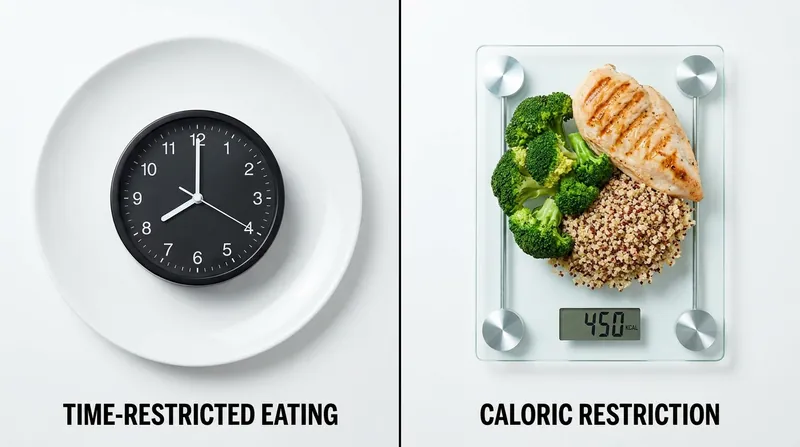
Time-Restricted Eating dictates exactly when food can be consumed, typically compressing meals into an eight-hour window, while the Mediterranean Diet dictates what should be consumed, emphasizing healthy fats, lean proteins, and complex carbohydrates without clock-based restrictions.
Recent landmark trials published in Nature Medicine and The BMJ have finally put these two heavyweights head-to-head, providing granular data on how they alter body composition, visceral fat, and long-term adherence. The findings reveal that neither approach is universally superior; rather, they offer distinct physiological trade-offs that cater to different metabolic needs and lifestyle constraints.[2][4]
To understand the comparative advantage of each protocol, it is essential to examine their underlying mechanisms. Time-Restricted Eating operates primarily by extending the body's natural fasting state, which lowers insulin levels and forces the metabolism to tap into stored glycogen and subcutaneous fat for energy. It effectively creates a caloric deficit by eliminating late-night snacking and reducing the total hours available for consumption.
Conversely, the Mediterranean Diet operates through nutrient density and glycemic control. By prioritizing olive oil, nuts, fish, and fibrous vegetables, it stabilizes blood sugar and reduces systemic inflammation. It does not inherently restrict calories or eating windows, relying instead on the high satiety of its macronutrient profile to naturally regulate appetite. This fundamental divergence—timing versus composition—forms the basis of their respective strengths and weaknesses in clinical applications.[5]
When evaluating Time-Restricted Eating, the "for" argument centers on absolute behavioral simplicity. For individuals overwhelmed by macronutrient tracking, point systems, or complex meal prep, compressing the eating window offers a binary rule: you are either in the eating phase or the fasting phase. This cognitive ease translates to high short-term compliance.
Participants do not need to overhaul their grocery lists or learn new culinary skills; they simply delay their first meal and advance their last. Furthermore, this approach naturally curtails the mindless evening snacking that frequently sabotages traditional calorie-restriction diets, making it a highly effective tool for rapid initial weight reduction.[1][5]
However, the "against" argument for Time-Restricted Eating highlights significant social and physiological friction. Human social life is heavily organized around food, and strict fasting windows often preclude participation in late dinners, morning brunches, or spontaneous workplace meals.
Physiologically, compressing protein intake into a narrow window can make it difficult to consume the necessary amino acids to maintain lean muscle mass, particularly for older adults or active individuals. Furthermore, while short-term adherence is exceptionally high, longitudinal data suggests that compliance drops significantly after the one-year mark, as the rigidity of the fasting window becomes increasingly difficult to reconcile with the unpredictability of daily life.[5]
Looking at the "evidence" row for Time-Restricted Eating, recent clinical data quantifies its exact impact. A 2025 randomized controlled trial published in Nature Medicine tracked 197 adults with obesity, comparing eight-hour restricted eating schedules against a Mediterranean diet control group. The results demonstrated that all time-restricted groups achieved greater absolute weight loss over twelve weeks, shedding an average of 5.3 to 6.8 pounds compared to the control group.
Furthermore, a massive 2025 network meta-analysis in The BMJ, which pooled 99 clinical trials, confirmed that intermittent fasting strategies yield weight loss comparable to strict continuous calorie restriction, with alternate-day fasting showing a slight edge of 1 to 2 percent more weight loss in the short term.[1][2][4]
Shifting the analysis to the Mediterranean Diet, the "for" argument is anchored in unparalleled longevity and cardiovascular health benefits. Unlike fasting protocols, this approach is less of a diet and more of a sustainable dietary pattern. It is rich in monounsaturated fats, omega-3 fatty acids, and antioxidants, which actively repair endothelial function and reduce arterial plaque.
Because it does not restrict meal timing or mandate prolonged fasting, it integrates seamlessly into family meals and social gatherings. The diet encourages the enjoyment of food, including moderate wine consumption and diverse culinary exploration, which fosters a healthy psychological relationship with eating and prevents the binge-restrict cycles common in rigid diet protocols.[3][5]
The "against" argument for the Mediterranean Diet revolves around its lack of built-in caloric boundaries and higher barrier to entry. Because the diet includes calorie-dense foods like olive oil, nuts, and avocados, individuals who struggle with portion control can easily consume a caloric surplus while eating objectively healthy foods.
It requires a baseline level of nutritional literacy and culinary skill, as heavily processed convenience foods are largely excluded. Additionally, the reliance on fresh produce, high-quality seafood, and extra virgin olive oil can significantly increase grocery expenditures, making it less accessible for budget-conscious households compared to simply skipping a meal.[5]
Examining the "evidence" row for the Mediterranean Diet reveals its distinct superiority in specific metabolic markers. While the Nature Medicine trial showed that Time-Restricted Eating won on the scale, it failed to beat the Mediterranean diet for visceral fat loss—the dangerous, metabolically active fat stored around internal organs.
The researchers concluded that dietary quality and adherence play a more pivotal role than meal timing in managing visceral adipose tissue. Furthermore, decades of cohort studies consistently link adherence to a Mediterranean-like diet with substantial reductions in all-cause mortality and cardiovascular disease, a long-term track record that intermittent fasting has yet to replicate in human trials.[2][3]
In a direct head-to-head quantification, the trade-offs become starkly apparent. Time-Restricted Eating reliably produces a 2 to 4 percent greater reduction in total body weight and subcutaneous fat over a three-to-six-month horizon, primarily by enforcing an effortless caloric deficit. Fasting glucose levels also see rapid improvements, particularly when the eating window is shifted to the earlier part of the day.
The Mediterranean Diet, conversely, produces slower initial weight loss but achieves superior reductions in visceral adipose tissue and systemic inflammatory markers. It also boasts a significantly higher retention rate in multi-year longitudinal studies, suggesting that while fasting wins the sprint, dietary quality wins the marathon.[2][4]
Translating these clinical findings into practical application requires matching the protocol to the patient. Time-Restricted Eating fits well when an individual has a highly structured daily routine, struggles primarily with late-night snacking, and experiences decision fatigue when asked to track calories or macronutrients.
It is an excellent intervention for those who naturally lack an appetite in the morning and prefer to consume larger, more satisfying meals later in the day without exceeding their energy requirements. The binary nature of the rules provides a clear, unambiguous boundary that many find liberating rather than restrictive.[5]
Conversely, Time-Restricted Eating does not fit when an individual has a history of disordered eating, as the strict fasting windows can trigger binge-restrict psychological patterns. It is also contraindicated for patients who require morning food intake to buffer specific medications, pregnant women, or highly active athletes who need evenly distributed protein synthesis throughout the day to recover from training. Finally, it is a poor fit for individuals whose professional or social lives demand frequent evening engagements, as the friction of refusing food at social gatherings often leads to protocol abandonment.[5]
The Mediterranean Diet fits well when a person prioritizes long-term cardiovascular health and longevity over rapid, scale-based weight loss. It is the optimal choice for individuals who enjoy cooking, have access to fresh ingredients, and prefer a flexible approach to meal timing that accommodates family dinners and social events. Because it emphasizes satiety through healthy fats and fiber, it is highly effective for those who experience severe hunger pangs or energy crashes on restrictive diets. It serves as a foundational lifestyle shift rather than a temporary weight-loss intervention.[5]
However, the Mediterranean Diet does not fit when an individual requires rigid, unambiguous rules to maintain a caloric deficit. For those who struggle to moderate portions of highly palatable, calorie-dense foods like nuts and olive oil, the lack of strict boundaries can stall weight loss entirely. It is also less suitable for individuals with severe time constraints who rely heavily on convenience foods, or those operating on a strict grocery budget, as the cost of fresh seafood and high-quality produce can be prohibitive compared to standard dietary patterns.[5]
Ultimately, the comparative data underscores that there is no single winner in the realm of nutritional interventions. The efficacy of any protocol is entirely dependent on the specific metabolic goals and psychological disposition of the individual. Time-Restricted Eating offers a powerful, accessible tool for rapid weight reduction and glycemic control through behavioral simplicity.
The Mediterranean Diet provides an unparalleled, evidence-backed framework for visceral fat reduction and long-term cardiovascular health. The most successful approach is the one that an individual can sustain not just for a twelve-week clinical trial, but for a decade of daily life.[5]
Key terms
- Time-Restricted Eating (TRE)
- A dietary strategy that limits daily food consumption to a specific window of time, typically 8 to 10 hours, while fasting for the remainder of the day.
- Visceral Adipose Tissue
- A dangerous type of fat stored deep within the abdominal cavity, surrounding internal organs, which is strongly linked to cardiovascular disease and insulin resistance.
- Subcutaneous Fat
- The visible fat stored just beneath the skin, which is less metabolically harmful than visceral fat.
- Endothelial Function
- The ability of blood vessels to expand and contract properly, a key indicator of cardiovascular health that is improved by nutrient-dense diets.
- Macronutrients
- The three main categories of nutrients that provide energy: carbohydrates, proteins, and fats.
Frequently asked
Does intermittent fasting cause more weight loss than calorie counting?
No. Large meta-analyses show that intermittent fasting yields similar weight loss to continuous calorie restriction, acting primarily as a behavioral tool to help people eat fewer calories.
Which diet is better for losing visceral belly fat?
Recent clinical trials indicate that the Mediterranean Diet is superior for reducing visceral adipose tissue, whereas fasting primarily reduces subcutaneous fat.
Can I drink coffee during the fasting window?
Yes, black coffee and water do not break a fast, as they contain zero calories and do not trigger an insulin response.
Is the Mediterranean diet expensive to follow?
It can be, as it relies heavily on fresh produce, high-quality seafood, and extra virgin olive oil, which generally cost more than heavily processed convenience foods.
Viewpoints in depth
Behavioral Nutritionists
Focus on the psychological ease of adherence and cognitive load.
This camp argues that the primary driver of the obesity epidemic is not a lack of nutritional knowledge, but the cognitive fatigue of constant decision-making in a hyper-palatable food environment. They champion Time-Restricted Eating because it replaces hundreds of micro-decisions about portion size and macronutrients with a single, binary rule: watch the clock. Evidence from short-term trials supports this, showing that removing the option to eat in the evening naturally eliminates the most calorie-dense, low-satiety snacks from a person's diet without requiring them to track a single calorie.
Cardiometabolic Researchers
Prioritize long-term cardiovascular outcomes and visceral fat reduction over absolute scale weight.
Researchers focused on longevity and heart disease emphasize that not all weight loss is metabolically equal. They point to data showing that while fasting protocols effectively reduce subcutaneous fat (the fat just under the skin), they often fail to out-perform standard dietary advice in reducing visceral adipose tissue—the dangerous fat surrounding internal organs that drives systemic inflammation. This camp advocates for the Mediterranean Diet, citing decades of cohort data demonstrating that the specific nutrient profile of olive oil, fish, and nuts actively repairs endothelial function, a benefit that simply skipping meals does not provide.
Sports Dietitians
Focus on muscle preservation, athletic performance, and protein synthesis.
Professionals working with active populations frequently caution against aggressive Time-Restricted Eating. They argue that the body can only utilize a certain amount of protein for muscle synthesis in a single sitting. By compressing all meals into a narrow six-to-eight-hour window, individuals often fail to maximize muscle protein synthesis throughout the day, risking the loss of lean muscle mass alongside fat. This camp generally prefers the Mediterranean Diet or a modified, wider eating window, ensuring that patients maintain their metabolic rate and physical strength during a caloric deficit.
- Metabolic Timing Proponents
- Focus on the physiological benefits of fasting and circadian alignment.
- Dietary Quality Advocates
- Focus on nutrient density, visceral fat, and long-term heart health.
- Pragmatic Lifestyle Analysts
- Focus on real-world adherence, trade-offs, and personalized nutrition.
Perspectives this story doesn't cover
- Individuals with a history of eating disorders, for whom strict fasting windows can be psychologically harmful.
- Shift workers who cannot adhere to standard circadian-aligned eating windows.
Sources
Source coverage
5 outlets
3 viewpoints surfaced





- [1]National Institute on AgingMetabolic Timing Proponents
Timeframe of 8-hour restricted eating irrelevant to weight loss
Read on National Institute on Aging → - [2]Nature MedicineDietary Quality Advocates
Effects of early, late and self-selected time-restricted eating on visceral adipose tissue and cardiometabolic health in participants with overweight or obesity: a randomized controlled trial
Read on Nature Medicine → - [3]Annals of Internal MedicineDietary Quality Advocates
In overweight or obesity, intermittent fasting does not differ from dietary advice but increases weight loss vs. no intervention
Read on Annals of Internal Medicine → - [4]The BMJMetabolic Timing Proponents
Intermittent fasting strategies and their effects on body weight and other cardiometabolic risk factors: systematic review and network meta-analysis of randomised clinical trials
Read on The BMJ → - [5]Factlen Editorial TeamPragmatic Lifestyle Analysts
Synthesis by Factlen editorial team
Read on Factlen Editorial Team →

More in Fitness
See all →GLP-1 Science
The Science of Muscle Preservation on GLP-1 Drugs: Why Resistance Training and High Protein Are Now Essential
4 sources

Nutrition Policy
US Dietary Guidelines Shift Focus to Whole Foods and Explicitly Target Ultra-Processed Carbs
5 sources

Diet Science
Time-Restricted Eating vs. Calorie Counting: What the Latest Clinical Data Reveals
6 sources
Diet Science
Intermittent Fasting vs. Mediterranean Diet: Which Weight Loss Approach Fits You Best?
4 sources

Comments
Every angle. Every day.
Get Fitness stories with full source coverage and perspective breakdowns, free every day.