
How to Plan an EV Road Trip in 2026: The Ultimate Explainer
With the universal adoption of the NACS plug and a massive expansion of fast-charging infrastructure, electric vehicle road trips have transitioned from a stressful gamble to a highly optimized travel experience.
By Factlen Editorial Team
- EV Adopters & Enthusiasts
- Focuses on the quiet, smooth driving experience, lower fuel costs, and the seamless integration of route-planning technology.
- Infrastructure & Industry Experts
- Prioritizes the massive scale-up of public charging ports, grid management, and the standardization of hardware to ensure reliability.
- Environmental & Health Advocates
- Emphasizes the critical reduction in tailpipe emissions and the public health benefits of transitioning away from combustion engines.
What's not represented
- · Rural gas station owners transitioning to EV hubs
- · Grid operators managing local power loads
Why this matters
As electric vehicles reach mass adoption, understanding the mechanics of fast charging and route planning is essential for any driver looking to travel long distances efficiently. Mastering these tools saves hours of travel time, reduces fuel costs, and completely eliminates the fear of being stranded.
Key points
- The US public charging network has expanded to over 288,000 ports by mid-2026.
- The industry-wide adoption of the NACS plug allows most EVs to use the Tesla Supercharger network.
- Drivers should only fast-charge to 80% on road trips, as the charging rate drops significantly afterward.
- Dynamic route-planning apps are essential for calculating stops based on weather, elevation, and charger uptime.
- New 'rechargeries' are replacing isolated chargers with luxury lounges, Wi-Fi, and dining options.
The great American road trip has historically been defined by the spontaneous search for a glowing gas station sign. For years, attempting that same journey in an electric vehicle introduced a modern phobia: range anxiety. But by the summer of 2026, the narrative has fundamentally shifted. The infrastructure has caught up to the ambition, transforming the EV road trip from a pioneer’s gamble into a mainstream, highly optimized travel method.[8]
The sheer scale of the buildout is staggering. As of June 2026, the United States boasts more than 288,000 public charging ports spread across 95,000 locations. Federal initiatives, notably the rebooted National Electric Vehicle Infrastructure (NEVI) program, have mandated fast chargers every 50 miles along major interstate corridors. The question is no longer whether you can make it to your destination, but rather how efficiently you can optimize the journey.[4][8]
Successfully navigating a cross-country electric journey requires a slight but crucial mindset shift. Drivers must unlearn the century-old habit of running the tank to empty and filling it to the brim. Instead, the 2026 EV road trip is governed by software algorithms, charging curves, and a universal plug standard that has finally brought order to a previously fragmented ecosystem.[3][8]
The most significant catalyst for this new era of travel is the industry-wide adoption of the North American Charging Standard (NACS). Originally developed as Tesla’s proprietary connector, NACS—officially designated as SAE J3400—has become the undisputed de facto plug for the continent. Nearly every major automaker has aligned with the standard, ending the frustrating era of arriving at a station only to find the wrong cable.[1][2][8]

For drivers hitting the road in 2026, this standard manifests in two ways. Newer EV models are rolling off assembly lines with native NACS ports built directly into the chassis. Meanwhile, drivers of older vehicles equipped with the legacy Combined Charging System (CCS) utilize automaker-provided adapters. Both setups grant seamless access to the sprawling Tesla Supercharger network, which remains the gold standard for uptime and reliability.[1][2]
This interoperability has profoundly simplified route planning. When a Ford, Rivian, or Hyundai can plug into the same high-speed network as a Tesla, the map of available routes expands exponentially. Charging networks are also deploying dual CCS and NACS configurations, pushing the total number of universally accessible high-speed ports to record highs and effectively eliminating the "charging deserts" that once plagued rural routes.[2][8]
But having access to chargers is only half the equation; understanding the physics of the battery is the other. The golden rule of the modern EV road trip is the 20–80% charging window. Unlike a gas tank, which fills at a constant rate from empty to full, an electric vehicle battery accepts power on a variable "charging curve."[3][8]
But having access to chargers is only half the equation; understanding the physics of the battery is the other.
Industry experts often compare DC fast charging to pouring water into a glass. You can pour rapidly when the glass is empty, but you must slow to a trickle as it nears the top to avoid spilling. In an EV, the battery management system throttles the influx of electricity as the state of charge approaches 80% to protect the battery cells from heat degradation.[3]

Consequently, attempting to charge an EV to 100% at a highway fast charger is a rookie mistake that wastes valuable travel time. The final 20% can take as long as the first 80%. Veteran EV road-trippers optimize their travel by making slightly more frequent, shorter stops—typically 15 to 20 minutes—unplugging the moment the charging curve drops off, and continuing down the highway.[3][6]
To execute this "hopscotch" strategy flawlessly, drivers rely heavily on specialized software. Winging it is strongly discouraged. Applications like A Better Routeplanner (ABRP) and native in-car navigation systems have become the co-pilots of the electric age. These tools do not just plot a line on a map; they perform complex, dynamic calculus.[3][6][8]
A modern route planner factors in the specific make and model of the vehicle, the starting battery percentage, and real-time variables that affect efficiency. If the route involves climbing a steep mountain pass, driving into a stiff headwind, or navigating freezing temperatures, the software automatically adjusts the estimated range and recalculates the necessary charging stops to ensure a safe buffer.[3][6]
Furthermore, crowdsourced applications like PlugShare provide a critical layer of real-time intelligence. Users check in to stations, report broken screens, and confirm successful charging sessions. This allows drivers to verify the operational status of a charger before they are committed to it, and to always identify a backup station within their remaining range—a practice that effectively neutralizes the fear of being stranded.[3][6]

The hardware at these stops is also evolving rapidly. The 2026 landscape is increasingly dominated by ultra-fast chargers capable of delivering 350 kilowatts or more. For vehicles with advanced 800-volt architectures, these stations can add nearly 200 miles of range in under 15 minutes. This technological leap is narrowing the time gap between an electric charge and a traditional gas station fill-up.[5][8]
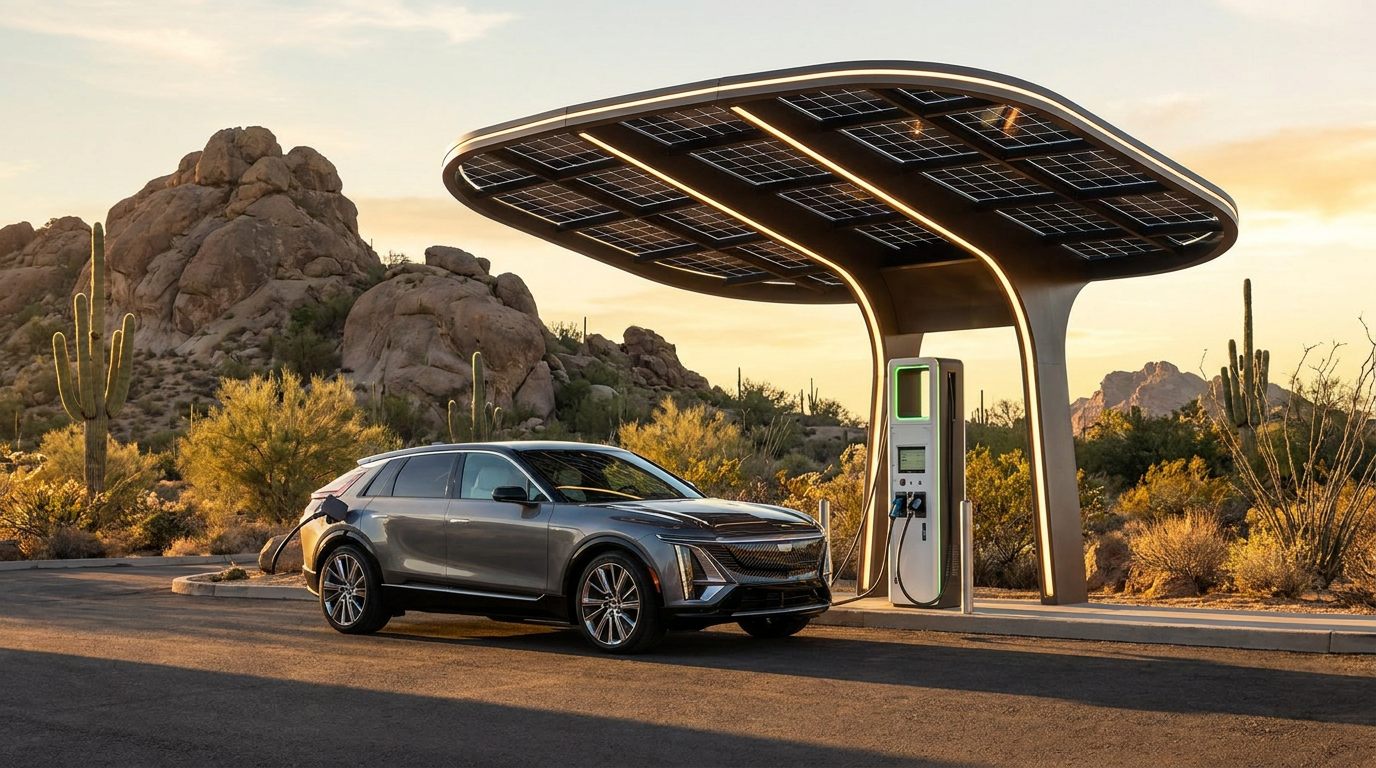
The physical environment of the charging stop is transforming alongside the technology. The industry is moving away from placing chargers in the desolate corners of big-box store parking lots. Instead, developers are building dedicated "rechargeries"—multi-fuel hubs and luxury lounges equipped with Wi-Fi, clean restrooms, and quality dining options, turning the mandatory 20-minute pause into a welcome respite.[7][8]

Ultimately, the 2026 EV road trip is not just a greener alternative; for many, it is a superior travel experience. The absence of engine noise and vibration reduces driver fatigue, while the lower cost of electricity compared to gasoline yields significant savings over long distances. By embracing the rhythm of the charging curve and the power of smart routing, drivers are discovering that the electric highway is wide open.[4][8]
How we got here
Late 2023
Major automakers begin announcing the shift from the CCS plug to Tesla's NACS connector.
2024–2025
Automakers distribute NACS adapters to existing EV owners, opening up the Supercharger network.
Early 2026
The NEVI federal funding program reboots, accelerating the deployment of highway charging corridors.
Mid 2026
The US surpasses 288,000 public charging ports, making EV road trips viable nationwide.
Viewpoints in depth
The EV Driver's View
Embracing the new rhythm of road travel through technology and planned breaks.
For veteran EV drivers, the road trip is no longer a source of anxiety but an exercise in optimization. This camp emphasizes that the transition requires unlearning the 'gas station mentality.' Instead of driving until the tank is empty, EV drivers sync their charging sessions with natural biological breaks—meals, restroom stops, and leg-stretching. By leveraging advanced route-planning software and adhering strictly to the 20–80% charging curve, they argue that electric travel is actually less fatiguing, significantly cheaper per mile, and far quieter than traditional combustion-engine travel.
The Infrastructure Provider's View
Focusing on hardware standardization, grid capacity, and the economics of fast-charging networks.
Network operators and hardware manufacturers view the 2026 landscape as a triumph of standardization. The industry-wide pivot to the North American Charging Standard (NACS) was a watershed moment that drastically reduced the capital expenditure required to support multiple plug types. This camp is now focused on the next frontier: deploying 350-kilowatt ultra-fast chargers and integrating Vehicle-to-Grid (V2G) technologies. Their primary challenge is balancing the massive, intermittent power demands of highway fast-charging hubs with local grid capacities, often necessitating on-site battery storage and solar canopies to smooth out the load.
The Public Health View
Highlighting the invisible benefits of zero-emission highway corridors.
Environmental and public health organizations look beyond the logistics of the road trip to the macro-level impacts of mass EV adoption. This perspective highlights that replacing millions of combustion-engine miles with zero-emission travel directly correlates to reduced rates of asthma, cardiovascular disease, and premature death, particularly in communities situated near major interstate highways. For this camp, the rapid expansion of NEVI-funded charging infrastructure is not just a convenience for vacationers, but a critical public health intervention that cleans the air along the nation's busiest transportation corridors.
What we don't know
- How well the local power grids in highly remote tourist destinations will handle peak holiday charging surges.
- The exact timeline for when legacy CCS chargers will be fully phased out or retrofitted across all minor networks.
Key terms
- NACS (North American Charging Standard)
- The universal charging connector standard, originally developed by Tesla, now adopted by nearly all major automakers in North America.
- DC Fast Charging (Level 3)
- High-power charging stations found along highways that can recharge an EV battery to 80% in 15 to 30 minutes.
- Charging Curve
- The rate at which an EV battery accepts power, which starts fast when the battery is empty and slows down significantly as it approaches 100%.
- State of Charge (SoC)
- The current energy level of an electric vehicle's battery, expressed as a percentage.
- Preconditioning
- The process where an EV automatically warms or cools its battery to the optimal temperature before arriving at a fast charger to maximize charging speed.
Frequently asked
Do I need to charge my EV to 100% at every stop?
No. Fast charging slows down dramatically after 80% to protect the battery. For road trips, it is much faster to charge to 80% and make slightly more frequent stops.
What happens if a charging station is broken?
Modern route-planning apps like PlugShare and ABRP provide real-time crowdsourced data on charger functionality. It is always recommended to have a backup station planned within your remaining range.
Can non-Tesla vehicles use Superchargers now?
Yes. By 2026, most major automakers have adopted the NACS standard, allowing their vehicles to use the Tesla Supercharger network either natively or via an approved adapter.
Sources
Source coverage
8 outlets
3 viewpoints surfaced








[1]GreenCarsEnvironmental & Health Advocates
NACS Charging in 2026: The Plug Conversation Gets Practical
Read on GreenCars →[2]CharINInfrastructure & Industry Experts
The shift to NACS: What it means for the future of EV charging in North America
Read on CharIN →[3]Plug In AmericaEV Adopters & Enthusiasts
A Comprehensive Guide for First-Time EV Road-Trippers
Read on Plug In America →[4]American Lung AssociationEnvironmental & Health Advocates
Defeating Range Anxiety: Charging Stations Galore
Read on American Lung Association →[5]DriivzInfrastructure & Industry Experts
Six Predictions Shaping the EV Charging Industry in 2026
Read on Driivz →[6]iChargeEV Adopters & Enthusiasts
How to Plan a Road Trip with an EV — Your Complete Guide
Read on iCharge →[7]ChevySUVEV Adopters & Enthusiasts
Charging Network Expansion in 2026: Where New EV Fast Chargers Are Coming
Read on ChevySUV →[8]Factlen Editorial TeamEV Adopters & Enthusiasts
Synthesis by Factlen editorial team
Read on Factlen Editorial Team →
Every angle. Every day.
Get travel stories with full source coverage and perspective breakdowns delivered to your inbox.