
How to Maximize Heat Pump Efficiency and Lifespan
Heat pumps can achieve up to 500% efficiency by moving heat rather than generating it, but improper operation and neglected maintenance can quickly erase those savings. Here is the definitive guide to keeping your system running optimally.
By Factlen Editorial Team
- Energy Efficiency Advocates
- Focus on emissions reduction, grid impact, and maximizing thermal transfer efficiency.
- HVAC Professionals
- Focus on system longevity, proper refrigerant handling, and preventing mechanical failures.
- Consumer Advocates
- Focus on lowering monthly utility bills, DIY maintenance, and practical operation.
What's not represented
- · Renters who cannot control their building's HVAC maintenance
- · Residents in extreme cold climates requiring specialized dual-fuel setups
Why this matters
Heat pumps can slash home heating bills and carbon emissions, but treating them like traditional furnaces can accidentally trigger massive electricity spikes. Understanding how to operate and maintain these systems is essential for homeowners looking to protect their investment and maximize their monthly savings.
Key points
- Heat pumps achieve 300% to 500% efficiency by moving ambient heat rather than burning fuel to create it.
- Lowering the thermostat at night can force the system to use inefficient backup heating, erasing energy savings.
- Replacing indoor air filters every one to three months is the most critical DIY maintenance task for preserving airflow.
- Annual professional servicing is required to check refrigerant levels, which drastically impact system efficiency.
As millions of households transition away from fossil-fuel heating, the electric heat pump has emerged as the cornerstone of the modern, energy-efficient home. Unlike traditional gas furnaces or baseboard heaters that consume fuel to generate warmth, heat pumps operate on a fundamentally different principle: they move heat from one place to another. This mechanical advantage allows them to achieve efficiencies that border on the magical, often delivering three to five times more energy than they consume.[1][2]
But that remarkable efficiency is not guaranteed. A heat pump is a sophisticated thermal transfer system, and its performance is highly sensitive to how it is operated and maintained. The U.S. Department of Energy notes that the difference in energy consumption between a well-maintained heat pump and a severely neglected one can range from 10% to 25%. Understanding the mechanics of the system is the first step toward unlocking its full financial and environmental benefits.[2]
To grasp why maintenance matters, it helps to understand the underlying metrics of heat pump efficiency. The most universal measure is the Coefficient of Performance (COP), which provides a snapshot of efficiency under specific conditions. A COP of 4.0 means that for every single unit of electrical energy the system consumes, it outputs four units of heat energy—an efficiency of 400%. By comparison, the most advanced high-efficiency gas furnaces top out at around 98% efficiency, because combustion can never yield more energy than is stored in the fuel itself.[3][4]

Because real-world temperatures fluctuate, the industry also uses seasonal metrics. In the United States, heating efficiency is measured by the Heating Seasonal Performance Factor (HSPF2), while cooling efficiency is tracked via the Seasonal Energy Efficiency Ratio (SEER2). As of recent regulatory updates, the Department of Energy requires all new split-system heat pumps to meet a minimum HSPF2 of 7.5 and a SEER2 of 14.3, though high-efficiency models routinely score much higher.[3][4]
Achieving these laboratory-grade ratings in a real home requires a shift in how residents interact with their thermostats. For decades, energy conservation advice dictated that homeowners should turn down the thermostat when leaving the house or going to sleep. With heat pumps, this "setback" strategy can actually increase energy bills.[2][6]
The reason lies in the system's backup heating mechanism. Heat pumps are designed to maintain a steady temperature using their highly efficient compressor. If a homeowner drops the temperature by ten degrees at night and then demands a rapid warm-up in the morning, the heat pump may not be able to bridge the gap quickly enough. To compensate, the system will trigger its auxiliary electric resistance heaters—often referred to as "heat strips." These backup heaters operate at a mere 100% efficiency, consuming massive amounts of electricity and entirely defeating the purpose of the heat pump.[2][6]
Consequently, the golden rule of heat pump operation is "set it and forget it." Finding a comfortable baseline temperature and leaving the thermostat alone allows the inverter-driven compressor to hum along at a low, steady, and highly efficient speed. Furthermore, experts advise against using the "Auto" mode on the thermostat, which can cause the system to wastefully toggle between heating and cooling on days with wide temperature swings. Instead, manually select "Heat" in the winter and "Cool" in the summer.[6]
Instead, manually select "Heat" in the winter and "Cool" in the summer.
Beyond thermostat habits, the single most impactful action a homeowner can take is managing the system's airflow. Heat pumps require a massive, unimpeded volume of air to extract or reject heat effectively. The primary bottleneck for this airflow is the indoor air filter.[2][7]
HVAC professionals universally recommend checking and replacing indoor air filters every one to three months. A clogged filter forces the blower motor to work exponentially harder to pull air through the system. This not only drives up electricity consumption but also alters the pressure and temperature dynamics over the indoor coil, which can lead to the system freezing up or the compressor overheating.[2][7]

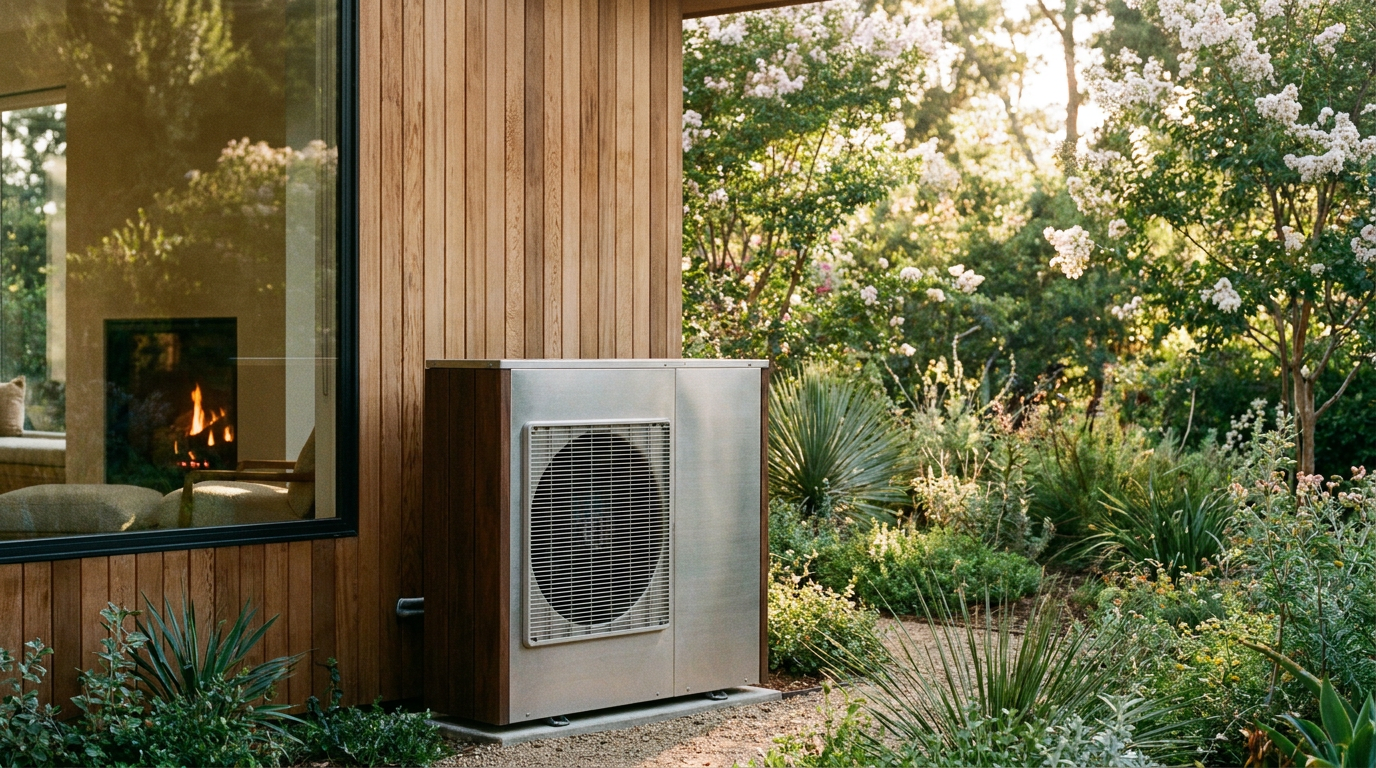
Airflow management extends to the exterior of the home as well. The outdoor unit, known as the condenser, must be able to breathe freely. Homeowners should regularly inspect the perimeter of the unit, ensuring that leaves, grass clippings, snow, and encroaching vegetation are cleared away. A minimum clearance of 18 to 24 inches on all sides is standard practice to prevent the system from suffocating.[5][7]
The physical cleanliness of the heat pump's coils is equally critical. The outdoor condenser coils are exposed to the elements and can quickly become caked in dirt, pollen, and debris, which acts as an insulating blanket that traps heat. Homeowners can gently wash the outdoor coils with a garden hose on a low-pressure setting, but they must be careful not to use high-pressure nozzles or power washers, which can easily bend the delicate aluminum fins and permanently restrict airflow.[5][7]
While filter changes and exterior clearing are firmly in the realm of do-it-yourself maintenance, the internal mechanics of a heat pump require professional oversight. Because these systems operate year-round—handling both heating and cooling duties—they accumulate wear and tear twice as fast as a standalone air conditioner or furnace.[5]
Annual or bi-annual professional servicing is considered essential for long-term reliability. During a tune-up, a certified technician will measure the system's refrigerant charge. Even a slight refrigerant leak can devastate a heat pump's efficiency, forcing the compressor to run continuously to meet the thermostat's demands. Unlike a filter change, handling refrigerant requires specialized gauges and environmental certifications.[2][4][5]

A professional technician will also inspect the system's electrical terminals, lubricate moving parts, and test the reversing valve—the crucial component that switches the flow of refrigerant to change the system from an air conditioner into a heater. They will also verify the operation of the defrost cycle, which prevents the outdoor unit from turning into a block of ice during cold, humid winter days.[2][7]
Ultimately, a heat pump is an investment in long-term comfort and decarbonization. While the initial installation can be costly, the operational savings are profound. By adhering to steady thermostat settings, maintaining rigorous airflow hygiene, and partnering with professionals for annual checkups, homeowners can ensure their system delivers on its promise of 400% efficiency for decades to come.[1][5]
Viewpoints in depth
Energy Efficiency Advocates
Focus on the environmental and grid-level benefits of optimized heat pumps.
For environmental agencies and grid operators, heat pump maintenance is a macro-level priority. When millions of heat pumps operate at peak efficiency, it dramatically reduces the overall strain on the electrical grid during winter peaks. Advocates emphasize that poorly maintained systems relying on inefficient electric resistance backup heaters can cause localized grid stress, making proper consumer education a critical component of national decarbonization strategies.
HVAC Professionals
Emphasize the mechanical necessity of preventative maintenance to avoid catastrophic failures.
Technicians view heat pumps through the lens of mechanical wear and tear. Because these systems run year-round for both heating and cooling, their compressors and blower motors endure double the workload of traditional split systems. HVAC professionals argue that annual servicing is not just about lowering utility bills, but about catching minor issues—like a slow refrigerant leak or a failing capacitor—before they destroy the compressor, which is the most expensive component to replace.
Cost-Conscious Homeowners
Prioritize immediate utility savings and accessible DIY maintenance.
For the average consumer, the primary appeal of a heat pump is the promise of slashed utility bills. This perspective focuses heavily on the actionable, low-cost steps that protect that investment. Homeowners in this camp prioritize regular filter changes, clearing debris from the outdoor unit, and learning the 'set it and forget it' thermostat method to prevent the costly activation of auxiliary heat strips.
What we don't know
- Exactly how long a specific heat pump will last, as lifespan heavily depends on local climate severity and the rigor of annual maintenance.
- How future dynamic electricity pricing models might change the 'set it and forget it' advice for heat pump operation.
Key terms
- Coefficient of Performance (COP)
- A metric showing how much heat a system produces for every unit of electricity it consumes at a specific moment.
- HSPF2
- Heating Seasonal Performance Factor; a rating that measures a heat pump's heating efficiency over an entire winter season.
- SEER2
- Seasonal Energy Efficiency Ratio; a rating that measures a heat pump's cooling efficiency over an entire summer season.
- Reversing Valve
- A mechanical component inside a heat pump that reverses the flow of refrigerant, allowing the system to switch between heating and cooling modes.
- Auxiliary Heat
- Inefficient electric resistance heaters built into the system that activate only when the heat pump cannot meet the thermostat's demand quickly enough.
Frequently asked
Why is my heat pump blowing cool air in the winter?
Heat pumps output air at a lower temperature than gas furnaces, usually around 90-100°F. While this feels cool to the touch compared to your body temperature, it is still warm enough to efficiently heat your home.
Should I turn my heat pump down at night to save money?
No. Lowering the temperature at night can force the system to use highly inefficient electric backup heaters to warm the house back up in the morning. It is better to 'set it and forget it'.
Can I cover my heat pump in the winter to protect it from snow?
No. Heat pumps need massive amounts of airflow to extract heat from the outside air. Covering the unit will suffocate it and prevent it from working.
How often do I really need to change the filter?
Experts recommend checking the filter monthly and replacing it every one to three months, depending on dust levels, pet hair, and system usage.
Sources
Source coverage
7 outlets
3 viewpoints surfaced







[1]Factlen Editorial TeamConsumer Advocates
Synthesis by Factlen editorial team
Read on Factlen Editorial Team →[2]U.S. Department of EnergyEnergy Efficiency Advocates
Proper Operation and Maintenance of Heat Pumps
Read on U.S. Department of Energy →[3]CarrierHVAC Professionals
Understanding Heat Pump Efficiency Ratings
Read on Carrier →[4]TraneHVAC Professionals
What is HSPF2? Heat Pump Efficiency Explained
Read on Trane →[5]DaikinHVAC Professionals
Regular heat pump maintenance for a long life
Read on Daikin →[6]BC HydroEnergy Efficiency Advocates
Heat pump maintenance and operation
Read on BC Hydro →[7]BKV EnergyHVAC Professionals
The Ultimate Heat Pump Maintenance Checklist
Read on BKV Energy →

Every angle. Every day.
Get home stories with full source coverage and perspective breakdowns delivered to your inbox.