
The 2026 Quantum Leap: How 'Logical Qubits' Finally Solved Computing's Biggest Error Problem
After decades of struggling with fragile hardware, quantum computing has officially entered the fault-tolerant era. Breakthroughs in error correction mean adding more qubits now makes systems more stable, unlocking the path to commercially viable quantum power.
By Factlen Editorial Team
- Quantum Hardware Engineers
- Focused on the physical and mathematical milestones of error suppression.
- Commercial Enterprise Adopters
- Focused on hybrid integration and near-term business value.
- Scientific Researchers
- Focused on unlocking molecular simulation and materials discovery.
What's not represented
- · Post-quantum cryptography experts preparing for the eventual threat to current encryption standards.
Why this matters
Fault-tolerant quantum computers will eventually simulate molecular structures and chemical reactions that classical supercomputers cannot touch, revolutionizing drug discovery, battery materials, and advanced manufacturing.
Key points
- Quantum computing has officially exited the 'noisy' era and entered the fault-tolerant era.
- Engineers have proven that adding more physical qubits now exponentially decreases logical error rates.
- Multiple hardware architectures, including superconducting circuits and neutral atoms, are hitting the same milestones.
- Future systems will operate as hybrid models, with quantum chips acting as specialized accelerators for classical supercomputers.
For decades, quantum computing has been trapped in a frustrating paradox: the very properties that make quantum mechanics so powerful also make it incredibly fragile. Engineers have long known that harnessing quantum states could unlock unprecedented computational power, but keeping those states stable proved to be one of the hardest physics challenges of the century.[1]
Entering 2026, the industry was stuck in what researchers called the Noisy Intermediate-Scale Quantum (NISQ) era. Processors were limited to a few hundred "physical qubits" that would lose their computational state—a process called decoherence—in fractions of a millisecond. This extreme sensitivity to heat and environmental noise made deep, complex calculations nearly impossible.[2]
But 2026 has marked a definitive turning point, shifting quantum computing from a theoretical physics problem into a scalable engineering discipline. The breakthrough isn't just about building bigger chips; it is about fundamentally solving the error problem that has held the technology back.[1][2]
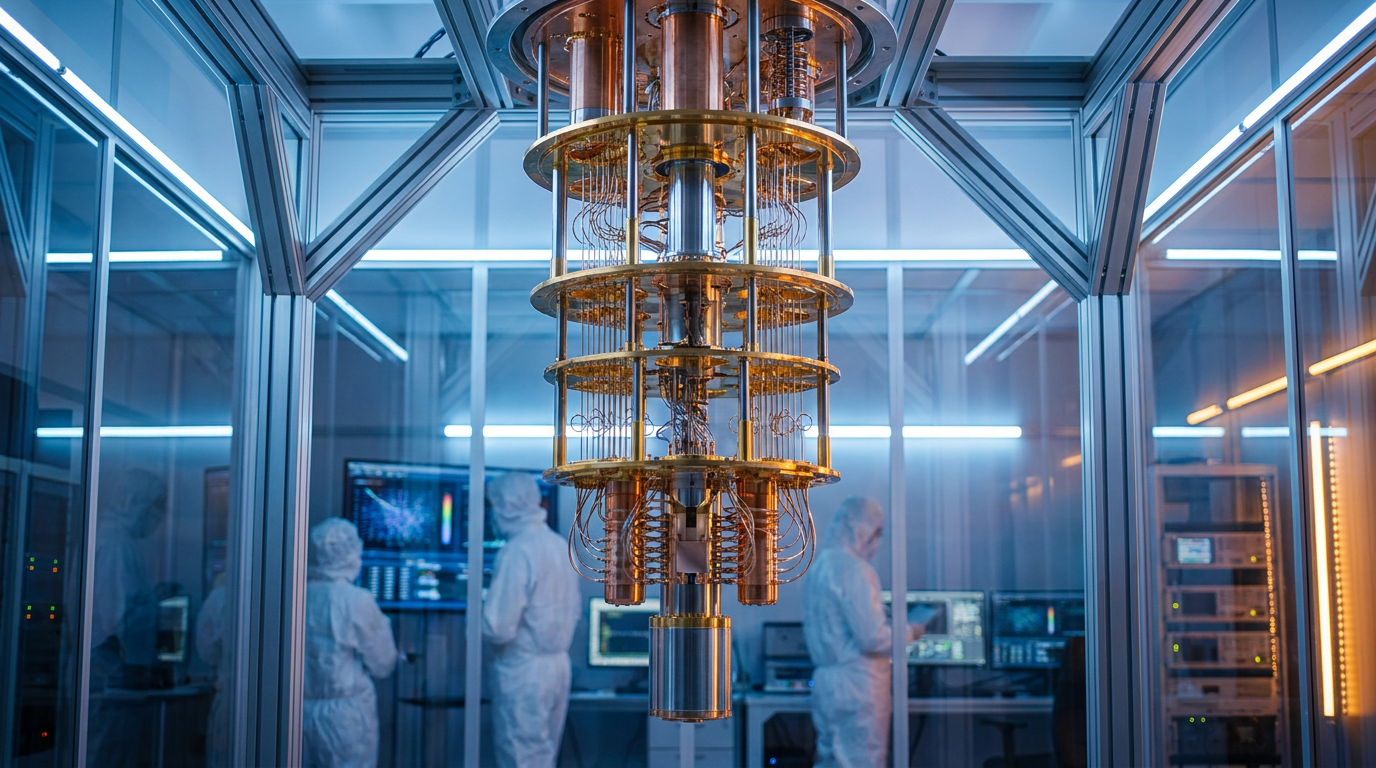
The key to this transition is the "logical qubit." Unlike a physical qubit, which is a single, error-prone quantum system like a superconducting circuit or a trapped ion, a logical qubit is a highly stable virtual construct.[4]

By grouping dozens or even hundreds of physical qubits together using advanced error-correction codes, engineers can create a single logical qubit. If one physical qubit flips or fails due to environmental noise, the surrounding qubits detect and correct the error before it corrupts the calculation.[4][6]
Historically, this approach faced a mathematical wall. Adding more physical qubits to a system required more control wiring and generated more heat, which introduced more noise than the error-correction codes could fix. It was a vicious cycle where bigger systems simply meant faster failures.[6]
That barrier has now been shattered. Multiple organizations have demonstrated "below-threshold" error correction, proving that as they increase the number of physical qubits encoding a logical qubit, the overall error rate actually decreases exponentially.[6][7]
Google's Willow processor provided one of the most striking demonstrations of this exponential error suppression. By scaling up their surface-code lattice, Google showed that their logical error rates dropped dramatically, proving that fault-tolerant quantum computing obeys the scaling curves theorists predicted years ago.[2][6]

Google's Willow processor provided one of the most striking demonstrations of this exponential error suppression.
Meanwhile, Microsoft partnered with Atom Computing to tackle the problem using a completely different architecture: neutral atoms manipulated by lasers. They successfully created and entangled highly accurate logical qubits that can be continuously stabilized while a computation is actively running.[5][7]
This capability—mid-circuit measurement and continuous error correction without collapsing the delicate quantum state—is the holy grail of fault-tolerant computing. It means the system is actively detecting and fixing problems in real-time, much like how biological systems maintain homeostasis.[6][7]
IBM has also pushed the field forward with its Heron and Condor processors, focusing heavily on "quantum-centric supercomputing." Rather than trying to make a quantum computer do everything, IBM's architecture seamlessly integrates quantum processors with classical supercomputers.[3][5]
In these hybrid workflows, standard classical computers handle the bulk of the data processing, while the quantum processing unit is treated like a highly specialized accelerator. It is called upon only to solve the specific, exponentially complex bottlenecks that classical chips cannot crack.[2][5]

QuEra, another major player in the neutral-atom space, recently demonstrated a 30-logical-qubit system, reinforcing that multiple distinct hardware paths—from superconducting circuits to neutral atoms—are converging on the same fault-tolerant threshold simultaneously.[2][5]
The implications for engineering-intensive industries are profound. While today's systems are not yet ready to break encryption or run global logistics networks, the math is now on a predictable scaling path that enterprise leaders can plan around.[2][4]
Once systems reach roughly 1,000 logical qubits, they will be able to simulate molecular structures and chemical reactions with perfect accuracy. This capability will allow researchers to design new battery materials, discover life-saving drugs, and optimize industrial catalysts without relying on physical trial and error.[2][6]

Despite the massive optimism, significant engineering hurdles remain. Scaling from dozens of logical qubits to thousands will require massive advancements in cryogenic cooling, laser control systems, and the sheer physical footprint of the hardware.[1][4]
Furthermore, the software stack required to translate real-world chemistry problems into quantum circuits is still in its infancy. Developers must build entirely new algorithmic libraries that can take advantage of fault-tolerant hardware.[4]
How we got here
Pre-2024
The NISQ Era (Noisy Intermediate-Scale Quantum), where processors were too error-prone for deep calculations.
2024-2025
Early demonstrations of logical qubits by Harvard, QuEra, and Microsoft proved error correction was theoretically possible.
Early 2026
Google's Willow chip and Atom Computing demonstrated 'below-threshold' error suppression, proving scalability.
Late 2026
The industry officially shifts focus from raw physical qubit counts to stable logical qubit performance.
Viewpoints in depth
Quantum Hardware Engineers
Focused on the physical and mathematical milestones of error suppression.
For the engineers building the hardware, 2026 is the year the math finally worked. For decades, the field was haunted by the reality that adding more physical qubits to a system introduced more noise than the error-correction codes could handle. The recent demonstrations of 'below-threshold' scaling—where increasing the lattice size actually drives the logical error rate down exponentially—validates years of theoretical physics. Their focus is now entirely on scaling the control wiring, cryogenic cooling, and laser precision required to support thousands of logical qubits.
Commercial Enterprise Adopters
Focused on hybrid integration and near-term business value.
Industry analysts and enterprise IT leaders are less concerned with the physics of decoherence and more focused on how quantum processors integrate into existing tech stacks. This camp champions the 'quantum-centric supercomputing' model, where classical CPUs and GPUs handle 99% of a workload, outsourcing only the most complex mathematical bottlenecks to a quantum processing unit via the cloud. For them, the 2026 milestones mean they can finally begin writing algorithms for fault-tolerant systems, preparing their logistics and chemistry pipelines for the day hardware reaches commercial scale.
Scientific Researchers
Focused on unlocking molecular simulation and materials discovery.
Chemists and materials scientists view fault-tolerant quantum computing as the ultimate simulation engine. Because the natural world operates on quantum mechanics, classical computers struggle to accurately simulate even relatively simple molecules. Researchers are closely tracking the march toward 1,000 logical qubits, the estimated threshold where quantum computers will be able to model complex chemical reactions without physical trial and error. This capability promises to revolutionize battery design, fertilizer production, and drug discovery.
What we don't know
- Exactly how much physical space and energy will be required to cool and control a commercially viable 1,000-logical-qubit system.
- Which underlying hardware architecture (superconducting circuits, neutral atoms, or topological qubits) will ultimately dominate the market.
- How quickly software developers can build the necessary algorithmic libraries to take advantage of fault-tolerant hardware.
Key terms
- Decoherence
- The process by which a quantum system loses its delicate quantum state due to interference from the outside environment.
- Physical Qubit
- The actual, tangible hardware component (like a superconducting circuit or trapped ion) that stores quantum information.
- Logical Qubit
- A highly stable, virtual qubit created by networking multiple physical qubits together using error-correction algorithms.
- Fault Tolerance
- The ability of a computing system to continue operating properly even when individual components fail or produce errors.
- Superposition
- A fundamental principle of quantum mechanics where a qubit can exist in multiple states simultaneously, allowing for massive parallel processing.
Frequently asked
What is a logical qubit?
A logical qubit is a highly stable, virtual unit of computation created by networking many physical qubits together using error-correction codes.
Why is error correction so important?
Quantum states are incredibly fragile and easily disrupted by heat or noise. Without error correction, complex calculations fail before they can finish.
Will quantum computers replace my laptop?
No. Quantum computers are specialized tools for solving exponentially complex math and chemistry problems. They will work alongside classical computers, not replace them.
When will quantum computers be commercially useful?
With the 2026 breakthroughs in fault tolerance, experts predict practical quantum advantage for specific chemistry and materials science problems within the next 5 to 10 years.
Sources
Source coverage
7 outlets
3 viewpoints surfaced







[1]Factlen Editorial TeamQuantum Hardware Engineers
Synthesis by Factlen editorial team
Read on Factlen Editorial Team →[2]BQPSimCommercial Enterprise Adopters
The 2026 Quantum Computing Milestones: From Physics to Engineering
Read on BQPSim →[3]LumiChatsScientific Researchers
What IBM and Google Actually Achieved in 2026
Read on LumiChats →[4]SpinQuantaScientific Researchers
2026 Qubit Breakthroughs: The Fault-Tolerant Foundation Era
Read on SpinQuanta →[5]Wissen ResearchCommercial Enterprise Adopters
Quantum Computing in 2026: Breakthroughs and Hybrid Systems
Read on Wissen Research →[6]CyberNativeQuantum Hardware Engineers
Below-Threshold Quantum Error Correction Explained
Read on CyberNative →[7]SubstackQuantum Hardware Engineers
Atom Computing and the Sub-Threshold Error Correction Milestone
Read on Substack →

Every angle. Every day.
Get technology stories with full source coverage and perspective breakdowns delivered to your inbox.