
How Thomas Tuchel Rebuilt England: The Tactical Blueprint for the 2026 World Cup
Under Thomas Tuchel, England has abandoned traditional 'English grit' for a sophisticated positional play system, prioritizing team chemistry and aggressive counter-pressing over individual star power.
By Factlen Editorial Team
- System Purists
- Analysts who praise the structural dominance, positional play, and counter-pressing that Tuchel has implemented.
- Tournament Pragmatists
- Observers who value the team's defensive solidity and Tuchel's willingness to use direct tactics as a Plan B.
- Individual Talent Advocates
- Skeptics who question the risk of leaving generational, creative talents at home in favor of system players.
What's not represented
- · Opposition Managers
- · Domestic Club Managers
Why this matters
For a nation that has endured 60 years of tournament heartbreak, Tuchel's ruthless structural overhaul represents England's most calculated attempt yet to win a major trophy. By prioritizing a cohesive system over a collection of stars, the team offers a fascinating case study in modern international football tactics.
Key points
- Thomas Tuchel has transformed England into a possession-dominant 'attacking engine' built on positional play.
- The team transitions from a 4-2-3-1 into an aggressive 3-2-5 shape when in possession.
- Tuchel controversially omitted star players like Phil Foden to prioritize team chemistry and specific tactical roles.
- Harry Kane operates as a false nine, dropping deep to create space for direct runners like Marcus Rashford.
- Despite the aesthetic system, Tuchel has integrated pragmatic tactics like long throws for knockout football.
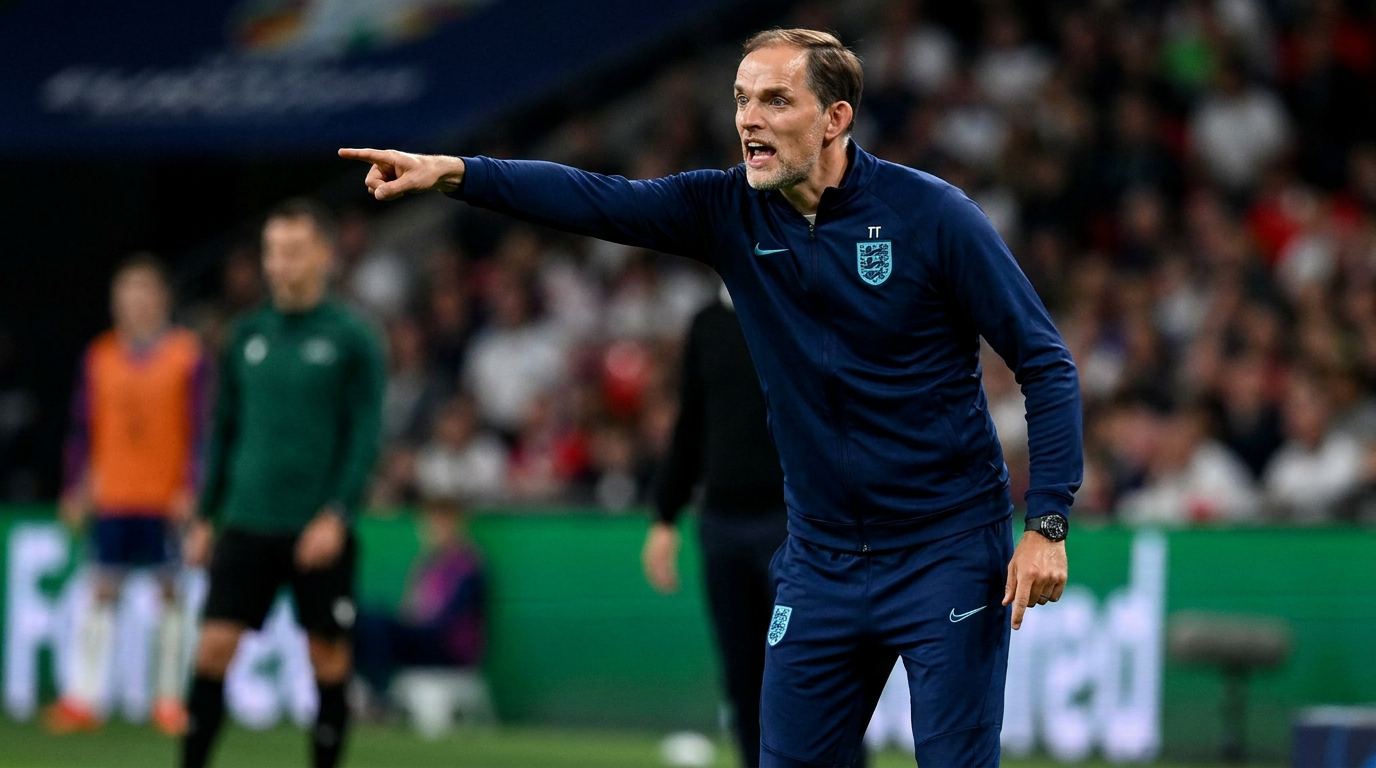
As the 2026 FIFA World Cup kicks into high gear across North America, the narrative surrounding the England national team is unlike any in recent memory. For decades, the Three Lions have been defined by a familiar cycle of generational talent, immense public pressure, and eventual knockout-stage heartbreak. But under the stewardship of Thomas Tuchel, who took the reins in late 2024, the traditional reliance on "English grit" and individual brilliance has been entirely dismantled. In its place stands a sophisticated, highly calibrated tactical machine built on the principles of positional play and relentless counter-pressing. Tuchel's mandate is singular and clear: end the 60-year wait for a major men's international trophy. To achieve this, the German tactician has transformed England into what data analysts are calling an "attacking engine," a system designed to suffocate opponents through structural dominance rather than relying on moments of isolated magic.[1][4][6]
The foundation of this new era was laid during a flawless qualification campaign that quietly redefined the team's identity. England arrived in the United States as the only European nation to progress through the qualifying rounds without conceding a single goal. This defensive perfection was not the result of a deep, conservative block—a frequent criticism of the Gareth Southgate era—but rather a byproduct of absolute control. In all eight of their qualifying matches, Tuchel's side never held less than 70 percent of possession. By monopolizing the ball and compressing the pitch, England effectively starved their opponents of transition opportunities, proving that a high-functioning offensive system can simultaneously serve as the ultimate defensive shield.[1]
Perhaps the most striking evidence of Tuchel's ruthless commitment to his system came during the squad selection process in May. In a move that sent shockwaves through the English press, the manager omitted several of the Premier League's most productive attackers, including Phil Foden, Cole Palmer, and Trent Alexander-Arnold. Instead of trying to shoehorn eleven superstars onto the pitch, Tuchel prioritized specific profiles that fit his tactical blueprint. He has been candid about this philosophy, noting that the best group is not necessarily a collection of the most talented individuals, but rather those who create the best chemistry. This calculated gamble underscores a fundamental shift in English football culture: the system is now the star.[2][6]

On paper, England lines up in a flexible 4-2-3-1 formation, but this starting shape is merely a defensive reference point. The true nature of Tuchel's blueprint reveals itself when the team has possession. As they build out from the back, the structure fluidly morphs into an aggressive 3-2-5 or even a 3-1-6. This transformation is heavily reliant on the versatility of the full-backs. Reece James, when deployed on the right, frequently tucks inside to act as a third central defender, providing a secure base for ball circulation. Conversely, the opposite full-back is given the license to push high and wide, joining the attacking line to stretch the opposition's defensive block to its breaking point.[1][5][6]
At the heart of this positional fluidity is a revamped midfield pivot that balances defensive solidity with progressive passing. Declan Rice remains the undisputed anchor, but his role has evolved. Rather than sitting rigidly in front of the defense, Rice is encouraged to push up into the half-spaces, utilizing the ball-carrying ability that makes him so effective at the club level. To facilitate this, Tuchel has introduced Nottingham Forest's Elliot Anderson as Rice's primary partner. Anderson has been a revelation, providing the necessary tactical discipline to cover the spaces Rice vacates, while simultaneously serving as the team's primary progressive passer from deep areas.[1][4]
Anderson's statistical profile perfectly illustrates why Tuchel values him over more traditional, static defensive midfielders. Averaging nearly nine progressive passes per 90 minutes, Anderson actively moves the play forward rather than merely circulating possession sideways. Crucially, he also averages over ten ball recoveries per 90 minutes, highlighting the immense defensive workload he carries. This combination of vertical passing and relentless ball-winning is the engine room of Tuchel's setup, allowing England to transition rapidly from defense to attack while maintaining a secure structure behind the ball.[4]

Anderson's statistical profile perfectly illustrates why Tuchel values him over more traditional, static defensive midfielders.
Ahead of the double pivot, the attacking quartet operates with a level of synchronized movement rarely seen in international football. Jude Bellingham occupies the nominal number 10 role, but Tuchel has been careful not to burden the Real Madrid star with the sole responsibility of creating chances. Bellingham is utilized as a dynamic, box-to-box presence who links play through central areas and arrives late in the penalty box to finish moves. By sharing the creative burden across the front line, Tuchel has ensured that if an opponent successfully man-marks Bellingham, the system possesses enough alternative mechanisms to break down a low block.[1][5]
The linchpin of these attacking mechanisms is captain Harry Kane, who operates less as a traditional striker and more as a false nine. Kane frequently drops deep into the midfield to receive possession, dragging opposition center-backs out of position and creating numerical overloads in the center of the pitch. His elite passing range and vision allow him to dictate the tempo of the attack, effectively turning him into a secondary playmaker. While this role occasionally takes him away from the penalty area, his ability to hold up the ball under pressure is vital for England's structured build-up play.[4][5][6]
Kane's tendency to drop deep creates a tactical necessity for direct, vertical runners who can exploit the space he vacates behind the opposition's defensive line. This is where the wide players become crucial. Bukayo Saka remains a fixture on the right flank, offering relentless one-on-one ability and intelligent inside runs. On the left, the recall of Marcus Rashford provides the perfect counterbalance. Rashford's instinct is to stay wide, threaten the space behind the defense, and offer a direct outlet through well-timed sprints. This push-pull dynamic—Kane dropping short while Rashford and Saka sprint long—makes England's front line incredibly difficult to contain.[2][4]

While the attacking patterns are highly choreographed, Tuchel's defensive philosophy is equally aggressive. The moment possession is lost, England does not retreat into a compact shape. Instead, they initiate a fierce counter-press, aiming to suffocate the opponent and win the ball back within seconds. The forwards trigger the press by closing down the center-backs, forcing predictable passes, while the midfield and full-backs step forward aggressively to compress the space and win second balls. This high-wire act requires immense physical conditioning and tactical discipline, but it ensures that the game is played almost entirely in the opposition's half.[4][6]
Despite this commitment to aesthetic, positional football, Tuchel has not abandoned the dark arts of tournament play. In a surprising admission ahead of the World Cup, the manager revealed that he has been actively drilling his team on long throw-ins and direct kicks from the goalkeeper. Recognizing that knockout football often descends into chaotic, fine-margin battles, Tuchel wants his side to possess a pragmatic Plan B. By integrating set-piece dominance and direct play into an otherwise sophisticated possession system, he is attempting to build a team capable of winning ugly when the beautiful game fails to produce a breakthrough.[3]

As England navigates the group stages and looks toward the knockout rounds, the ultimate test of Tuchel's blueprint is underway. The squad's dominant early performances, including a commanding pre-tournament victory over Costa Rica, suggest that the players have fully internalized the manager's complex demands. The defensive structure looks impenetrable, the midfield is balanced, and the attacking rotations are fluid. Yet, the true measure of this tactical revolution will not be found in possession statistics or expected goals, but in how the team responds when faced with the elite opposition that has historically been their undoing.[1][5]
For a nation that lives and breathes the game, the shift from emotional, star-driven football to a cold, calculated tactical machine represents a profound cultural adjustment. Tuchel has gambled his reputation on the belief that structure and chemistry will ultimately triumph over individual brilliance. If his positional play system can successfully navigate the treacherous waters of the World Cup knockout stages, he will not only end 60 years of hurt but also permanently redefine the identity of the England national team. The pieces are all in place; now, the machine must execute.[1][6]
How we got here
October 2024
Thomas Tuchel is appointed as the manager of the England national team, replacing Gareth Southgate.
November 2025
England completes their World Cup qualifying campaign with zero goals conceded.
May 2026
Tuchel announces his 26-man World Cup squad, controversially omitting several high-profile stars to prioritize system fit.
June 2026
England arrives in North America for the World Cup, debuting their refined tactical system.
Viewpoints in depth
System Purists
Analysts who praise the structural dominance and counter-pressing that Tuchel has implemented.
For tactical purists, Tuchel's England is a masterclass in modern footballing principles. They point to the team's flawless qualifying record—zero goals conceded while maintaining over 70% possession—as proof that the best defense is absolute control of the ball. By implementing a strict positional play system, Tuchel has eliminated the chaotic transitions that often plagued previous England sides. Analysts argue that the fluid 3-2-5 attacking shape, anchored by the disciplined double pivot of Declan Rice and Elliot Anderson, allows England to suffocate opponents in their own half, making them the most structurally sound team in the tournament.
Tournament Pragmatists
Observers who value the team's defensive solidity and Tuchel's willingness to use direct tactics as a Plan B.
Pragmatists are less concerned with the aesthetics of possession and more focused on Tuchel's ruthless edge. They highlight his surprising admission that England has been practicing long throw-ins and direct kicks from the goalkeeper as a stroke of genius for knockout football. In the high-stakes environment of a World Cup, where elite defenses can neutralize intricate passing networks, having a physical, direct Plan B is essential. This camp believes that Tuchel's willingness to win ugly, combined with a defense that refuses to concede, gives England the exact tournament DNA they have lacked for 60 years.
Individual Talent Advocates
Skeptics who question the risk of leaving generational, creative talents at home in favor of system players.
A vocal contingent of fans and pundits remains deeply skeptical of Tuchel's squad selection. By leaving out generational talents like Phil Foden, Cole Palmer, and Trent Alexander-Arnold, they argue that Tuchel has stripped the team of players capable of producing moments of isolated magic when the tactical system fails. This camp fears that if an elite opponent successfully neutralizes England's primary attacking patterns, the team will lack the individual brilliance necessary to unlock a stubborn defense. They view the prioritization of "chemistry" over pure talent as a massive gamble that could backfire spectacularly on the biggest stage.
What we don't know
- How the highly structured system will hold up when England goes behind against elite opposition.
- Whether the omission of creative wildcards like Phil Foden will haunt the team in tight knockout matches.
Key terms
- Positional Play (Juego de Posición)
- A tactical philosophy where the pitch is divided into specific zones, and players are tasked with occupying those zones to maintain structural balance and numerical superiority.
- Counter-pressing (Gegenpressing)
- The tactic of immediately attempting to win the ball back high up the pitch the moment possession is lost, rather than retreating into a defensive shape.
- False Nine
- A center-forward who frequently drops deep into the midfield to link up play, pulling opposition defenders out of position.
- Double Pivot
- Two central defensive midfielders who operate together to shield the defense and dictate the tempo of the team's passing.
Frequently asked
Why were players like Phil Foden and Cole Palmer left out?
Thomas Tuchel prioritized tactical balance and specific roles over individual brilliance, opting for players who naturally fit his high-pressing, positional system.
What formation does England play under Tuchel?
They nominally line up in a 4-2-3-1, but this fluidly shifts into a 3-2-5 or 3-1-6 when England has possession of the ball.
Who is playing alongside Declan Rice in midfield?
Nottingham Forest's Elliot Anderson has emerged as the preferred partner, providing high defensive work rates and progressive passing.
How does Harry Kane fit into this system?
Kane operates as a false nine, dropping deep into the midfield to link play and create space for fast wingers like Bukayo Saka and Marcus Rashford to run behind the defense.
Sources
Source coverage
6 outlets
3 viewpoints surfaced






[1]The GuardianIndividual Talent Advocates
England World Cup 2026 team guide: tactics, key players and expert predictions
Read on The Guardian →[2]beIN SportsIndividual Talent Advocates
Tuchel completely reshaped England ahead of the World Cup
Read on beIN Sports →[3]Goal.comTournament Pragmatists
England manager Thomas Tuchel reveals he wants team to use long throws in bid to win World Cup 2026
Read on Goal.com →[4]Daily MirrorSystem Purists
You only need these 4 charts to understand Thomas Tuchel's World Cup masterplan
Read on Daily Mirror →[5]Deccan HeraldTournament Pragmatists
Thomas Tuchel's England Take Shape Ahead of FIFA World Cup 2026
Read on Deccan Herald →[6]365ScoresSystem Purists
The Tuchel Era: A German Architect at Wembley
Read on 365Scores →
More in sports
See all 8 stories →Standings
The 2026 Global Ice Hockey Championship Picture: Final Standings and Summer Stakes
0 sources

Injury
MLB Aces Complete Long Road Back: Cole, Musgrove Headline Wave of Successful UCL Recoveries
0 sources
Women's Boxing
The 3-Minute Round Debate Reshaping Women's Boxing
0 sources
Standings
Global Baseball Standings: Underdogs Surge and Juggernauts Pace the Leagues in June 2026
0 sources

Every angle. Every day.
Get sports stories with full source coverage and perspective breakdowns delivered to your inbox.