
How the Brain Builds a Sentence, Neuron by Neuron
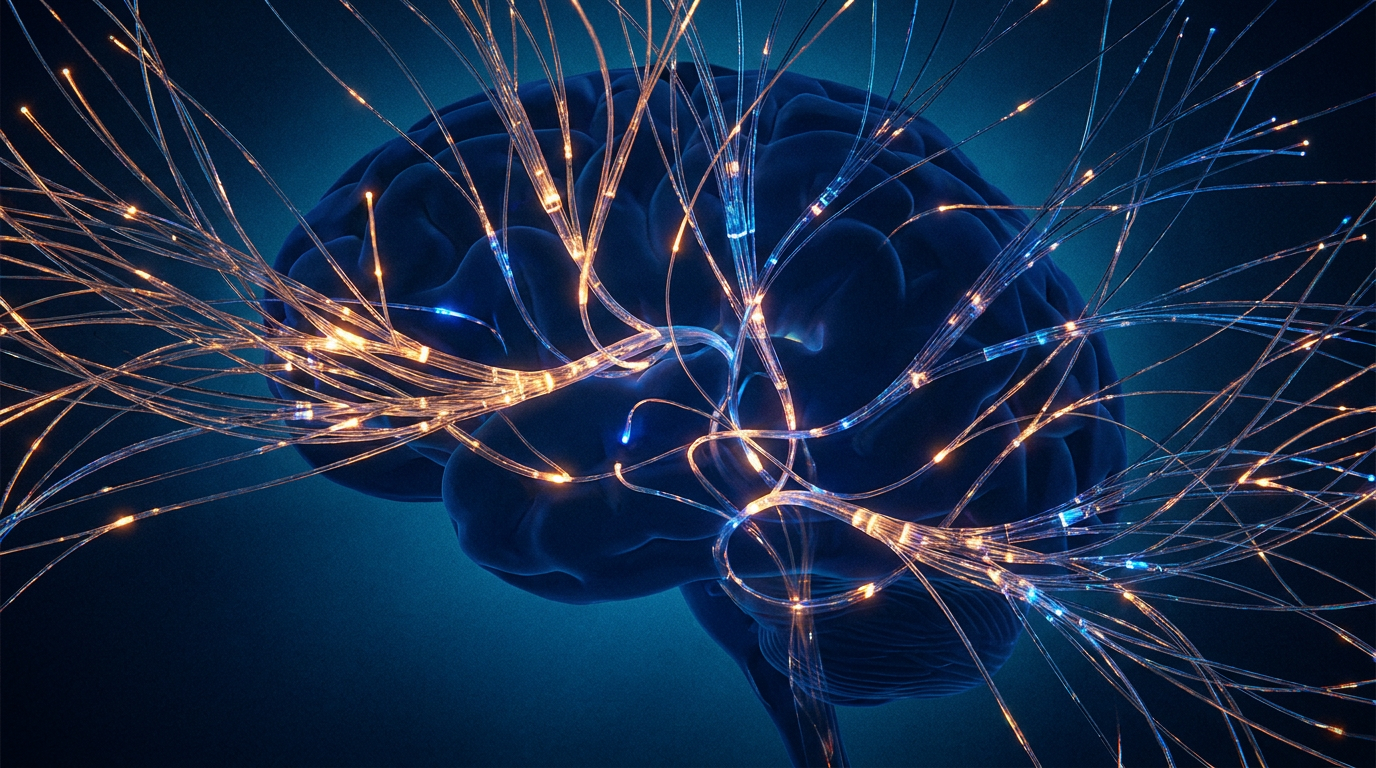
By tracking the electrical activity of individual brain cells during natural conversation, scientists have discovered how neurons encode the meaning of words and predict speech before it happens.
By Factlen Editorial Team
- Neuroscientists & BCI Developers
- Focus on mapping the brain's linguistic architecture to build next-generation brain-computer interfaces.
- Clinical Rehabilitation Specialists
- Prioritize the translation of neural decoding into therapies that restore communication for paralyzed patients.
- Cognitive Linguists
- Analyze how single-cell data redefines our understanding of human semantics, grammar, and the evolution of language.
What's not represented
- · Bioethicists on neural privacy
- · Patients living with locked-in syndrome
Why this matters
Understanding how the brain processes language at the cellular level is the critical missing link for developing advanced neuroprosthetics. This breakthrough paves the way for brain-computer interfaces that could seamlessly restore natural, conversational speech for individuals paralyzed by ALS, strokes, or severe injuries.
Key points
- Researchers tracked the electrical activity of individual neurons in the human brain during natural, unscripted conversations.
- Specific neurons act as a microscopic thesaurus, encoding the abstract meaning of words and concepts rather than just sounds.
- Machine-learning models successfully predicted what a person was going to say before the words were spoken.
- The networks for speaking and listening partially overlap, with specific cellular shifts occurring during conversational turn-taking.
- The findings provide a critical foundation for developing advanced brain-computer interfaces to help paralyzed patients communicate.
The speed of human speech is a cognitive marvel. In the flow of natural conversation, a person produces an average of three words per second. In those fractions of a second, the brain must seamlessly retrieve vocabulary, apply complex grammatical rules, and coordinate the intricate motor movements of the mouth, tongue, and vocal cords.
For decades, the precise biological mechanism of how the brain orchestrates this feat at the cellular level has remained a profound mystery. While functional MRI scans have successfully identified broad regions of the brain responsible for language, they measure blood flow rather than electrical impulses, lacking the resolution to see individual cells at work.
Now, a landmark body of research published in the journal Nature has provided an unprecedented look at the brain's linguistic architecture. By tracking the electrical activity of individual neurons in real-time, scientists have discovered exactly how the brain builds a sentence from the ground up.[1]
The research, led by a team of investigators at Massachusetts General Hospital and Harvard Medical School, utilized a cutting-edge technology to peer into the living brain. The scientists relied on microelectrode arrays, including advanced Neuropixels probes, which are capable of recording the firing patterns of single cells.[3][6]

These arrays were temporarily implanted in the brains of a small group of patients who were already undergoing invasive monitoring for severe epilepsy. With the patients' consent, the researchers recorded the activity of hundreds of single neurons in the prefrontal and frontotemporal cortex—regions long associated with language—while the individuals participated in unscripted, naturally flowing conversations.[2][3]
The resulting data revealed a highly specialized division of labor among brain cells. Rather than a single language center firing all at once, the researchers discovered that specific neurons are dedicated to the most basic building blocks of speech.[1][2]
For example, the researchers observed that certain neurons consistently fired just milliseconds before a patient articulated a specific phoneme, such as the consonant "da." Other distinct groups of cells were responsible for taking those phonemes and assembling them into syllables, acting as the brain's microscopic typesetters.[3]
But the cellular specialization extends far beyond the mere mechanical production of sound. By applying advanced machine-learning and natural language processing models to the neural data, the team uncovered neurons that encode the actual meaning of words.[4][5]

These semantic neurons are capable of distinguishing between different abstract concepts. The neural signature that activates when a person processes the concept of an "animal"—such as hearing or preparing to say the word "dog"—is distinctly different from the neural pattern that fires for the concept of a "car."[1][3]
These semantic neurons are capable of distinguishing between different abstract concepts.
Remarkably, the researchers found that they could predict what a person was going to say before the words were ever spoken. By monitoring the firing patterns of a relatively small number of neurons, the AI models could reliably decode the intended consonants, vowels, and general concepts the person was formulating.[3][5]
The study also illuminated the intricate biological dance between speaking and listening. The neural recordings demonstrated that comprehending speech and producing speech rely on a partially shared network of neurons distributed throughout the frontal and temporal lobes.[4]
Furthermore, the researchers identified specific, time-aligned shifts in cellular activity that occur when a person transitions from listening to a conversation partner to speaking themselves. This neural pivot represents the fundamental biological rhythm of human turn-taking in conversation.[4]
This level of granularity is not just a triumph of basic neuroscience; it represents a critical stepping stone for clinical applications. The ability to decode lexical semantic information—the actual meaning of thoughts—from neural activity opens entirely new frontiers for brain-computer interfaces.[2][7]

Current brain-computer interfaces, which are designed to help paralyzed patients communicate, largely rely on decoding the intended motor movements of the vocal tract or having patients spell words letter by letter on a screen. These methods, while groundbreaking, are often slow, cognitively demanding, and lack the natural cadence of speech.[7]
By tapping directly into the neurons that represent abstract concepts and word meanings, future neuroprosthetics could bypass the motor system entirely. This would allow a device to translate a patient's intended concepts into synthesized speech at the speed of a natural conversation.[3][8]
Such technology could be profoundly transformative for individuals who have lost the ability to speak due to neurodegenerative conditions like amyotrophic lateral sclerosis, severe strokes, or traumatic brain injuries.[3][7]
Despite the profound implications, the researchers emphasize that the technology is still in its infancy and faces significant hurdles. The current studies rely on invasive intracranial recordings, which carry surgical risks and cannot be easily scaled to the general public.[5][8]

Additionally, while the machine-learning models can decode basic semantic features with an accuracy significantly above chance—roughly 21 percent compared to a 10 percent baseline—the decoding is not yet perfect.[5]
Capturing the full nuance of human language, including sarcasm, metaphor, complex emotional undertones, and highly abstract philosophical concepts, remains a monumental challenge that will require mapping vastly larger networks of cells.[4][8]
The next phase of research will focus on expanding these semantic decoding capabilities across a wider diversity of languages and ecological contexts. By revealing how the brain builds a sentence neuron by neuron, science has taken a major step toward understanding our most uniquely human trait, paving the way for technologies that could one day give a voice back to those who have lost it.[5][8]
How we got here
2018
Researchers develop adaptive deep brain stimulation devices that can record brain activity in home environments.
2020
Neuroscientists successfully map the 3D shapes and electrical properties of thousands of individual neurons in the mammalian brain.
Early 2024
Initial studies demonstrate that single neurons in the human brain represent basic speech sounds like consonants and vowels.
June 2026
Researchers successfully use machine learning to decode the semantic meaning of words from single-cell activity during natural conversation.
Viewpoints in depth
Neuroscientists & BCI Developers
Focus on mapping the brain's linguistic architecture to build next-generation brain-computer interfaces.
For researchers building brain-computer interfaces, the discovery of semantic neurons is a paradigm shift. Historically, neuroprosthetics have focused on decoding the motor cortex—trying to intercept the brain's instructions to the lips, tongue, and jaw. By proving that individual neurons in the frontotemporal cortex encode abstract concepts and word meanings before they are spoken, developers can now design systems that decode the intent of speech rather than just the mechanics. This conceptual decoding is seen as the key to achieving natural, conversational speeds in future speech-restoration devices.
Clinical Rehabilitation Specialists
Prioritize the translation of neural decoding into therapies that restore communication for paralyzed patients.
Clinicians view these findings through the lens of patient quality of life. Conditions like ALS, locked-in syndrome, and severe strokes rob individuals of their ability to interact with loved ones, leading to profound isolation. Rehabilitation specialists argue that while the neuroscience is fascinating, the true value of the research lies in its potential to bypass damaged motor pathways entirely. They advocate for accelerating the translation of these invasive microelectrode studies into safe, long-term implantable devices that can give non-verbal patients a reliable, expressive voice.
Cognitive Linguists
Analyze how single-cell data redefines our understanding of human semantics, grammar, and the evolution of language.
For linguists, the ability to observe the brain building a sentence neuron by neuron settles decades-old debates about how language is physically represented in the mind. The finding that specific neurons act as a microscopic thesaurus—firing for the concept of 'animal' regardless of the specific word used—provides biological proof for theories of semantic networks. Linguists are particularly interested in the discovery that the networks for speaking and listening partially overlap, suggesting that human communication evolved as a deeply integrated, reciprocal system rather than two separate cognitive processes.
What we don't know
- How the brain encodes highly abstract concepts, metaphors, and emotional undertones at the single-neuron level.
- Whether semantic decoding can be achieved using non-invasive technologies rather than surgically implanted microelectrodes.
- How these neural language networks differ across individuals who speak multiple languages or have developmental speech disorders.
Key terms
- Neuropixels probes
- Advanced microelectrode arrays that can simultaneously record the electrical activity of hundreds of individual neurons with high precision.
- Phoneme
- The smallest unit of sound in speech, such as the 'd' sound in 'dog', which neurons assemble to build spoken words.
- Semantic decoding
- The process of using machine learning to extract the actual meaning of words and concepts from brain activity, rather than just the physical sounds.
- Frontotemporal cortex
- A region of the brain located near the front and sides that is heavily involved in language production, comprehension, and cognitive processing.
- Brain-computer interface
- A system that translates brain activity into commands for external devices, often used to help paralyzed patients communicate or control prosthetics.
Frequently asked
How fast does the human brain process speech?
During natural conversation, the human brain processes and produces about three words per second, seamlessly coordinating vocabulary, grammar, and motor movements.
How did researchers record individual neurons?
Scientists used Neuropixels probes—microelectrode arrays temporarily implanted in the brains of patients undergoing monitoring for severe epilepsy.
Can this technology read people's minds?
No. While the models can decode specific word meanings and concepts from neural activity during active conversation, the technology requires invasive brain implants and is currently limited to basic semantic features, not complex inner thoughts.
Who will benefit from this research?
The primary goal is to develop advanced brain-computer interfaces that can restore natural speech for individuals who have lost the ability to communicate due to ALS, strokes, or traumatic brain injuries.
Sources
Source coverage
8 outlets
3 viewpoints surfaced






[1]NatureNeuroscientists & BCI Developers
Single-neuronal elements of speech production in humans
Read on Nature →[2]National Institutes of HealthClinical Rehabilitation Specialists
Researchers discover single-cell brain activity that underlies human speech
Read on National Institutes of Health →[3]Massachusetts General HospitalNeuroscientists & BCI Developers
Study discovers neurons in the human brain that can predict what we say
Read on Massachusetts General Hospital →Natural language processing models reveal neural dynamics of human conversation
Read on Nature Communications →[5]bioRxivNeuroscientists & BCI Developers
Decoding lexical semantic information from stereo-electroencephalography recordings during spontaneous conversation
Read on bioRxiv →[6]Harvard Medical SchoolClinical Rehabilitation Specialists
How the Brain Builds Language
Read on Harvard Medical School →[7]National Institute on DeafnessClinical Rehabilitation Specialists
Advancing Brain-Computer Interfaces for Speech Restoration
Read on National Institute on Deafness →[8]Factlen Editorial TeamCognitive Linguists
Synthesis by Factlen editorial team
Read on Factlen Editorial Team →


Every angle. Every day.
Get science stories with full source coverage and perspective breakdowns delivered to your inbox.