
SpaceX Options Trading Shatters Records Following Historic $75 Billion IPO
Just days after executing the largest initial public offering in history, SpaceX has ignited the derivatives market with unprecedented options volume. The launch offers retail and institutional investors new ways to navigate the aerospace giant's massive market debut and its surprise $60 billion acquisition of AI startup Cursor.
By Factlen Editorial Team
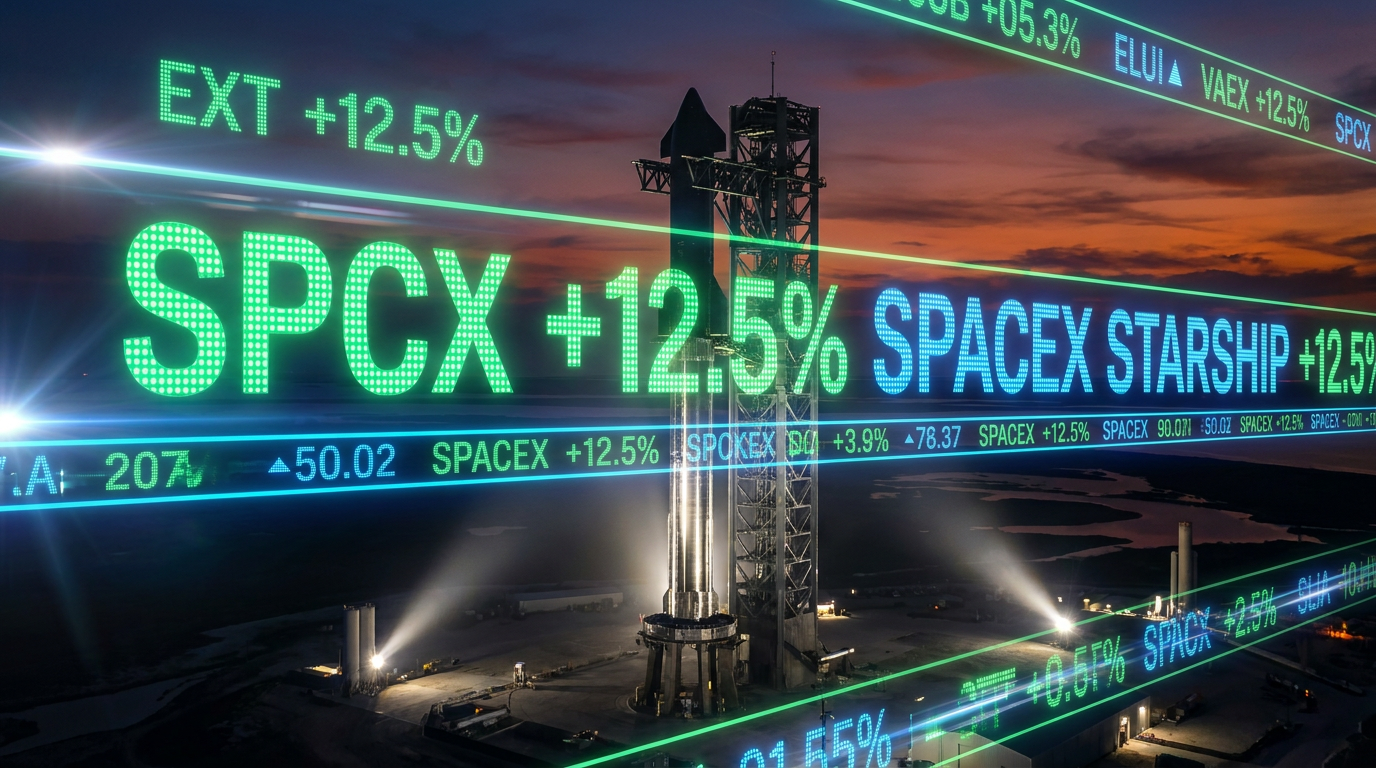
- Institutional Bulls
- Views the unprecedented volume and the $60 billion Cursor acquisition as validation of SpaceX's multi-trillion-dollar tech dominance.
- Retail Options Traders
- Focuses on capitalizing on extreme implied volatility through premium selling and defined-risk spreads.
- Fundamental Analysts
- Warns that the current price action is distorted by a 4% free float and cautions about the upcoming lock-up expiry.
What's not represented
- · Early SpaceX Employees
- · Competitor Aerospace Firms
Why this matters
The launch of SpaceX options provides a rare, real-time look at how modern financial markets digest a multi-trillion-dollar mega-cap listing. Understanding these extreme volatility dynamics empowers retail investors to use defined-risk strategies rather than gambling on overpriced premiums.
Key points
- SpaceX options trading launched with record-breaking volume just days after its historic $75 billion IPO.
- Implied volatility for near-term contracts exceeded 200%, making options premiums exceptionally expensive.
- SpaceX announced a $60 billion all-stock acquisition of AI coding startup Cursor, fueling bullish market sentiment.
- Options experts advise retail traders to use defined-risk strategies like vertical spreads rather than buying naked options.
- Analysts warn that the stock's rapid surge is magnified by a tiny 4% free float, which will change drastically in December.
The financial world witnessed history on June 12, 2026, when Space Exploration Technologies Corp. executed the largest initial public offering ever recorded. Pricing its shares at $135, SpaceX raised a staggering $75 billion, instantly cementing a valuation north of $2 trillion. The sheer scale of the debut captivated Wall Street, but the true structural earthquake struck the market a few days later. When the stock surged past $200 per share in its opening sessions, it set the stage for an unprecedented derivatives launch that would test the limits of modern market mechanics.[7]
On June 16, options trading for SpaceX—under the ticker SPCX—officially went live across major exchanges. The launch triggered what executives at Cboe Global Markets described as the most aggressive first-day trading activity ever recorded for a newly listed equity. Retail and institutional investors alike flooded the options chain, eager to leverage the aerospace giant's massive momentum. The immediate influx of capital transformed the SPCX options board into a hyper-liquid battleground, defying the usual sluggishness associated with brand-new derivatives markets.[4]
The underlying stock's massive trading volume was the catalyst for this smooth options rollout. With over 230 million shares changing hands in the early days of trading, market makers found themselves in an incredibly liquid environment. This deep pool of available shares allowed institutional market makers to execute their delta hedges instantly, offloading their directional risk without moving the underlying price. As a result, they were able to offer surprisingly tight bid-ask spreads—sometimes as narrow as 5 to 10 cents on active strikes—a rarity for a stock that had only been public for 48 hours.[6]
Traders immediately gravitated toward bullish bets, betting heavily on SpaceX's continued ascent. The put-call ratio stood at a heavily skewed 0.7, indicating that trading volume in bearish put options was 30% lower than the activity in bullish calls. One conspicuously massive trade caught the attention of derivatives analysts across the Street: a single institutional trader purchased 7,000 call contracts with a strike price of $325 expiring in July. For that specific trade to wind up in the money, SpaceX shares would need to surge more than 50% in a matter of weeks.[4]

Adding high-octane fuel to the market's enthusiasm was a surprise corporate maneuver announced just as the options market opened. SpaceX revealed a $60 billion all-stock acquisition of the artificial intelligence coding startup Cursor. The blockbuster deal immediately signaled that CEO Elon Musk views the newly public entity not just as an aerospace and satellite communications provider, but as a foundational player in the generative AI arms race.[2][7]
For Cursor, the acquisition serves as a massive lifeline and a strategic pivot. The startup had recently faced intense competition from Anthropic's Claude Code, leading some in the tech community to question its long-term viability. Now, backed by SpaceX's immense capital and integrated into the broader xAI ecosystem, Cursor is positioned to reclaim its crown as a heavyweight in the AI coding space. The market digested the $60 billion price tag as a bold, aggressive expansion of SpaceX's total addressable market.[2]
However, the combination of a record-breaking IPO, a blockbuster AI acquisition, and a newly minted options chain created extreme pricing dynamics. Implied volatility—the market's mathematical forecast of a likely movement in a security's price—reached staggering levels. Because a new options chain on a stock with no pricing history is structurally different from any established market, market makers were forced to price premiums from scratch, using only the stock's violent post-IPO surges as their primary reference point.[5]
However, the combination of a record-breaking IPO, a blockbuster AI acquisition, and a newly minted options chain created extreme pricing dynamics.
The resulting premiums were historic. On the first day of options trading, the implied volatility for June contracts expiring in just two days hit an astronomical 201%, while July options sat at 125%. The term structure showed a massive 91 percentage-point spread from the front month to long-term expiries, with no historical data to anchor the pricing. This extreme volatility means that the options themselves are incredibly expensive, pricing in massive daily swings in the underlying stock.[5][6]

This environment presents both lucrative opportunities and significant risks for retail traders looking to participate. Because the options premiums are so inflated, buying naked calls or puts requires a massive outlay of capital and carries a low probability of profit if the stock simply trades sideways. A naked short put on a near-the-money strike, for instance, might require upwards of $16,000 in buying power just to hold the position, effectively pricing out smaller retail accounts.[6]
To navigate this, options experts are advising retail investors to act as premium sellers or to utilize strictly defined-risk strategies. One popular approach gaining traction is writing cash-covered puts at the original $135 IPO strike price. By selling these puts, an investor collects a massive upfront premium. If the stock remains above $135, the investor keeps the cash as pure profit; if the stock falls below that level, they are obligated to buy the shares, but at an effective cost basis well below the initial IPO price.[3]
Other derivatives analysts recommend vertical spreads to mitigate the extreme capital requirements. By turning a naked short put into a vertical spread—simultaneously buying a lower-strike put to cap the downside risk—a trader can drop the buying power requirement from $16,000 down to just $350. This allows retail participants to trade the high implied volatility of SpaceX without exposing their portfolios to catastrophic losses if the stock suddenly reverses course.[6]
Despite the euphoric trading and the sophisticated options strategies being deployed, fundamental analysts are urging caution regarding the stock's underlying mechanics. The rapid surge from the $135 IPO price to over $200 per share was significantly magnified by a remarkably small free float. The laws of supply and demand are currently heavily skewed in favor of early buyers, creating a scarcity premium that may not reflect the company's long-term equilibrium value.[4]

Currently, only about 4% of total SpaceX shares are freely available to be traded by the public. The remaining 96% of the company's equity—held by insiders, early venture capitalists, and employees—is strictly locked up until December 2026. When that massive supply of shares finally hits the open market, the thin-float dynamic that drove the initial price explosion could rapidly reverse, testing the stock's true valuation and potentially crushing over-leveraged call buyers.[4][7]
Furthermore, the company's aggressive capital expenditures are coming under the microscope of institutional analysts. While the Starlink satellite division generated a healthy $4.4 billion in operating profit last year, the company's AI division is burning through billions in operating losses as it builds out massive data centers. The $60 billion Cursor acquisition only adds to the narrative that SpaceX will need to continuously feed its AI ambitions with massive amounts of capital, a reality that could weigh on future earnings reports.[7]
For now, however, the momentum remains firmly in the hands of the bulls. The successful and hyper-liquid launch of SPCX options has provided the market with a dynamic new playground, allowing investors to express complex views on the future of space exploration and artificial intelligence. SpaceX's debut has cemented itself not just as a historic capital-raising milestone, but as a defining moment in modern financial market structure.[1][4]
How we got here
June 12, 2026
SpaceX lists on the Nasdaq at $135 per share, raising $75 billion in the largest IPO in history.
June 16, 2026
Options trading for SPCX officially launches with record-breaking volume; SpaceX announces $60B acquisition of Cursor.
June 17, 2026
Retail and institutional investors flood the derivatives market, driving implied volatility above 200%.
December 2026
The lock-up period for insider shares is scheduled to expire, releasing the remaining 96% of equity into the market.
Viewpoints in depth
Retail Options Traders
Focuses on capitalizing on extreme implied volatility through premium selling and defined-risk spreads.
For retail traders, the SpaceX options chain is less about the company's long-term aerospace goals and entirely about mathematical probability. Because implied volatility opened above 200%, the cost of buying options is prohibitively expensive, requiring massive price swings just to break even. Instead, this camp is utilizing strategies like cash-covered puts and vertical spreads to act as the 'casino' rather than the gambler, collecting inflated premiums while strictly defining their maximum downside risk.
Institutional Bulls
Views the unprecedented volume and the $60 billion Cursor acquisition as validation of SpaceX's multi-trillion-dollar tech dominance.
Institutional buyers are looking past the short-term volatility and focusing on the sheer scale of SpaceX's ambitions. The $60 billion acquisition of AI startup Cursor signals that SpaceX is not just a rocket company, but a foundational pillar of the generative AI economy. For these investors, the aggressive call buying—such as the massive 7,000-contract block at the $325 strike—reflects a conviction that SpaceX's integration of satellite data networks and artificial intelligence will create a monopoly that justifies its $2 trillion valuation.
Fundamental Analysts
Warns that the current price action is distorted by a 4% free float and cautions about the upcoming lock-up expiry.
Fundamental analysts are urging investors to separate the company's undeniable engineering triumphs from the mechanics of its stock. They point out that the rapid post-IPO surge is largely an artifact of scarcity, with only 4% of the company's shares currently available to trade. This camp is highly focused on the December 2026 lock-up expiry, warning that when the remaining 96% of shares flood the market, the supply-demand imbalance will correct violently. Furthermore, they caution that the massive capital expenditures required to fund the newly acquired AI division could weigh heavily on near-term profitability.
What we don't know
- How the market will absorb the massive influx of supply when the 96% insider lock-up expires in December 2026.
- Whether the $60 billion Cursor acquisition will successfully integrate with SpaceX's existing xAI infrastructure to generate near-term revenue.
- Where implied volatility will ultimately settle once the initial post-IPO euphoria subsides and market makers establish a historical pricing baseline.
Key terms
- Implied Volatility (IV)
- The market's mathematical forecast of a likely movement in a security's price, used to price options contracts.
- Put-Call Ratio
- A measurement of trading volume that compares the number of bearish put options to bullish call options traded.
- Free Float
- The portion of a company's shares that are in the hands of public investors and available to trade, excluding locked-up insider shares.
- Delta Hedging
- A strategy used by options market makers to reduce directional risk by buying or selling the underlying stock as they facilitate options trades.
- Vertical Spread
- An options strategy involving the simultaneous buying and selling of options of the same type and expiration but at different strike prices, used to limit risk.
Frequently asked
Why are SpaceX options so expensive?
Because the stock has no pricing history and experienced extreme post-IPO movement, market makers priced implied volatility above 200%, making the premiums very costly to purchase.
What is a cash-covered put?
An options strategy where an investor sells a put option and holds enough cash to buy the stock if it falls to the strike price, allowing them to collect high upfront premiums.
When does the SpaceX IPO lock-up expire?
The lock-up period for the remaining 96% of insider and employee shares expires in December 2026, which will significantly increase the supply of tradable shares.
Why did SpaceX buy Cursor?
SpaceX acquired the AI coding startup for $60 billion to merge its aerospace infrastructure with generative AI, bolstering its xAI division and expanding its technological footprint.
Sources
Source coverage
7 outlets
3 viewpoints surfaced






[1]MarketWatchInstitutional Bulls
SpaceX options volume explodes as trading kicks off. Here is a low-risk strategy to play the massive surge.
Read on MarketWatch →Social media declared Cursor dead. Then SpaceX handed the AI startup a $60 billion lifeline.
Read on MarketWatch →[3]Seeking AlphaRetail Options Traders
Buying SpaceX at IPO prices
Read on Seeking Alpha →[4]MorningstarInstitutional Bulls
SpaceX options see most aggressive first-day trading activity ever
Read on Morningstar →[5]Saxo BankRetail Options Traders
Trading the SpaceX options chain: A case study in extreme implied volatility
Read on Saxo Bank →[6]tastyliveRetail Options Traders
SpaceX Options Just Launched
Read on tastylive →[7]IndmoneyFundamental Analysts
SpaceX Stock: IPO Hype or Red Flag?
Read on Indmoney →



Every angle. Every day.
Get finance stories with full source coverage and perspective breakdowns delivered to your inbox.