
From Chatbots to Digital Teammates: How Agentic AI is Automating the Modern Workflow
Artificial intelligence is moving beyond generating text to autonomously executing complex tasks. Large Action Models are transforming AI into active digital teammates capable of navigating software and completing multi-step goals.
By Factlen Editorial Team
- Enterprise Leaders
- Viewing agentic AI as the ultimate lever for operational efficiency and cost reduction.
- AI Researchers
- Focusing on the architectural leap required to move from language prediction to real-world actuation.
- Security Analysts
- Highlighting the severe risks of granting autonomous execution capabilities to probabilistic models.
What's not represented
- · Frontline Workers
- · Software Interface Designers
Why this matters
As AI transitions from a conversational tool to an autonomous actor, it will fundamentally change how we interact with computers. Understanding agentic AI is crucial for anyone looking to leverage the next wave of productivity tools to eliminate digital busywork.
Key points
- Agentic AI systems can proactively plan, reason, and execute multi-step goals without continuous human prompting.
- Large Action Models (LAMs) differ from traditional language models by focusing on navigating software environments and taking concrete actions.
- Enterprise adoption is accelerating, with companies using agents to automate complex workflows like remote code deployment and insurance claims processing.
- The shift requires robust new security measures, as autonomous agents need strict permission guardrails to prevent costly errors.
The era of the chatbot is evolving into something far more capable. For the past few years, artificial intelligence has largely served as a conversational partner—users input a prompt, and the model generates text, code, or images. But a new paradigm is rapidly taking over the tech landscape in 2026: Agentic AI. Instead of merely answering questions, these systems are designed to take autonomous action, transforming AI from a passive consultant into an active digital teammate.[7]
At the heart of this shift is the development of Large Action Models (LAMs). While traditional Large Language Models (LLMs) are trained to predict the next word in a sequence, LAMs are engineered to predict and execute the next action within a software environment. If an LLM tells a user how to process an invoice, a LAM actually logs into the accounting system, extracts the relevant data, reconciles the totals, and completes the workflow end-to-end.[3][7]
This transition requires a fundamental change in how AI processes information. Agentic systems operate on a continuous loop of perception, reasoning, and actuation. First, the model "perceives" its environment by gathering raw data from web pages, databases, or application programming interfaces (APIs). It reads the digital room, understanding the current state of the software it is interacting with before making a move.[4]

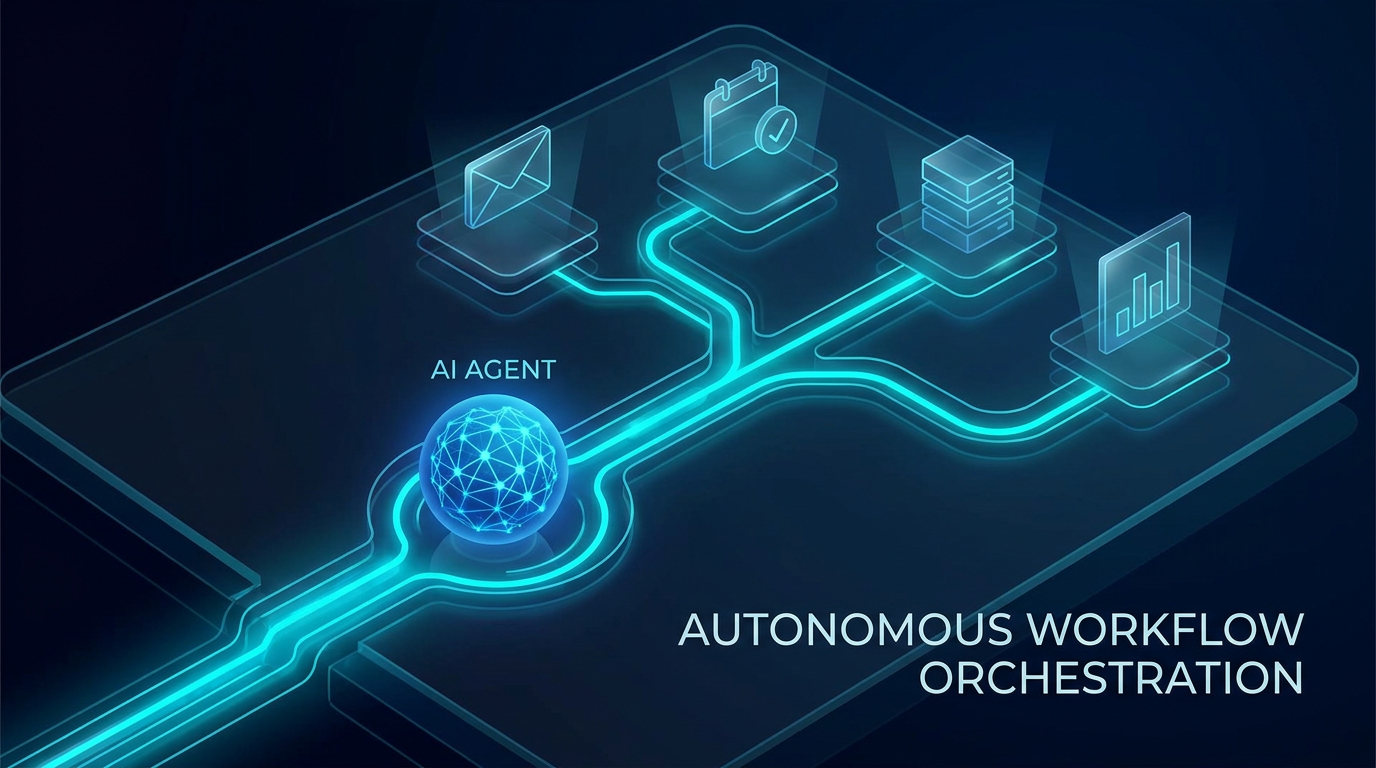
Next comes the reasoning phase. When given a high-level goal—such as "resolve this customer's shipping delay"—the AI agent does not just generate a pre-written response. It breaks the objective down into a multi-step plan. It might decide to check the inventory database, ping the logistics provider for a tracking update, and then draft a personalized email to the customer, all without requiring human micromanagement.[2]
Finally, the agent executes the plan through actuation. It clicks buttons, fills out forms, and sends API requests. Crucially, if a website layout has changed or an unexpected error occurs, the agent can adapt in real-time, adjusting its approach to ensure the task is completed successfully. This adaptability is what separates true agentic AI from older, rigid automation tools that break the moment a user interface updates.[5]
The underlying technology powering these capabilities often involves neuro-symbolic AI. This hybrid approach combines the nuanced pattern recognition of neural networks with the logical, rule-based decision-making of symbolic reasoning. By merging these two disciplines, developers are creating models that can both understand the messy reality of human language and strictly follow the logical steps required to execute a complex digital task.[5]

The underlying technology powering these capabilities often involves neuro-symbolic AI.
Enterprise adoption of these autonomous agents is accelerating rapidly. Companies are moving beyond experimental chatbots and integrating LAMs directly into their core operations. For example, Spotify developed an internal tool called "Honk" that allows engineers to deploy new software features simply by describing their intent in plain English via Slack. The agentic system handles the complex remote code deployment in real-time, drastically reducing manual engineering overhead.[6]
In the financial and insurance sectors, agentic workflows are being used to overhaul legacy processes. Insurance firms are deploying AI agents to automate the entire claims lifecycle. When a claim is filed, the agent instantly assesses its validity, gathers necessary documentation from various internal systems, and communicates empathetically with the customer, freeing human adjusters to focus on highly complex edge cases.[4]
The productivity gains from this shift are substantial. Research indicates that businesses adopting agentic workflows can experience up to a 40 percent reduction in administrative overhead within their first quarter of implementation. Furthermore, AI agents can act as process orchestrators, taking a massive corporate workflow and automatically delegating subtasks to specialized sub-agents, which then coordinate with one another to deliver a finalized result.[2][7]

The impact is not limited to massive corporations; personal AI agents are becoming increasingly accessible to everyday users. Modern personal agents, running continuously in the background, can track weekly spending, hunt for specific online deals, or manage a cluttered inbox autonomously. These systems act as a tireless Chief of Staff, handling the digital busywork that consumes hours of the average person's week.[6]
However, elevating AI from a conversational tool to an autonomous actor introduces significant new challenges, particularly regarding security and permissions. Giving an AI agent the ability to delete files, send emails on a user's behalf, or execute financial transactions requires incredibly robust, permission-based guardrails. A hallucination in a text generator results in a factual error; a hallucination in an action model could result in a deleted database.[1]
Accountability also becomes a complex issue when software operates independently. If an agentic system makes a costly error—such as issuing an incorrect refund or agreeing to unfavorable contract terms—organizations must determine who bears the responsibility. Clear lines of oversight are essential, and most current deployments keep humans "in the loop" to approve high-stakes actions before they are finalized.[1]

Despite these hurdles, the trajectory of the technology is clear. Industry analysts project that by 2028, a third of all enterprise software will feature embedded agentic AI capabilities. As these models become more reliable and deeply integrated into our digital infrastructure, the burden of routine digital chores will increasingly shift from humans to machines.[3][6]
Ultimately, the rise of Large Action Models represents the fulfillment of AI's original promise: not just to simulate human conversation, but to actively assist in human labor. By seamlessly connecting siloed applications and executing complex, multi-step goals, agentic AI is poised to become the defining productivity breakthrough of the decade, empowering workers to focus on creativity and strategy.[7]
How we got here
Pre-2023
AI is dominated by predictive models and early chatbots that can only respond to direct, narrow prompts.
2023-2024
Large Language Models (LLMs) like GPT-4 popularize generative AI, but remain largely confined to text and image creation.
2025
Early agentic frameworks and Large Action Models (LAMs) begin emerging, allowing AI to interact with external APIs and software.
2026
Agentic AI sees widespread enterprise adoption, shifting the focus from conversational AI to autonomous task execution.
Viewpoints in depth
Enterprise Leaders' view
Viewing agentic AI as the ultimate lever for operational efficiency and cost reduction.
For corporate executives, LAMs represent a way to finally automate the long tail of complex, unpredictable business processes that older, rigid tools couldn't handle. By deploying agents to manage everything from supply chain logistics to customer service, they aim to drastically reduce administrative overhead and allow human employees to focus purely on high-level strategy and creative problem-solving.
AI Researchers' view
Focusing on the architectural leap required to move from language prediction to real-world actuation.
Technologists emphasize that building a LAM is fundamentally different from building an LLM. It requires integrating neuro-symbolic AI—combining the probabilistic nature of neural networks with strict, rule-based logic. Their primary challenge is ensuring these models can adapt to unexpected changes in a software environment, like a redesigned website, without breaking or hallucinating an incorrect action.
Security Analysts' view
Highlighting the severe risks of granting autonomous execution capabilities to probabilistic models.
Risk professionals warn that the leap from generating text to taking action introduces unprecedented vulnerabilities. If an AI agent has the credentials to access databases, send emails, or move money, a single hallucination or malicious prompt injection could cause catastrophic damage. They advocate for strict human-in-the-loop architectures and granular permission systems to ensure AI agents cannot execute high-stakes actions without explicit human approval.
What we don't know
- How legal liability will be structured when an autonomous AI agent makes a costly financial or operational error on behalf of a company.
- The long-term impact on entry-level knowledge work as AI agents increasingly take over routine administrative and coordination tasks.
Key terms
- Agentic AI
- Artificial intelligence systems capable of proactively planning, reasoning, and autonomously executing multi-step goals without human intervention.
- Large Action Model (LAM)
- An advanced AI model designed not just to process language, but to navigate software environments and execute concrete actions.
- Neuro-symbolic AI
- A hybrid AI approach that combines the pattern recognition of neural networks with the logical, rule-based decision-making of symbolic reasoning.
- Actuation
- The final step in an AI agent's workflow where it physically or digitally executes a task, such as clicking a button or sending an API request.
Frequently asked
What is the difference between a chatbot and an AI agent?
A chatbot primarily answers questions and generates text based on user prompts. An AI agent can understand a broader goal, break it down into steps, and actively use software tools to complete the task autonomously.
Can AI agents control my computer?
Yes, advanced AI agents can be granted permission to navigate your operating system, manage files, and interact with applications on your behalf, acting as a digital assistant.
What happens if an AI agent makes a mistake?
Because AI agents can take real actions, mistakes can have tangible consequences, such as sending an incorrect email or deleting data. This is why experts strongly recommend keeping a 'human in the loop' to approve high-stakes actions.
Sources
Source coverage
7 outlets
3 viewpoints surfaced







[1]MIT SloanSecurity Analysts
What is agentic AI?
Read on MIT Sloan →[2]McKinsey & CompanyEnterprise Leaders
What is agentic AI?
Read on McKinsey & Company →[3]Salesforce AI ResearchAI Researchers
What Are Large Action Models (LAMs)?
Read on Salesforce AI Research →[4]UiPathEnterprise Leaders
What is Agentic Automation?
Read on UiPath →[5]DataCampAI Researchers
What Are Large Action Models (LAMs)?
Read on DataCamp →[6]FirecrawlSecurity Analysts
What are agentic AI systems?
Read on Firecrawl →[7]Factlen Editorial TeamEnterprise Leaders
Synthesis by Factlen editorial team
Read on Factlen Editorial Team →

More in ai
See all 5 stories →


Every angle. Every day.
Get ai stories with full source coverage and perspective breakdowns delivered to your inbox.