
The Evidence on Office-to-Residential Conversions: What the Data Shows in 2026
As cities grapple with vacant commercial real estate and housing shortages, adaptive reuse has been hailed as a silver bullet. A review of 2026 market data and economic research reveals where office-to-apartment conversions are actually working, and the physical and financial hurdles limiting their scale.
By Factlen Editorial Team
- Real Estate Economists
- Focus on the strict financial and architectural limitations, emphasizing that only a fraction of buildings are viable.
- Urban Planners
- View conversions primarily as a tool for downtown revitalization and preventing urban decay, regardless of the high cost.
- Housing Market Analysts
- Track the actual delivery of units and their impact on overall supply, rent prices, and leasing velocity.
What's not represented
- · Low-income housing advocates who argue public subsidies should go to dedicated affordable housing rather than luxury conversions.
- · Commercial landlords holding out hope for a return-to-office rather than selling at a loss.
Why this matters
The transformation of empty office buildings into housing represents one of the most significant shifts in urban planning of the 21st century. Understanding the hard evidence behind these conversions helps communities separate realistic housing solutions from architectural pipe dreams.
Key points
- 2026 is projected to see a record 55,000 new apartment units created from former office spaces.
- Only about 11% of existing office buildings possess the physical dimensions required for legal residential conversion.
- Plumbing and HVAC retrofits drive conversion costs to $300-$500 per square foot, rivaling new construction.
- Projects generally only succeed financially when the original office building is purchased at a 50% to 60% discount.
- Most resulting units are luxury-priced, though economists note this still helps ease overall housing market pressure.
- Municipal tax incentives are proving essential to scaling these projects in major downtowns.
For the better part of a decade, urban planners and frustrated renters have pointed to a seemingly obvious solution to two simultaneous crises. On one hand, the post-2020 shift to hybrid work left millions of square feet of downtown office space vacant. On the other, a chronic underbuilding of residential units pushed housing affordability to historic lows. The intuitive leap—turning empty cubicles into much-needed apartments—has dominated city council meetings and architectural digests alike. But as the first massive wave of these adaptive reuse projects reaches completion in 2026, the theoretical debate has finally given way to hard, measurable evidence.[5][6]
The scale of the conversion boom is undeniably real, and the data points to a historic shift in how American cities utilize their downtowns. According to comprehensive 2026 tracking data from Yardi Matrix, developers are projected to deliver over 55,000 converted apartment units this year alone, a staggering 400% increase compared to the pre-pandemic baseline of 2019. This is not a localized phenomenon; while early efforts were concentrated in older East Coast cities, the current wave spans the Sun Belt, the Midwest, and the Pacific Northwest, indicating a maturing asset class rather than a regional quirk.[3]
However, the evidence strongly refutes the narrative that adaptive reuse is a universal panacea for the housing shortage. A landmark analysis by the National Bureau of Economic Research (NBER) evaluated the physical characteristics of thousands of commercial buildings across top U.S. metropolitan areas. The findings present a sobering physical reality: only about 11% of existing office buildings are structurally and architecturally viable for residential conversion. The primary culprit is the "deep floor plate"—the massive, windowless interior spaces typical of 1980s and 1990s office towers, which make it impossible to provide legal light and air requirements to residential bedrooms without cutting costly light wells through the center of the structure.[1]

Beyond the geometry of the buildings, the plumbing and mechanical realities present formidable hurdles. Commercial buildings are designed with centralized utility cores—a bank of elevators and shared restrooms in the middle of the floor. Residential buildings require decentralized plumbing, with water and waste lines running to individual kitchens and bathrooms spread across the perimeter. CBRE Research's 2026 cost analysis demonstrates that retrofitting these systems, along with upgrading HVAC infrastructure to allow individual climate control, drives the average conversion cost to between $300 and $500 per square foot. In many markets, this rivals the cost of ground-up new construction.[2]
Because the physical conversion costs are so high, the financial viability of these projects hinges entirely on the acquisition price of the underlying real estate. The NBER evidence shows that for a conversion to pencil out for a developer, the value of the office building must plummet by roughly 50% to 60% from its peak valuation. We are now seeing this exact "price discovery" phase play out in real time. Buildings that sold for $100 million in 2018 are trading for $40 million in 2026, finally unlocking the financial math required to justify the massive capital expenditure of a residential retrofit.[1][5]

Because the physical conversion costs are so high, the financial viability of these projects hinges entirely on the acquisition price of the underlying real estate.
Even with depressed acquisition costs, the evidence overwhelmingly points to the necessity of public-private partnerships to scale these efforts. Bloomberg CityLab's tracking of successful municipal programs highlights that cities offering targeted tax abatements and expedited zoning approvals are capturing the lion's share of new units. Washington D.C.'s 20-year tax abatement program and Calgary's direct per-square-foot subsidy model have emerged as the gold standards, proving that when municipalities share the financial risk, developers are willing to tackle the complex engineering challenges of adaptive reuse.[5]
A critical question surrounding this trend is its impact on housing affordability. The data here is nuanced and highly contested. Because of the exorbitant costs of retrofitting, the vast majority of completed conversions in 2025 and 2026 have been positioned as luxury or Class-A market-rate apartments. Direct creation of low-income housing through office conversions remains statistically negligible without massive, direct government subsidies. Critics argue this does little to help the most vulnerable renters, instead creating high-end enclaves in former business districts.[3][4]
However, urban economists and researchers at the Urban Land Institute point to the well-documented phenomenon of "filtering." By adding thousands of new luxury units to the downtown market, these conversions absorb high-income renters who would otherwise bid up the prices of older, more affordable housing stock in surrounding neighborhoods. Furthermore, the ULI evidence highlights a profound secondary benefit: the revitalization of the urban core. Replacing 9-to-5 commuters with 24/7 residents has provided a crucial lifeline to downtown retail, restaurants, and transit systems that were facing a "doom loop" of declining foot traffic and tax revenue.[4][6]

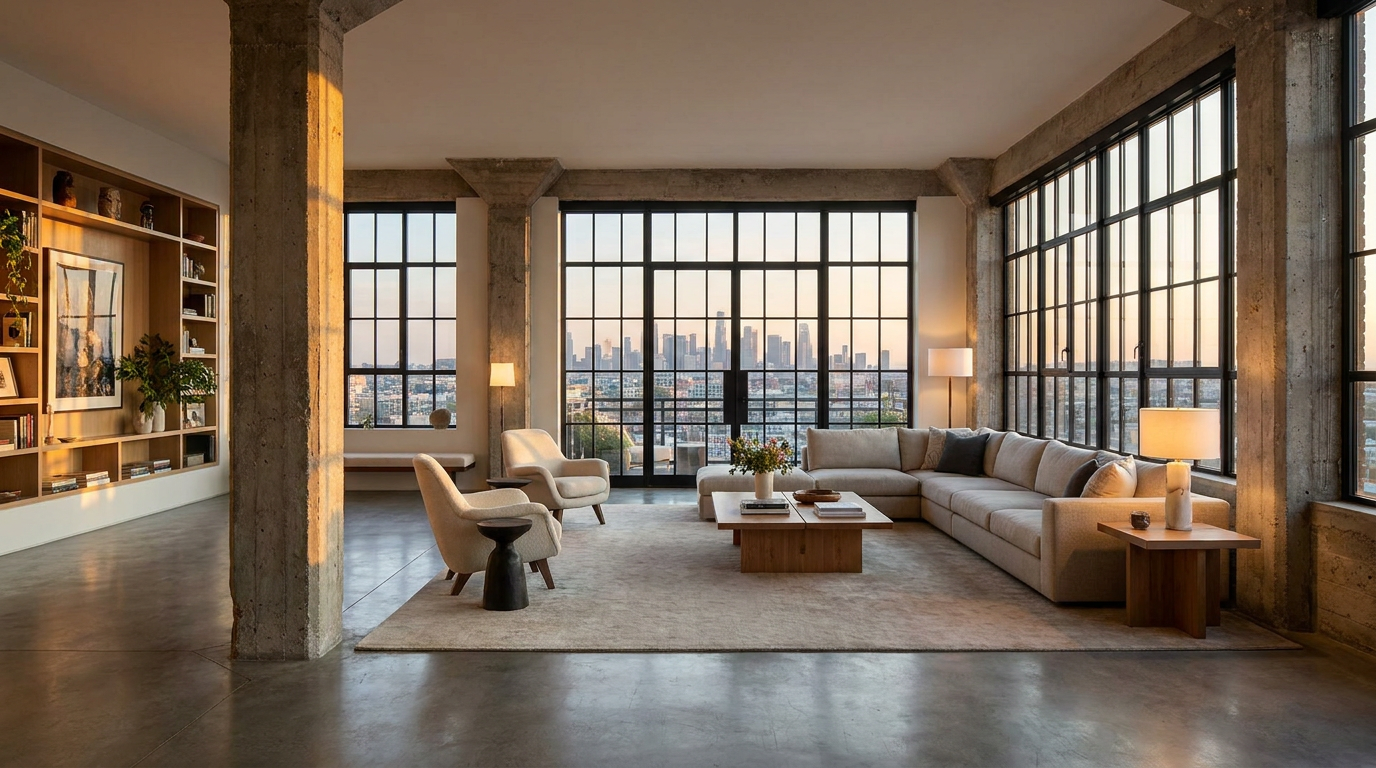
The architectural outcomes of these projects are also generating a unique new class of housing. Because developers must work within the constraints of commercial structures, the resulting apartments often feature characteristics rarely found in modern ground-up residential construction. High ceilings, massive industrial windows, exposed concrete pillars, and unusually deep living spaces have become the hallmarks of the adaptive reuse aesthetic. This distinct product type has proven highly attractive to renters, with Yardi Matrix reporting that converted buildings are leasing up 20% faster than comparable new-build residential towers in the same submarkets.[3]
Looking ahead, the evidence suggests that adaptive reuse will not single-handedly solve the national housing deficit, which numbers in the millions of units. The 11% viability cap places a hard ceiling on the total potential supply. Yet, dismissing the trend because it is not a total cure ignores its profound localized impact. In specific downtown corridors—from Lower Manhattan to the Chicago Loop to downtown Dallas—these conversions are fundamentally rewriting the DNA of the neighborhood, transitioning them from monocultural business districts into vibrant, mixed-use communities.[1][5]
The ultimate verdict from the 2026 data is one of pragmatic optimism. Office-to-residential conversion is a highly complex, capital-intensive surgical procedure, not a mass-production assembly line. It requires the perfect alignment of distressed asset pricing, cooperative municipal zoning, and specific architectural geometry. But when those factors align, the evidence proves that it is one of the most effective tools available for breathing new life into stranded urban assets and incrementally easing the pressure on the housing market.[2][6]
How we got here
2020-2021
The widespread shift to remote work empties downtown office cores, sparking initial theories about mass residential conversions.
2022-2023
Interest rates rise, freezing commercial real estate transactions and delaying the price drops needed for developers to buy buildings cheaply.
2024
Major cities like Washington D.C. and Chicago introduce aggressive tax abatement programs to subsidize the high costs of adaptive reuse.
2025
Office valuations officially bottom out, triggering a wave of distressed asset sales to residential developers.
2026
A record-breaking 55,000 converted units hit the market, providing the first large-scale data on the trend's success.
Viewpoints in depth
The Architectural Pragmatists
Experts who emphasize the physical limitations of commercial buildings.
This camp, heavily represented by structural engineers and real estate economists, argues that the public drastically overestimates how many offices can become homes. They point to the 'deep floor plate' problem: modern office buildings are designed as massive squares to maximize cubicle space, meaning the center of the building is entirely cut off from natural light. Because residential building codes strictly require windows in bedrooms for fire egress and mental health, developers are forced to either carve massive, expensive 'light wells' through the center of the concrete structure, or abandon the project entirely. Their data suggests we will hit a hard ceiling on conversions once the 'easy' buildings—mostly narrower, pre-World War II structures—are used up.
The Urban Revitalists
Planners who see conversions as a necessary lifeline for dying downtowns.
For urban planners and municipal leaders, the exact cost per square foot or the luxury price tag of the resulting units is secondary to a larger existential goal: saving the urban core. This perspective argues that monocultural business districts, which empty out at 5:00 PM, are fundamentally fragile. By subsidizing office-to-residential conversions, cities are importing a 24/7 population that supports local coffee shops, dry cleaners, grocery stores, and public transit. They view the tax abatements given to developers not as a corporate handout, but as a necessary investment to prevent the 'doom loop' of falling property tax revenues and degrading city services.
What we don't know
- Whether the pace of conversions will plateau once the 'low-hanging fruit' of easily convertible, pre-war buildings is exhausted.
- How the influx of luxury units in downtown cores will affect long-term commercial retail mixes in those specific neighborhoods.
Key terms
- Adaptive Reuse
- The process of taking an existing structure built for one purpose (like an office) and renovating it for a new use (like housing).
- Deep Floor Plate
- A building design where the distance from the exterior windows to the central core is very long, resulting in large interior spaces with no natural light.
- Filtering
- An economic concept in housing where building new luxury units causes higher-income renters to move, freeing up older, more affordable units for middle- and lower-income renters.
- Price Discovery
- The process by which buyers and sellers in a market determine the new, lower value of an asset, such as a vacant office building.
Frequently asked
Why can't we just put apartments in all the empty office buildings?
Most office buildings are too wide. Residential building codes require bedrooms to have windows for light and egress, and the deep interior spaces of modern office towers make this architecturally impossible without cutting massive holes in the building.
Are these converted apartments affordable?
Directly, no. Because the cost of retrofitting plumbing and HVAC is so high, developers almost exclusively price these as luxury units to recoup their investment. However, adding supply helps ease overall market pressure.
How much does it cost to convert an office to an apartment?
Current data shows it costs between $300 and $500 per square foot, which is often comparable to the cost of building a brand new structure from the ground up.
Sources
Source coverage
6 outlets
3 viewpoints surfaced



[1]National Bureau of Economic ResearchReal Estate Economists
The Economics of Commercial-to-Residential Conversions
Read on National Bureau of Economic Research →[2]CBRE ResearchReal Estate Economists
2026 Adaptive Reuse Report: Office-to-Multifamily Trends
Read on CBRE Research →[3]Yardi MatrixHousing Market Analysts
Adaptive Reuse Transition: 2025-2026 Apartment Conversions
Read on Yardi Matrix →[4]Urban Land InstituteUrban Planners
Downtown Revitalization and the Missing Middle
Read on Urban Land Institute →[5]Bloomberg CityLabUrban Planners
How Office Conversions Are Finally Making a Dent in the Housing Crisis
Read on Bloomberg CityLab →[6]Factlen Editorial Team
Synthesis by Factlen editorial team
Read on Factlen Editorial Team →
Every angle. Every day.
Get real estate stories with full source coverage and perspective breakdowns delivered to your inbox.