
How the Blended Wing Body is Rewriting the Rules of Aviation
After a century of tube-and-wing designs, aerospace engineers are turning to a radical new aircraft shape that promises to cut fuel consumption by up to 50 percent.
By Factlen Editorial Team
- BWB Developers
- Startups believe the traditional tube-and-wing design has reached its physical limits and requires a radical architectural shift.
- Aviation Researchers
- Aerospace engineers and government agencies focus on the proven aerodynamic math and military utility of the design.
- Commercial Airlines
- Carriers view the BWB as a necessary solution to capacity crunches and fuel costs, provided it fits existing airports.
- Legacy Manufacturers
- Established giants remain cautious about the manufacturing complexities of pressurized non-cylindrical fuselages.
What's not represented
- · Airport Infrastructure Operators
- · Aviation Safety Regulators (FAA/EASA)
Why this matters
Commercial aviation is struggling to meet its net-zero emissions targets while keeping ticket prices affordable. A successful transition to blended wing aircraft would drastically reduce the environmental impact of flying and lower the fuel costs that drive up airfare.
Key points
- The Blended Wing Body (BWB) merges the wings and fuselage into a single lifting surface, drastically reducing aerodynamic drag.
- Startups like JetZero claim the design can cut fuel consumption and emissions by up to 50 percent using conventional engines.
- Major airlines and the U.S. military are backing the technology, with a full-scale demonstrator scheduled to fly in 2027.
- The wide cabin design offers a theater-like passenger experience while still fitting into existing airport gates and taxiways.
- Advances in digital design and carbon-composite manufacturing have finally made the complex shape viable for commercial production.
The commercial airplane has not fundamentally changed its shape since the dawn of the jet age. The iconic "tube-and-wing" design—a cylindrical fuselage with swept wings attached to the sides—has served the industry well for decades, but aerospace engineers warn it is rapidly approaching the physical limits of aerodynamic efficiency.
As airlines face mounting pressure to decarbonize by 2050 and jet fuel remains their single largest operating cost, incremental tweaks to engines and winglets are yielding diminishing returns. To achieve a true step-change in performance, the industry is realizing that a radical architectural shift is required.[1][2]
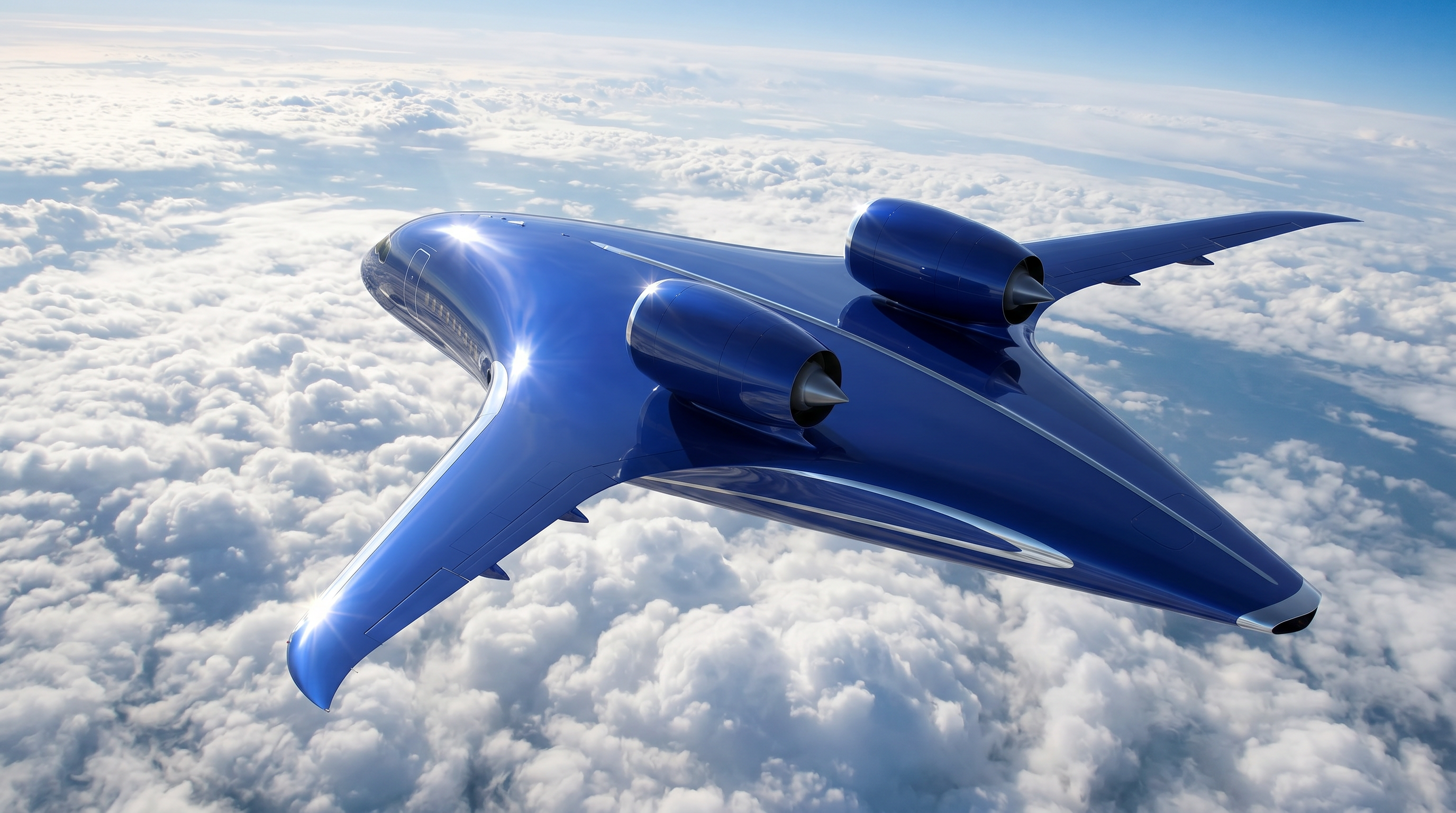
Enter the Blended Wing Body (BWB). Unlike conventional aircraft, a BWB has no clear dividing line between the wings and the main fuselage. The entire airframe is smoothly integrated into a single, flattened lifting surface.[6]
Aerodynamically, this solves a massive inefficiency inherent in modern planes. Traditional tube-and-wing aircraft suffer from "form drag" at the sharp junction where the wing meets the body. Furthermore, the heavy cylindrical fuselage contributes weight and drag without generating any lift of its own.[6]

By merging the components, a BWB minimizes the aircraft's total "wetted area"—the surface area exposed to the external airflow. Because the entire wide body acts as an airfoil, the design boosts the aircraft's lift-to-drag ratio by roughly 30 percent compared to traditional configurations.[6]
The concept is not entirely new. The aviation industry has flirted with blended wings for a century, dating back to early 1920s experiments and McDonnell Douglas's "Project Redwood" in the late 1990s.[3][6]
The most significant historical validation came from NASA and Boeing's X-48 program. Between 2007 and 2013, sub-scale remote-controlled BWB models flew over 120 test flights at NASA's Dryden Flight Research Center, proving the design's low-speed stability and aerodynamic promise.[3][5]
So why hasn't a BWB carried commercial passengers yet? Historically, the primary hurdles were manufacturing and pressurization. A cylindrical tube is naturally excellent at handling the outward stress of a pressurized cabin; a flattened, wide shape requires heavy, complex internal structural supports to prevent it from ballooning at high altitudes.
Historically, the primary hurdles were manufacturing and pressurization.
Today, those engineering barriers are falling. Advances in digital multidisciplinary design optimization (MDAO) and the maturation of lightweight carbon-composite manufacturing have finally made large-scale BWB airframes manufacturable, certifiable, and economically viable.
Leading the charge in 2026 is California-based startup JetZero. The company is developing the Z4, a BWB aircraft designed to carry 200 to 250 passengers with a range of 5,000 nautical miles, directly targeting the mid-market gap left by aging Boeing 757 and 767 fleets.[1]
JetZero claims the Z4 will deliver up to a 50 percent reduction in fuel burn and greenhouse gas emissions compared to current tube-and-wing aircraft. Crucially, it achieves this using conventional high-bypass turbofan engines, avoiding the certification delays associated with unproven electric or hydrogen powertrains.[1]

The aerospace industry is putting serious capital behind the effort. In early 2026, JetZero secured a $175 million Series B funding round, drawing investments from major players including RTX Ventures, Northrop Grumman, and United Airlines Ventures.[4]
The U.S. Air Force and NASA are also heavily invested, awarding JetZero a $235 million contract to build a full-scale technology demonstrator. That prototype, utilizing Pratt & Whitney engines, is slated to make its first flight in 2027.[1][4]
JetZero is not alone in the space. Another startup, Natilus, is developing its own 200-passenger BWB called the Horizon. Promising a 30 percent fuel burn reduction, Natilus is positioning its aircraft as a solution to the anticipated global shortage of narrowbody manufacturing capacity.[2]
For passengers, the BWB promises a radically different cabin experience. The wide interior allows for theater-like seating configurations, higher ceilings, wider aisles, and significantly more personal space, which could also translate to faster boarding times at congested hubs.[1]

Despite the radical shape, developers are designing these aircraft to fit seamlessly into existing airport infrastructure. The Z4 is engineered to use standard gates, runways, and jet bridges, removing a major logistical hurdle that often blocks radical aviation redesigns.[1]
Legacy manufacturers are watching the space closely. Airbus previously explored a BWB design for its ZEROe hydrogen-powered concept, noting that the wide interior is ideal for storing bulky liquid hydrogen tanks, though the European giant recently scaled back its immediate hydrogen testing timelines.[3][7]
Significant uncertainties remain before the public can buy a ticket. Regulators must determine how to safely evacuate a cabin that is much wider than traditional planes, and airlines must gauge passenger acceptance of middle seating sections that are far removed from any natural windows.
Nevertheless, with a full-scale demonstrator taking to the skies next year and commercial deliveries targeted for the early 2030s, the blended wing body is closer to reality than ever before. It represents the most viable, near-term path to sustainable, high-capacity aviation in the 21st century.
How we got here
1924
The Westland Dreadnought, an early attempt at a blended wing design, is built but crashes on its first flight.
Late 1990s
McDonnell Douglas develops the 'Project Redwood' BWB concept before merging with Boeing.
2007–2013
NASA and Boeing successfully fly the X-48, a series of sub-scale remote-controlled BWB demonstrators, proving the design's stability.
2020
Airbus unveils the ZEROe BWB concept as a potential future hydrogen-powered airliner.
2023
JetZero publicly announces plans to build a commercial BWB airliner, securing backing from the U.S. Air Force.
January 2026
JetZero raises $175 million in Series B funding, backed by United Airlines and aerospace defense contractors.
2027 (Projected)
A full-scale BWB technology demonstrator is scheduled to make its maiden flight.
Viewpoints in depth
BWB Developers' view
Startups believe the traditional tube-and-wing design has reached its physical limits.
Companies like JetZero and Natilus argue that incremental improvements to traditional aircraft—such as slightly better engines or new winglets—are yielding diminishing returns. To meet the industry's 2050 net-zero emissions pledges and combat rising fuel costs, they insist a radical architectural shift is required. By utilizing conventional engines on a highly efficient airframe, they aim to bypass the regulatory and technological hurdles of unproven electric or hydrogen propulsion systems.
Aviation Researchers' view
Aerospace engineers and government agencies focus on the proven aerodynamic math and military utility.
For organizations like NASA and the U.S. Air Force, the blended wing body is a known quantity aerodynamically. Decades of wind tunnel testing and the X-48 flight program proved that the BWB shape can increase the lift-to-drag ratio by roughly 30 percent. The military is particularly interested in the design for aerial refueling tankers and cargo transports, as the wide body allows for massive internal volume and offloads fuel more efficiently than traditional converted airliners.
Legacy Manufacturers' view
Established giants remain cautious about the manufacturing complexities of pressurized non-cylindrical fuselages.
While Boeing and Airbus have both researched BWB designs extensively, they have hesitated to bring them to the commercial passenger market. A traditional cylindrical tube is naturally adept at handling the stress cycles of cabin pressurization. A flattened, wide body requires heavy, complex internal structural supports to prevent the cabin from ballooning at high altitudes. Legacy manufacturers are currently prioritizing incremental upgrades to their existing narrowbody cash cows while keeping BWB concepts in the research phase for future alternative fuels.
What we don't know
- How aviation regulators will adapt evacuation protocols for the ultra-wide, theater-like cabin layouts.
- Whether passengers will embrace a cabin design where the majority of seats are far removed from natural windows.
- If the complex composite manufacturing required for the BWB airframe can be scaled up to meet global airline demand.
Key terms
- Blended Wing Body (BWB)
- An aircraft configuration with no clear dividing line between the wings and the main fuselage, allowing the entire craft to generate lift.
- Form Drag
- Aerodynamic resistance caused by the shape of an object moving through a fluid, highly prevalent in traditional tube-and-wing aircraft junctions.
- Wetted Area
- The total surface area of an aircraft that is in contact with the external airflow; minimizing this reduces friction and drag.
- Lift-to-Drag Ratio (L/D)
- A crucial metric of aerodynamic efficiency, measuring the amount of lift generated compared to the aerodynamic drag created.
- Multidisciplinary Design Optimization (MDAO)
- Advanced computational engineering that allows designers to simultaneously solve for aerodynamics, structural integrity, and materials.
Frequently asked
What is a blended wing body aircraft?
It is an aircraft design where the wings and fuselage are merged into a single, smooth lifting surface, eliminating the traditional cylindrical tube shape.
Why is a blended wing more efficient?
By removing the sharp junction between the wing and the body, it reduces aerodynamic drag. The entire wide fuselage also generates lift, significantly cutting fuel consumption.
Will these planes fit at normal airport gates?
Yes. Developers like JetZero are specifically designing their BWB aircraft to fit within existing airport infrastructure, including standard gates, taxiways, and jet bridges.
When will passengers be able to fly on one?
While full-scale demonstrators are expected to fly in 2027, commercial passenger flights are targeted for the early 2030s, pending rigorous safety certification.
Where are the windows in a blended wing plane?
Because the cabin is much wider than a traditional jet, passengers in the middle sections will not have access to natural windows, though designers may use digital screens to simulate them.
Sources
Source coverage
7 outlets
4 viewpoints surfaced







[1]AIN OnlineBWB Developers
JetZero Aims to Replace Traditional Airliners With a Blended Wing Body
Read on AIN Online →[2]FLYING MagazineBWB Developers
Natilus Unveils Horizon Blended-Wing Body Aircraft
Read on FLYING Magazine →[3]Aerospace Testing InternationalLegacy Manufacturers
The history of NASA’s X-48 blended wing aircraft
Read on Aerospace Testing International →[4]JDA JournalCommercial Airlines
United, RTX, Northrop Bet On JetZero’s ‘All-Wing’ Aircraft
Read on JDA Journal →[5]NASAAviation Researchers
Advanced Aircraft Concepts for Environmental Sustainability (AACES) 2050
Read on NASA →[6]WikipediaAviation Researchers
Blended wing body
Read on Wikipedia →[7]AirbusLegacy Manufacturers
ZEROe: Towards the world’s first zero-emission commercial aircraft
Read on Airbus →
More in automotive
See all 18 stories →Grid Tech
How Millions of Parked EVs Are Becoming the Grid's Ultimate Backup Battery
8 sources

Transit Tech
Trackless Trams: The Hybrid Technology Reshaping Mid-Tier Public Transit
6 sources
Marine Tech
The Hydrofoil Revolution: How Electric Boats Finally Solved Range Anxiety
6 sources
AV Architecture
How End-to-End AI Replaced 300,000 Lines of Code in Autonomous Vehicles
10 sources

Every angle. Every day.
Get automotive stories with full source coverage and perspective breakdowns delivered to your inbox.