
How 'Sponge Cities' Are Using Nature to Solve Urban Flooding
Cities worldwide are abandoning traditional concrete drainage in favor of nature-based infrastructure that absorbs, stores, and filters heavy rainfall.
By Factlen Editorial Team
- Urban Planners & Architects
- Advocate for integrating blue-green infrastructure to replace outdated concrete systems.
- Municipal Governments
- Focus on the cost-benefit analysis and the logistics of retrofitting existing cities.
- Hydrological Engineers
- Emphasize measurable metrics of runoff reduction and the physical limits of natural absorption.
What's not represented
- · Real estate developers
- · Traditional concrete manufacturers
Why this matters
As climate change brings heavier, more concentrated rainfall, traditional urban drainage systems are failing. The shift toward nature-based flood defenses offers a proven, cost-effective blueprint for protecting homes and infrastructure while making cities greener and cooler.
Key points
- Sponge cities use nature-based infrastructure to absorb, store, and filter rainwater instead of relying solely on concrete pipes.
- Permeable pavements, bioswales, and sunken parks can reduce urban runoff volume by up to 86% in pilot cities.
- Nature-based flood solutions are estimated to be 50% more affordable than traditional engineered alternatives.
- Beyond flood mitigation, green infrastructure cools neighborhoods, improves water quality, and creates recreational public spaces.
For most of the 20th century, cities were built on a combative premise: when it rains, get the water out as fast as possible. Urban planners paved over natural wetlands, buried rivers in concrete channels, and laid millions of miles of subterranean pipes to whisk stormwater away from streets and buildings.[4][6]
But as the climate warms, this traditional "grey infrastructure" is increasingly failing. Heavier, more concentrated downpours are overwhelming municipal drainage systems that were designed for a gentler era of weather, turning streets into rivers and causing billions of dollars in property damage globally.[1][4]
Enter the "Sponge City." Rather than fighting water with higher concrete walls and wider pipes, this paradigm-shifting urban design philosophy embraces it. The goal is to design urban spaces that act like giant sponges—absorbing, storing, filtering, and slowly releasing rainwater back into the natural environment.[3][6]
The concept, pioneered by landscape architect Dr. Kongjian Yu, gained massive global traction in 2014 when China adopted it as a national mandate. Facing severe urban flooding alongside simultaneous groundwater shortages, the government set an ambitious target: by 2030, 80% of urban areas should absorb and reuse at least 70% of their stormwater.[3][4]

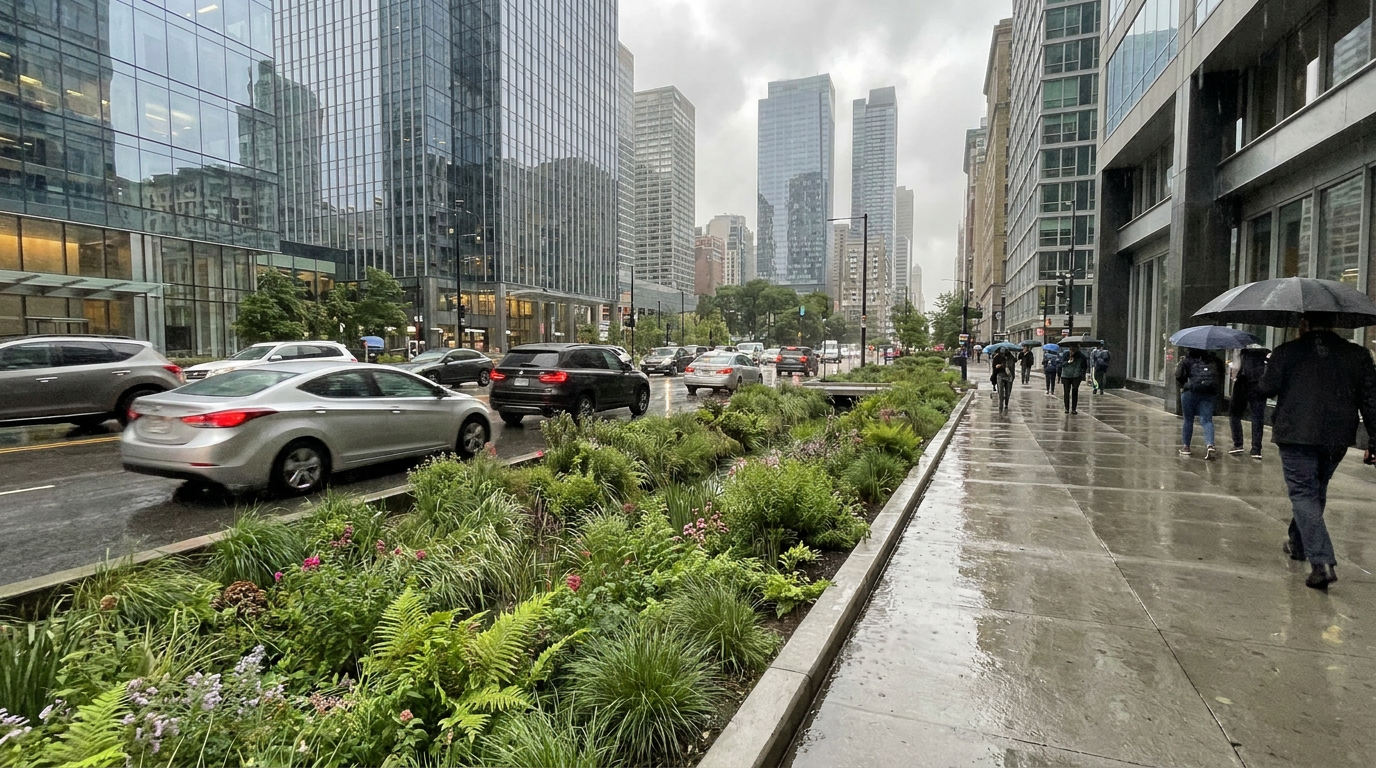
The mechanics of a sponge city rely on what planners call "blue-green infrastructure." At the street level, impermeable asphalt is systematically replaced with porous, permeable pavements that allow water to seep directly through to the soil below, rather than pooling on the surface.[4][5]
Traditional concrete gutters are swapped for "bioswales"—gently sloped, vegetated drainage courses filled with specific soil mixes and deep-rooted plants. These bioswales slow the velocity of runoff and naturally filter out motor oil and heavy metals before the water reaches larger waterways.[3][4]
On a larger scale, sunken parks and urban wetlands serve dual purposes. In dry weather, they operate as recreational green spaces for local residents. During heavy storms, they are designed to safely flood, acting as temporary retention basins that keep excess water out of residential basements and subway systems.[3][4]
The hydrological results of these interventions are highly measurable. In Wuhan, a city historically plagued by devastating seasonal floods, the implementation of rain gardens and artificial wetlands cut annual runoff volume by 77% to 86%, according to recent hydrological assessments.[5]

The hydrological results of these interventions are highly measurable.
The movement has rapidly expanded far beyond Asia. Following a catastrophic 2011 storm that caused $2 billion in damages in just two hours, Copenhagen, Denmark, launched its "Cloudburst" plan. The city is blanketing its neighborhoods with hundreds of flood-mitigation projects, successfully reducing flood risk by up to 50% in high-priority zones.[1]
In the United States, Philadelphia’s "Green City, Clean Waters" initiative is retrofitting hard surfaces across the city with porous materials. The primary goal is to prevent the city's aging combined sewage and stormwater system from overflowing and releasing untreated water into rivers during heavy rains.[3]
The economic argument for transitioning to sponge cities is becoming increasingly compelling for municipal governments. Research published by the World Economic Forum and global design firm Arup indicates that nature-based solutions are, on average, 50% more affordable than traditional engineered alternatives.[1][2]
Furthermore, these green interventions deliver an estimated 28% more added value than grey infrastructure. Beyond immediate flood mitigation, they actively recharge depleted groundwater aquifers and naturally purify urban water supplies through complex plant root systems.[1][5]

The co-benefits extend significantly to public health and urban livability. The integration of trees, water features, and green roofs mitigates the "urban heat island" effect, cooling dense neighborhoods by several degrees during deadly summer heatwaves.[5]
However, transitioning to a sponge city is not without friction. Retrofitting dense, centuries-old urban centers requires substantial upfront capital and complex logistical planning. Tearing up existing roads to install permeable surfaces is disruptive to daily life and expensive in the short term.[3][6]
There is also a cultural hurdle within city planning departments. Traditional civil engineering has long prioritized predictable, centralized, and highly controlled grey infrastructure. Shifting to decentralized, nature-based systems requires a fundamental change in how municipalities manage their public works.[4][6]

Maintenance represents another critical factor. While a concrete pipe might sit underground untouched for decades, bioswales and rain gardens are living ecosystems. They require regular landscaping, debris removal, and ecological care to remain functional and prevent clogging.[4]
Hydrologists also caution that sponge cities are not a silver bullet for all climate extremes. While highly effective at managing standard heavy rainfall and flash floods, natural absorption has physical limits. Once the soil reaches total saturation during a multi-day mega-storm, traditional emergency overflow systems are still required.[5][6]
Despite these challenges, the consensus among modern urban planners is clear: the concrete-only approach is a dead end. As the planet warms and weather patterns become more volatile, the cities that thrive will be those that learn to bend with nature, rather than trying to build a wall against it.[6]
How we got here
2011
A catastrophic storm in Copenhagen causes $2 billion in damages, prompting the city's 'Cloudburst' green infrastructure plan.
2014
China officially adopts the sponge city concept as a nationwide urban development policy.
2025
The World Economic Forum reports that nature-based flood solutions are 50% more affordable than engineered alternatives.
2030
The target year for Chinese pilot cities to absorb and reuse 70% of their urban stormwater.
Viewpoints in depth
Urban Planners & Architects
Advocate for integrating blue-green infrastructure to replace outdated concrete systems.
This camp views the 20th-century reliance on concrete and pipes as a fundamental design flaw that works against the natural water cycle. They argue that cities must be redesigned to mimic natural ecosystems, emphasizing that green infrastructure not only solves drainage issues but also fundamentally improves the livability, aesthetics, and biodiversity of urban spaces.
Municipal Governments
Focus on the cost-benefit analysis and the logistics of retrofitting existing cities.
City officials are highly motivated by the long-term savings and disaster mitigation promised by sponge cities, especially as climate change accelerates. However, they grapple with the immediate logistical nightmares and high upfront capital required to tear up existing streets, as well as the ongoing operational budgets needed to maintain living, growing infrastructure.
Hydrological Engineers
Emphasize measurable metrics of runoff reduction and the physical limits of natural absorption.
Engineers focus on the data, validating that permeable surfaces and retention basins drastically reduce peak flow during storms. While supportive of nature-based solutions, they caution against over-reliance, noting that once the soil reaches total saturation during a multi-day mega-storm, traditional emergency overflow systems remain an absolute necessity to prevent catastrophic damage.
What we don't know
- How well sponge city infrastructure will hold up against unprecedented, days-long mega-storms that exceed historical modeling.
- The long-term maintenance costs of widespread urban green infrastructure compared to traditional concrete systems over a 50-year lifespan.
Key terms
- Sponge City
- An urban design model that uses natural landscapes to absorb, store, and reuse stormwater.
- Grey Infrastructure
- Traditional engineered water management systems built from concrete, steel, and pipes.
- Blue-Green Infrastructure
- A network of natural and semi-natural areas, including water bodies and green spaces, designed to manage urban water.
- Bioswale
- A vegetated, shallow depression designed to capture, treat, and infiltrate stormwater runoff.
- Permeable Pavement
- Porous surfacing materials that allow rainwater to pass through into the soil below, reducing surface runoff.
Frequently asked
What is the difference between green and grey infrastructure?
Grey infrastructure relies on concrete, pipes, and pumps to move water away quickly. Green infrastructure uses natural elements like soil, plants, and wetlands to absorb and filter water on-site.
Can a sponge city completely prevent flooding?
No. While highly effective at managing standard heavy rainfall and flash floods, natural absorption has physical limits and can still be overwhelmed by extreme, multi-day mega-storms.
Is it possible to retrofit an existing concrete city?
Yes. Cities like Philadelphia and Copenhagen are actively retrofitting hard surfaces with permeable pavements and converting traditional parks into sunken retention basins.
Sources
Source coverage
6 outlets
3 viewpoints surfaced






[1]World Economic ForumMunicipal Governments
Why 'sponge cities' are the future of urban flood management
Read on World Economic Forum →[2]ArupMunicipal Governments
Global Sponge Cities Snapshot
Read on Arup →[3]Topos MagazineUrban Planners & Architects
Sponge Cities: Nature-Based Solutions in Urban Planning
Read on Topos Magazine →[4]Scientific Research PublishingHydrological Engineers
Grey vs. Green Infrastructure: The Sponge City Paradigm
Read on Scientific Research Publishing →[5]IWA PublishingHydrological Engineers
Assessing the Runoff Reduction of Sponge City Green Infrastructure
Read on IWA Publishing →[6]Factlen Editorial TeamUrban Planners & Architects
Synthesis by Factlen editorial team
Read on Factlen Editorial Team →
Every angle. Every day.
Get environment stories with full source coverage and perspective breakdowns delivered to your inbox.