
How 'Sponge Cities' Are Redesigning the Urban Landscape to Stop Flooding
By replacing impermeable concrete with nature-based infrastructure, cities worldwide are learning to absorb extreme rainfall rather than fighting it.
By Factlen Editorial Team
- Urban Planners & Architects
- Argue that cities must fundamentally redesign their relationship with water by integrating green infrastructure into every level of the built environment.
- Environmental Economists
- Focus on the immense cost-savings and return on investment that nature-based solutions provide compared to traditional disaster recovery.
- Traditional Civil Engineers
- Emphasize that while green infrastructure is vital, heavy 'gray' infrastructure like deep tunnels is still required to handle extreme mega-storms.
What's not represented
- · Displaced residents in flood-prone areas
- · Municipal taxpayers funding retrofits
Why this matters
As extreme weather events become more frequent, traditional concrete drainage systems are failing. Understanding how cities are redesigning themselves to absorb water reveals how we can protect our homes, lower infrastructure costs, and create greener, more livable urban spaces.
Key points
- Sponge cities use nature-based solutions to absorb rainwater rather than funneling it into storm drains.
- Permeable pavements, green roofs, and bioswales replace traditional concrete and asphalt.
- The approach drastically reduces urban flooding and replenishes local groundwater tables.
- Nature-based solutions offer an estimated 7-to-1 return on investment by avoiding storm damage.
- Green infrastructure also cools cities, improves air quality, and restores urban biodiversity.
- Extreme mega-storms still require hybrid approaches combining green parks with engineered overflow tunnels.
For over a century, modern urban planning has treated rainwater as an enemy to be banished. Cities were paved with impermeable concrete and asphalt, designed to channel precipitation into storm drains and pipe it away as quickly as possible. But as climate change accelerates the frequency and intensity of extreme weather, this traditional "gray infrastructure" is increasingly overwhelmed, turning streets into rivers and causing billions in property damages.[1]
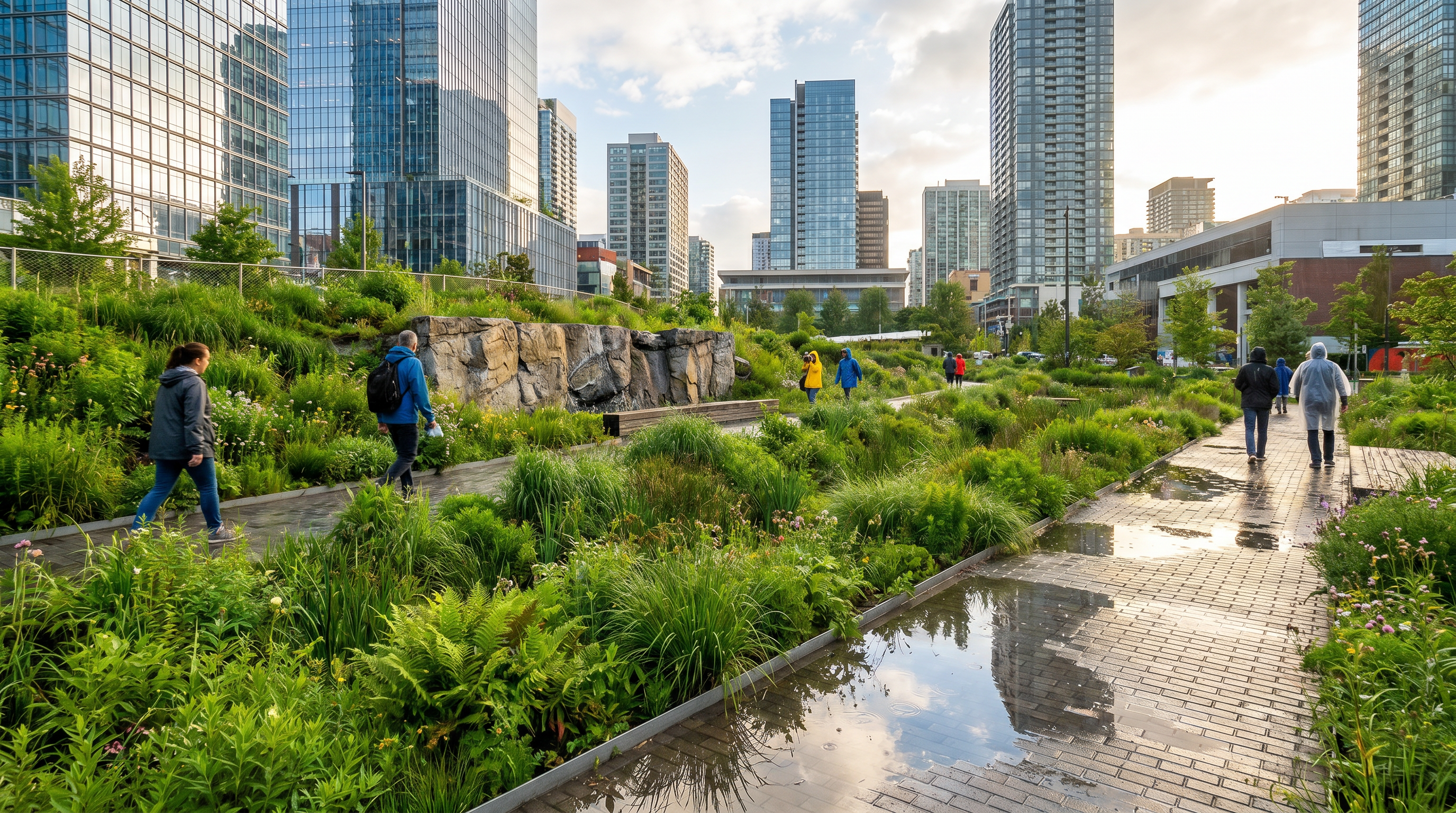
In response, a radical paradigm shift is taking root in urban design: the "sponge city." Rather than fighting water with rigid barriers and narrow pipes, this approach redesigns urban landscapes to absorb, filter, and store rainfall exactly where it lands. By mimicking natural hydrological cycles, cities are transforming themselves from concrete funnels into massive, city-wide sponges.[1][4]
The concept was formalized in 2013 by Chinese landscape architect Professor Kongjian Yu, who observed that traditional engineering was failing to protect rapidly expanding urban centers. Yu advocated for a return to nature-based solutions, arguing that cities should work alongside seasonal water movements rather than attempting to conquer them with brute force.[2][4]
The mechanics of a sponge city rely on replacing hard, impermeable surfaces with porous, absorptive alternatives. Traditional asphalt roads and concrete sidewalks force water to pool and accelerate runoff. In a sponge city, these are replaced with permeable pavements that allow water to seep directly into the earth below, recharging local groundwater tables and drastically reducing the burden on municipal sewers.[1][7]

Above ground, green infrastructure acts as the primary absorptive layer. Green roofs covered in vegetation capture rainfall before it ever reaches the street. At the surface level, bioswales and rain gardens—shallow, vegetated depressions planted with deep-rooted native species—are installed along sidewalks and intersections to catch, hold, and filter runoff.[6][7]
Blue infrastructure is equally critical to the equation. For decades, cities buried their natural streams in concrete pipes to make way for development. The sponge city model advocates for "daylighting" these rivers—bringing them back to the surface and restoring their natural, meandering paths. Reconnecting rivers to their historical floodplains allows excess water to spill over safely into designated wetlands rather than into residential basements.[5]
The efficacy of these nature-based solutions is not merely theoretical; it has been proven in extreme conditions. During Hurricane Harvey in 2017, a 200-acre reclaimed urban wetland in Clear Lake, Texas—formerly an abandoned golf course—acted as a massive sponge. It successfully absorbed torrential downpours, protecting surrounding homes from potentially deadly flooding while neighboring areas with traditional drainage suffered catastrophic damage.[3]
The efficacy of these nature-based solutions is not merely theoretical; it has been proven in extreme conditions.
In Europe, Copenhagen stands as a premier example of proactive adaptation. Following a devastating 2011 storm that caused nearly $2 billion in damages in just two hours, the Danish capital launched an ambitious "Cloudburst Management Plan." The city redesigned public spaces, such as Enghave Park, to function as temporary reservoirs during heavy rains, seamlessly blending recreational areas with flood defense.[2]

Spain has also embraced the model with remarkable success. In Alicante, the La Marjal Floodable Park was engineered to store up to 45,000 cubic meters of water during extreme weather events. On dry days, it serves as a vibrant public recreation area; during storms, it transforms into a vital retention basin that prevents local economic disruption and material damage.[6]
In Asia, the city of Xiamen implemented extensive green roofs, permeable paving, and restored wetlands. These interventions have successfully reduced surface water runoff by 50%, demonstrating the massive volumetric impact that distributed green infrastructure can achieve when deployed at scale.[7]
Beyond flood mitigation, the economic argument for sponge cities is overwhelming. The U.S. National Oceanic and Atmospheric Administration (NOAA) estimates that coastal wetlands provide $23.2 billion in storm protection services annually. Furthermore, wetland and reef restoration projects yield a remarkable return on investment, delivering roughly seven dollars in flood-reduction benefits for every single dollar spent.[3]

The secondary benefits of "sponginess" extend well beyond water management. Integrating vegetation into the concrete jungle significantly reduces the urban heat island effect, lowering city temperatures during summer heatwaves. These green corridors also improve air quality, sequester carbon, and create vital habitats that restore urban biodiversity.[5][6]
However, transitioning to a sponge city is not without significant challenges and uncertainties. Retrofitting dense, historically built-up urban centers is exceptionally expensive and requires navigating complex zoning laws, property rights, and subterranean utility networks. It is a generational project, not a quick fix.[1]
Geological realities also dictate the limits of natural absorption. A city's inherent "sponginess" depends heavily on its underlying soil composition and the depth of its water table. Sandy soils, like those found in parts of Auckland, New Zealand, drain rapidly and naturally buffer heavy rainfall. In contrast, regions built on dense clay soils have a much lower natural absorption capacity, requiring more extensive engineering to achieve the same results.[2]
Furthermore, civil engineers caution that green infrastructure alone cannot neutralize the threat of a 1-in-1000-year mega-storm. When the ground reaches total saturation, water will inevitably pool. Therefore, the most resilient cities employ a hybrid approach. Copenhagen, for instance, pairs its green parks with massive subterranean "gray" tunnels designed to rapidly flush excess water into the harbor when natural systems are overwhelmed.[2]

Ultimately, the sponge city concept represents a necessary evolution in human habitation. As the climate continues to warm and weather patterns become increasingly volatile, the illusion that we can pave our way out of nature's path has shattered. By inviting water back into the urban landscape, cities are not just surviving the storms—they are learning to thrive within them.[1][4]
How we got here
July 2011
A catastrophic storm hits Copenhagen, causing $2 billion in damages and prompting the city's pioneering Cloudburst Management Plan.
2013
Landscape architect Kongjian Yu formally proposes the 'sponge city' concept to address urban flooding.
2014
The Chinese government launches a massive national initiative to transform urban areas into sponge cities.
August 2017
A reclaimed urban wetland in Clear Lake, Texas, successfully protects surrounding homes from the devastating floods of Hurricane Harvey.
2023
Kongjian Yu is awarded the Oberlander Prize for his globally adopted work on climate-accelerated urban flooding.
Viewpoints in depth
The Urban Design View
Advocates for a complete paradigm shift from concrete funnels to absorptive landscapes.
Landscape architects and urban planners argue that the 20th-century model of paving over nature has failed. By treating rainwater as a resource rather than a hazard, they believe cities can solve multiple crises at once. Integrating bioswales, green roofs, and permeable pavements doesn't just prevent flooding; it actively cools the urban heat island, purifies local air, and creates recreational green spaces that improve public health.
The Economic View
Highlights the massive financial return on investment of nature-based solutions.
For environmental economists, the argument for sponge cities is purely mathematical. Traditional 'gray' infrastructure like concrete levees and storm drains constantly depreciate and require expensive maintenance. In contrast, nature-based solutions appreciate in value over time as ecosystems mature. With data showing a $7 return for every $1 spent on wetland restoration, economists view green infrastructure as the most fiscally responsible method of climate adaptation.
The Engineering Reality
Cautions that green infrastructure has physical limits during catastrophic weather events.
While supportive of the sponge city concept, traditional civil engineers warn against viewing it as a silver bullet. They point out that soil has a maximum saturation point; once a rain garden is full, it acts just like concrete. For this reason, engineers advocate for a hybrid approach. They argue that cities still need massive, engineered 'gray' infrastructure—like Copenhagen's subterranean cloudburst tunnels—to act as an emergency fail-safe when nature-based solutions are overwhelmed by 1-in-1000-year storms.
What we don't know
- How well sponge city infrastructure will hold up against unprecedented, off-the-charts mega-storms that exceed current climate models.
- The exact long-term maintenance costs of widespread permeable pavements compared to traditional asphalt.
- How quickly historically dense cities can retrofit their infrastructure given complex zoning and property rights.
Key terms
- Green Infrastructure
- Natural or semi-natural systems, such as parks and rain gardens, integrated into urban areas to manage water and provide environmental benefits.
- Permeable Pavement
- Paving materials that allow water to seep through their surface into the ground below, reducing surface runoff.
- Bioswale
- A vegetated, shallow ditch designed to capture, treat, and infiltrate stormwater runoff as it moves downstream.
- Daylighting
- The process of uncovering and restoring rivers or streams that were previously buried in underground concrete pipes.
- Gray Infrastructure
- Traditional, engineered water management systems built from concrete and steel, such as storm drains, pipes, and dams.
Frequently asked
What exactly is a sponge city?
A sponge city is an urban area designed to naturally absorb, filter, and store rainwater using green infrastructure like parks, permeable pavements, and wetlands, rather than channeling it away through concrete pipes.
Can a sponge city completely prevent flooding?
No. While they drastically reduce routine flooding and surface runoff, extreme mega-storms can still overwhelm natural absorption limits, which is why hybrid systems with underground tunnels are often needed.
Are nature-based solutions expensive to build?
While retrofitting dense cities requires upfront investment, nature-based solutions are highly cost-effective long-term. Studies show they can yield up to seven dollars in flood-reduction benefits for every dollar spent.
How does a city retrofit existing concrete streets?
Cities replace traditional asphalt with permeable paving, install rain gardens at intersections, add green roofs to existing buildings, and 'daylight' buried streams to restore natural water flow.
Sources
Source coverage
7 outlets
3 viewpoints surfaced







[1]Factlen Editorial Team
Synthesis by Factlen editorial team
Read on Factlen Editorial Team →[2]World Economic ForumEnvironmental Economists
How 'sponge cities' can help protect against flooding
Read on World Economic Forum →[3]NOAA Office for Coastal ManagementEnvironmental Economists
Nature-Based Solutions for Coastal Management
Read on NOAA Office for Coastal Management →[4]University of the Built EnvironmentUrban Planners & Architects
What on earth are sponge cities?
Read on University of the Built Environment →[5]Global Infrastructure BaselTraditional Civil Engineers
Building resilience: Leveraging Nature-based Solutions for flood risk management
Read on Global Infrastructure Basel →[6]SingularGreenUrban Planners & Architects
Sponge City: Urban Solutions for a Sustainable Future
Read on SingularGreen →[7]MEA GroupTraditional Civil Engineers
Case studies: Successful Sponge City projects worldwide
Read on MEA Group →
More in environment
See all 8 stories →Geothermal Tech
How Enhanced Geothermal Systems Are Unlocking 24/7 Clean Energy
7 sources
Reef Tech
Beyond Planting: How Acoustic Enrichment and Micro-Fragmentation Are Rebuilding Coral Reefs
6 sources
Wildfire Tech
How AI is Catching Wildfires Before the First 911 Call
7 sources
Atmospheric Water
How Metal-Organic Frameworks Are Pulling Drinking Water From Desert Air
9 sources

Every angle. Every day.
Get environment stories with full source coverage and perspective breakdowns delivered to your inbox.