
How Solid-State Batteries Work—and Why 2026 is Their Breakthrough Year
After years of laboratory development, solid-state batteries are finally entering pilot production, promising to double EV ranges and slash charging times.
By Factlen Editorial Team
- Solid-State Developers
- Companies and engineers focused on the core technological breakthroughs in energy density and safety.
- Industry Realists
- Market analysts cautioning that scaling manufacturing and lowering costs will take years.
- EV Market Watchers
- Automotive journalists tracking the race between global automakers to integrate the technology.
What's not represented
- · Lithium-ion battery manufacturers
- · Raw material suppliers and miners
Why this matters
Solid-state batteries are poised to eliminate the two biggest hurdles to electric vehicle adoption: range anxiety and long charging times. By doubling energy density and removing fire risks, this technology will make EVs lighter, safer, and capable of charging as quickly as filling a gas tank.
Key points
- Solid-state batteries replace flammable liquid electrolytes with solid materials, drastically improving safety.
- The technology enables the use of pure lithium-metal anodes, potentially doubling the energy density of current EV batteries.
- Automakers project that solid-state vehicles could achieve over 600 miles of range and charge in under 10 minutes.
- Pilot production lines, such as QuantumScape's Eagle Line, have officially launched in 2026 to supply automakers with test cells.
- Mass adoption faces significant hurdles, as early solid-state cells currently cost three to five times more than traditional lithium-ion batteries.
Lithium-ion batteries have powered the electric vehicle revolution, but they are approaching their physical limits. While they have successfully transitioned millions of drivers away from combustion engines, persistent hurdles remain for mass adoption. Range anxiety, heavy vehicle weights, and lengthy charging times are inherent bottlenecks of current battery chemistry. To truly replace fossil fuels, the automotive industry needs a leap forward in energy storage, not just an incremental update.[4][5]
Enter the solid-state battery. Long considered the "holy grail" of energy storage, this technology promises to fundamentally rewrite the rules of electric mobility. By changing the core architecture of the battery cell, solid-state designs aim to double driving ranges, slash charging times to mere minutes, and eliminate the fire risks associated with current battery chemistries. For consumers, this represents the moment when electric vehicles transition from being a compelling alternative to becoming objectively superior to internal combustion engines in every measurable metric.[2][3]
For years, solid-state batteries were confined to laboratory experiments and theoretical white papers, leading to skepticism about their viability. But in 2026, the industry has crossed a critical threshold. The technology is finally moving from the lab bench to the factory floor, with highly automated pilot production lines spinning up across the globe to supply automakers with testable, automotive-grade cells.[1][6]
To understand why solid-state batteries are so revolutionary, one must first understand the limitations of conventional lithium-ion cells. In a standard battery, lithium ions travel back and forth between the positive cathode and the negative anode through a liquid electrolyte. This liquid acts as the chemical highway for the ions, allowing the battery to charge when plugged into the grid and discharge when powering the vehicle's electric motors. While this mechanism has been refined over decades, the reliance on a liquid medium introduces fundamental physical constraints that engineers can no longer engineer their way around.[4]

This liquid electrolyte is highly effective at transporting ions, but it comes with significant safety and packaging drawbacks. It is inherently volatile and flammable, requiring heavy protective casing and complex thermal management systems to prevent thermal runaway—the dangerous chain reaction that causes highly publicized battery fires. This safety infrastructure adds dead weight to the vehicle, forcing automakers to build heavier cars that require even more energy to move, creating a frustrating cycle of diminishing returns for vehicle efficiency.[4][5]
Furthermore, the liquid electrolyte necessitates the use of a bulky graphite anode to store the lithium ions safely during the charging cycle. Graphite is highly stable and reliable, but it is heavy and takes up a large amount of physical space inside the cell. This graphite adds significant weight and volume to the battery pack without contributing to its actual energy capacity, placing a hard ceiling on how much power the battery can hold. Engineers have pushed graphite-based lithium-ion cells to their absolute limits, meaning any future gains will be incremental at best.[4]
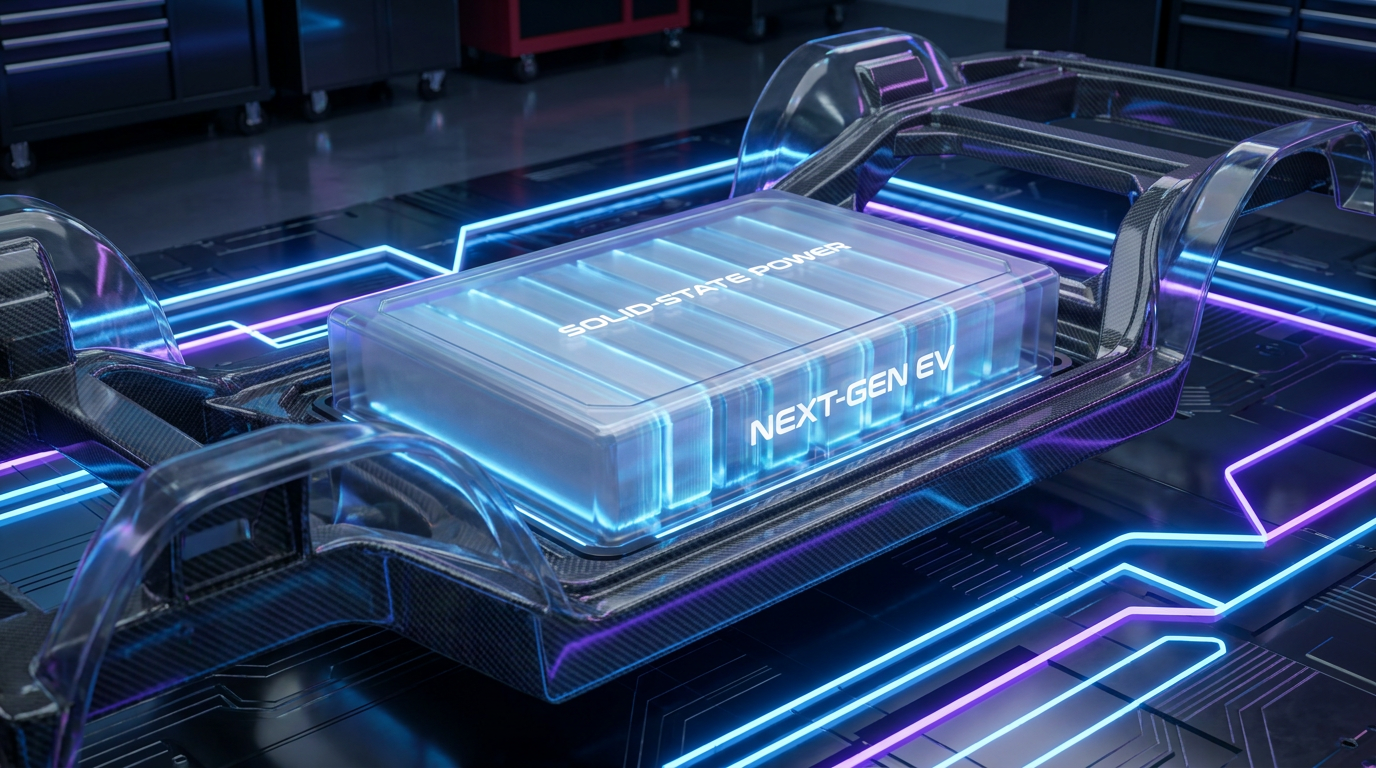
Solid-state batteries solve this structural flaw by replacing the liquid electrolyte with a solid material—typically a specialized ceramic, glass, or sulfide compound. This solid layer acts as both the electrolyte highway for the ions and a rigid physical separator between the positive and negative electrodes, entirely eliminating the need for flammable liquids. By removing the volatile components, battery packs can be designed without the heavy cooling systems and armor plating required by traditional cells, instantly making the entire vehicle lighter and more efficient.[1][2]
Solid-state batteries solve this structural flaw by replacing the liquid electrolyte with a solid material—typically a specialized ceramic, glass, or sulfide compound.
Because the solid electrolyte is non-flammable and physically rigid, it prevents the formation of "dendrites." Dendrites are microscopic, needle-like structures of lithium that can grow inside a liquid battery over time as it charges and discharges. In a conventional battery, these sharp structures can eventually pierce the thin plastic separator between the anode and cathode, causing a catastrophic short circuit. The impenetrable solid barrier in a solid-state cell stops these structures from forming, fundamentally solving the primary safety hazard of high-density energy storage.[4][5]
Defeating dendrites unlocks the ultimate prize in battery chemistry: the pure lithium-metal anode. By stripping away the heavy graphite and using pure lithium, solid-state cells can achieve energy densities approaching 500 watt-hours per kilogram (Wh/kg). This is nearly double the energy density of today's best lithium-ion cells, meaning the battery can store twice the power in the exact same physical footprint.[1][4][7]

The real-world implications for drivers are staggering. Automakers project that solid-state EVs will comfortably exceed 600 miles of range on a single charge, effectively curing range anxiety and making cross-country road trips seamless. Moreover, because the solid materials can withstand much higher voltages and temperatures without degrading, charging times could plummet to under 10 minutes. This mirrors the convenience of filling up at a traditional gas station, removing the last major lifestyle barrier for consumers who have been hesitant to adopt electric vehicles due to charging logistics.[2][3][6]
The race to commercialize this technology has accelerated dramatically in 2026. In California, QuantumScape recently inaugurated its "Eagle Line," a highly automated pilot facility designed to produce solid-state cells with ceramic separators. Backed by major investments from Volkswagen, the facility is now producing cells for direct integration into automaker test vehicles. This transition from laboratory prototypes to automated manufacturing lines proves that the core chemistry works; the challenge has now shifted entirely to scaling the production machinery.[1][4]
Meanwhile, Toyota has partnered with petrochemical giant Idemitsu Kosan to mass-produce sulfide-based solid electrolytes, leveraging Idemitsu's expertise in material refinement. The Japanese automaker has validated plans to begin integrating these advanced batteries into passenger vehicles by 2027, targeting an initial range of 745 miles and eventually scaling up to a 9-gigawatt-hour annual production target. Toyota's massive financial commitment signals to the broader industry that solid-state technology is no longer a speculative research project, but a core pillar of future automotive manufacturing.[2][3]
Chinese manufacturers are also moving aggressively to capture the market. Companies like Greater Bay Technology and Dongfeng have announced the successful production of A-sample solid-state cells, with ambitious targets to begin mass production and vehicle integration in late 2026 and 2027. Battery behemoth CATL is heavily investing in sulfide-based solid-state patents to maintain its global dominance, ensuring that the transition to solid-state chemistry does not erode China's commanding lead in the global battery supply chain.[3][6][7]

Despite these monumental milestones, significant hurdles remain before solid-state batteries become ubiquitous on global roads. The primary challenge is manufacturing scale. Building a flawless battery in a controlled laboratory is vastly different from producing millions of cells in a gigafactory, where even microscopic defects can ruin a cell's performance.[4][5]
The physics of solid-solid interfaces also present unique engineering difficulties that do not exist in liquid systems. Unlike a liquid that naturally coats the electrodes and fills every microscopic gap, solid materials must maintain perfect physical contact as the battery expands and contracts during charging cycles. If microscopic gaps form between the solid layers, the flow of ions is interrupted, and the battery loses its capacity. Maintaining this flawless contact over hundreds of thousands of miles of vibration and temperature changes requires immense precision in manufacturing.[4]
Cost is the final, and perhaps most formidable, barrier to mass adoption. Industry analysts estimate that early solid-state cells are currently three to five times more expensive to produce than conventional lithium-ion batteries, largely due to the complex manufacturing environments and novel materials required. Consequently, their initial rollout will be strictly limited to flagship luxury vehicles, high-performance sports cars, and commercial applications where buyers are willing to pay a massive premium for cutting-edge performance and reduced weight.[5][7]

However, as production scales and manufacturing techniques mature over the next decade, costs are expected to fall dramatically. While traditional lithium-ion batteries will remain the workhorse of the EV industry for the foreseeable future, 2026 marks the year the solid-state era officially began, promising a future where electric vehicles are lighter, safer, and capable of driving further than their combustion-engine predecessors.[4]
How we got here
2020
Toyota announces initial plans for a solid-state vehicle, but postpones the launch due to production feasibility challenges.
2023
Major developers announce breakthroughs in solid electrolyte durability, proving the chemistry can withstand rapid charging.
Feb 2026
QuantumScape inaugurates its 'Eagle Line' pilot facility in California to produce solid-state cells for automaker sampling.
Apr 2026
Chinese battery makers announce the successful production of A-sample solid-state cells, targeting mass production.
2027–2028
Automakers project the first commercial rollout of passenger vehicles equipped with solid-state batteries.
Viewpoints in depth
Solid-State Developers
Companies developing the core technology emphasize the breakthroughs in energy density and safety.
Developers like QuantumScape and Toyota argue that the fundamental science of solid-state batteries is now proven. By successfully replacing flammable liquid electrolytes with solid ceramics or sulfides, they have unlocked the ability to use pure lithium-metal anodes without the risk of dendrite short-circuits. These pioneers view the current phase not as a scientific challenge, but as an engineering and scaling task, pointing to newly inaugurated pilot lines as proof that commercialization is imminent.
Industry Realists
Market analysts caution that scaling manufacturing and lowering costs will take years.
While acknowledging the impressive laboratory results, battery industry analysts and researchers emphasize the immense difficulty of mass production. Manufacturing solid-state cells requires unprecedented precision to maintain perfect physical contact between solid layers as the battery expands and contracts. Analysts project that because early solid-state cells currently cost three to five times more than traditional lithium-ion batteries, they will be restricted to niche luxury vehicles until the early 2030s, meaning conventional batteries will continue to dominate the mass market.
EV Market Watchers
Automotive journalists are tracking the race to integrate the technology to capture premium market share.
For automakers, solid-state technology represents the ultimate competitive advantage in the EV market. Companies across Japan, China, and Europe are aggressively securing supply chains for solid electrolytes and copper foils to ensure they aren't left behind. These integrators view solid-state batteries as the definitive cure for consumer 'range anxiety,' betting that the promise of 600-plus mile ranges and 10-minute charging times will convince holdouts to finally transition away from combustion engines.
What we don't know
- Exactly how quickly manufacturing yields can be scaled to gigawatt-hour levels without compromising cell quality.
- Whether the solid-solid interfaces will maintain their integrity over hundreds of thousands of miles of real-world driving.
- When the cost of solid-state batteries will reach parity with conventional lithium-ion technology.
Key terms
- Electrolyte
- The medium inside a battery that allows ions to flow between the positive and negative electrodes.
- Anode
- The negative electrode of a battery, traditionally made of graphite in lithium-ion cells, but replaced by pure lithium metal in solid-state designs.
- Dendrites
- Microscopic, needle-like structures of lithium that can grow inside a battery, potentially piercing the separator and causing a short circuit.
- Thermal Runaway
- A dangerous chain reaction inside a battery where excess heat causes further heating, potentially leading to a fire or explosion.
- Energy Density
- The amount of energy a battery can store relative to its weight, typically measured in watt-hours per kilogram (Wh/kg).
Frequently asked
What is a solid-state battery?
A solid-state battery replaces the liquid electrolyte found in conventional lithium-ion batteries with a solid material, such as a ceramic or sulfide, making it safer and more energy-dense.
When will solid-state batteries be available in cars?
Pilot production has begun in 2026, with automakers like Toyota and Dongfeng planning to introduce the first solid-state EVs in limited quantities between 2026 and 2028.
Why are solid-state batteries better than lithium-ion?
They eliminate the fire risk of flammable liquid electrolytes, allow for much faster charging times (under 10 minutes), and can nearly double the driving range of an electric vehicle.
Will solid-state batteries make electric vehicles cheaper?
Not initially. Currently, solid-state cells cost three to five times more to produce than traditional lithium-ion batteries, meaning they will first appear in high-end luxury vehicles before costs eventually come down.
Sources
Source coverage
7 outlets
3 viewpoints surfaced







[1]QuantumScapeSolid-State Developers
QuantumScape Inaugurates Eagle Line for Solid-State Battery Production
Read on QuantumScape →[2]ToyotaSolid-State Developers
Breakthrough with solid-state batteries
Read on Toyota →[3]ElectrekEV Market Watchers
China ramps up solid-state EV battery production
Read on Electrek →[4]Battery TechnologyIndustry Realists
Reality Check: Solid-State Batteries
Read on Battery Technology →[5]IDTechExIndustry Realists
Solid-State Batteries 2026-2036: Technology, Forecasts, Players
Read on IDTechEx →[6]CarsGuideEV Market Watchers
Game-changing solid-state batteries are back on the agenda
Read on CarsGuide →[7]ElectriveEV Market Watchers
CATL secures patent for solid-state batteries
Read on Electrive →

More in guides
See all 5 stories →Auto Tech
EV vs. PHEV in 2026: How to Choose the Right Electric Vehicle for Your Lifestyle
0 sources
Metabolic Health
The Science of Zone 2 Cardio: Why the 'Conversational Pace' is Revolutionizing Longevity
0 sources

Personalized Oncology
How mRNA Cancer Vaccines Work: The Science Behind the New Era of Personalized Oncology
0 sources

Every angle. Every day.
Get guides stories with full source coverage and perspective breakdowns delivered to your inbox.