
How Solar LEDs and Acoustic Pingers Are Solving the Global Bycatch Crisis
New sensory deterrents and ropeless gear are drastically reducing the accidental capture of sharks, turtles, and whales without harming commercial fishers' livelihoods.
By Factlen Editorial Team
- Marine Conservationists
- Advocate for mandatory adoption of bycatch reduction tools to prevent the extinction of vulnerable marine megafauna.
- Small-Scale Fishers
- Prioritize the economic viability of their livelihoods, requiring that new technologies maintain target catch rates and remain affordable.
- Fisheries Technologists
- Focus on the engineering and biological data, working to refine sensory deterrents to be species-specific and operationally durable.
What's not represented
- · Seafood Consumers
- · Regulatory Enforcement Agencies
Why this matters
Bycatch threatens the survival of marine megafauna and the economic stability of coastal communities worldwide. Proving that technology can protect endangered species without destroying commercial fishing livelihoods offers a scalable blueprint for global ocean conservation.
Key points
- Commercial fishing inadvertently captures 38 million tons of non-target marine life annually, driving several species toward extinction.
- Illuminating gillnets with green LED lights reduces sea turtle bycatch by 63% and shark bycatch by 95%.
- Crucially, these illuminated nets maintain the exact same catch rates and market value for the targeted fish.
- New solar-powered LED nodes eliminate the high cost of battery replacement, making the technology viable for small-scale fishers.
- Modern 'seal-safe' acoustic pingers use high frequencies to warn dolphins away without accidentally attracting seals.
- Ropeless gear technology successfully removes vertical buoy lines from the water column, protecting endangered whales from entanglement.
Commercial fishing operations inadvertently capture an estimated 38 million tons of non-target marine life every year. This phenomenon, known as bycatch, accounts for roughly 40 percent of the world's global catch and is a primary driver pushing several species of sea turtles, sharks, and cetaceans toward extinction. For decades, the conservation narrative framed the issue as an intractable conflict between the economic survival of coastal communities and the ecological survival of marine megafauna. Outright bans on specific fishing methods often devastate local economies, while unregulated fishing depletes the ocean's biodiversity.[2][6]
However, a wave of recent technological interventions is fundamentally rewriting that narrative. Rather than forcing fishers to abandon their trade, researchers and engineers are developing Bycatch Reduction Technologies designed to exploit the specific sensory biology of marine animals. By using light, sound, and mechanical innovations, these tools aim to achieve the holy grail of fisheries management: actively deterring endangered species from interacting with fishing gear while maintaining the exact same catch rates for the target fish that sustain human livelihoods.[5][6]
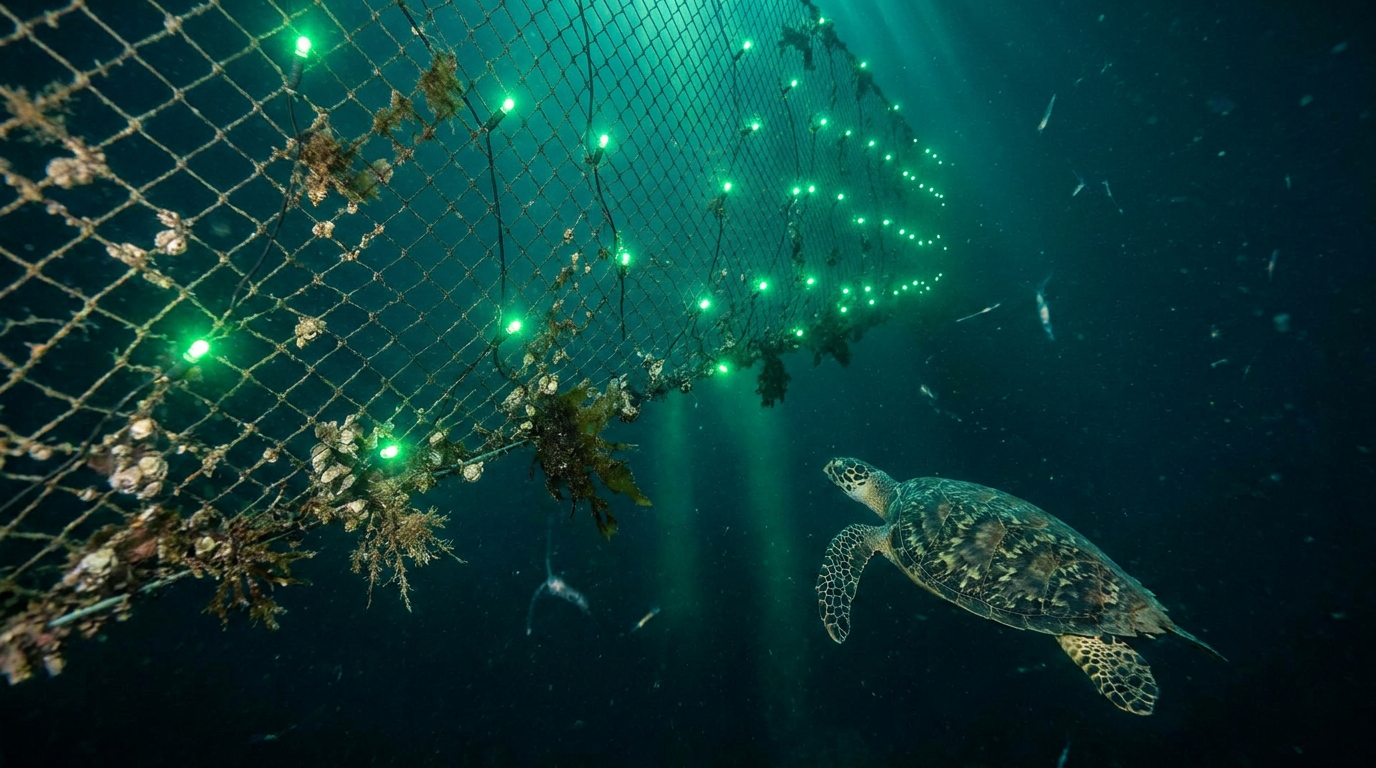
One of the most promising breakthroughs involves the use of light-emitting diodes on gillnets. Gillnets are vertical panels of netting that hang in the water column, widely used by small-scale artisanal fleets across the globe. Because they are virtually invisible underwater, they pose a severe entanglement risk to sea turtles. Marine biologists hypothesized that illuminating the nets with specific wavelengths of light—particularly green or ultraviolet—could provide a visual cue to turtles, whose eyes are highly sensitive to those spectrums, without alerting the commercially valuable fish that lack the same visual receptors.[1][2]
The field data has been overwhelmingly positive. In a landmark controlled study conducted off the coast of Baja California, Mexico, researchers deployed gillnets illuminated with green LED lights alongside standard, unlit nets. The results were striking: the illuminated nets reduced overall bycatch by 63 percent. Specifically, the glowing nets triggered a 95 percent reduction in the accidental capture of sharks, skates, and rays, and an 81 percent drop in Humboldt squid entanglement.[2]
Crucially for the fishing industry, the study found absolutely no significant reduction in the amount of targeted fish caught. The market value of the catch remained stable, and the fishers actually saved significant time and labor. Because the nets contained drastically fewer massive, tangled animals like sharks and turtles, the time required to retrieve and disentangle the gear dropped by 57 percent. Making the daily operation easier and more efficient is widely considered the most critical factor in convincing commercial fleets to adopt new conservation technologies voluntarily.[2][5]

While the data proves the efficacy of illuminated nets, the underlying biological mechanisms remain partially mysterious. Researchers understand why sea turtles avoid the lights, but the profound deterrent effect on sharks was an unexpected secondary benefit. Marine biologists currently assume the green light acts as a generalized warning signal or disrupts the sharks' spatial orientation, but the exact visual physiology driving the avoidance behavior is still being mapped. Regardless of the scientific mechanism, the operational success has prompted rapid expansion of the technology.[2][6]
The primary barrier to scaling LED nets globally has been the operational cost. The batteries required to power the lights are expensive and require constant replacement, a prohibitive expense for artisanal fishers in developing nations. To solve this, recent trials in 2025 and 2026 have successfully integrated solar-powered LED nodes into the nets. These units charge during the day, can last for a week on just 30 minutes of sunlight, and flash at an optimized duty cycle to conserve energy. Field tests of these solar nets maintained the 63 percent reduction in sea turtle bycatch while entirely eliminating the recurring cost of battery replacement.[1][2]
While light works well for visual navigators like turtles, it is less effective for marine mammals that navigate via echolocation in turbid waters. To protect dolphins and porpoises, technologists rely on Acoustic Deterrent Devices, commonly known as pingers. These are small, cylindrical units attached to fishing gear that emit high-frequency sound waves. The acoustic signals are designed to alert cetaceans to the presence of the net or to actively annoy them enough to keep them at a safe distance.[3]
While light works well for visual navigators like turtles, it is less effective for marine mammals that navigate via echolocation in turbid waters.
Pingers have been tested extensively over the last two decades, demonstrating significant bycatch reductions for species like the harbour porpoise, striped dolphin, and several types of beaked whales. In the Baltic Sea, a next-generation device called the Porpoise ALert moved beyond emitting simple artificial noise. Instead, it broadcasts synthetic harbour porpoise communication signals—essentially speaking to the animals in their own acoustic language to warn them away from the gillnets.[3][6]
The acoustic approach is not without its complications. Early iterations of pingers broadcasted at low frequencies, around 10 kilohertz, which successfully deterred dolphins but inadvertently created a dinner bell effect for pinnipeds. Sea lions and seals, whose hearing ranges perfectly matched the low-frequency pings, learned to associate the sound with a trapped, easy meal. They would follow the noise, depredate the caught fish, and frequently become entangled themselves.[3]

To counter the dinner bell phenomenon, modern seal-safe pingers were engineered to transmit at much higher frequencies—typically between 70 and 120 kilohertz. These ultrasonic pitches are easily detected by the highly sensitive echolocation anatomy of dolphins and porpoises but fall completely outside the audible hearing range of seals and sea lions. This targeted acoustic engineering ensures that the deterrent reaches the intended audience without ringing the dinner bell for unintended predators.[3][6]
Another persistent challenge with acoustic deterrents is habituation. Over time, some cetacean populations learn that the annoying sound does not represent a physical threat and begin to ignore it, leading to a gradual increase in bycatch rates. To combat this, newer pingers utilize randomized duty cycles, constantly altering the timing, pitch, and duration of the sound emissions. By preventing the acoustic landscape from becoming predictable, the devices maintain their deterrent efficacy over much longer periods.[3]
Beyond gillnets, the trap and pot fisheries—such as those targeting lobster and crab—present a different entanglement threat. These fisheries rely on vertical buoy lines connecting the seafloor traps to surface markers. These thick ropes are a primary cause of mortality for large, migrating baleen whales, most notably the critically endangered North Atlantic Right Whale. Because whales cannot easily see or echolocate the vertical lines, they swim directly into them, resulting in severe lacerations, restricted movement, and eventual drowning.[4]
The technological solution to this crisis is ropeless or on-demand fishing gear. Instead of leaving a vertical line in the water column for days, the buoy and rope are stowed in a weighted bag or spool attached to the trap on the ocean floor. When the fishing vessel returns to retrieve the catch, it transmits a secure, encrypted acoustic signal down to the specific trap. The acoustic release mechanism triggers, inflating a lift bag or releasing the buoy, which then rapidly ascends to the surface, bringing the retrieval line with it.[4][6]
Extensive trials conducted between 2023 and 2026 by federal agencies and commercial fleets have proven that on-demand gear works reliably in harsh marine environments. However, the transition faces steep logistical hurdles. The acoustic release mechanisms are currently vastly more expensive than traditional rope. Furthermore, without surface buoys marking the location of the traps, other fishing vessels cannot see where gear is deployed, creating a high risk of gear conflict and entanglement between different fleets operating in the same waters.[4][5]

To resolve the gear conflict issue, technologists are developing virtual gear marking systems. These cloud-based platforms use GPS and the acoustic transponders to plot the exact location of bottom-stowed traps on digital charts, which are then shared across the navigational displays of all vessels in the area. While the software exists, achieving universal adoption and ensuring interoperability between different manufacturers' proprietary systems remains a complex regulatory challenge.[4][6]
Ultimately, the success of any Bycatch Reduction Technology hinges on the human element. Research indicates that the adoption of these tools remains lower than their proven efficacy would suggest. Fishers are understandably risk-averse; their profit margins are razor-thin, and any modification to their gear carries the threat of reduced catches or increased operational complexity. Conservation mandates that ignore these socioeconomic realities frequently fail due to lack of compliance or active resistance.[5]
The path forward requires treating commercial fishers as partners rather than adversaries in the engineering process. When technologies like solar-powered LEDs and seal-safe pingers are co-developed with the fleets that will use them, adoption rates soar. By proving that ecological preservation and economic efficiency are not mutually exclusive, these innovations are slowly transforming the global fishing industry, offering a viable blueprint for a sustainable coexistence between human industry and marine megafauna.[5][6]
How we got here
1990s
Early acoustic deterrent devices (pingers) are introduced to reduce cetacean bycatch, but face issues with the 'dinner bell' effect attracting seals.
2010s
Marine biologists begin experimenting with illuminating gillnets using battery-powered LEDs to deter sea turtles.
2022
A landmark study in Baja California proves that green LED nets reduce shark and ray bycatch by 95 percent without affecting target fish.
2023–2024
Extensive field trials of 'ropeless' acoustic release gear demonstrate successful retrieval methods to protect North Atlantic Right Whales.
2025–2026
Solar-powered LED nets are successfully tested, eliminating the prohibitive cost of battery replacement for small-scale fishers.
Viewpoints in depth
Marine Conservationists
Focused on reducing megafauna mortality and preserving ocean biodiversity.
For conservation organizations, bycatch is an existential crisis for marine ecosystems. They point to the staggering 38 million tons of global bycatch as evidence that traditional, unregulated fishing methods are fundamentally incompatible with ocean health. This camp strongly advocates for the mandatory implementation of Bycatch Reduction Technologies across all commercial fleets. While they acknowledge the financial burden these tools place on fishers, they argue that the cost of inaction—the extinction of species like the North Atlantic Right Whale or the Vaquita porpoise—is infinitely higher. They frequently push for government subsidies to help fleets transition to ropeless gear and illuminated nets.
Small-Scale Fishers
Focused on maintaining target catch, reducing gear damage, and keeping operational costs manageable.
Artisanal and small-scale fishers operate on incredibly tight profit margins and view top-down conservation mandates with deep skepticism. Their primary concern is that gear modifications will reduce their target catch or make the physical act of fishing more dangerous and time-consuming. However, this camp is highly receptive to technologies that offer tangible operational benefits. When illuminated nets demonstrate a 57 percent reduction in the time spent untangling unwanted sharks—without shrinking the marketable catch—fishers become the strongest advocates for the technology. Their core demand is that any mandated technology must be affordable, durable, and proven not to harm their livelihoods.
Fisheries Technologists
Focused on refining sensory deterrents and gear mechanics to solve specific species interactions.
Engineers and marine technologists view bycatch as a complex, but ultimately solvable, design flaw in fishing gear. They focus on the sensory biology of the animals, asking how light wavelengths, acoustic frequencies, and mechanical releases can be tuned to separate target from non-target species. This camp is deeply concerned with the nuances of implementation, such as battery life, acoustic habituation, and the 'dinner bell' effect. They argue that there is no universal silver bullet; instead, they advocate for a highly localized approach where specific technologies are custom-tailored to the unique environmental conditions and species profiles of individual fisheries.
What we don't know
- The exact visual physiology explaining why sharks and rays are so strongly deterred by green LED lights remains unmapped.
- It is unclear how quickly certain cetacean populations might habituate to newer, randomized acoustic pingers over multi-year periods.
- The regulatory framework for standardizing virtual gear marking systems across different proprietary ropeless technologies is still unresolved.
Key terms
- Bycatch
- The unwanted fish and other marine creatures caught accidentally during commercial fishing for a different species.
- Gillnet
- A vertical panel of netting that hangs in the water column, designed to catch fish by their gills, but often invisible to larger marine animals.
- Acoustic Deterrent Device (Pinger)
- A small electronic device attached to fishing nets that emits high-frequency sound waves to warn dolphins and porpoises away.
- Ropeless Gear
- An on-demand fishing system that stows the retrieval buoy on the seafloor until triggered by an acoustic signal, eliminating vertical lines that entangle whales.
- Catch Per Unit Effort (CPUE)
- A standard measurement used in fisheries to assess the abundance of a target species and the economic efficiency of the fishing gear.
Frequently asked
Do illuminated nets catch fewer fish?
No. Multiple controlled studies have shown that while LED-illuminated nets drastically reduce the bycatch of turtles and sharks, the catch rate and market value of the targeted fish remain exactly the same.
What is the 'dinner bell' effect?
Early acoustic pingers used low frequencies that seals and sea lions could hear. Instead of being deterred, these animals learned to associate the sound with trapped fish, attracting them to the nets like a dinner bell.
How does ropeless fishing gear work?
Instead of leaving a rope in the water for days, the buoy and line are stored on the ocean floor. The fishing vessel sends a secure acoustic signal to the trap, which releases the buoy to the surface only when the boat is ready to haul it in.
Why do green lights deter sharks?
Marine biologists are not entirely sure. While they know turtles avoid the light visually, the profound deterrent effect on sharks was an unexpected benefit, likely acting as a generalized warning signal that disrupts their spatial orientation.
Sources
Source coverage
6 outlets
3 viewpoints surfaced






[1]Global Seafood AllianceFisheries Technologists
Solar-powered net lights cut sea turtle bycatch by 63 percent
Read on Global Seafood Alliance →[2]World Economic ForumMarine Conservationists
How glowing fishing nets could help save sharks and sea turtles
Read on World Economic Forum →[3]Food and Agriculture OrganizationFisheries Technologists
Marine mammal bycatch mitigation: Acoustic Deterrent Devices
Read on Food and Agriculture Organization →[4]NOAA FisheriesFisheries Technologists
Developing Ropeless Fishing Gear to Reduce Whale Entanglement
Read on NOAA Fisheries →[5]ICES Journal of Marine ScienceSmall-Scale Fishers
Understanding perspectives and barriers that affect fishers' responses to bycatch reduction technologies
Read on ICES Journal of Marine Science →[6]Factlen Editorial TeamMarine Conservationists
Synthesis by Factlen editorial team
Read on Factlen Editorial Team →

More in science
See all 72 stories →Cryo-EM Advance
Laser Phase Plate Breakthrough Illuminates the Smallest Proteins in Human Cells
7 sources

Exoplanet Habitability
How Astronomers Are Using the 'Da Vinci Glow' to Hunt for Alien Oceans
5 sources

Forensic Genealogy
26-Year Mystery in Olympic National Park Solved as DNA Identifies Remains of Joseph Louis Serrao Jr.
6 sources

Stonehenge Origins
Stonehenge's Altar Stone Mystery Points to an Epic Human Journey
7 sources

Every angle. Every day.
Get science stories with full source coverage and perspective breakdowns delivered to your inbox.