
How Agentic Workflows and Multi-Agent Systems Are Reshaping Productivity
AI has evolved from passive chatbots into autonomous agents that can plan, use tools, and collaborate to execute complex workflows. Here is how multi-agent systems are turning knowledge workers into orchestrators.
By Factlen Editorial Team

- Enterprise Leaders
- Focuses on the operational ROI of agents, valuing the massive cost reductions and the ability to handle peak demand autonomously.
- AI Researchers & Engineers
- Focuses on the technical breakthroughs, such as standardized protocols and the shift from single-model scaling to multi-agent reasoning loops.
- Knowledge Workers
- Views agents as digital colleagues that handle mundane execution, freeing humans to focus on strategic decision-making and orchestration.
What's not represented
- · Small business owners lacking enterprise budgets
- · Labor unions monitoring automation impact
Why this matters
AI is no longer just a tool that answers questions—it is now a digital workforce that executes complex, multi-step tasks autonomously. Understanding how agentic workflows operate is essential for anyone looking to remain competitive, as these systems are rapidly transforming how businesses operate and how knowledge workers spend their time.
Key points
- AI has transitioned from conversational chatbots to autonomous agents capable of executing multi-step goals.
- Agentic workflows use a reasoning loop to adapt to errors, unlike traditional rigid automation scripts.
- Multi-agent systems divide complex tasks among specialized models, improving speed by 3 to 5 times.
- Standardized protocols like MCP have made it easier for agents to securely use external tools and APIs.
- Over half of surveyed companies now have AI agents running in production environments.
- Human workers are shifting from manual task execution to higher-level orchestration and review roles.
The era of the chatbot is officially over. For the past few years, artificial intelligence was primarily a conversational partner—a tool that waited patiently for a human to type a prompt before generating text or code. But in 2026, the paradigm has fundamentally shifted. We have entered the era of "agentic workflows," where AI systems no longer just answer questions; they execute multi-step goals autonomously.[1][7]
Unlike traditional automation, which relies on rigid "if-this-then-that" rules, an agentic workflow is dynamic. If a standard automation script encounters a broken link or an unexpected error, the entire process crashes. An autonomous AI agent, however, possesses a reasoning layer. If a web search API fails, the agent recognizes the error, adapts its plan, and seamlessly switches to a Wikipedia search tool to complete the task without requiring human intervention.[7][8]
This shift from a fixed path to a reasoning loop is transforming enterprise productivity. According to recent industry data, 57% of companies now have AI agents running in production environments, moving far beyond the experimental pilot phases of 2024 and 2025. Gartner projects that by the end of 2026, 40% of all enterprise applications will embed task-specific AI agents, up from less than 5% just a year prior.[1][2][5]
To understand how these systems operate, it is essential to break down the five core capabilities that define a true autonomous agent: perception, reasoning, planning, tool use, and memory. Perception allows the agent to ingest its environment, whether that is a user prompt, a database, or a live API feed. Reasoning and planning enable the model to break a massive, ambiguous goal into a sequence of discrete, manageable steps.[1][8]

Tool use is where the system takes action. An agent without tools is merely a language model generating text. Today's agents are equipped with the ability to execute Python code, query SQL databases, browse the live web, and interact with CRM platforms. Finally, memory and self-correction allow the agent to evaluate its own output, recognize hallucinations or errors, and iterate until the result meets the required standard.[1][7]
AI pioneer Andrew Ng has been instrumental in codifying this shift, outlining four primary design patterns for agentic workflows: reflection, tooling, planning, and multi-agent collaboration. Reflection involves the AI critiquing its own work to improve it. Tooling gives the AI hands to manipulate the digital world. Planning allows it to map out a sequence of actions. But it is the fourth pattern—multi-agent collaboration—that has unlocked the most dramatic gains in 2026.[8]
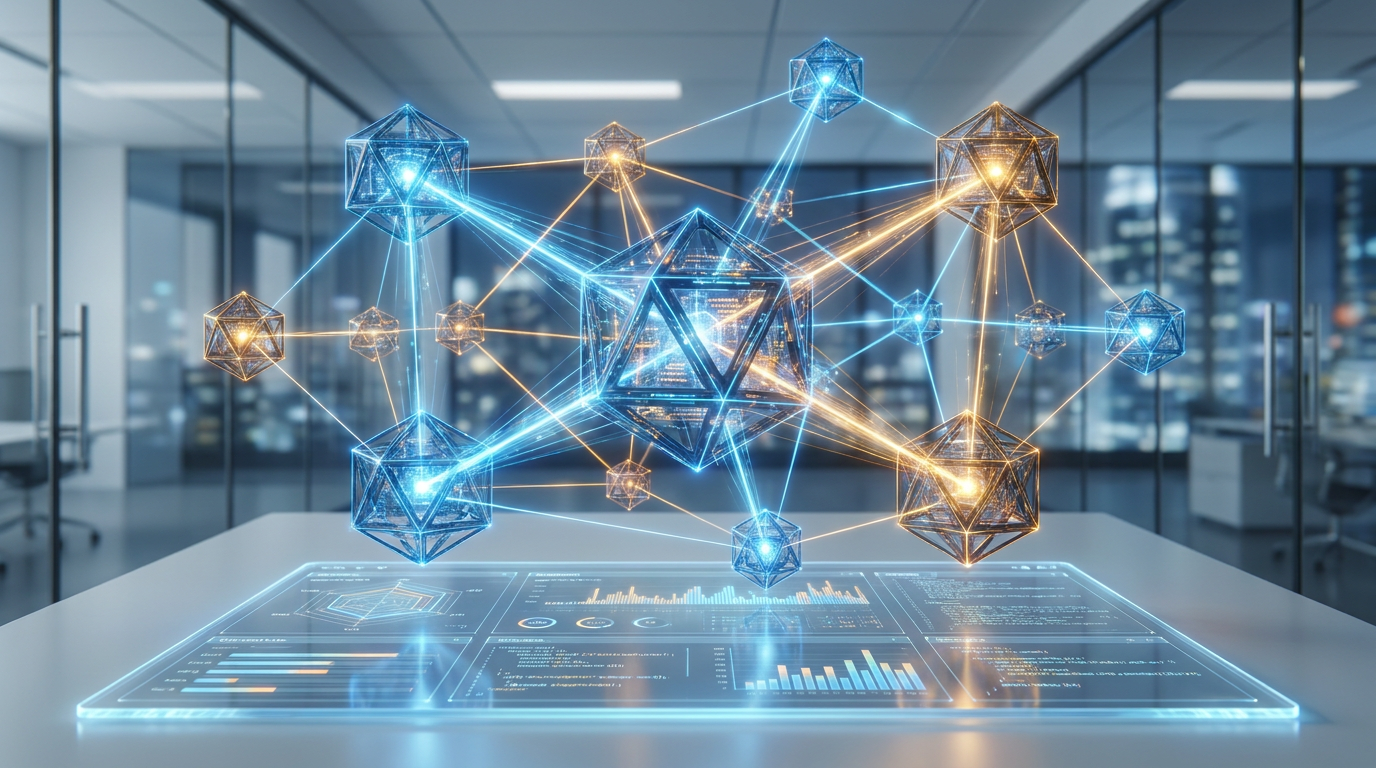
If 2025 was the year of the single AI agent, 2026 is the year of the multi-agent system. Instead of relying on one massive, generalized AI model to handle every aspect of a complex project, developers are now orchestrating teams of specialized agents. In a multi-agent architecture, one agent might be responsible for web research, another for data analysis, a third for writing code, and a fourth for quality assurance.[5][6][8]
If 2025 was the year of the single AI agent, 2026 is the year of the multi-agent system.
This division of labor mirrors human organizational structures and yields remarkable results. Enterprise deployments of multi-agent systems are completing complex tasks three to five times faster than single-agent setups. Because these systems can route simpler tasks to smaller, cheaper models while reserving heavy reasoning for frontier models, organizations are reporting up to 90% lower operational costs alongside a 40% to 60% improvement in accuracy.[6]

The infrastructure enabling this collaboration has matured rapidly. The widespread adoption of the Model Context Protocol (MCP) has standardized how agents connect to external tools and data sources, eliminating the need for custom integrations. Simultaneously, Agent-to-Agent (A2A) protocols now allow different AI models to negotiate, share findings, and coordinate peer-to-peer without requiring a central human orchestrator to pass messages between them.[5]
The real-world impact of these coordinated systems is already visible across major industries. In customer service and operations, multi-agent systems are achieving astonishing containment rates—meaning the AI handles the entire customer journey from start to finish without escalating to a human. Recent benchmarks show containment rates of 80% to 99.5% in sectors like financial services, healthcare, and IT support.[4]
For example, a modern loan processing workflow might involve a "Journey Orchestration Agent" that coordinates the entire process. It delegates tasks to an "Eligibility Agent" for real-time quotes, a "Risk Agent" for compliance checks, and a "Document Generation Agent" to finalize the paperwork. The entire process, which once took days of human coordination, is completed in minutes.[4]

The economic implications are vast. Researchers at MIT Sloan note that AI agents are capable of executing economic transactions and strategic interactions on behalf of human principals. The agentic AI market has surged to approximately $10.9 billion in 2026, growing at a compound annual rate of over 45%. This is not just a software upgrade; it is a fundamental redesign of how digital work flows through an organization.[1][3][5]
Crucially, the rise of agentic workflows is not about replacing human workers, but elevating them. As AI agents take over the execution of repetitive, multi-step tasks, human professionals are transitioning into roles as orchestrators and reviewers. A financial analyst who previously spent hours manually pulling data and formatting reports can now deploy a team of agents to synthesize 100 earnings reports overnight, allowing the analyst to spend their morning making high-level strategic decisions.[4][8]

This shift democratizes access to complex capabilities. With the rise of no-code agent platforms, non-developers can now describe a goal in plain English and watch as the platform automatically assembles the necessary agents and tools to achieve it. The barrier to entry for building bespoke, highly capable software systems has never been lower.[7]
As we look beyond 2026, the focus is shifting toward robust governance and safety. With agents operating autonomously, enterprises are implementing strict audit trails, least-privilege permissions, and real-time compliance monitoring to ensure these systems act reliably. The organizations that master this balance of autonomy and oversight are building a compounding competitive advantage, turning the promise of artificial intelligence into tangible, everyday empowerment.[2][5][8]
How we got here
2023–2024
Large language models popularize generative AI through conversational chatbots that require constant human prompting.
Early 2025
Developers begin experimenting with single autonomous agents capable of using basic tools and browsing the web.
Late 2025
AI pioneer Andrew Ng popularizes the concept of 'agentic workflows,' emphasizing reflection, tooling, and planning.
Early 2026
Standardization protocols like MCP and A2A mature, allowing seamless tool integration and peer-to-peer agent communication.
Mid 2026
Multi-agent systems reach enterprise scale, with 57% of companies deploying autonomous workflows in production environments.
Viewpoints in depth
Enterprise Leaders
Focused on the operational efficiency and cost reductions driven by autonomous workflows.
For executives and operations leaders, the appeal of agentic AI lies in its ability to scale effortlessly. Traditional automation required expensive engineering time to map out every possible edge case, and even then, systems would break when confronted with unexpected inputs. Agentic workflows solve this by reasoning through exceptions in real-time. Leaders are particularly drawn to multi-agent systems because they can route simpler tasks to cheaper models, reducing API costs by up to 90% while maintaining high accuracy. The focus in boardrooms has shifted from experimenting with AI to deploying robust governance frameworks that allow these agents to operate safely at scale.
AI Researchers & Engineers
Focused on the architectural breakthroughs that allow models to collaborate and use tools.
The engineering community views the rise of multi-agent systems as a necessary evolution past the limitations of single, monolithic language models. Researchers note that prompting a single model to act as a researcher, coder, and reviewer simultaneously often leads to degraded performance and hallucinations. By splitting these personas into distinct agents that communicate via standardized protocols like the Model Context Protocol (MCP) and Agent-to-Agent (A2A) frameworks, engineers can build highly resilient systems. Their current focus is on optimizing the 'reasoning loops' and improving the memory architecture so agents can learn from past mistakes without requiring complete retraining.
Knowledge Workers
Focused on the transition from manual execution to strategic orchestration.
For the professionals actually using these tools daily, agentic AI represents a fundamental shift in job responsibilities. Rather than spending hours pulling data, formatting spreadsheets, or drafting routine emails, workers are learning to act as managers of digital teams. They define the goals, provide the necessary context, and review the final output generated by the multi-agent system. While there is a learning curve in understanding how to properly prompt and constrain these agents, early adopters report massive productivity gains, allowing them to dedicate their time to high-level strategy, creative problem-solving, and relationship building.
What we don't know
- How quickly smaller businesses without enterprise IT budgets will be able to adopt multi-agent systems.
- The long-term impact of agentic workflows on entry-level knowledge worker jobs, which traditionally involved the tasks agents now automate.
- How regulatory bodies will approach liability when an autonomous agent makes a costly error without human oversight.
Key terms
- Agentic Workflow
- An AI system that uses a reasoning loop to autonomously plan and execute a sequence of actions to achieve a goal, rather than following a rigid script.
- Multi-Agent System
- An AI architecture where multiple specialized agents collaborate, communicate, and divide labor to solve complex problems more efficiently than a single model.
- Model Context Protocol (MCP)
- A standardized protocol that allows AI agents to securely connect to external tools, APIs, and data sources without requiring custom integration work.
- Tool Use
- The capability of an AI agent to interact with external software, such as executing Python code, searching the web, or updating a CRM database.
- Reasoning Loop
- The continuous process where an AI agent observes its environment, plans its next step, takes action, and evaluates the result until a goal is met.
Frequently asked
What is the difference between a chatbot and an AI agent?
Chatbots wait for a human prompt to generate text. AI agents receive a goal, form a plan, use external tools, and execute multi-step workflows autonomously without needing step-by-step instructions.
What is a multi-agent system?
It is an architecture where a complex task is divided among several specialized AI agents—such as a researcher, a coder, and a reviewer—that collaborate to achieve a goal more efficiently than a single model.
How do AI agents interact with the real world?
They use 'tools,' which are API connections that allow the AI to browse the live web, execute code, query databases, send emails, and update software platforms.
Are AI agents replacing human jobs?
Currently, they are acting as digital colleagues that handle repetitive, multi-step tasks. This allows human workers to transition into higher-level orchestrator and decision-making roles.
Sources
Source coverage
8 outlets
3 viewpoints surfaced








[1]AIBuzz BlogAI Researchers & Engineers
The Complete 2026 Explainer for Autonomous AI Agents
Read on AIBuzz Blog →[2]LabwyzeEnterprise Leaders
Autonomous AI Agents in Enterprise: The 2026 Revolution
Read on Labwyze →[3]MIT SloanKnowledge Workers
What is agentic AI? The next evolution of generative AI
Read on MIT Sloan →[4]Druid AIEnterprise Leaders
Why 2026 is the Year of the Multi-Agent System
Read on Druid AI →[5]Dev.toAI Researchers & Engineers
Building Production-Ready Multi-Agent Systems in 2026
Read on Dev.to →[6]Ruh AIKnowledge Workers
What is Multi-Agent Collaboration? The 2025-2026 Guide
Read on Ruh AI →[7]AnyCap AIAI Researchers & Engineers
Agentic Workflows: What They Are and How to Build Them
Read on AnyCap AI →[8]Factlen Editorial TeamKnowledge Workers
Synthesis by Factlen editorial team
Read on Factlen Editorial Team →

More in ai
See all 134 stories →Agentic AI
How Autonomous AI Agents Are Moving from Chatbots to Action-Takers
8 sources
Local AI
The Rise of Local AI: How to Run Powerful Language Models on Your Own Laptop
6 sources

Open-Source AI
Open-Source AI Models Reach Frontier Parity, Democratizing Access for Developers
7 sources

EU AI Act
Global Tech Faces Operational Reckoning as EU AI Act's August 2026 Deadline Looms
8 sources
Every angle. Every day.
Get ai stories with full source coverage and perspective breakdowns delivered to your inbox.