
The Rise of Local AI: Running ChatGPT-Level Models on Your Own Machine
Advances in consumer hardware and open-source models are moving artificial intelligence out of the cloud and directly onto laptops, offering unprecedented privacy, zero subscription costs, and offline capabilities.
By Factlen Editorial Team
- Open-Source Developers
- Value the freedom to tinker, fine-tune, and build without API limits or vendor lock-in.
- Privacy Advocates
- Prioritize data sovereignty and keeping sensitive information off corporate servers.
- Hardware Manufacturers
- See on-device AI as the catalyst for a massive upgrade cycle in consumer electronics.
What's not represented
- · Cloud AI Providers
- · Enterprise IT Security Auditors
Why this matters
Moving AI processing from the cloud to your local machine ensures your sensitive data—like personal documents, proprietary code, and private conversations—never leaves your device, while eliminating recurring API and subscription fees.
Key points
- Advances in open-source models allow consumer laptops to run AI systems rivaling cloud-based platforms.
- Local AI processing guarantees absolute privacy, as user data never leaves the physical device.
- Running models locally eliminates recurring subscription fees and API costs.
- Tools like Ollama and LM Studio have made installing and running local AI accessible to non-experts.
- Apple and PC manufacturers are building dedicated AI hardware (NPUs) to handle these workloads efficiently.
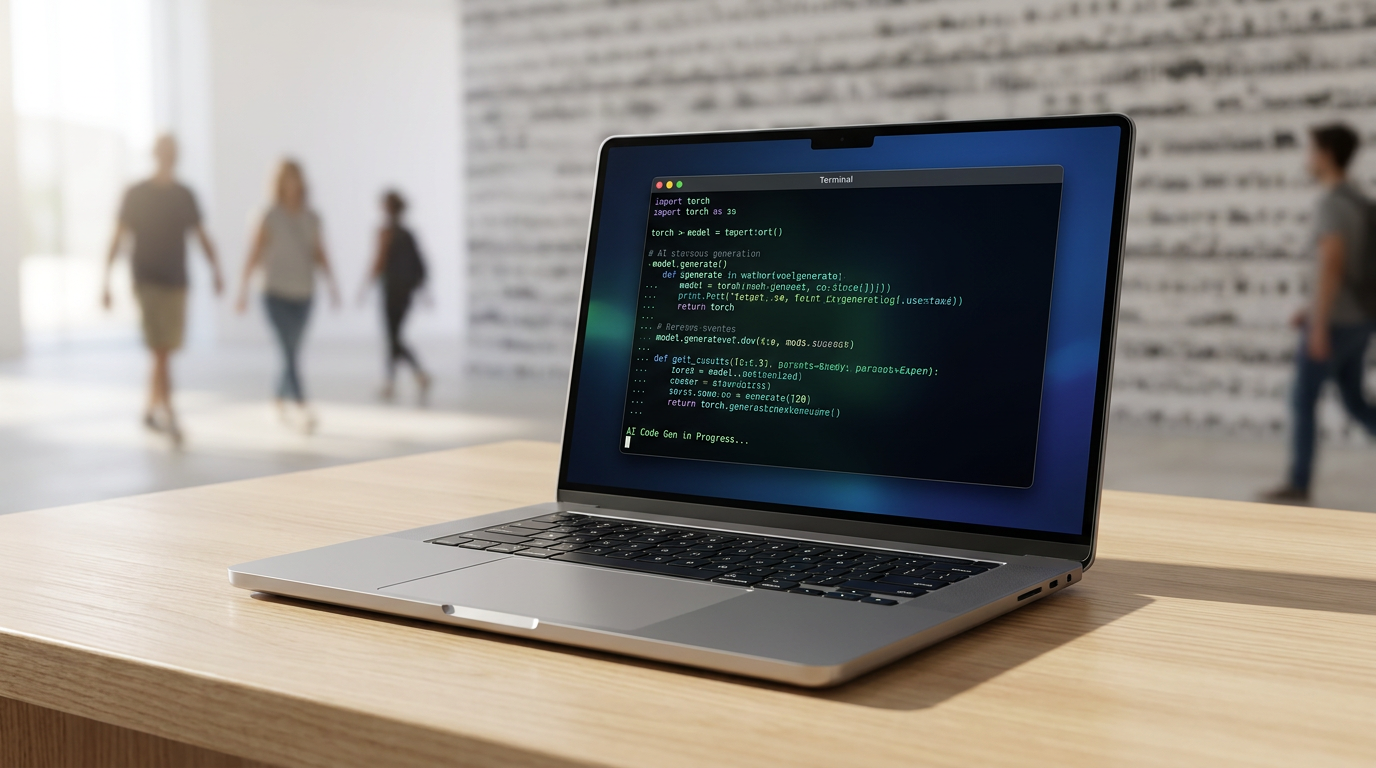
For the past few years, interacting with artificial intelligence meant sending your thoughts, code, and private documents to servers owned by tech giants. The cloud was the undisputed engine of the AI boom. But in 2026, a quiet revolution is taking place on the edge. Advances in open-source models and consumer hardware have made it entirely feasible to run highly capable Large Language Models (LLMs) directly on your own laptop or smartphone. This shift from cloud-dependent processing to local, on-device AI is fundamentally changing how developers, enterprises, and everyday users interact with machine learning, prioritizing privacy and offline reliability over sheer scale.[1]
The catalyst for this transition is twofold: the rapid maturation of open-weight models and the arrival of purpose-built hardware. Models like Meta's Llama 3, Alibaba's Qwen3, and DeepSeek have reached a level of sophistication where their compressed versions can match or exceed the performance of proprietary cloud models from just a year ago. According to recent benchmarks, top-tier open-source models now score exceptionally well on complex coding and reasoning tasks, effectively closing the gap for most practical applications. These models are freely available on platforms like Hugging Face, which now hosts over a million open-source models and has become the de facto "GitHub of AI."[5][9]
The most compelling argument for local AI is privacy. When you use a cloud-based chatbot, your inputs—whether they are proprietary business strategies, sensitive legal documents, or personal health questions—are transmitted to external servers. Even with stringent enterprise data policies, this transmission introduces inherent risk. Running models locally eliminates this concern entirely, as the data never leaves the physical device. This absolute data sovereignty is driving adoption among privacy advocates, healthcare professionals, and corporate IT departments who require strict compliance with data protection regulations.[1][6][8]
Beyond privacy, local AI offers significant operational advantages: zero latency and complete offline capability. Cloud-based AI is inherently tethered to internet connectivity and server uptime. If the network drops or the API provider experiences an outage, the AI workflow halts. Local LLMs, however, function seamlessly in air-gapped environments, during flights, or in remote locations. Furthermore, for applications requiring real-time responsiveness—such as voice assistants or live coding copilots—eliminating the network round-trip time results in a dramatically smoother and more immediate user experience.[1][6]

The financial economics of local AI are equally disruptive. Cloud AI relies on a pay-per-token or monthly subscription model, which can become prohibitively expensive for high-volume users or automated agentic workflows that generate millions of tokens a day. With local inference, the only ongoing cost is the electricity required to power the machine. Once the initial hardware investment is made, users can query the model infinitely without worrying about API limits, unexpected billing spikes, or vendor lock-in.[8][9]
However, running these massive mathematical engines requires serious hardware. The model weights must be loaded entirely into the system's memory, making RAM the most critical bottleneck. A standard 7-billion parameter model requires roughly 8GB of memory just to load, while larger, more capable models demand 16GB, 32GB, or even 64GB of RAM. Historically, this required expensive, specialized graphics cards (GPUs). Today, the landscape has shifted, with modern laptops increasingly equipped to handle these heavy workloads natively.[1][7]

Apple has been uniquely positioned to capitalize on this trend thanks to its Apple Silicon architecture. The M-series chips feature a unified memory architecture, meaning the CPU and GPU share the same pool of high-speed RAM. A MacBook Pro with 64GB of unified memory can comfortably load massive AI models that would otherwise require multiple expensive desktop GPUs. Apple has leaned heavily into this hardware advantage, overhauling its Apple Intelligence platform in 2026 to deeply integrate on-device processing across iOS and macOS.[2][3][7]
Apple has been uniquely positioned to capitalize on this trend thanks to its Apple Silicon architecture.
Apple's strategy explicitly contrasts with cloud-first competitors by making AI an ambient, invisible part of the operating system rather than a standalone chatbot. The company's new architecture relies on highly optimized Apple Foundation Models that run locally for everyday tasks like summarization, text generation, and photo editing. When a request exceeds the device's capabilities, the system seamlessly routes it to Private Cloud Compute—a secure server environment where Apple guarantees user data is never stored or made accessible to third parties.[2][3][4]
On the PC side, 2026 has been defined by the rise of the "AI PC." Chipmakers like Qualcomm, AMD, and Intel have introduced processors featuring dedicated Neural Processing Units (NPUs). These NPUs are designed specifically to handle AI computations efficiently, freeing up the CPU and GPU while consuming a fraction of the power. While NPUs are excellent for lightweight, always-on tasks like background blurring or live captions, running full-scale LLMs still heavily benefits from dedicated GPUs, with AMD's ROCm platform and NVIDIA's CUDA remaining the gold standards for heavy local inference.[6][7]
The software ecosystem bridging this powerful hardware with the open-source models has also matured remarkably. Two tools in particular—Ollama and LM Studio—have democratized access to local AI, turning what used to be a complex, error-prone Python setup into a one-click installation. These platforms handle the heavy lifting of downloading models, managing dependencies, and optimizing performance for the host machine's specific hardware configuration.[1][8]

Ollama has emerged as the darling of the developer community. Operating primarily as a lightweight, background command-line tool, it allows users to download and run models with a single terminal command. More importantly, Ollama exposes a local API that mimics the OpenAI standard. This means developers can easily point their existing applications, coding assistants, and automation scripts to their local machine instead of a cloud provider, instantly transforming cloud-dependent software into private, on-device tools.[8]
For users who prefer a graphical interface, LM Studio offers a polished, desktop application experience. It provides a searchable directory of models hosted on Hugging Face, allowing users to download and chat with different AI systems using a familiar, ChatGPT-style interface. LM Studio also includes advanced features like vision capabilities and document analysis, making it highly accessible for non-programmers who want to experiment with local AI without touching a command line.[1]
To make these massive models fit onto consumer hardware, the community relies heavily on a technique called quantization. Quantization compresses the model by reducing the precision of its mathematical weights—for example, converting 16-bit numbers to 4-bit numbers. While this dramatically reduces the RAM required to run the model, it comes with a slight trade-off in reasoning quality and nuance. However, modern quantization techniques have become so advanced that the performance degradation is often imperceptible for everyday tasks.[1][8]
The push for local AI is also expanding beyond laptops and into mobile devices. Frameworks and mobile-native SDKs are enabling developers to embed LLMs directly into iOS and Android applications. This allows for voice-driven apps and intelligent assistants that process speech and text entirely on the phone, eliminating the awkward pauses caused by network latency and ensuring that personal voice data is never transmitted to the cloud.[1]

Despite the rapid progress, local AI is not a panacea. Running complex inference on a laptop generates significant heat and rapidly drains battery life. Furthermore, while local models are incredibly capable, the absolute cutting-edge frontier models—those with hundreds of billions or trillions of parameters—will always require massive data center infrastructure. Local AI is not about replacing the cloud entirely; it is about right-sizing the compute, ensuring that everyday, privacy-sensitive tasks are handled locally, while reserving the cloud for the most demanding computational challenges.[1][6]
As we move further into 2026, the dichotomy between cloud and local AI is blurring into a seamless hybrid model. Operating systems and applications are becoming smart enough to route simple queries to the local NPU, complex coding tasks to the local GPU, and impossible questions to the cloud—all in a fraction of a second. By putting the power of large language models directly into the hands of users, the local AI movement is ensuring that the future of computing remains decentralized, private, and firmly under the user's control.[1][4]
How we got here
Early 2023
Meta leaks the original LLaMA model, sparking the open-source AI movement.
Late 2023
Tools like Ollama and LM Studio launch, simplifying local model execution.
Mid 2024
Apple announces Apple Intelligence, committing to on-device AI processing.
Early 2026
Open-source models like Llama 3 and Qwen3 match proprietary models in key benchmarks.
June 2026
Apple overhauls its Apple Intelligence architecture for deeper system-wide local integration.
Viewpoints in depth
Privacy Advocates
Prioritize data sovereignty and keeping sensitive information off corporate servers.
For privacy advocates and enterprise compliance officers, local AI is a non-negotiable requirement. They argue that transmitting sensitive data—such as medical records, proprietary source code, or personal communications—to third-party cloud providers introduces unacceptable security risks. By running models entirely on-device, organizations can leverage the productivity benefits of AI while maintaining absolute cryptographic control over their data, ensuring compliance with strict global privacy regulations.
Open-Source Developers
Value the freedom to tinker, fine-tune, and build without API limits or vendor lock-in.
The developer community views local AI as a return to the decentralized roots of computing. Relying on proprietary cloud APIs creates vendor lock-in and subjects projects to arbitrary rate limits, censorship, and unexpected pricing changes. By utilizing open-weight models and local execution engines like Ollama, developers have the freedom to fine-tune models for specific niche tasks, build autonomous agents that run 24/7 without incurring massive bills, and inspect the underlying mechanics of the AI systems they deploy.
Hardware Manufacturers
See on-device AI as the catalyst for a massive upgrade cycle in consumer electronics.
Companies like Apple, Qualcomm, and AMD are heavily incentivized to push the local AI narrative, as it drives demand for high-margin, premium hardware. Running LLMs requires significant amounts of high-speed RAM and dedicated Neural Processing Units (NPUs). Hardware manufacturers are positioning the 'AI PC' as an essential upgrade, arguing that the battery efficiency, speed, and privacy benefits of on-device processing justify the investment in next-generation silicon.
What we don't know
- Whether open-source models will continue to keep pace with the multi-billion-dollar frontier models developed by OpenAI and Google.
- How quickly mobile devices will overcome battery and thermal constraints to run large models continuously.
Key terms
- Local LLM
- A Large Language Model downloaded and executed entirely on a user's personal computer or device, rather than on a remote server.
- Quantization
- A compression technique that reduces the precision of an AI model's mathematical weights, allowing it to run on consumer hardware with less RAM.
- NPU (Neural Processing Unit)
- A specialized hardware chip designed specifically to accelerate artificial intelligence computations efficiently.
- Inference
- The process of running live data through a trained AI model to generate an output or prediction.
- Open Weights
- AI models where the underlying mathematical parameters are made publicly available, allowing anyone to download and run them.
Frequently asked
Can I run a local LLM on my current laptop?
Yes, if your laptop has at least 8GB to 16GB of RAM. Tools like LM Studio can run smaller, compressed models on most modern Mac and Windows machines.
Is a local AI as smart as ChatGPT?
Top-tier open-source models like Llama 3 and Qwen3 perform similarly to GPT-4 on many coding and reasoning tasks, though the largest cloud models still hold an edge in complex, multi-step logic.
Does running AI locally cost money?
No. Once you own the hardware, downloading open-source models and running inference is completely free, with no subscription or API fees.
What is the difference between Ollama and LM Studio?
Ollama is a command-line tool designed for developers to run models in the background, while LM Studio provides a user-friendly graphical interface similar to ChatGPT.
Sources
Source coverage
9 outlets
3 viewpoints surfaced









[1]Factlen Editorial TeamPrivacy Advocates
Synthesis by Factlen editorial team
Read on Factlen Editorial Team →[2]AppleHardware Manufacturers
Apple introduces the next generation of Apple Intelligence
Read on Apple →[3]MacRumorsHardware Manufacturers
Apple Overhauls Apple Intelligence Architecture
Read on MacRumors →[4]MindStudioHardware Manufacturers
What is Apple's AI strategy in 2026?
Read on MindStudio →[5]Hugging FaceOpen-Source Developers
The State of Open Source AI in 2026
Read on Hugging Face →[6]ASUSPrivacy Advocates
Privacy and Data Ownership with Local LLMs
Read on ASUS →[7]David's BlueprintHardware Manufacturers
Best Laptops for Running Local LLMs in 2026
Read on David's Blueprint →[8]ServermanOpen-Source Developers
What is Ollama? Running AI Locally
Read on Serverman →[9]WhatLLMOpen-Source Developers
Open Source vs Proprietary: The Gap Has Closed
Read on WhatLLM →

More in ai
See all 139 stories →EU AI Act
Global Tech Faces Operational Reckoning as EU AI Act's August 2026 Deadline Looms
8 sources

Clinical AI
Healthcare's New AI Breakthrough Focuses on Fixing Fragmented Patient Records
6 sources

Embodied AI
How End-to-End Neural Networks Are Giving Humanoid Robots the Gift of General Intelligence
6 sources

Mechanistic Interpretability
How Scientists Are Finally Cracking Open the AI 'Black Box'
8 sources

Every angle. Every day.
Get ai stories with full source coverage and perspective breakdowns delivered to your inbox.