
SpaceX Completes Historic $75 Billion IPO, Vaulting Valuation Past $2 Trillion
Elon Musk's space exploration company shattered Wall Street records with the largest public offering in history, surging 19% in its Nasdaq debut and minting the world's first trillionaire.
By Factlen Editorial Team
- Growth Investors & Technologists
- View the $2 trillion valuation as a fair premium for a company building the foundational infrastructure for the space economy and artificial intelligence.
- Market Structure Analysts
- Focus on the mechanical impact of the IPO, warning that fast-tracked index inclusion will force passive funds to buy the stock regardless of price.
- Traditional Valuation Skeptics
- Argue that the company's multi-billion dollar losses make the historic valuation highly speculative and disconnected from fundamental earnings.
What's not represented
- · Competitors in the legacy aerospace sector
- · Retail investors who were unable to secure an allocation
Why this matters
SpaceX's unconventional IPO mechanics—including a fixed price and massive retail allocation—could rewrite how mega-cap tech companies go public. Furthermore, its fast-tracked inclusion into major index funds means everyday retirement accounts will soon automatically hold a stake in the space race.
Key points
- SpaceX raised a record $75 billion in its IPO, surpassing Saudi Aramco's 2019 listing.
- Shares surged 19% on their first day of trading, closing at $160.95.
- The debut pushed the company's valuation past $2.1 trillion, making it the sixth-largest U.S. company.
- Elon Musk's net worth crossed the $1 trillion mark, making him the world's first trillionaire.
- Nasdaq fast-tracked the stock's inclusion into major indices, forcing passive funds to buy shares.
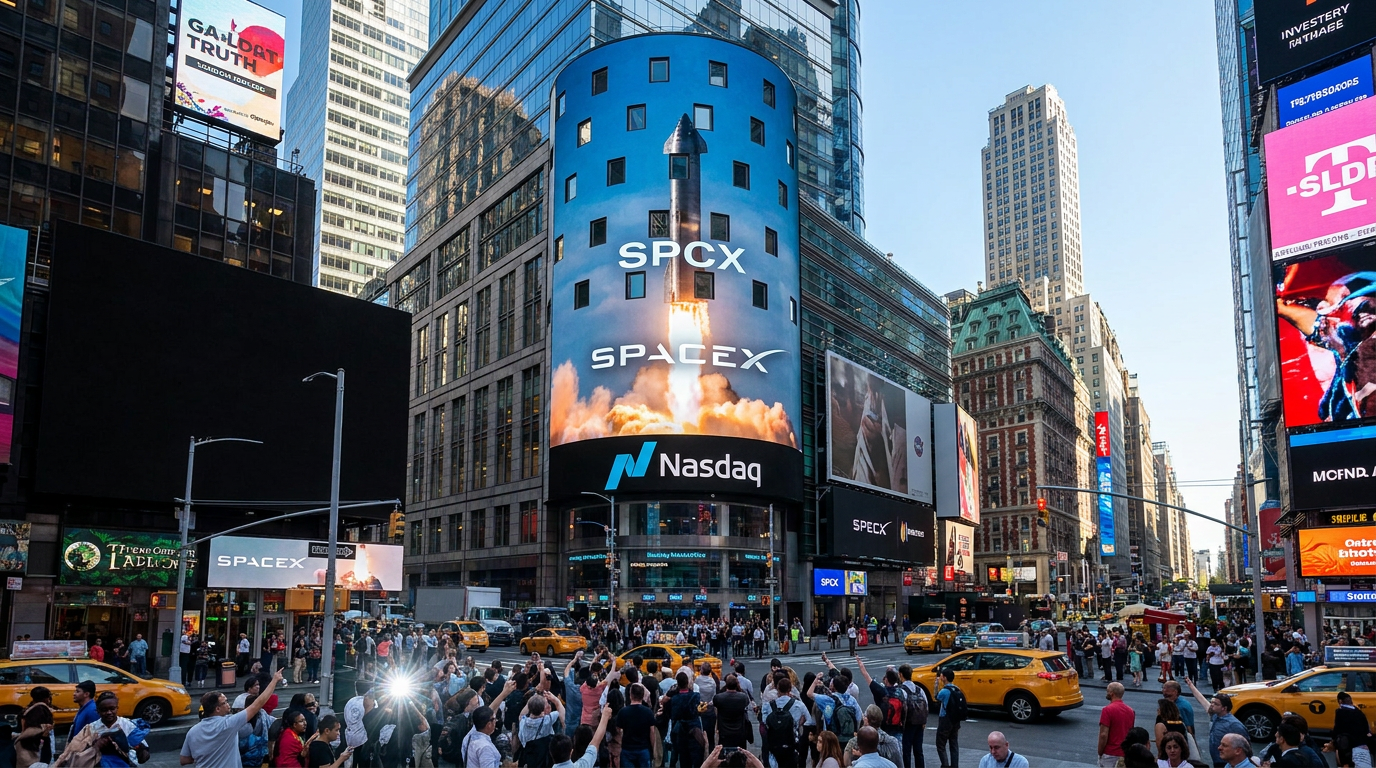
SpaceX officially launched as a publicly traded company on Friday, shattering Wall Street records with a staggering $75 billion initial public offering. Trading under the ticker symbol SPCX on the Nasdaq exchange, the aerospace and satellite giant bypassed traditional financial norms to execute the largest market debut in history. The massive capital raise is roughly two and a half times the size of the previous global record—Saudi Aramco's $29.4 billion listing in 2019—and firmly establishes a new era of mega-cap technology offerings. For years, investors have eagerly awaited the chance to buy into Elon Musk's sprawling space empire, and the sheer scale of the debut indicates that institutional appetite for the commercial space sector has never been higher.[1][2]
The trading action on Friday morning immediately validated the immense pre-market hype. While the company had priced its shares at a fixed $135, the stock opened for public trading at $150 and quickly caught fire. Throughout the intraday session, shares surged as high as $176.52, representing a gain of nearly 31% from the initial offering price. By the time the closing bell rang in New York, the stock had settled at $160.95, locking in a 19% first-day gain. The smooth execution of the listing eased Wall Street's nerves, proving that the market could easily absorb an offering of this unprecedented magnitude without buckling under the weight of the supply.[3][5]
The massive first-day pop vaulted SpaceX's total market capitalization past the $2.1 trillion mark, instantly making it the sixth-largest public company in the United States—trailing only a handful of established tech behemoths like Apple, Microsoft, and Nvidia. The milestone also triggered a historic wealth threshold for the company's founder. Propelled by his massive equity stake and super-voting shares in the newly public entity, CEO Elon Musk saw his personal net worth soar to an estimated $1.1 trillion. This unprecedented financial leap officially minted Musk as the world's first individual trillionaire, capping off a remarkable journey for a company that nearly went bankrupt after a series of failed rocket launches in 2008.[4][6]

Beyond the sheer scale of the capital raised, the mechanics of the SpaceX IPO have completely rewritten the Wall Street playbook. Rather than running a traditional, weeks-long 'bookbuilding' process to gauge institutional demand and narrow down an indicative price range, SpaceX simply handed the market a fixed $135 price tag and moved forward. Furthermore, the company made a deliberate strategic choice to earmark an unprecedented 30% of the IPO float specifically for retail investors. This massive allocation—roughly three times the standard norm for a mega-cap debut—democratized access to the blockbuster event, allowing everyday traders to participate in a wealth-generation event that is typically reserved almost entirely for institutional heavyweights and well-connected insiders.[8]
Beyond the sheer scale of the capital raised, the mechanics of the SpaceX IPO have completely rewritten the Wall Street playbook.
Underneath the soaring valuation, however, lies a highly complex and heavily scrutinized financial picture. According to its prospectus, SpaceX generated a robust $18.7 billion in total revenue in 2025, largely driven by the rapid expansion of its Starlink satellite internet constellation and its near-monopoly on commercial orbital launch services. Yet, the company remains highly unprofitable as it aggressively reinvests its capital. Between the start of 2025 and March 2026, SpaceX posted an $8.7 billion net loss, driven by massive capital expenditures on its next-generation Starship rocket program and the build-out of artificial intelligence infrastructure in orbit. Traditional valuation metrics struggle to justify a $2 trillion market cap for a company with such steep ongoing losses.[3][6]
Despite the glaring lack of bottom-line profitability, analysts note that investors are happily buying into a completely different paradigm. Dubbed the 'Price to Elon Ratio' by several trading desks, the premium valuation reflects absolute market confidence in Musk's track record of disrupting legacy industries. Investors are not valuing SpaceX on its current earnings; rather, they are pricing in an estimated $28.5 trillion total addressable market. This sprawling vision encompasses a future of multi-planetary colonization, global broadband dominance, and the seamless integration of xAI's data centers operating in the vacuum of space. For the bulls, the $75 billion raised on Friday is simply the war chest required to build the infrastructure of the next century.[1][5]

The ripple effects of this historic IPO will soon reach far beyond active stock pickers, directly impacting everyday retirement accounts. In anticipation of the blockbuster listing, major index providers, including Nasdaq, proactively altered their eligibility rules to allow 'fast entry' for mega-cap companies. Under these revised guidelines, SpaceX is expected to be absorbed into major headline benchmarks within just 15 trading days, entirely bypassing the standard months-long seasoning period. Additionally, index providers have waived standard minimum float requirements, acknowledging that a company of SpaceX's sheer size cannot be held to the same structural rules as a traditional mid-cap debut.[7]
This accelerated index inclusion means that passive index funds and exchange-traded funds (ETFs) will soon be forced to buy massive quantities of SPCX shares to accurately replicate their benchmark weights. Market structure analysts warn that this dynamic could create intense, mandatory liquidity demand in the coming weeks. As a result, the stock's near-term price discovery process may be driven less by fundamental valuation and more by mechanical supply-and-demand imbalances. While this forced buying could push the stock even higher, it also means that millions of Americans will soon hold a stake in the volatile space venture through their 401(k)s, whether they actively chose to invest in it or not.[4][7]

Ultimately, SpaceX's successful debut is being widely viewed on Wall Street as a critical dress rehearsal for a coming wave of artificial intelligence mega-listings. With AI heavyweights like OpenAI and Anthropic expected to pursue their own massive public offerings later this year, the market's voracious appetite for SpaceX proves that investors are more than willing to fund visionary, capital-intensive technologies at historic valuations. If Friday's trading action is any indication, the public markets are fully prepared to embrace the next generation of technological moonshots, setting the stage for a transformative year in global finance.[1][2]
How we got here
December 2025
SpaceX executes a private tender offer that values the company at roughly half of its eventual IPO price.
April 2026
The aerospace company confidentially files paperwork for an initial public offering, sparking intense Wall Street speculation.
May 2026
Major index providers, including Nasdaq, alter their eligibility rules to allow fast-tracked inclusion for mega-cap IPOs.
June 11, 2026
SpaceX bypasses traditional bookbuilding and prices its IPO at a fixed $135 per share, raising a record $75 billion.
June 12, 2026
Shares debut on the Nasdaq, surging 19% to close at $160.95 and officially minting Elon Musk as the world's first trillionaire.
Viewpoints in depth
The Visionary Premium
Growth investors argue that traditional valuation metrics cannot capture SpaceX's total addressable market.
Bulls in the technology sector argue that traditional price-to-earnings ratios are irrelevant for a company building the foundational infrastructure for the next century. They view the $2 trillion valuation as a fair price for a near-monopoly on orbital launch capabilities and the massive recurring revenue potential of the Starlink network. By pricing in the 'Price to Elon Ratio,' these investors are betting that SpaceX's integration with xAI and its multi-planetary ambitions will unlock a $28.5 trillion market opportunity that legacy tech giants simply cannot access.
The Profitability Skeptics
Traditional financial analysts warn that the historic valuation is highly speculative given the company's massive cash burn.
More conservative market analysts point out that despite an impressive $18.7 billion in top-line revenue, SpaceX continues to burn through billions of dollars in cash. They highlight the company's $8.7 billion net loss over the past year as a major red flag, warning that the $2 trillion valuation is disconnected from fundamental earnings. For these skeptics, the current fervor resembles the peak of the dot-com bubble, where promises of future market dominance overshadowed the immediate reality of highly capital-intensive, unprofitable operations.
The Index Fund Dilemma
Market structure experts are focused on the mechanical impact of forcing passive funds to buy the stock.
Analysts focused on market mechanics are raising alarms about the unintended consequences of the IPO's sheer scale. Because Nasdaq and other providers fast-tracked SpaceX's inclusion into major indices, passive retirement funds are forced to buy the stock regardless of its fundamental valuation. This mandatory buying creates an artificial floor for the stock price but also exposes everyday pensioners to the high-beta volatility of an unprofitable tech venture, fundamentally altering the risk profile of standard 401(k) portfolios.
What we don't know
- How the stock will perform once the initial wave of mandatory index-fund buying subsides.
- When SpaceX will achieve consistent bottom-line profitability given its massive capital expenditures.
- Whether the underwriters will exercise their right to sell additional shares, potentially raising the total capital to $86 billion.
Key terms
- Initial Public Offering (IPO)
- The process by which a private company offers its shares to the public for the first time, transitioning into a publicly traded entity.
- Market Capitalization
- The total dollar value of a company's outstanding shares of stock, calculated by multiplying the current share price by the total number of shares.
- Float
- The number of a company's shares that are available for trading by the general public, excluding closely held shares owned by insiders.
- Passive Index Fund
- An investment fund designed to automatically track the performance of a specific market benchmark, such as the Nasdaq 100, rather than actively picking individual stocks.
- Bookbuilding
- The traditional process underwriters use to determine the price of an IPO by gauging demand from institutional investors over a period of weeks.
Frequently asked
Can I buy SpaceX stock now?
Yes. Following its initial public offering on June 12, 2026, SpaceX shares are now trading publicly on the Nasdaq exchange under the ticker symbol SPCX.
How much money did the SpaceX IPO raise?
The company raised a record-breaking $75 billion by selling 555.6 million shares at a fixed price of $135 each, making it the largest IPO in history.
Is SpaceX a profitable company?
No. Despite generating $18.7 billion in revenue in 2025, the company posted an $8.7 billion net loss between early 2025 and March 2026 due to massive investments in its Starship and AI programs.
How did Elon Musk become a trillionaire?
Musk's massive equity stake in SpaceX, combined with the company's new $2.2 trillion public valuation, pushed his estimated personal net worth past the $1 trillion mark.
Sources
Source coverage
8 outlets
3 viewpoints surfaced








[1]ReutersGrowth Investors & Technologists
SpaceX vaults over US$2 trillion valuation as stock jumps after record IPO
Read on Reuters →[2]Los Angeles TimesMarket Structure Analysts
SpaceX shares rise 19% in stock market debut after historic IPO
Read on Los Angeles Times →[3]CBS NewsTraditional Valuation Skeptics
SpaceX stock soars 19% on first day of trading following record-breaking $75 billion IPO
Read on CBS News →[4]The GuardianMarket Structure Analysts
Elon Musk becomes world's first trillionaire as SpaceX ends trading day with valuation of $2.1tn
Read on The Guardian →[5]Business InsiderGrowth Investors & Technologists
SpaceX IPO: SPCX stock rises 19% in its first day of trading, cementing Musk as the first-ever trillionaire
Read on Business Insider →[6]Associated PressTraditional Valuation Skeptics
SpaceX soars 23% in Wall Street debut and makes Elon Musk the first trillionaire
Read on Associated Press →[7]CME GroupMarket Structure Analysts
The SpaceX Mega-IPO: Why Index Choice Matters
Read on CME Group →[8]Fidelity InvestmentsMarket Structure Analysts
SpaceX IPO explained
Read on Fidelity Investments →
More in finance
See all 123 stories →Retirement Planning
How Fixed-Index Annuities Work: Decoding the Retirement Seminar Pitch
7 sources

Creator Economy
The Rise of the AI-Augmented Side Hustle: How Generative Tools are Reshaping Freelance Economics
6 sources

Retirement Planning
The Mechanics of Fixed-Indexed Annuities: What the Free Dinner Seminars Don't Tell You
6 sources

Behavioral Finance
The 'Echo Chamber Penalty': How Political Polarization is Costing Retail Investors
6 sources

Every angle. Every day.
Get finance stories with full source coverage and perspective breakdowns delivered to your inbox.