
Personalized mRNA Cancer Vaccine Halves Melanoma Recurrence in 5-Year Milestone
Five-year clinical trial data reveals that a bespoke mRNA vaccine combined with immunotherapy reduces the risk of melanoma returning or spreading by 49%, offering a durable new weapon against the deadliest skin cancer.
By Factlen Editorial Team
- Clinical Oncologists
- Focuses on the durable five-year survival data as a functional cure milestone for high-risk melanoma patients.
- RNA Therapeutics Researchers
- Views the sustained T-cell response as definitive validation of the mRNA platform, prioritizing its expansion to lung and renal cancers.
- Health Economists
- Cautions that the complex, bespoke manufacturing process for individualized vaccines presents unprecedented scalability and affordability challenges.
What's not represented
- · Patients currently undergoing standard melanoma treatments without access to the trial.
- · Regulatory officials evaluating the unprecedented approval pathways for bespoke, N=1 therapies.
Why this matters
For patients facing high-risk melanoma, surviving five years without a recurrence is widely considered a functional cure. This sustained efficacy validates the mRNA platform's ability to train the immune system for long-term cancer surveillance, paving the way for personalized treatments across multiple tumor types.
Key points
- Five-year data from the KEYNOTE-942 trial shows a 49% reduction in melanoma recurrence when combining an mRNA vaccine with pembrolizumab.
- The combination therapy also reduced the risk of distant metastasis by 59% compared to immunotherapy alone.
- The vaccine is custom-manufactured for each patient, encoding up to 34 unique neoantigens found in their specific tumor.
- Blood analyses confirmed the presence of sustained, novel T-cell clones, indicating long-term immune system reprogramming.
- A larger Phase 3 trial is fully enrolled to confirm these results, while trials for lung, renal, and bladder cancers are underway.
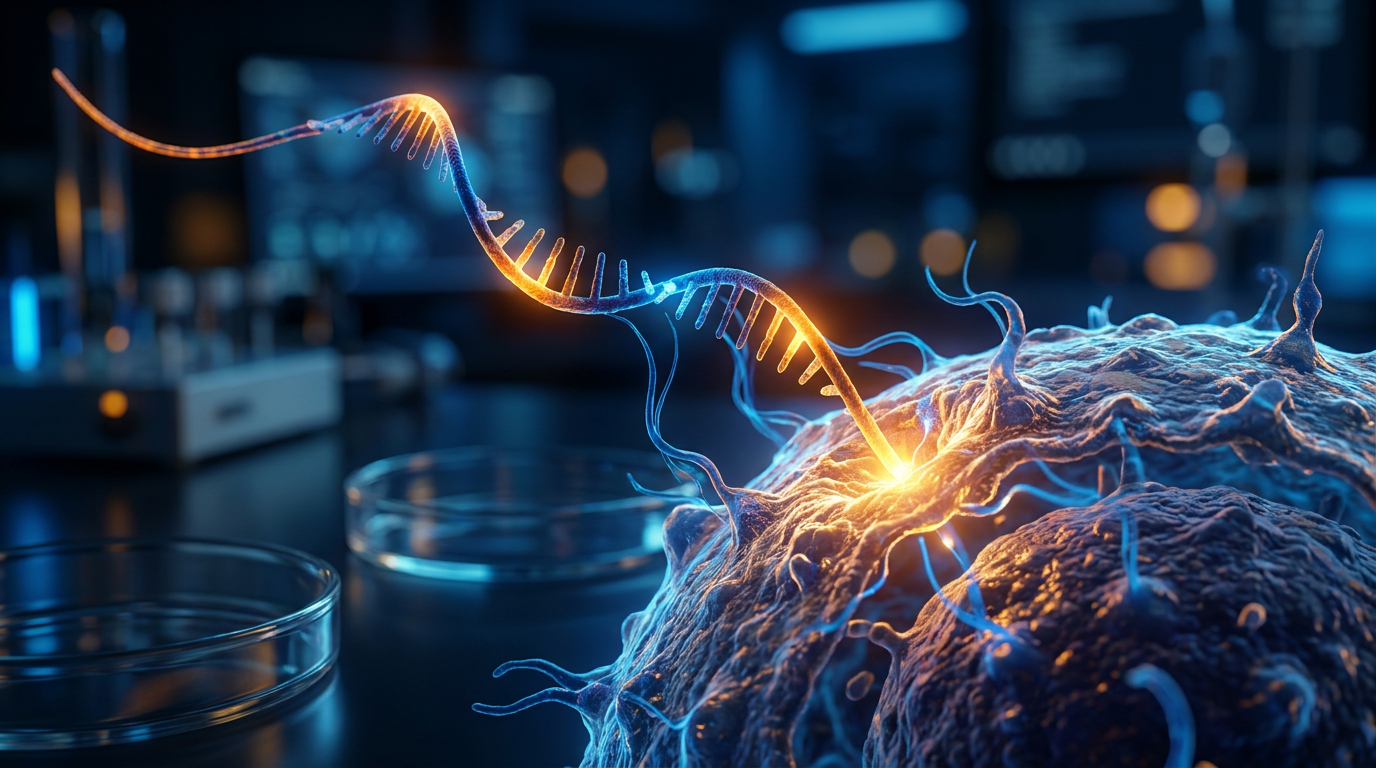
The long-held promise of training the human immune system to hunt down cancer has reached a critical evidentiary milestone. Five-year follow-up data from the KEYNOTE-942 Phase 2b clinical trial reveals that a personalized mRNA cancer vaccine, when combined with standard immunotherapy, halves the risk of recurrence in patients with high-risk melanoma.[1][3]
The findings, presented at the 2026 American Society of Clinical Oncology (ASCO) Annual Meeting and published simultaneously in the Journal of Clinical Oncology, provide the most robust long-term evidence to date for individualized neoantigen therapy. The experimental vaccine, known as intismeran autogene (formerly mRNA-4157 or V940), is co-developed by Moderna and Merck.[1][2]
The primary clinical claim centers on a sustained reduction in disease recurrence. The trial demonstrated that the combination of the custom mRNA vaccine and pembrolizumab—marketed as Keytruda—reduced the risk of melanoma recurrence or death by 49% compared to pembrolizumab alone. At the five-year mark, 68.8% of patients receiving the combination therapy remained cancer-free, compared to just 49.1% in the immunotherapy-only cohort.[2][5]

Beyond local recurrence, the data shows a profound impact on preventing distant metastasis. Melanoma is particularly lethal because of its propensity to spread rapidly to other organs, such as the brain or lungs. The trial data showed a 59% reduction in the risk of distant metastasis or death for patients receiving the combination therapy, with distant metastasis-free survival standing at 83.9% versus 65.4% for the control group.[3][4]
While the Phase 2b trial was not strictly powered to definitively measure overall survival as a primary endpoint, the data revealed a strong favorable trend that has caught the attention of the oncology community. Overall survival reached 92.2% in the combination group versus 71.3% in the Keytruda-only group, suggesting that preventing recurrence directly translates to extended lifespans for high-risk patients.[3][5]
The mechanism driving these results relies on a highly bespoke manufacturing process. Unlike preventative vaccines, intismeran autogene is a therapeutic vaccine custom-built for each patient after their tumor is surgically removed. Scientists sequence the patient's unique tumor DNA to identify specific genetic mutations, and then encode up to 34 of these unique "neoantigens" into a synthetic strand of messenger RNA.[3][8]

The mechanism driving these results relies on a highly bespoke manufacturing process.
This custom mRNA works synergistically with existing immunotherapy drugs. Once injected, the mRNA instructs the patient's cells to produce the targeted neoantigens, effectively handing the immune system a precise biological wanted poster for the cancer. Because tumors often deploy chemical signals to evade immune detection, pairing the vaccine with pembrolizumab—a checkpoint inhibitor that removes the brakes from the immune system—ensures that the newly trained T-cells can successfully attack remaining microscopic cancer cells.[1][8]
These clinical outcomes are supported by deep translational evidence gathered throughout the trial. Blood analyses of participants revealed that the vaccine produced sustained, novel T-cell clones that persisted for years after the initial treatment. This indicates that the therapy successfully reprograms the adaptive immune system for long-term surveillance, rather than just providing a temporary, short-lived immune boost.[4]
In the field of oncology, the five-year recurrence-free mark is widely considered a functional milestone for a potential cure, particularly for stage III and IV melanoma. Because the 49% risk reduction reported at five years remains identical to the results seen at the three-year mark, oncologists are increasingly confident that the vaccine's protective effect does not wane over time.[8]
Despite the highly encouraging data, transparent uncertainty remains regarding the definitive proof of efficacy. The KEYNOTE-942 trial enrolled 157 patients, which is a relatively small sample size for sweeping oncology approvals. The true test of the therapy's statistical power will come from the ongoing global Phase 3 trial, known as INTerpath-001, which has fully enrolled over 1,000 patients across multiple international sites.[3][8]

A significant open question also remains regarding the logistics and economics of bespoke medicine. Because each dose must be custom-manufactured from a fresh tumor biopsy within a tight timeframe, the supply chain is vastly more complex than that of off-the-shelf drugs. Health economists caution that ensuring affordable, timely access to a personalized mRNA vaccine on a global scale will require unprecedented manufacturing innovations.[3][6]
The success in melanoma has catalyzed a massive expansion of the mRNA oncology pipeline across the pharmaceutical industry. Moderna and Merck are currently running Phase 3 trials applying the exact same personalized vaccine technology to non-small cell lung cancer, while Phase 2 trials are actively underway for renal cell carcinoma and bladder cancer.[6][8]
The regulatory landscape is rapidly adapting to accommodate these novel therapies. The FDA has granted fast track and breakthrough therapy designations to several mRNA cancer immunotherapies over the past year, signaling a clear willingness to accelerate the review process for personalized treatments that address high unmet medical needs.[7]
Ultimately, the five-year melanoma data represents a coming-of-age moment for mRNA technology. While the platform gained global prominence through emergency COVID-19 vaccines, its foundational promise was always rooted in oncology. As these personalized therapies move closer to regulatory approval, they offer a tangible glimpse into a future where cancer treatment is uniquely coded to the DNA of the individual patient.[6]
How we got here
2020-2021
The emergency authorization of COVID-19 vaccines validates the safety and delivery mechanisms of the mRNA platform on a global scale.
2023
Moderna and Merck release three-year data from the KEYNOTE-942 trial, showing a 49% reduction in melanoma recurrence.
Early 2026
The global Phase 3 trial (INTerpath-001) for the personalized melanoma vaccine reaches full enrollment of over 1,000 patients.
June 2026
Five-year follow-up data is presented at ASCO, confirming the durability of the 49% risk reduction and a 59% drop in distant metastasis.
Viewpoints in depth
Clinical Oncologists' view
The five-year durability marks a functional cure milestone for high-risk patients.
For clinicians treating stage III and IV melanoma, the five-year mark without recurrence is the gold standard for evaluating long-term success. Oncologists emphasize that the stability of the data—maintaining a 49% risk reduction from year three through year five—proves the vaccine induces genuine immunological memory. Rather than simply delaying recurrence, the combination therapy appears to be fundamentally altering the trajectory of the disease, offering a functional cure to patients who previously faced grim long-term prognoses.
RNA Therapeutics Researchers' view
The sustained T-cell response validates the mRNA platform for broader oncological applications.
Researchers view the KEYNOTE-942 results as the definitive proof-of-concept for individualized neoantigen therapy. The translational data showing sustained, novel T-cell clones years after treatment confirms that synthetic mRNA can successfully reprogram the adaptive immune system. This mechanistic validation is driving intense investment into applying the same bespoke sequencing and lipid nanoparticle delivery systems to other high-mutation tumors, including non-small cell lung cancer and bladder cancer.
Health Economists' view
Bespoke manufacturing presents unprecedented challenges for global scalability and healthcare budgets.
While celebrating the clinical efficacy, health economists and payers point to the daunting logistics of personalized medicine. Unlike off-the-shelf biologics, intismeran autogene requires a fresh tumor biopsy to be sequenced, synthesized into custom mRNA, and delivered back to the specific patient within weeks. Scaling this highly individualized supply chain to serve hundreds of thousands of patients globally will require massive investments in decentralized manufacturing, raising critical questions about the ultimate price tag and equitable access to the therapy.
What we don't know
- Whether the highly promising Phase 2b efficacy will be perfectly replicated in the much larger, 1,000-patient Phase 3 trial.
- The final commercial price of the bespoke vaccine and how public and private health insurers will cover the complex manufacturing costs.
- Whether the personalized mRNA approach will prove equally effective in tumors with lower mutation burdens than melanoma.
Key terms
- Neoantigen
- A unique protein that forms on cancer cells when tumor DNA mutates, serving as a specific target for the immune system.
- Messenger RNA (mRNA)
- A molecule that carries genetic instructions to cells, teaching them how to make specific proteins that trigger an immune response.
- Adjuvant therapy
- Additional cancer treatment given after primary treatment, such as surgery, to lower the risk that the cancer will return.
- Checkpoint inhibitor
- A type of immunotherapy drug, like pembrolizumab, that blocks proteins that stop the immune system from attacking cancer cells, effectively taking the 'brakes' off T-cells.
- Distant metastasis
- The spread of cancer from its original site to distant organs or lymph nodes, which significantly lowers survival rates.
Frequently asked
How is a cancer vaccine different from a flu shot?
Traditional vaccines are preventative, given to healthy individuals to stop an infection before it starts. This mRNA cancer vaccine is therapeutic, meaning it is custom-built and administered after a patient has already been diagnosed and undergone surgery, training their immune system to hunt down any remaining cancer cells.
How long does the protection last?
The latest trial data shows that the protective effects are durable for at least five years. The 49% reduction in recurrence risk seen at the three-year mark was perfectly maintained at the five-year follow-up, suggesting long-term immune memory.
Will this vaccine work for other types of cancer?
Researchers are highly optimistic. The same personalized mRNA technology is currently being tested in Phase 3 clinical trials for non-small cell lung cancer, and in Phase 2 trials for renal cell carcinoma and bladder cancer.
Is the vaccine approved for public use yet?
Not yet. While the Phase 2b trial results are highly promising, the FDA and other regulatory bodies typically require data from larger Phase 3 trials—which are currently fully enrolled and underway—before granting full commercial approval.
Sources
Source coverage
8 outlets
3 viewpoints surfaced








[1]MerckRNA Therapeutics Researchers
Moderna and Merck Announce 5-Year Data for mRNA-4157 in Combination with KEYTRUDA
Read on Merck →[2]Journal of Clinical OncologyClinical Oncologists
Intismeran Autogene Plus Pembrolizumab Versus Pembrolizumab Alone in High-Risk Resected Melanoma: 5-Year Update
Read on Journal of Clinical Oncology →[3]Medical BriefClinical Oncologists
Combination therapy sustains 49% melanoma reduction after 5 years
Read on Medical Brief →[4]Managed Healthcare ExecutiveClinical Oncologists
Five years later, personalized mRNA vaccine cuts melanoma recurrence risk by half
Read on Managed Healthcare Executive →[5]Dallas ExpressHealth Economists
Personalized mRNA Vaccine Reduces Melanoma Risk by 49%
Read on Dallas Express →[6]BioPharm InternationalRNA Therapeutics Researchers
mRNA Platform Matures Beyond COVID-19
Read on BioPharm International →[7]Oncology News CentralHealth Economists
FDA Fast Tracks and Breakthrough Designations for mRNA Cancer Immunotherapies
Read on Oncology News Central →[8]PackGene BiotechRNA Therapeutics Researchers
Merck & Moderna's Personalized mRNA Vaccine Sustains 49% Risk Reduction in Melanoma at Five Years
Read on PackGene Biotech →
More in science
See all 76 stories →Stonehenge Origins
Evidence Pack: Neolithic Humans, Not Glaciers, Transported Stonehenge's 6-Ton Altar Stone
8 sources

Planetary Physics
Why Astronomers Are Using 'Earthshine' to Track Climate Change and Hunt for Exoplanets
6 sources

Cellular Imaging
The Laser Phase Plate: A Century-Old Physics Trick Just Unlocked the Human Proteome
5 sources
Cryo-EM Advance
Laser Phase Plate Breakthrough Illuminates the Smallest Proteins in Human Cells
7 sources
Every angle. Every day.
Get science stories with full source coverage and perspective breakdowns delivered to your inbox.