
How Kyoto is Using 'Smart Tourism' and Local Guides to Solve Overtourism
Faced with crushing crowds at major heritage sites, Kyoto is pioneering a new travel model that combines AI-driven crowd routing with hyper-local neighborhood guides.
By Factlen Editorial Team
- Sustainable Tourism Advocates
- Argue that dispersing tourists to local neighborhoods empowers residents and preserves culture.
- Urban Technologists
- Focus on data-driven infrastructure and AI routing to manage carrying capacity.
- Academic Skeptics
- Warn that technological and routing solutions may simply spread the problem without addressing root causes.
What's not represented
- · Long-term Kyoto residents living in newly promoted 'hidden gem' neighborhoods
- · Multinational hotel operators facing shifts in tourist spending
Why this matters
As global travel rebounds to record highs, popular destinations are buckling under the weight of overtourism. Kyoto’s pioneering shift toward data-driven crowd management and hyper-local neighborhood guides offers a blueprint for how travelers can experience authentic culture without destroying the communities they visit.
Key points
- Kyoto is combatting overtourism by shifting visitors away from saturated hubs like Arashiyama and Gion.
- Smart tourism tech uses AI and real-time data to monitor crowds and dynamically route foot traffic.
- Hyper-local guides are leading travelers to quiet neighborhoods, craft studios, and lesser-known temples.
- Spatial dispersion ensures tourism revenue directly benefits local artisans and residents.
- Skeptics warn that without capping total visitor numbers, routing apps may just spread crowds to new areas.
For decades, the global imagination of Kyoto has been defined by a handful of iconic, postcard-perfect images: the golden reflection of Kinkaku-ji shimmering on a quiet pond, the towering green stalks of the Arashiyama bamboo forest, and the vibrant vermilion gates of Fushimi Inari winding up the mountainside. But in recent years, the reality of visiting Japan’s ancient capital has often felt less like a serene spiritual retreat and more like navigating a crowded theme park. As international travel surges, the sheer volume of visitors has fundamentally altered the city's rhythm, prompting a desperate search for sustainable alternatives.
This phenomenon, widely known in the travel industry as overtourism, occurs when the influx of visitors exceeds a destination's physical and social carrying capacity. In Kyoto, it has led to severe resource strain, the gradual displacement of long-term residents, and a degradation of the very cultural heritage that tourists travel thousands of miles to see. The friction between locals and visitors reached a boiling point recently when municipal authorities were forced to implement luggage bans on crowded city buses and physically close off private alleys in the historic Gion district to protect residents from aggressive sightseers and unauthorized photography.[6]
Faced with the prospect of becoming a hollowed-out museum city suffering from the "Venice effect," Kyoto is now pioneering a radically different approach to hospitality. Rather than simply capping total border numbers, the city and its local entrepreneurs are deploying a sophisticated dual strategy: implementing "Smart Tourism" technology to manage crowd flow, paired with a grassroots push toward hyper-local, neighborhood-led guiding that redefines what it means to visit the city.[5]
The technological mechanism relies heavily on data forecasting and real-time visitor management. Across global heritage sites, municipalities are increasingly piloting predictive dashboards that combine foot traffic sensors with weather and transport data. In Kyoto, geo-tracking apps now inform tourists of real-time crowding at major shrines, while AI-based models simulate capacity thresholds to optimize entry timing and dynamically route visitors away from bottlenecks.[6]

These digital tools aim to achieve what urban planners call "spatial dispersion"—the deliberate routing of visitors away from saturated hotspots and into lesser-known districts. Academic studies on smart tourism technologies indicate that when visitors use real-time routing apps, they not only reduce their carbon footprint but also report significantly higher satisfaction levels due to the distinct lack of overwhelming crowds.[4]
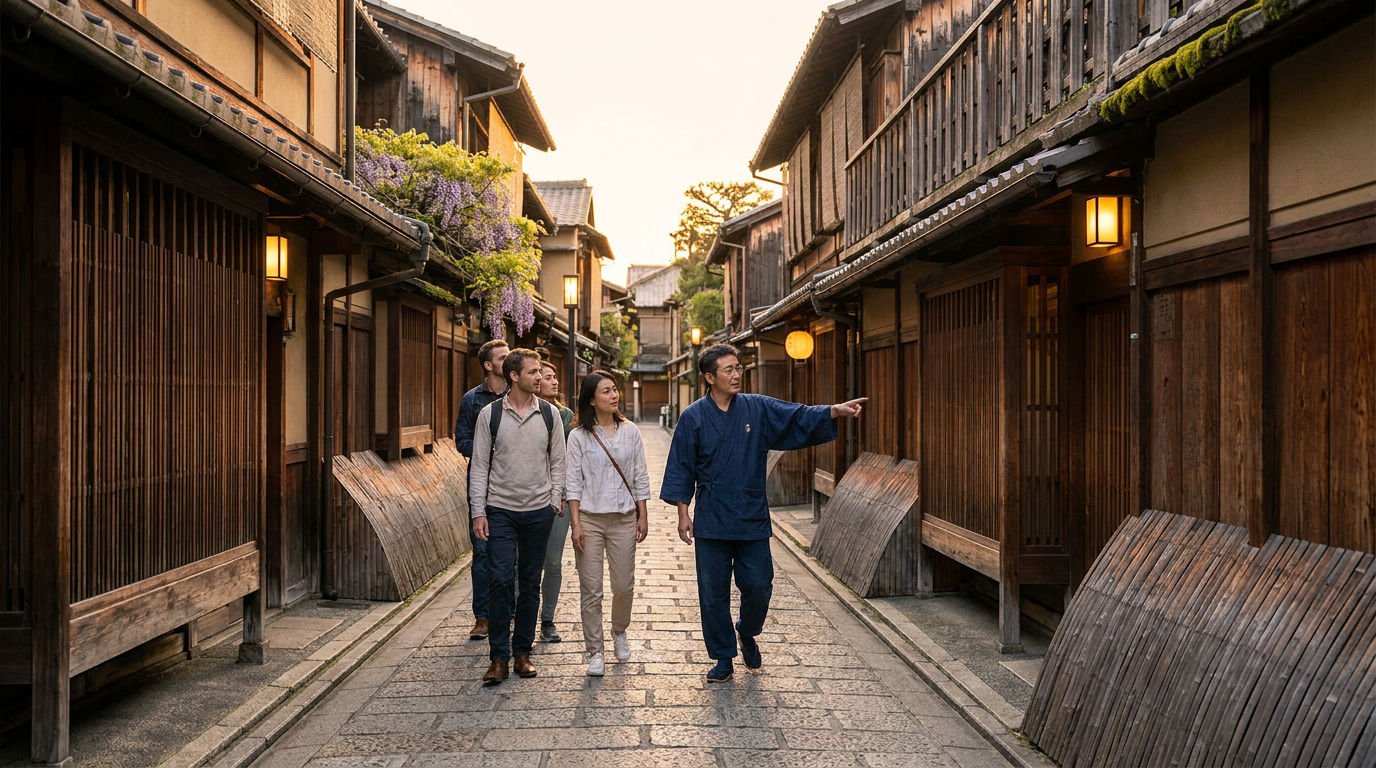
But technology alone cannot solve the deeply human element of overtourism. The second, and arguably more transformative, half of Kyoto's strategy is the elevation of the hyper-local neighborhood guide. Travel platforms and local cooperatives are actively redirecting visitors to the city's quiet, residential pockets, transforming everyday neighborhoods into the main attraction and shifting the economic benefits directly to local residents.[1]
Instead of battling crowds at the Silver Pavilion, travelers are being guided to areas like Shimogamo and Demachiyanagi, where the Kamo River delta offers peaceful morning walks and independent artisan studios. In the north, the creative district of Kitayama blends traditional leather and dyeing workshops with modern lifestyle cafes, providing a slower, more authentic glimpse into everyday Japanese life that standard tour buses completely bypass.[1]

This shift from checklist sightseeing to experiential "slow travel" is fundamentally changing the local economy. By participating in Zen meditation and sutra copying led by resident monks at Manpukuji Temple, or joining a matcha tea ceremony in the rolling green hills of Uji—Kyoto's historic tea capital—tourists inject capital directly into local hands rather than multinational hotel chains or massive tour operators.[3]
This shift from checklist sightseeing to experiential "slow travel" is fundamentally changing the local economy.
The economic benefits of this community-led model are substantial and well-documented. The OECD reports that destinations embedding community participation and benefit-sharing into their tourism frameworks consistently outperform others in resilience and long-term stability. When local residents have a direct financial stake in the tourism economy, they become active, willing stewards of their cultural heritage rather than resentful bystanders.[5]
Furthermore, exploring Kyoto's hidden gems reveals a staggering depth of history that mass tourism entirely ignores. The city boasts over 1,600 temples and shrines, yet the vast majority remain virtually empty on any given day. At Otagi Nenbutsu-ji, tucked away in the hills beyond the crowded Arashiyama bamboo grove, visitors can wander among 1,200 whimsical, moss-covered stone statues in blissful quiet, guided by locals who intimately know the area's intricate history.[2]

Despite these highly promising developments, the transition to a sustainable tourism model is not without its vocal skeptics. Some academic researchers caution that relying on digital apps and smart routing may only serve as a superficial band-aid if the underlying economic dependency on mass tourism is not addressed at a structural level.[4]
From this critical perspective, true sustainability requires a fundamental rethinking of tourism's purpose, moving away from endless growth metrics toward adaptive governance and continuous monitoring. If spatial dispersion merely pushes the same high volume of tourists into previously quiet residential neighborhoods, it risks spreading the overtourism disease to vulnerable areas rather than actually curing it.[4]
To prevent this exact scenario, Kyoto's local guides are heavily emphasizing strict cultural etiquette and small-group sizes. The focus is on "high-value, low-impact" experiences—a philosophy borrowed from Bhutan's highly successful tourism model, which limits overall numbers while ensuring that the revenue generated directly supports cultural preservation and community well-being.[7]

For the modern traveler, this evolution means that visiting Kyoto in 2026 requires a fundamentally different mindset. The era of racing through five major temples in a single day is rapidly ending, replaced by the expectation that visitors will slow down, respect local boundaries, and seek out the quiet corners where the authentic soul of the city still thrives.
Ultimately, Kyoto's grand experiment with smart technology and hyper-local guiding serves as a vital test case for the entire global travel industry. If the city can successfully balance its profound cultural heritage with the relentless demands of modern wanderlust, it will provide a sustainable, replicable blueprint for heritage sites worldwide, proving that tourism can still be a force for mutual enrichment.[8]
How we got here
Pre-2020
Kyoto experiences record-breaking tourism growth, leading to severe crowding at major sites like Kinkaku-ji and Fushimi Inari.
2023
Post-pandemic travel rebounds sharply, reigniting tensions between tourists and Kyoto residents over noise, litter, and transit crowding.
Early 2024
Kyoto implements a ban on large luggage aboard city buses and closes private alleys in the Gion district to tourists.
2025
The city accelerates its 'Smart Tourism' initiatives, deploying predictive dashboards and AI routing to manage visitor flow.
2026
A new ecosystem of hyper-local, neighborhood-led guides flourishes, successfully dispersing travelers to off-the-beaten-path districts.
Viewpoints in depth
Sustainable Tourism Advocates
Argue that dispersing tourists to local neighborhoods empowers residents and preserves culture.
This camp, which includes local guides and cultural preservationists, believes the future of travel lies in "slow tourism." By shifting the focus away from checklist sightseeing toward intimate, neighborhood-level experiences—such as craft workshops and tea ceremonies—they argue that tourism revenue can directly support the local economy rather than multinational corporations. They emphasize that spatial dispersion protects fragile heritage sites from physical degradation while fostering genuine cultural exchange.
Urban Technologists
Focus on data-driven infrastructure and AI routing to manage carrying capacity.
Technologists and smart-city planners argue that human behavior at scale can only be managed through data. They advocate for the widespread adoption of predictive dashboards, geo-tracking apps, and dynamic entry pricing. In their view, overtourism is primarily a logistical failure that can be solved by optimizing visitor flow, ensuring that tourists are automatically rerouted when a specific shrine or district reaches its maximum carrying capacity.
Academic Skeptics
Warn that technological and routing solutions may simply spread the problem without addressing root causes.
Researchers studying the socio-cultural impacts of tourism caution against viewing smart apps and spatial dispersion as silver bullets. They argue that pushing tourists into previously quiet residential neighborhoods might just spread the "Venice effect" to areas fundamentally unequipped to handle it. This camp insists that true sustainability requires a broader policy shift—such as capping total visitor numbers and reducing the city's overall economic reliance on the tourism sector.
What we don't know
- Whether spatial dispersion will eventually cause overtourism in Kyoto's currently quiet residential neighborhoods.
- How effectively AI-driven routing apps can change the behavior of first-time visitors determined to see famous landmarks.
- If the economic benefits of hyper-local tourism can scale enough to replace the revenue generated by mass tourism.
Key terms
- Overtourism
- The excessive influx of tourists to a destination beyond its carrying capacity, leading to resource strain and resident displacement.
- Smart Tourism
- The use of data, AI, and digital infrastructure to optimize visitor flow, manage crowds, and enhance the sustainability of travel destinations.
- Spatial Dispersion
- A tourism management strategy that deliberately routes visitors away from saturated hotspots into lesser-known, off-the-beaten-path areas.
- Machiya
- Traditional wooden townhouses found throughout Kyoto, historically serving as both residences and workspaces for merchants and artisans.
- Venice Effect
- A phenomenon where a city becomes so overwhelmed by mass tourism that local residents are priced out and the area becomes a hollowed-out museum city.
Frequently asked
What is 'Smart Tourism' in Kyoto?
It involves using data sensors, AI-based capacity models, and mobile apps to monitor crowd levels in real-time and route visitors away from congested areas.
How does spatial dispersion help the local economy?
By directing tourists to lesser-known neighborhoods, spending is distributed to local artisans, family-run cafes, and neighborhood guides rather than concentrated in a few major hubs.
Are Kyoto's main attractions closed to tourists?
No, but local authorities have implemented restrictions, such as banning large luggage on city buses and closing certain private alleys in Gion to protect residents from overcrowding.
What is a machiya?
A machiya is a traditional Japanese wooden townhouse, many of which are being preserved and repurposed as local cafes, craft studios, or boutique homestays.
Sources
Source coverage
8 outlets
3 viewpoints surfaced








[1]Japan Cultural TrailsSustainable Tourism Advocates
5 Kyoto Neighborhoods Locals Love (and Visitors Rarely See)
Read on Japan Cultural Trails →[2]Your Friend The NomadSustainable Tourism Advocates
Kyoto Hidden Gems: Off the Beaten Path
Read on Your Friend The Nomad →[3]Happiness on the WaySustainable Tourism Advocates
Non-Touristy Things to Do in Kyoto
Read on Happiness on the Way →[4]Preprints.orgAcademic Skeptics
Evidence from religious attractions in Kyoto, Japan: Navigating overtourism destinations
Read on Preprints.org →[5]Earth5RUrban Technologists
Japan: Tradition Meets Smart Sustainability
Read on Earth5R →[6]AsueneUrban Technologists
Managing Overtourism: Smart Tourism Strategies
Read on Asuene →[7]IerekUrban Technologists
Destination management for sustainable cultural tourism
Read on Ierek →[8]Factlen Editorial TeamAcademic Skeptics
Synthesis by Factlen editorial team
Read on Factlen Editorial Team →
Every angle. Every day.
Get travel stories with full source coverage and perspective breakdowns delivered to your inbox.