
How End-to-End AI is Finally Making General-Purpose Humanoid Robots a Reality
By replacing rigid, hand-coded programming with end-to-end neural networks, robotics companies have unlocked a new era of "embodied AI" that allows humanoid machines to learn complex physical tasks simply by observing humans.
By Factlen Editorial Team
- Embodied AI Researchers
- Argue that scaling laws apply to physical movement just as they do to language, meaning robots will achieve generalized intelligence simply by processing massive amounts of video and teleoperation data.
- Industrial Automation Leaders
- View humanoid robots primarily as a necessary, scalable solution to severe demographic shifts and chronic shortages in skilled manufacturing and logistics labor.
- Commercial Robotics Startups
- Focus on the race to achieve mass production, driving down the per-unit cost of actuators and sensors to make general-purpose robots economically viable for both factories and homes.
What's not represented
- · Labor Union Representatives
- · Consumer Privacy Advocates
Why this matters
For decades, robots were confined to highly structured, single-purpose tasks behind factory safety cages. The breakthrough of "embodied AI" means machines can now adapt to unpredictable environments, paving the way for robots to safely assist in eldercare, household chores, and industries facing severe labor shortages.
Key points
- The robotics industry has shifted from rigid, hand-coded programming to end-to-end neural networks.
- Vision-Language-Action (VLA) models allow robots to understand speech, process visual data, and execute physical tasks simultaneously.
- Robots now learn through 'imitation learning,' observing human video data rather than relying on explicit software rules.
- Major automakers, including BMW and Hyundai, are actively deploying AI-powered humanoids in their 2026 manufacturing operations.
- The transition to 'embodied AI' is expected to drive the humanoid robotics market to nearly $43 billion by 2034.
The year 2026 marks a quiet but profound inflection point in the history of physical labor. Across the globe, humanoid robots are transitioning from clumsy laboratory experiments into capable workers, stepping onto factory floors and into commercial pilot programs. At a BMW facility in Germany, Figure AI's robots are handling delicate automotive parts. In Georgia, Boston Dynamics' all-electric Atlas is training alongside human workers at a sprawling Hyundai plant. And in logistics centers across North America, Agility Robotics' Digit is already executing paid, contracted work.[1][3][7]
This sudden acceleration is not primarily a story about better motors or stronger batteries, though hardware has certainly improved. It is a story about a fundamental revolution in software. The robotics industry has abandoned decades of traditional programming in favor of a breakthrough known as "embodied AI"—giving artificial intelligence a physical body to interact with the real world.[2][7]
To understand the magnitude of this shift, one must look at how robots used to be programmed. For years, the industry relied on a paradigm known as "Sense-Plan-Act." Engineers had to write explicit, hand-coded rules for every possible scenario. A separate software module processed visual data, another planned the path of the arm, and a third translated that plan into electrical currents for the motors.[5][7]
This modular approach was incredibly brittle. If a robot encountered an object that was slightly rotated, or if the lighting in the room changed, the hand-coded rules would fail, and the machine would freeze. Programming a robot to fold a shirt or crack an egg required months of painstaking engineering, and the resulting code could only perform that one specific task in that one specific environment.[2][7]

Today, that brittle architecture has been replaced by "End-to-End" (E2E) neural networks. Borrowing the same deep learning techniques that power large language models like ChatGPT, roboticists are now training massive neural networks to handle the entire process simultaneously. Raw sensor data—video from cameras and tactile feedback from fingertips—flows into one end of the network, and precise motor torque commands flow out the other.[2][5]
Engineers call this elegant new approach "Pixels-to-Torque." Instead of writing "if-then" rules, developers feed the neural network thousands of hours of video showing humans performing tasks. The AI observes the visual inputs and the corresponding physical actions, gradually learning the probabilistic "physics" of the task. It learns how to balance, how to grip, and how to adapt to mistakes, all without a single line of explicit behavioral code.[5][7]
The engine driving this capability is the Vision-Language-Action (VLA) model. A VLA model acts as the robot's central brain, unifying visual perception, natural language understanding, and physical control. When a human tells a robot, "Put the groceries away," the VLA model instantly processes the spoken command, identifies the unfamiliar objects on the table, and generates the continuous stream of motor commands needed to grasp an apple and place it in the refrigerator.[2][5][7]
The engine driving this capability is the Vision-Language-Action (VLA) model.
Figure AI's proprietary VLA model, known as Helix, exemplifies this leap. Released in early 2025, Helix uses a single set of neural network weights to control 35 degrees of freedom across the robot's body at a blistering rate of 200 times per second. Because it relies on generalized learning rather than task-specific fine-tuning, a Figure robot equipped with Helix can successfully manipulate thousands of household items it has never encountered before.[3][4][7]

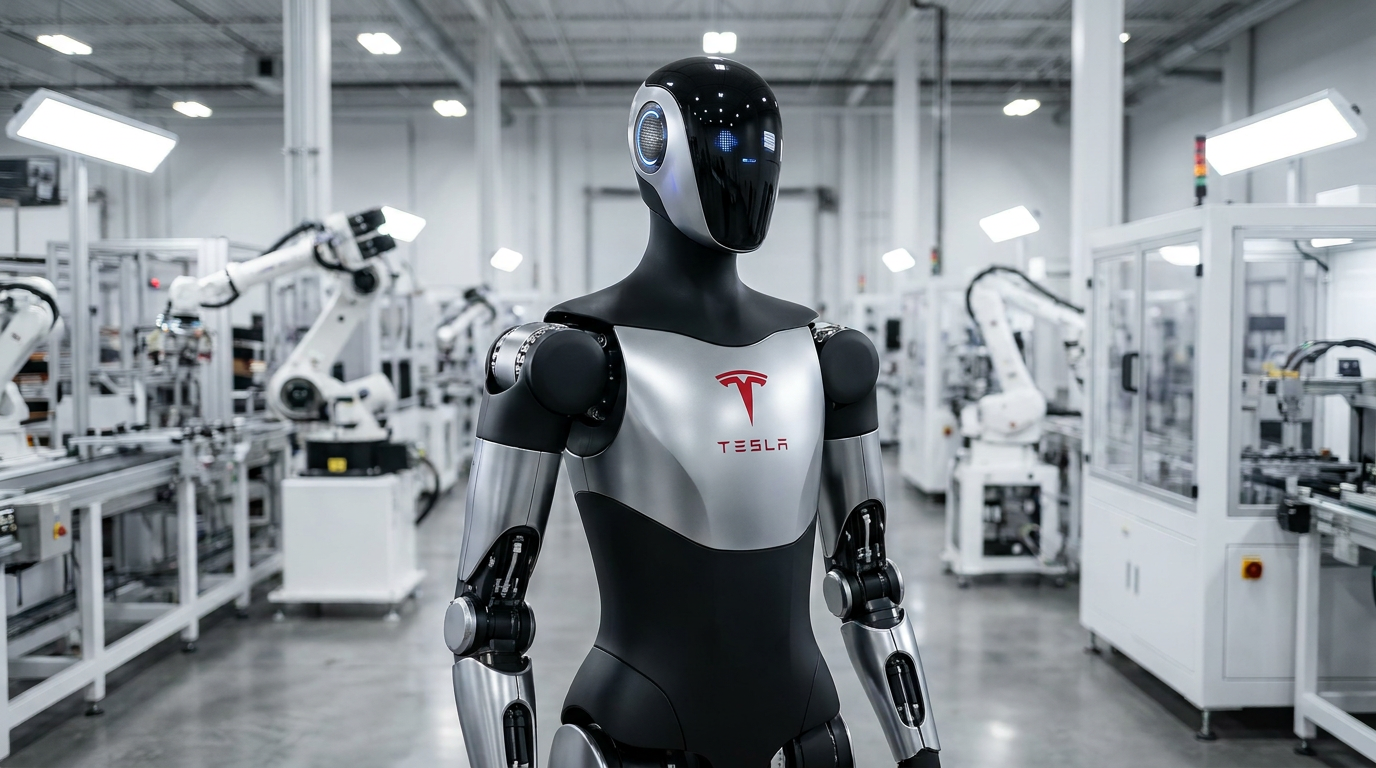
Tesla has taken a similar, highly scaled approach with its Optimus program. Leveraging the exact same end-to-end transformer architecture used in its Full Self-Driving (FSD) vehicles, Tesla is training Optimus on a massive diet of human teleoperation data. The company has essentially collapsed the distinction between navigating a car through a busy intersection and navigating a robotic hand toward a delicate battery cell.[4][5]
To accelerate this learning, companies are utilizing "neural world simulators." Rather than waiting to collect data in the physical world, AI models generate thousands of synthetic training scenarios. A robot can practice opening a door or stirring a pot millions of times in a hyper-realistic digital environment before ever attempting the action with its physical servos. This "sim-to-real" transfer allows the collective intelligence of the robotic fleet to grow exponentially.[2][5][7]
Even legacy robotics pioneers have pivoted to this new paradigm. Boston Dynamics, famous for its viral videos of hydraulic robots performing backflips, retired its older models in 2024. Its new, fully electric Atlas platform is built entirely around AI. The new Atlas uses advanced computer vision to teach itself complex physical movements simply by watching video footage of human workers or professional athletes, translating visual data directly into physical drills.[1][3][7]
The commercial implications of this software revolution are staggering. The global market for humanoid robots with physical AI is projected to surge from roughly $2.9 billion in 2025 to nearly $43 billion by 2034. The initial wave of deployments is heavily concentrated in manufacturing and logistics, where companies are desperate to fill chronic shortages in skilled and manual labor.[6][7]

However, the ultimate prize remains the unstructured environment of the human home. While a factory floor is relatively predictable, a living room is chaotic—filled with delicate glassware, scattered toys, and unpredictable pets. The true test of end-to-end AI will be its ability to generalize its training to safely navigate and assist in these highly variable domestic spaces.[2][7]
Hardware constraints also remain a hurdle. While the AI "brains" are advancing at an astonishing rate, manufacturing reliable, low-cost dexterous hands that can match the sensitivity and durability of human fingers is still a profound engineering challenge. Early mass-production units still carry high price tags, and the industry is racing to drive down the cost of custom actuators and tactile sensors.[4][6]
Despite these challenges, the trajectory is undeniable. By abandoning the rigid programming of the past and embracing the fluid, observational learning of end-to-end neural networks, the robotics industry has crossed a critical threshold. We are entering an era where machines no longer need to be programmed to understand our world—they simply need to watch, learn, and act.[1][2][7]
How we got here
July 2013
Boston Dynamics unveils the first hydraulic Atlas robot, primarily designed for search and rescue tasks under DARPA oversight.
April 2024
Boston Dynamics retires its legacy hydraulic Atlas, announcing a fully electric, AI-driven successor the following day.
Early 2025
Figure AI releases its Helix VLA model and Figure 03 robot, demonstrating the ability to manipulate unseen objects via natural language.
Late 2025
Tesla confirms the use of a 'neural world simulator' to train its Optimus robots, leveraging the same architecture as its Full Self-Driving vehicles.
Mid 2026
Humanoid deployments shift from small-scale pilots to contracted, paid industrial work across major automotive and logistics facilities.
Viewpoints in depth
Embodied AI Researchers
Argue that scaling laws apply to physical movement just as they do to language, meaning robots will achieve generalized intelligence simply by processing massive amounts of video and teleoperation data.
For researchers focused on the software architecture of robotics, the physical hardware is increasingly viewed as a solved problem, or at least a secondary one. Their primary focus is on 'scaling laws'—the principle that as neural networks grow larger and are fed more high-quality data, their capabilities improve predictably. By feeding Vision-Language-Action models millions of hours of first-person human video, researchers believe robots will develop a generalized, intuitive understanding of physics, geometry, and material properties. They argue that just as ChatGPT learned the underlying structure of language by reading the internet, humanoid robots will learn the underlying structure of physical reality by watching it, eventually eliminating the need for any task-specific programming.
Industrial Automation Leaders
View humanoid robots primarily as a necessary, scalable solution to severe demographic shifts and chronic shortages in skilled manufacturing and logistics labor.
From the perspective of factory managers and logistics executives, the humanoid form factor is a pragmatic solution to a looming demographic crisis. As older generations retire and younger workers turn away from repetitive manual labor, industries are facing critical staffing shortages. Traditional robotic automation requires companies to spend millions redesigning their factory floors, installing safety cages, and building custom conveyor systems. Industrial leaders favor humanoid robots because they are 'drop-in' replacements; they can walk up the same stairs, use the same hand tools, and operate in the exact same footprint as a human worker, drastically lowering the barrier to automating existing facilities.
Commercial Robotics Startups
Focus on the race to achieve mass production, driving down the per-unit cost of actuators and sensors to make general-purpose robots economically viable for both factories and homes.
For the hardware engineers and executives building these machines, the ultimate bottleneck is no longer the AI's intelligence, but the cost and reliability of the physical components. Building a robot that can gently grasp an egg and then lift a 50-pound box requires incredibly sophisticated electric servo motors, harmonic drives, and tactile sensors. Startups are intensely focused on vertical integration—designing their own chips, batteries, and actuators in-house to escape the high costs of third-party suppliers. Their goal is to drive the per-unit cost of a humanoid robot down to the price of a mid-range consumer vehicle, which they view as the necessary threshold for mass adoption in the consumer home market.
What we don't know
- How quickly end-to-end AI models can adapt to the highly unstructured, chaotic environments of consumer homes compared to relatively predictable factory floors.
- Whether the cost of highly sensitive tactile sensors and dexterous robotic hands can be reduced fast enough to meet aggressive mass-market pricing targets.
- How regulatory bodies will classify and govern autonomous humanoid robots operating in public spaces or alongside human workers.
Key terms
- End-to-End (E2E) Neural Network
- An AI architecture where a single model handles an entire process from start to finish—taking in raw sensor data and directly outputting motor commands without relying on separate, hand-coded software modules.
- Pixels-to-Torque
- A shorthand phrase describing how modern robotic AI maps visual input (pixels from a camera) directly into physical force (torque applied by the robot's motors).
- Sim-to-Real Transfer
- The process of training an AI model inside a highly realistic digital simulation and then successfully deploying that learned behavior into a physical robot in the real world.
- Degrees of Freedom (DOF)
- The number of independent movements a robotic joint or limb can make. A higher DOF generally indicates a more flexible and capable robot.
Frequently asked
What is a Vision-Language-Action (VLA) model?
A VLA model is an AI system that unifies visual perception, natural language understanding, and physical movement. It allows a robot to hear a spoken command, look at its environment, and immediately generate the physical motions required to complete the task.
How do these new robots learn tasks?
Instead of being manually programmed with code, they use 'imitation learning.' They process thousands of hours of video showing humans performing tasks, allowing the neural network to learn the physical mechanics of the action by observation.
Are humanoid robots currently working in real factories?
Yes. As of 2026, companies like BMW, Hyundai, and Toyota have integrated humanoid robots from Figure AI, Boston Dynamics, and Agility Robotics into their manufacturing and logistics facilities for paid, productive work.
Why are they shaped like humans?
Humanoid robots are designed to operate in environments built for people. By matching the human form, they can use human tools, climb standard stairs, and navigate factory floors without requiring companies to redesign their workspaces.
Sources
Source coverage
7 outlets
3 viewpoints surfaced







[1]CBS NewsIndustrial Automation Leaders
Meet Atlas: A 5'9", 200 pound, AI-powered humanoid created by Boston Dynamics
Read on CBS News →[2]MediumEmbodied AI Researchers
The convergence of AI and robotics is moving from rigid machines to adaptable systems
Read on Medium →[3]Humanoid PressCommercial Robotics Startups
Top 10 Humanoid Robots – 2026 Update: Deployments shift from pilots to paid jobs
Read on Humanoid Press →[4]TradingKeyCommercial Robotics Startups
In 2026, humanoid robots are transitioning from small-batch orders to large-scale mass production
Read on TradingKey →[5]OptimusK BlogEmbodied AI Researchers
FAQ: Tesla Optimus AI & Neural Networks
Read on OptimusK Blog →[6]Future Markets IncIndustrial Automation Leaders
Global Humanoid Robots Market 2026-2036
Read on Future Markets Inc →[7]Factlen Editorial Team
Synthesis by Factlen editorial team
Read on Factlen Editorial Team →
More in ai
See all 5 stories →


Every angle. Every day.
Get ai stories with full source coverage and perspective breakdowns delivered to your inbox.