
How Mass Timber is Replacing Concrete and Turning Skyscrapers into Carbon Sinks
Engineered wood products like cross-laminated timber are allowing architects to build taller, faster, and greener than ever before. By locking away carbon and surviving extreme fire tests, mass timber is fundamentally reshaping the modern city skyline.
By Factlen Editorial Team
- Sustainable Architecture Advocates
- Focus on the environmental necessity of transitioning away from concrete and steel.
- Urban Developers & Builders
- Focus on the economic and logistical advantages of prefabrication.
- Fire Safety & Testing Engineers
- Focus on rigorous empirical testing and building code compliance.
- Editorial Synthesis
- Neutral analysis of the structural and economic viability of mass timber.
What's not represented
- · Traditional Steel and Concrete Manufacturers
- · Forestry Conservationists
Why this matters
The global construction industry is responsible for nearly 40% of the world's carbon emissions. Mass timber offers a rare, scalable solution that not only slashes the carbon footprint of new buildings but actively pulls CO2 out of the atmosphere, all while speeding up construction.
Key points
- Mass timber uses engineered wood panels, like cross-laminated timber, to replace concrete and steel in high-rise construction.
- The material acts as a carbon sink, locking away CO2 while displacing the heavy emissions associated with traditional building materials.
- During a fire, thick timber panels char on the outside, creating an insulating layer that protects the structural core.
- Prefabricated wood panels allow buildings to be assembled much faster and with significantly lighter foundations.
- Milwaukee's Neutral Edison tower is currently under construction and will become the world's tallest mass timber building at 31 stories.
The modern city skyline has been defined by two materials for over a century: steel and concrete. But a quiet revolution is taking root in architecture, replacing the heavy, carbon-intensive ingredients of the industrial age with something much older. Wood is making a comeback, not as the fragile two-by-fours of suburban homebuilding, but as massive, engineered panels capable of supporting skyscrapers.[8]
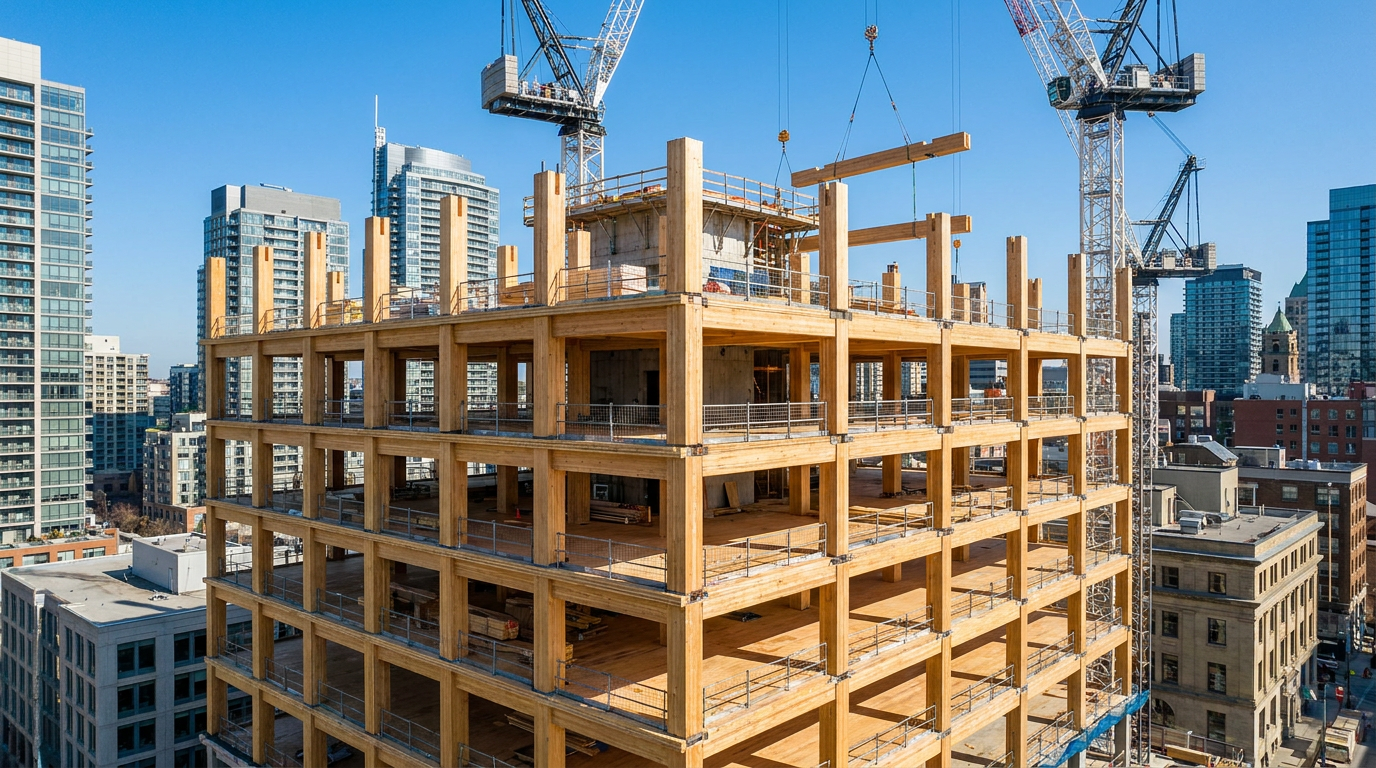
This new category of materials is known as mass timber. Unlike traditional lumber, mass timber involves taking smaller pieces of wood and binding them together under immense pressure to create structural elements that rival the strength of steel. The most popular variant, cross-laminated timber (CLT), is formed by stacking layers of wood at 90-degree angles and gluing them into massive panels.[3]
The resulting material is fundamentally changing what architects can design. Because the wood grains alternate directions, CLT panels resist the natural tendency of wood to warp, twist, or shrink. They can span up to 50 feet without intermediate supports, allowing for the kind of open, airy floor plans previously only possible with reinforced concrete.[3][4]
The environmental math driving this shift is staggering. The global construction industry is responsible for nearly 40% of the world's carbon emissions, with the production of cement and steel acting as primary culprits. Mass timber offers a dual climate benefit: it displaces the need for those emissions-heavy materials, and it actively sequesters carbon.[2][8]

Trees absorb carbon dioxide as they grow. When that wood is harvested and turned into a building, that carbon is locked away for the lifetime of the structure. A mid-rise commercial building constructed with mass timber can achieve a 15% to 26% reduction in its global warming potential compared to a traditional build, effectively turning city skylines into massive carbon sinks.[4][7]
But whenever wood is proposed for high-rise construction, the immediate and obvious question is fire safety. The idea of a 30-story wooden tower sounds to many like a towering inferno waiting to happen. However, fire safety engineers have demonstrated that mass timber behaves entirely differently than the light-frame wood used in single-family homes.[4][5]
When exposed to extreme heat, mass timber does not easily ignite or burn through. Instead, the outer layer of the thick wood panels chars. This charred layer acts as a natural, highly effective insulator, protecting the unburned structural core inside from the heat of the flames.[4][5]

When exposed to extreme heat, mass timber does not easily ignite or burn through.
Rigorous testing has repeatedly proven this mechanism. In a landmark study by Timberlab and the U.S. Forest Products Laboratory, exposed glulam columns were subjected to a 3-hour fire test in a massive furnace. The timber maintained its structural integrity throughout the ordeal, proving that properly engineered wood can meet or exceed the fire-resistance ratings required for non-combustible construction.[5]
Beyond environmental and safety metrics, developers are flocking to mass timber for its sheer efficiency. Because CLT panels are prefabricated in off-site factories, they arrive at the construction site cut to millimeter precision, complete with pre-routed openings for doors, windows, and plumbing.[2][3]
This prefabrication turns the construction site into an assembly line. Buildings go up remarkably fast, with entire floors often installed in a matter of hours. This speed translates to significantly reduced labor costs, less neighborhood disruption, and a faster return on investment for developers.[2]

The material is also remarkably light. Mass timber boasts a strength-to-weight ratio comparable to concrete, despite being up to five times lighter. This reduced weight means buildings require smaller, less expensive foundations, and they perform exceptionally well during seismic events, as the lighter frame exerts less force during an earthquake.[4]

Building codes are rapidly catching up to the science. In 2021, the International Building Code was updated to allow mass timber structures up to 18 stories tall, a watershed moment that triggered a boom in timber development across North America. Jurisdictions like British Columbia have aggressively expanded their codes to encourage the material's use in schools, care facilities, and high-rises.[7][8]
The race for the sky is now officially underway. In Milwaukee, Wisconsin, a 25-story mass timber tower named Ascent MKE held the title of the world's tallest timber building upon its completion in 2022. But records in this new architectural era are fleeting.[1]
Just blocks away from Ascent, construction is already underway on Neutral Edison, a 31-story mass timber high-rise slated for completion in 2026 or 2027. At 362 feet tall, it will feature a hybrid structural system, combining a concrete core with CLT floors and glulam framing, pushing the boundaries of what is structurally possible.[1]

The trend is global. Canada is preparing to unveil its 14-story Academic Wood Tower at the University of Toronto in 2026, while developers in Japan have proposed a staggering 70-story timber hybrid skyscraper to be completed by 2041.[6][8]
Challenges remain, of course. The industry must ensure that the surge in demand for mass timber is met with strictly sustainable forestry practices, lest the climate benefits be erased by deforestation. Additionally, protecting the wood from moisture during construction and throughout its lifespan is critical to preventing fungal decay.[2]
Yet, the trajectory is clear. Mass timber is no longer an experimental novelty; it is a proven, scalable climate solution. By turning forests into factories and buildings into carbon vaults, the architecture of the 21st century is finally learning to grow.[8]
How we got here
1990s
Cross-laminated timber is first developed and utilized in Europe.
2015
CLT is officially incorporated into the International Building Code in the United States.
2021
Building codes are updated to allow mass timber structures up to 18 stories tall.
2022
Ascent MKE in Milwaukee is completed, becoming the world's tallest timber building at 25 stories.
2026
Neutral Edison is scheduled to top out at 31 stories, claiming the new height record.
Viewpoints in depth
Sustainable Architecture Advocates
Focus on the environmental necessity of transitioning away from concrete and steel.
This camp argues that the construction industry cannot meet global climate goals without fundamentally changing its materials. Because cement and steel production account for a massive share of global emissions, advocates view mass timber as a rare 'carbon-negative' technology. They emphasize that trees act as natural carbon capture machines, and locking that carbon into long-lasting structures is one of the most scalable climate solutions available today.
Urban Developers & Builders
Focus on the economic and logistical advantages of prefabrication.
For developers, the appeal of mass timber is largely financial. Prefabricated CLT panels turn construction sites into assembly lines, drastically reducing the time required to erect a building. This speed lowers labor costs and allows developers to begin collecting rent sooner. Additionally, the lighter weight of the material means less money is spent on massive concrete foundations, making difficult urban infill sites more economically viable.
Fire Safety & Testing Engineers
Focus on rigorous empirical testing and building code compliance.
Initially skeptical of tall wooden structures, this group has been convinced by extensive empirical data. Fire safety engineers focus on the predictable 'char rate' of thick timber, which insulates the structural core during a fire. Their rigorous 2-hour and 3-hour furnace tests have provided the hard evidence necessary to update international building codes, ensuring that mass timber meets the exact same life-safety standards as non-combustible materials.
What we don't know
- How the global timber supply chain will handle a massive surge in demand without compromising old-growth forests.
- The long-term insurance premiums for mass timber high-rises, as underwriters are still gathering decades-long actuarial data on moisture and fire risks.
Key terms
- Cross-Laminated Timber (CLT)
- An engineered wood panel made by gluing layers of lumber together at 90-degree angles, creating immense structural strength.
- Embodied Carbon
- The total greenhouse gas emissions generated by the manufacturing, transportation, and installation of building materials.
- Char Rate
- The predictable speed at which the outer layer of thick wood burns, creating a protective insulating barrier for the core.
- Glulam
- Glue-laminated timber, made by bonding layers of wood with the grain running in the same direction, typically used for load-bearing columns and beams.
Frequently asked
Does mass timber construction contribute to deforestation?
When sourced responsibly, mass timber relies on fast-growing softwoods and sustainable forestry practices that replant harvested trees. However, experts warn that scaling the industry globally must be carefully managed to protect old-growth forests.
Is mass timber safe in an earthquake?
Yes. Because mass timber is up to five times lighter than concrete, it exerts significantly less force during a seismic event. Tests have shown CLT structures can withstand major earthquakes without collapsing.
How long do mass timber buildings last?
Properly engineered and maintained mass timber buildings can last for generations. The primary threat to their longevity is moisture, so they require careful waterproofing and weather protection during and after construction.
Sources
Source coverage
8 outlets
4 viewpoints surfaced








[1]Construction DiveUrban Developers & Builders
World's tallest mass timber building breaks ground in Wisconsin
Read on Construction Dive →[2]American UniversitySustainable Architecture Advocates
Fact Sheet: Mass Timber Construction
Read on American University →[3]WoodWorksUrban Developers & Builders
What is mass timber?
Read on WoodWorks →[4]NC State UniversitySustainable Architecture Advocates
5 Benefits of Building with Cross-Laminated Timber
Read on NC State University →[5]TimberlabFire Safety & Testing Engineers
3 Hour Fire Testing
Read on Timberlab →[6]Construction CanadaUrban Developers & Builders
Canada's tallest mass timber building to be built by 2026
Read on Construction Canada →[7]Province of British ColumbiaSustainable Architecture Advocates
Mass timber
Read on Province of British Columbia →[8]Factlen Editorial TeamEditorial Synthesis
Synthesis by Factlen editorial team
Read on Factlen Editorial Team →
Every angle. Every day.
Get home stories with full source coverage and perspective breakdowns delivered to your inbox.