
The Evidence on Office-to-Residential Conversions: Can Empty Towers Solve the Housing Crisis?
As post-pandemic office vacancies remain high, developers are increasingly converting commercial buildings into apartments. We examine the data on conversion costs, structural feasibility, and the actual impact on housing supply.
By Factlen Editorial Team
- Commercial Developers & Markets
- Focus on the financial feasibility, conversion costs, and the rapid growth of the adaptive reuse pipeline.
- Urban Planners & Policymakers
- Focus on revitalizing downtown ecosystems, increasing housing supply, and deploying policy incentives.
- Architects & Sustainability Experts
- Focus on structural viability, floor plates, and the environmental benefits of reducing embodied carbon.
- Editorial Synthesis
- Focus on aggregating the evidence into a cohesive verdict on the viability of the trend.
What's not represented
- · Local downtown small business owners
- · Low-income housing advocates
Why this matters
With national office vacancies hovering near 20% and a severe shortage of affordable housing, adaptive reuse offers a rare opportunity to solve two urban crises at once. Understanding the true costs and limitations of these conversions reveals whether your city's empty downtown can actually be transformed into a thriving residential neighborhood.
Key points
- The national pipeline for office-to-residential conversions hit a record 90,300 units in early 2026.
- Only about 25% of existing office buildings are structurally suitable for residential conversion.
- Ideal conversion candidates can be completed at a 30% lower cost than ground-up new construction.
- Deep floor plates and centralized plumbing make many modern glass towers too expensive to retrofit.
- Adaptive reuse significantly reduces embodied carbon by preserving the building's original foundation and framing.
- Municipal tax incentives are often required to make conversion projects financially viable for developers.
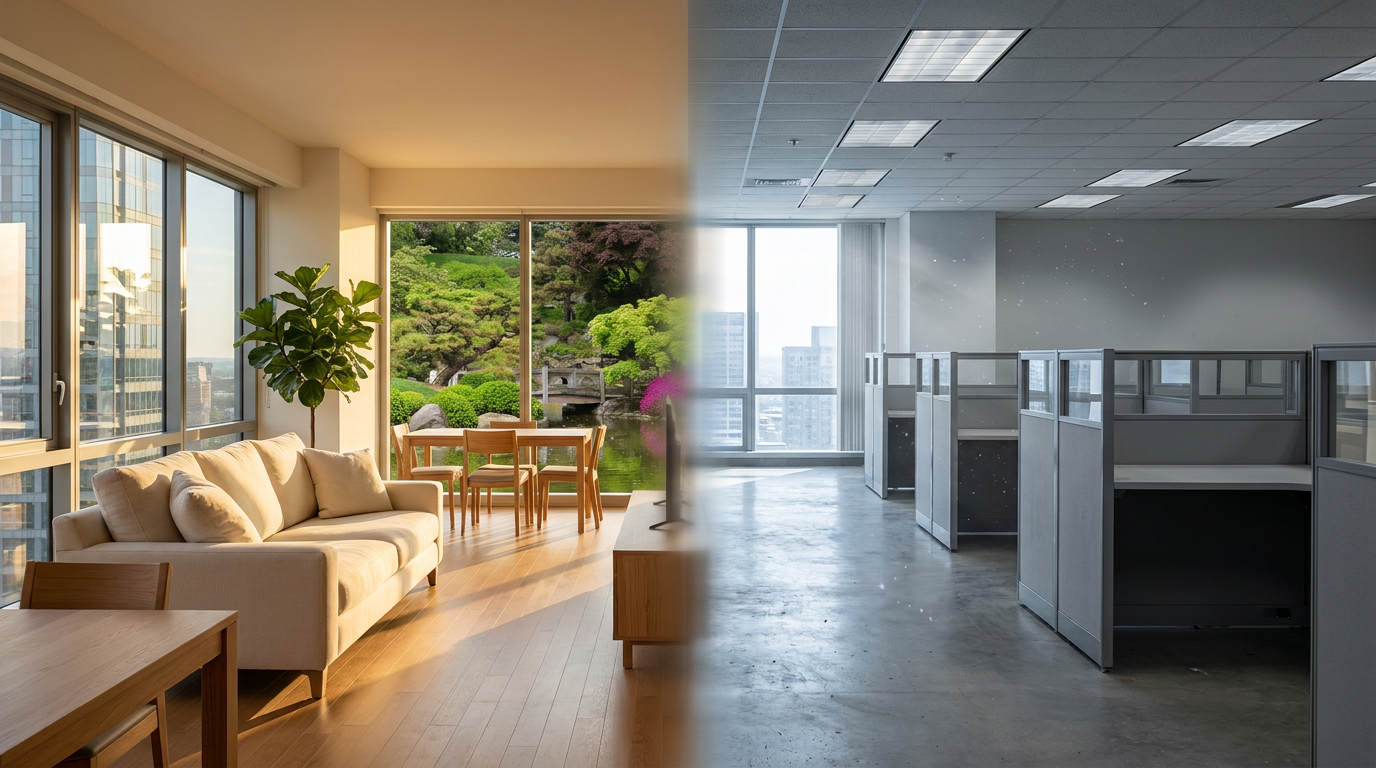
The post-pandemic era has left American cities grappling with a dual crisis: record-high office vacancies in downtown cores and a severe, nationwide shortage of affordable housing. In response, a seemingly elegant solution has captured the attention of urban planners and developers alike: adaptive reuse, specifically the conversion of empty office towers into residential apartments.[7]
As a concept, turning cubicles into living rooms sounds like a silver bullet. However, the reality of commercial real estate development is rarely so simple. To separate the architectural optimism from the financial realities, we examined the latest market data, engineering studies, and economic analyses to build an evidence pack on the true viability of office-to-residential conversions.[7]
The first major claim is that the conversion pipeline is scaling rapidly, and the evidence here is strong and highly visible. According to early 2026 data from real estate research firm RentCafe, there are currently 90,300 apartment units in the active office-to-residential conversion pipeline across the United States. This represents a 28% year-over-year increase and is nearly four times higher than the pipeline in 2022.[1]
This surge is not isolated to a single region. While the New York metropolitan area leads the nation with over 16,000 future converted units, cities like Washington, D.C., Chicago, and Los Angeles are all experiencing record levels of adaptive reuse. Office conversions now account for roughly 47% of all future adaptive reuse projects nationwide, significantly outpacing hotel and industrial conversions.[1]

The second major claim is that conversions are cheaper and faster than ground-up construction. The evidence for this is highly conditional. A comprehensive study by the global architecture firm Gensler found that, under the right circumstances, converting an office building into residential stock can be executed at a 30% lower cost than new construction.[2]
The primary mechanism for these savings lies in preserving the building's existing foundation and structural framing. By avoiding the massive expenses associated with demolition, excavation, and pouring new concrete, developers can theoretically bring units to market faster and with significantly less upfront capital.[2]
However, the counter-evidence reveals that structural realities severely limit feasibility. The caveat to the cost-savings claim is that very few buildings actually qualify. Gensler's analysis of over 1,000 potential conversion sites across North America concluded that only 25% of existing office buildings meet the structural criteria necessary for a viable residential conversion.[2]
However, the counter-evidence reveals that structural realities severely limit feasibility.
The architectural hurdles are steep. Modern office buildings often feature massive, deep floor plates designed for cubicle farms, which makes it nearly impossible to provide natural light and exterior windows for every residential unit. Furthermore, commercial buildings typically centralize plumbing and HVAC systems, meaning developers must core out the center of the building to run new, individualized utilities for dozens of apartments.[5]
Because of these structural challenges, the financial evidence is mixed. Real estate services firm CBRE reports that conversion costs can range wildly, from $100 to over $500 per square foot, depending on the original layout and the scope of the required retrofits. In cases where extensive plumbing and HVAC overhauls are required, industry practitioners note that conversions can actually become more expensive than simply tearing the building down and starting from scratch.[5]

The third claim is that conversions can meaningfully dent the housing crisis. The evidence suggests a moderate, localized impact rather than a macroeconomic cure. A 2022 study by the RAND Corporation focused on Los Angeles County found that if all underutilized commercial properties were repurposed, it could produce between 72,000 and 113,000 new housing units.[3]
While that sounds substantial, the RAND researchers noted this would only cover roughly 9% to 14% of the total housing Los Angeles County needs to produce over the next eight years to meet demand. Conversions are a valuable tool, but they cannot single-handedly close a housing deficit measured in the millions of units.[3]
Furthermore, academic research indicates that these projects rarely pencil out based on free-market dynamics alone. A 2023 working paper from NYU Stern highlighted that the steep acquisition costs of commercial real estate, combined with elevated interest rates, often stall private redevelopment.[4]
To make the math work, municipalities are increasingly stepping in with subsidies. The NYU Stern research points to successful policy interventions, such as New York City's tax abatements for developers who include affordable housing in their conversions, and Calgary's municipal funding program, which reimburses developers at a set rate per square foot of converted space.[4]

The fourth claim is that adaptive reuse is highly beneficial for the environment. The evidence here is robust and largely undisputed. Research published in the journal MDPI emphasizes that adaptive reuse aligns perfectly with circular economy principles by extending the life cycle of existing structures.[6]
The most significant environmental benefit is the reduction of embodied carbon—the greenhouse gas emissions associated with manufacturing, transporting, and installing new construction materials like steel and concrete. By preserving the heaviest and most carbon-intensive parts of a building, conversions drastically lower the environmental footprint of adding new housing stock.[6]
The evidence clearly shows that office-to-residential conversions are moving from a niche architectural novelty to a market-defining trend. However, they are not a universal remedy for the estimated 1.9 billion square feet of underutilized office space currently sitting vacant in the United States.[1][7]
Instead, adaptive reuse is a highly effective, surgical tool. When applied to the right asset—typically pre-1990 buildings with smaller floor plates, located in high-demand urban cores, and supported by municipal tax incentives—conversions offer a sustainable, economically viable path to breathing new life into empty downtowns.[2][4][5]
How we got here
Pre-2020
Office-to-residential conversions remain a niche architectural practice, primarily focused on historic textile mills and warehouses.
2020–2021
The pandemic triggers a massive shift to remote work, causing commercial office vacancies to spike in major downtown cores.
2022–2023
Municipalities begin introducing tax abatements and zoning reforms to incentivize developers to repurpose empty office space.
Early 2026
The national pipeline for office-to-apartment conversions hits a record 90,300 units, a nearly fourfold increase since 2022.
Viewpoints in depth
Commercial Developers
Conversions are a high-risk, high-reward financial puzzle.
Developers argue that while the demand for urban housing is clear, the financial mechanics of conversions are perilous. The massive variance in retrofit costs—ranging from $100 to over $500 per square foot—means that projects rarely pencil out without significant discounts on the initial building purchase or heavy municipal tax subsidies. For many developers, the math simply favors ground-up construction unless the city absorbs some of the risk.
Architects & Engineers
Success depends entirely on the building's original bones.
The architectural community emphasizes that not all offices are created equal. Pre-1990 buildings with narrower footprints and operable windows are prime candidates, whereas modern glass-box towers with massive, deep floor plates require cost-prohibitive structural coring just to ensure bedrooms have access to natural light. Engineers view adaptive reuse as a highly specific structural challenge rather than a blanket solution.
Urban Planners
Conversions are vital for saving downtown ecosystems.
City planners view adaptive reuse as a dual-purpose tool: it chips away at severe local housing shortages while simultaneously preventing downtown districts from falling into urban decay. By replacing daytime office workers with full-time residents, cities can sustain local retail, restaurants, and transit networks that would otherwise collapse under sustained 20% commercial vacancy rates.
What we don't know
- Whether post-pandemic remote work trends will permanently sustain the current 20% office vacancy rate.
- How the valuation of commercial real estate will settle once the current wave of office-backed loans matures.
Key terms
- Adaptive Reuse
- The process of repurposing an existing building for a new use, such as turning a commercial office tower into residential apartments.
- Floor Plate
- The total rentable area on a single floor of a building; deep floor plates in offices make residential conversions difficult due to a lack of exterior windows.
- Embodied Carbon
- The total greenhouse gas emissions generated by the manufacturing, transportation, and installation of building materials.
- Class B and C Offices
- Older, less modern commercial buildings that are currently seeing the highest vacancy rates and are prime candidates for residential conversion.
Frequently asked
Why can't all empty office buildings become apartments?
Many modern office buildings have massive, deep floor plates that make it impossible to provide natural light and windows for every residential unit. They also require expensive, centralized plumbing overhauls.
Is it cheaper to convert an office or build a new apartment?
It depends heavily on the building. While some conversions can be 30% cheaper by saving the foundation and framing, complex retrofits can push costs higher than ground-up new construction.
Will office conversions solve the housing crisis?
No, but they can help. Studies show that even if all suitable commercial properties were converted, it would only meet a fraction of the total housing deficit in major cities.
Sources
Source coverage
7 outlets
4 viewpoints surfaced







[1]RentCafeCommercial Developers & Markets
Office-to-Apartment Conversions Surge as Pipeline Nears 100,000 Units
Read on RentCafe →[2]GenslerArchitects & Sustainability Experts
Office-to-residential conversion costs can be 30% lower than new construction
Read on Gensler →[3]RAND CorporationUrban Planners & Policymakers
Can Adaptive Reuse of Commercial Real Estate Address the Housing Crisis in Los Angeles?
Read on RAND Corporation →[4]NYU SternUrban Planners & Policymakers
Office to Residential Conversions Across Cities
Read on NYU Stern →[5]CBRECommercial Developers & Markets
The Rise and Fall of Office to Multifamily Conversions: A Real Estate Investigation
Read on CBRE →[6]MDPIArchitects & Sustainability Experts
Determinants of Property Reuse for Age-Friendly Social Housing Development
Read on MDPI →[7]Factlen Editorial TeamEditorial Synthesis
Synthesis by Factlen editorial team
Read on Factlen Editorial Team →
Every angle. Every day.
Get real estate stories with full source coverage and perspective breakdowns delivered to your inbox.