
How Veterans Treatment Courts Are Quietly Transforming the Justice System
By replacing adversarial prosecution with team-based rehabilitation, Veterans Treatment Courts are drastically reducing recidivism and saving taxpayers millions.
By Factlen Editorial Team
- Rehabilitation Advocates
- Argue that VTCs address the root causes of crime, save taxpayer money, and honor the service of veterans.
- Systemic Reform Skeptics
- Argue that specialty courts still rely on carceral threats and gatekeep treatment behind an arrest.
- Neutral Analysts
- Provide objective synthesis of the data, mechanisms, and outcomes of the VTC model.
What's not represented
- · Victims' rights organizations
- · Civilian defendants who lack access to similar specialized dockets
Why this matters
Traditional incarceration costs taxpayers over $50,000 per person annually while doing little to treat the underlying trauma of justice-involved veterans. The rapid expansion of problem-solving courts proves that rehabilitation is not only more humane, but vastly more effective at preventing future crime.
Key points
- Veterans Treatment Courts replace adversarial prosecution with a collaborative, judge-led treatment team.
- Participants undergo 12 to 18 months of intensive supervision, drug testing, and mandatory treatment.
- The recidivism rate for VTC participants is roughly 14%, compared to 23-46% in traditional courts.
- Supervising a participant costs roughly $5,000 annually, compared to over $50,000 for incarceration.
- Critics note the programs often exclude veterans with violent charges who may need the most help.
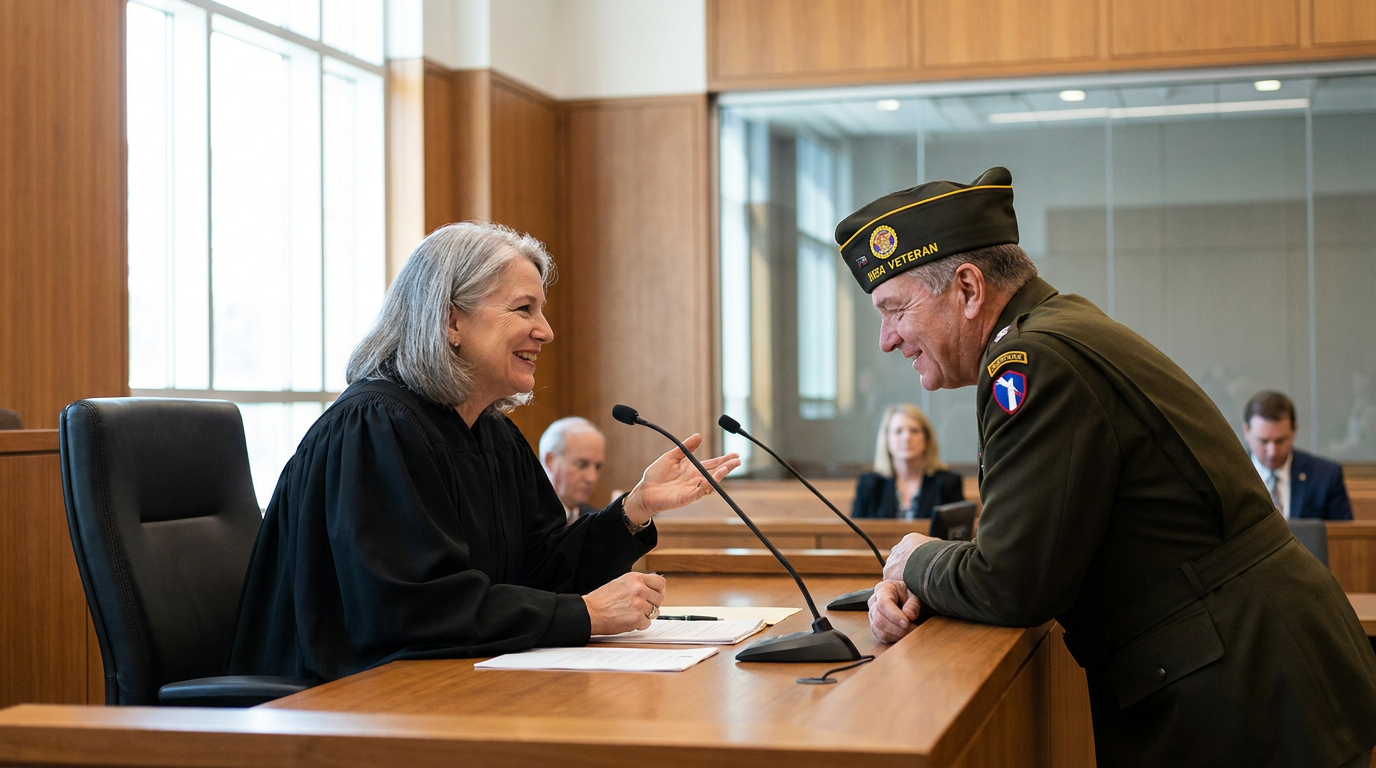
The traditional American criminal justice system is inherently adversarial. The prosecutor's job is to secure a conviction, the defense attorney's job is to prevent one, and the judge acts as an impartial referee. But in a rapidly growing number of courtrooms across the United States, those three parties are sitting on the same side of the table.[8]
This collaborative approach is the hallmark of Veterans Treatment Courts (VTCs), a specialized docket designed specifically for former military personnel whose involvement in the justice system is rooted in service-related trauma, mental illness, or substance use disorders. Rather than focusing on punishment, VTCs focus on rehabilitation, offering eligible veterans a rigorous, court-supervised treatment program as an alternative to incarceration.[5][6]
The stakes for this demographic are uniquely high. The transition from military deployment to civilian life often involves a profound loss of structure and purpose. For some, the invisible wounds of war—post-traumatic stress disorder (PTSD), traumatic brain injuries (TBI), and chronic pain—manifest as substance abuse and, eventually, a rap sheet. Traditional incarceration does little to treat these underlying issues, often exacerbating them instead.[5][7]
The mechanics of a Veterans Treatment Court represent a radical departure from standard legal proceedings. When a veteran is arrested for a qualifying offense—typically a non-violent misdemeanor or low-level felony—they can opt into the VTC track. If accepted, the adversarial posturing ends. The judge leads a unified treatment team that includes the prosecutor, the defense counsel, and a Veterans Justice Outreach (VJO) specialist from the Department of Veterans Affairs.[6][7]

However, opting into the program is not a "get out of jail free" card. The VTC model is intensely demanding. Participants must agree to a strict regimen that typically lasts 12 to 18 months. This includes mandatory attendance at substance abuse or mental health treatment sessions, frequent and randomized drug and alcohol testing, and bi-weekly appearances before the judge to report on their progress.[5][7]
A defining feature of the VTC model is its reliance on peer mentorship. Every participant is paired with a volunteer veteran mentor who has successfully navigated civilian life. This capitalizes on the deep-seated military ethos of leaving no one behind. Mentors provide non-clinical support, acting as coaches and confidants who understand the unique cultural language of the armed forces in a way that civilian judges and social workers cannot.[5][6]
The results of this intensive, wrap-around approach have been striking. Studies consistently show that VTC participants have a recidivism rate of approximately 14%. By contrast, veterans processed through the traditional criminal justice system reoffend at rates ranging from 23% to 46%. By treating the addiction or trauma that motivated the crime, the courts are effectively stopping the cycle of re-arrest.[7][8]
The results of this intensive, wrap-around approach have been striking.
State-level data from 2025 and 2026 underscores the model's efficacy. In Pennsylvania, the Unified Judicial System reported a 75% successful completion rate for its VTC participants in 2024. Graduates not only stayed out of jail, but they also saw massive improvements in life stabilization. Historical data from problem-solving courts in states like Michigan has shown unemployment dropping by over 80% among graduates, alongside significant increases in independent housing.[3][8]
Beyond the human impact, the fiscal argument for VTCs is driving their rapid expansion. In a 2026 address to the state legislature, the Nebraska Judicial Branch highlighted the staggering financial disparity between treatment and punishment. The average cost to supervise a problem-solving court participant in Nebraska is approximately $5,000 per year. The estimated cost of traditional incarceration is $50,005 per year.[1]

Recognizing this dual benefit of public safety and fiscal responsibility, states are actively scaling up their specialty dockets. Maine's 2026 Specialty Docket Report detailed the ongoing expansion of its Treatment and Recovery Courts, noting that the programs are essential for addressing the root causes of justice involvement. The bipartisan appeal is undeniable: the courts satisfy conservative priorities of taxpayer savings and accountability, while fulfilling progressive goals of diversion and rehabilitation.[2][8]
Despite the overwhelming enthusiasm, the model is not without its critics. Justice reform advocates point out a structural flaw known as "carveouts." Because VTCs are highly protective of their success rates and public image, they frequently exclude individuals with violent charges or extensive criminal histories. Critics argue this gatekeeping denies treatment to the exact population that requires the most intensive intervention.[4]
Furthermore, skeptics raise concerns about the courts' reliance on carceral threats. If a participant relapses or misses a drug test, judges utilize a system of graduated sanctions. While this often means increased community service or tighter supervision, it can also mean a short stint in jail. Reformers argue there is no clinical evidence that brief incarceration cures addiction, and that using jail as a therapeutic stick undermines the courts' rehabilitative mission.[4][8]

There is also a broader philosophical debate about the nature of the system itself. Some advocates argue that comprehensive, team-based wrap-around services should be freely available in the community, rather than gated behind a criminal arrest. The fact that a veteran must break the law to access this level of coordinated care is viewed by some as an indictment of the broader social safety net.[4][8]
Nevertheless, for the thousands of veterans who graduate from these programs each year, the philosophical debates are secondary to the tangible results. VTCs offer a literal lifeline, providing a structured pathway out of the justice system and back into society.[6][8]
As the United States continues to grapple with the long-term consequences of its post-9/11 conflicts, the justice system is slowly adapting. Veterans Treatment Courts represent a quiet but profound transformation—a recognition that the wounds of war sometimes manifest as a rap sheet, and that treating the wound is ultimately better for society than punishing the symptom.[5][8]
How we got here
1989
The first problem-solving court is established in Miami-Dade County to handle the influx of cases from the War on Drugs.
2008
The first dedicated Veterans Treatment Court is established in Buffalo, New York, recognizing the unique needs of justice-involved veterans.
2010
The VA formally creates the Veterans Justice Outreach program to integrate VA services directly into local courtrooms.
2024
The number of specialty courts in the U.S. surpasses 4,200, with VTCs operating in nearly every state.
2026
States like Nebraska and Maine report massive cost savings and announce further expansions of their problem-solving court networks.
Viewpoints in depth
Rehabilitation Advocates
Supporters view VTCs as a common-sense triumph that saves lives and taxpayer money.
This camp—which includes judges, prosecutors, and veterans' organizations—argues that traditional incarceration fundamentally fails individuals whose crimes stem from service-related trauma. By replacing the adversarial courtroom dynamic with a collaborative treatment team, VTCs address the root causes of addiction and mental illness. Proponents point to overwhelming data showing drastically lower recidivism rates and massive cost savings, arguing that the intensive supervision model provides the accountability veterans need to rebuild their lives.
Systemic Reform Skeptics
Critics argue that specialty courts are a flawed patch on a broken system that still relies too heavily on punishment.
Justice reform advocates caution against viewing specialty courts as a panacea. They point out that these courts often employ "carveouts" that exclude individuals with violent charges or extensive records—the very people who might benefit most from intensive intervention. Furthermore, skeptics criticize the ongoing use of short-term jail stays as a sanction for relapses, noting there is no clinical evidence that incarceration cures addiction. Ultimately, this camp argues that comprehensive mental health and substance abuse treatment should be freely available in the community, rather than gated behind a criminal arrest.
What we don't know
- Whether the long-term success rates of VTCs will hold as courts begin accepting participants with more severe criminal histories.
- How the expansion of these courts will be funded long-term if federal grant money decreases.
Key terms
- Veterans Justice Outreach (VJO) Specialist
- A VA employee who serves on the court's treatment team, assessing the veteran's clinical needs and connecting them to VA healthcare services.
- Problem-Solving Courts
- Specialized court dockets that focus on rehabilitation and treating the underlying causes of criminal behavior rather than solely issuing punishment.
- Recidivism
- The tendency of a convicted criminal to reoffend and re-enter the justice system.
- Carveouts
- Eligibility rules that exclude certain individuals from participating in diversion programs, often based on their criminal history or the nature of their current charges.
Frequently asked
Do Veterans Treatment Courts handle violent crimes?
It depends on the jurisdiction. While most VTCs strictly handle non-violent misdemeanors or low-level felonies, a growing number of courts are beginning to accept certain violent charges on a case-by-case basis.
Do participants still get a criminal record?
In many cases, successful completion of the VTC program results in the original charges being reduced or dismissed entirely, allowing the veteran to avoid a permanent criminal conviction.
Who pays for the treatment?
Treatment is typically provided through the Department of Veterans Affairs (VA) health network. For veterans ineligible for VA benefits, courts partner with community health providers, often funded by state or local grants.
What happens if a veteran fails a drug test?
VTCs use a system of graduated sanctions. A failed test might result in increased treatment requirements, community service, or, in some cases, a short stint in jail, rather than immediate expulsion from the program.
Sources
Source coverage
8 outlets
3 viewpoints surfaced








[1]Nebraska Judicial BranchRehabilitation Advocates
Problem-Solving Courts Generate Significant Long-Term Cost Savings
Read on Nebraska Judicial Branch →[2]Maine Judicial BranchRehabilitation Advocates
2025 Specialty Docket Report, Maine Treatment and Recovery Courts
Read on Maine Judicial Branch →[3]Unified Judicial System of PennsylvaniaRehabilitation Advocates
Pennsylvania's Veterans Treatment Courts Make a Difference for Veterans
Read on Unified Judicial System of Pennsylvania →[4]Prison Policy InitiativeSystemic Reform Skeptics
The problem with problem-solving courts
Read on Prison Policy Initiative →[5]Military.comRehabilitation Advocates
Veterans Treatment Courts: A Second Chance
Read on Military.com →[6]U.S. Department of Veterans AffairsRehabilitation Advocates
Veterans Treatment Court Provides Hope and Second Chances
Read on U.S. Department of Veterans Affairs →[7]American Addiction CentersRehabilitation Advocates
Veterans Treatment Court: How It Works & Eligibility
Read on American Addiction Centers →[8]Factlen Editorial TeamNeutral Analysts
Synthesis by Factlen editorial team
Read on Factlen Editorial Team →
Every angle. Every day.
Get law justice stories with full source coverage and perspective breakdowns delivered to your inbox.