
How Adaptive Tech and Inclusive Tournaments Are Leveling the Esports Playing Field
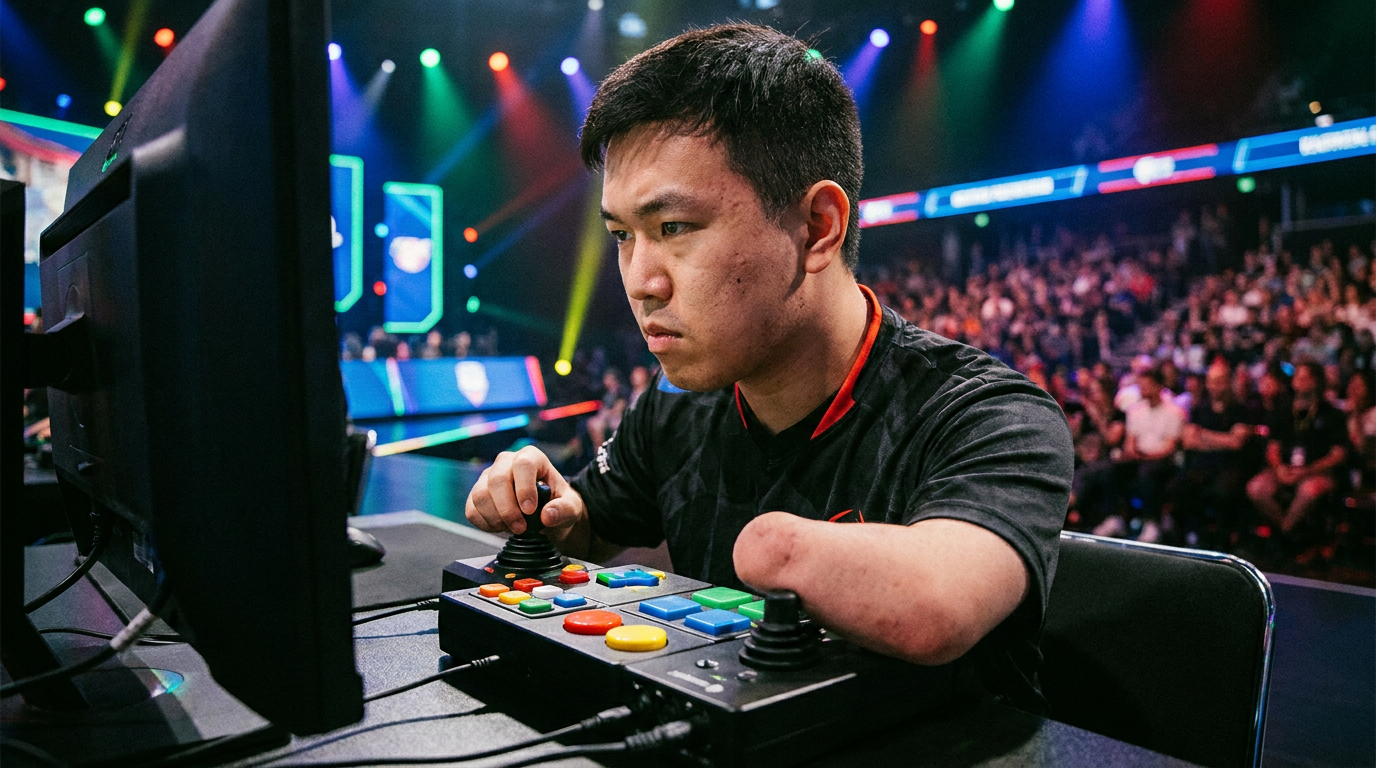
A new wave of modular controllers and updated tournament rules is dismantling physical barriers in competitive gaming. As adaptive esports leagues gain global traction, gamers with disabilities are proving that high-level strategy transcends physical limitations.
By Factlen Editorial Team
- Adaptive Competitors
- Gamers with disabilities emphasize that adaptive tech provides a vital community and a platform to showcase their strategic skills free from physical barriers.
- Tournament Organizers
- League operators focus on updating rulebooks to allow adaptive hardware through Parity Certification, ensuring inclusivity without compromising competitive integrity.
- Hardware Developers
- Companies prioritize modular, expandable designs that can be customized to fit any individual's unique range of motion.
- Accessibility Advocates
- Advocacy groups focus on combating social isolation and pushing the gaming industry toward universal design standards.
What's not represented
- · Able-bodied professional players adjusting to mixed-ability brackets
- · Game engine developers standardizing accessibility APIs
Why this matters
For millions of individuals with physical disabilities, traditional sports are inaccessible, often leading to social isolation. The rise of adaptive esports provides not just a competitive outlet, but a vital community and a platform where talent is measured by strategy rather than physical mobility.
Key points
- First-party adaptive controllers from Sony and Microsoft are making competitive gaming accessible to millions of players with physical disabilities.
- Tournament organizers are adopting 'Parity Certification' to allow custom hardware without violating anti-cheat regulations.
- Dedicated inclusive leagues, such as the Adaptive Esports Tournaments, are offering substantial prize pools and global exposure.
- Trailblazing teams like the all-quadriplegic Quad Gods are proving that esports success relies on strategy, not physical mobility.
Esports is often celebrated as the great equalizer—a digital arena where physical stature doesn't dictate success. Yet, for the estimated 400 million gamers worldwide living with disabilities, the playing field has historically been blocked by a rigid barrier: the standard video game controller. Designed for a specific range of two-handed motor function, traditional gamepads inadvertently exclude millions of potential competitors. Now, in 2026, a sweeping revolution in adaptive hardware and inclusive tournament design is fundamentally rewriting the rules of competitive gaming, transforming esports into a genuinely accessible frontier.[3][8]
The catalyst for this shift has been the rapid maturation of first-party adaptive hardware. Devices like the Xbox Adaptive Controller and Sony's PlayStation Access controller have moved accessibility from a niche aftermarket modification to a flagship console feature. These devices function less like traditional gamepads and more like highly customizable hubs. The Access controller, for instance, features a circular, modular design equipped with 19 interchangeable button caps and multiple joystick profiles, allowing players to tailor the physical interface to their exact range of motion and strength.[1][8]
The true power of these adaptive hubs lies in their expandability. Both Microsoft and Sony equipped their devices with industry-standard 3.5mm expansion ports—four on the Access controller alone—which allow players to plug in an array of third-party switches, foot pedals, and mouth-operated joysticks. A quadriplegic gamer can map complex, multi-button combos to a single large "pillow" button or a sensitive breath-controlled switch. Furthermore, software integration allows players to store up to 30 custom control profiles directly on their console, seamlessly swapping layouts depending on the game they are playing.[1][8]

Despite these hardware breakthroughs, adaptive gamers have long faced a systemic hurdle in professional esports: the tournament rulebook. For years, competitive circuits operated under strict "anti-cheat" regulations that mandated the use of standard, unmodified controllers. These rules were originally drafted to prevent able-bodied players from using macro-enabled hardware or turbo buttons to gain an unfair advantage. However, the blanket ban on third-party adapters and custom inputs effectively disqualified gamers with disabilities, forcing them out of mainstream brackets simply because they required a different physical interface to play.[3][8]
To dismantle this barrier, accessibility advocates and organizations like the British Esports Association have lobbied for updated competitive frameworks. The emerging solution is "Parity Certification"—a vetting process where tournament organizers evaluate adaptive setups to ensure they match the capabilities of a standard controller without automating gameplay. By focusing on Actions Per Minute (APM) parity rather than hardware uniformity, organizers can maintain competitive integrity while allowing disabled players to compete on a level playing field. This shift is slowly opening the doors of mainstream esports to a wider pool of talent.[3][8]
While mainstream integration progresses, dedicated inclusive leagues are flourishing, providing high-stakes environments specifically for disabled gamers. The Adaptive Esports Tournaments (AET), launched in partnership with Logitech G, AbleGamers, and Mount Sinai, has become a premier destination for adaptive competitors. Offering over $30,000 in cash and prizes, the AET hosts global showdowns in titles like Rocket League, proving that adaptive gaming can draw competitive talent and significant sponsorships. These tournaments serve as both a proving ground for new hardware and a vital community hub.[2][6][7]
While mainstream integration progresses, dedicated inclusive leagues are flourishing, providing high-stakes environments specifically for disabled gamers.
The momentum behind inclusive esports is now a global phenomenon. In December 2025, Daejeon, South Korea, hosted the inaugural Adaptive Esports Summit, bringing together industry leaders, hardware developers, and professional players. The event featured high-profile Tekken 8 and League of Legends tournaments specifically designed to showcase adaptive technologies in a professional setting. By allowing non-disabled professionals to compete alongside adaptive gamers using customized setups, the summit highlighted how technology can bridge the physical divide and elevate the overall standard of competition.[4][8]

The push for accessibility is also transforming grassroots and scholastic esports. At the June 2026 Gippsland Esports Competition in regional Australia, organizers integrated Xbox Adaptive Controllers and Logitech Adaptive Kits directly into their high school brackets. Utilizing official Disability Sport Australia grading and handicap systems, the tournament allowed advanced players and adaptive competitors to race side-by-side in titles like F1 2025. By providing dedicated accessibility staff and hardware on-site, regional tournaments are ensuring that the next generation of esports talent faces no physical barriers to entry.[5][8]
As the infrastructure for inclusive esports matures, trailblazing teams are emerging to challenge traditional stereotypes. The Quad Gods, formed out of a rehabilitation program at Mount Sinai Hospital, made history as the world's first all-quadriplegic esports team. By leveraging adaptive technology, the team competes in high-level tournaments, proving that strategic brilliance and teamwork are entirely independent of physical mobility. Their success has inspired a wave of similar organizations, demonstrating the profound rehabilitative and competitive potential of accessible gaming.[6][8]
In Europe, organizations like PARA.Ghost are carving out similar spaces. Based in Sweden, the Counter-Strike team consists entirely of players living with Duchenne Muscular Dystrophy, a progressive muscle-wasting disease. Competing under the ethos "Different Is The New Cool," PARA.Ghost provides a competitive sanctuary free from the toxic environments that disabled gamers often encounter online. Beyond competing, the organization actively develops new esports assistive devices, pushing the industry toward a future where players can bring their own customized gaming environments to any tournament in the world.[8]

Hardware parity is only half the equation; the software itself must be designed with inclusivity in mind. Game developers are increasingly building deep accessibility features directly into their competitive titles. Modern esports games now feature extensive options like automatic braking assists, toggle-to-hold aiming, and rich auditory feedback systems for visually impaired players. When these software features are combined with modular hardware, the cognitive and physical load of gaming is significantly reduced, allowing players to focus entirely on strategy and reaction time.[5][8]
Ultimately, the rise of adaptive esports extends far beyond the digital arena. For many individuals with severe physical disabilities, traditional sports are inaccessible, leading to profound social isolation. Esports provides a vital avenue for connection, teamwork, and the thrill of competition. Organizations like AbleGamers emphasize that providing a disabled person with a customized controller isn't just about letting them play a game; it's about giving them a community, an identity, and a platform to showcase their skills on a global stage.[2][8]
As the esports industry continues to evolve, the integration of adaptive technology will likely become a standard rather than an exception. With major hardware manufacturers investing heavily in modular controllers and tournament organizers rewriting their rulebooks, the barriers that once kept disabled gamers on the sidelines are rapidly falling. The 2026 competitive landscape proves that when technology levels the playing field, human talent and strategic ingenuity will always find a way to shine.[8]
How we got here
2018
Microsoft releases the Xbox Adaptive Controller, pioneering first-party accessible hardware.
Dec 2023
Sony launches the PlayStation Access controller, expanding modular options for disabled gamers.
Dec 2025
The inaugural Adaptive Esports Summit is held in South Korea, showcasing inclusive tech in professional play.
Jun 2026
The Gippsland Esports Competition integrates adaptive hardware directly into mainstream high school brackets.
Viewpoints in depth
Adaptive Competitors
Gamers with disabilities emphasize that adaptive tech provides a vital community and a platform to showcase their strategic skills free from physical barriers.
For players living with conditions like quadriplegia or muscular dystrophy, standard controllers represent an insurmountable physical wall. Adaptive competitors argue that esports should be a pure test of cognitive strategy, reaction time, and teamwork. By utilizing modular hardware, these players are finally able to translate their mental acuity into in-game action. Beyond the competition itself, adaptive gamers highlight the profound social benefits of these leagues, noting that inclusive esports combats the severe isolation often experienced by individuals with limited physical mobility.
Tournament Organizers
League operators focus on updating rulebooks to allow adaptive hardware through Parity Certification, ensuring inclusivity without compromising competitive integrity.
Esports operators have historically been highly protective of competitive integrity, leading to blanket bans on third-party hardware to prevent cheating via macros or automated inputs. However, organizers are now recognizing that these rules inadvertently discriminate against disabled players. The shift toward 'Parity Certification' represents a compromise: organizers rigorously test adaptive setups to ensure they match, but do not exceed, the Actions Per Minute (APM) capabilities of a standard controller. This allows leagues to welcome adaptive gamers while maintaining a level playing field.
Hardware Developers
Companies prioritize modular, expandable designs that can be customized to fit any individual's unique range of motion.
Hardware giants like Sony and Microsoft view accessibility not as a niche market, but as a core pillar of modern gaming infrastructure. Their engineering philosophy centers on expandability—creating base hubs equipped with industry-standard 3.5mm ports that allow players to plug in specialized third-party switches. By focusing on modularity, developers acknowledge that disability is a spectrum; no single controller design can accommodate everyone, but a customizable hub empowers players to build the exact interface they need.
What we don't know
- How quickly top-tier mainstream esports organizations will fully integrate Parity Certification into their global championship rulebooks.
- The long-term impact of emerging neural-link technologies on the future of competitive adaptive gaming.
Key terms
- Adaptive Controller
- A highly customizable gamepad designed for players with limited mobility, featuring modular buttons and external input jacks.
- APM (Actions Per Minute)
- A metric in esports measuring how many inputs a player can execute in one minute, used to gauge hardware parity.
- Parity Certification
- An emerging tournament standard ensuring custom adaptive controllers do not provide unfair automated advantages over standard gamepads.
- Duchenne Muscular Dystrophy
- A severe type of muscular dystrophy that progressively weakens muscles, affecting several prominent adaptive esports competitors.
Frequently asked
Can adaptive controllers be used in standard esports tournaments?
Historically, they were banned due to anti-cheat rules, but major tournaments are increasingly adopting 'Parity Certification' to allow them.
What makes a controller 'adaptive'?
They feature modular, swappable buttons, adjustable joysticks, and expansion ports that allow players to connect specialized switches or foot pedals.
Are there esports leagues specifically for disabled gamers?
Yes, organizations like Logitech G and AbleGamers host the Adaptive Esports Tournaments (AET), and dedicated teams like the Quad Gods compete globally.
Sources
Source coverage
8 outlets
4 viewpoints surfaced








[1]Sony Interactive EntertainmentHardware Developers
The Access controller's impact on gamers
Read on Sony Interactive Entertainment →[2]AbleGamersAccessibility Advocates
Making Esports Accessible
Read on AbleGamers →[3]Esports InsiderTournament Organizers
Accessibility in esports: Breaking down the barriers
Read on Esports Insider →[4]Esports RadarTournament Organizers
First Adaptive Esports Summit to be held in Daejeon
Read on Esports Radar →[5]Australian Esports LeagueTournament Organizers
Gippsland Esports Competition: All Abilities Adaptive Play
Read on Australian Esports League →[6]Mount SinaiAdaptive Competitors
Adaptive Esports and Gaming
Read on Mount Sinai →[7]Logitech GHardware Developers
Adaptive Esports Tournaments: Play Made Accessible
Read on Logitech G →[8]Factlen Editorial TeamAccessibility Advocates
Synthesis by Factlen editorial team
Read on Factlen Editorial Team →
Every angle. Every day.
Get gaming esports stories with full source coverage and perspective breakdowns delivered to your inbox.