
How Content Credentials and Invisible Watermarks Are Rebuilding Trust on the Internet
As generative AI makes synthetic media indistinguishable from reality, the tech industry has abandoned 'fake detection' in favor of a new standard: cryptographically proving what is real.
By Factlen Editorial Team
- Content Provenance Advocates
- Believe cryptographic metadata at the source is the only scalable way to establish truth.
- AI Watermarking Developers
- Argue that invisible pixel-level watermarking is necessary because metadata is too easily stripped.
- Open-Source AI Community
- Concerned about the centralization of trust lists and the ability to bypass watermarks in open weights.
What's not represented
- · Independent creators who may struggle to access or afford enterprise-grade cryptographic signing tools.
- · Privacy advocates concerned that ubiquitous provenance tracking could eliminate anonymous digital speech.
Why this matters
The ability to trust a photograph, video, or audio clip is foundational to journalism, law, and daily life. By shifting from an unwinnable arms race of 'detecting fakes' to a standardized system of proving authenticity, this technology protects consumers from manipulation and restores the credibility of digital media.
Key points
- The tech industry is shifting from trying to detect AI fakes to cryptographically proving content authenticity.
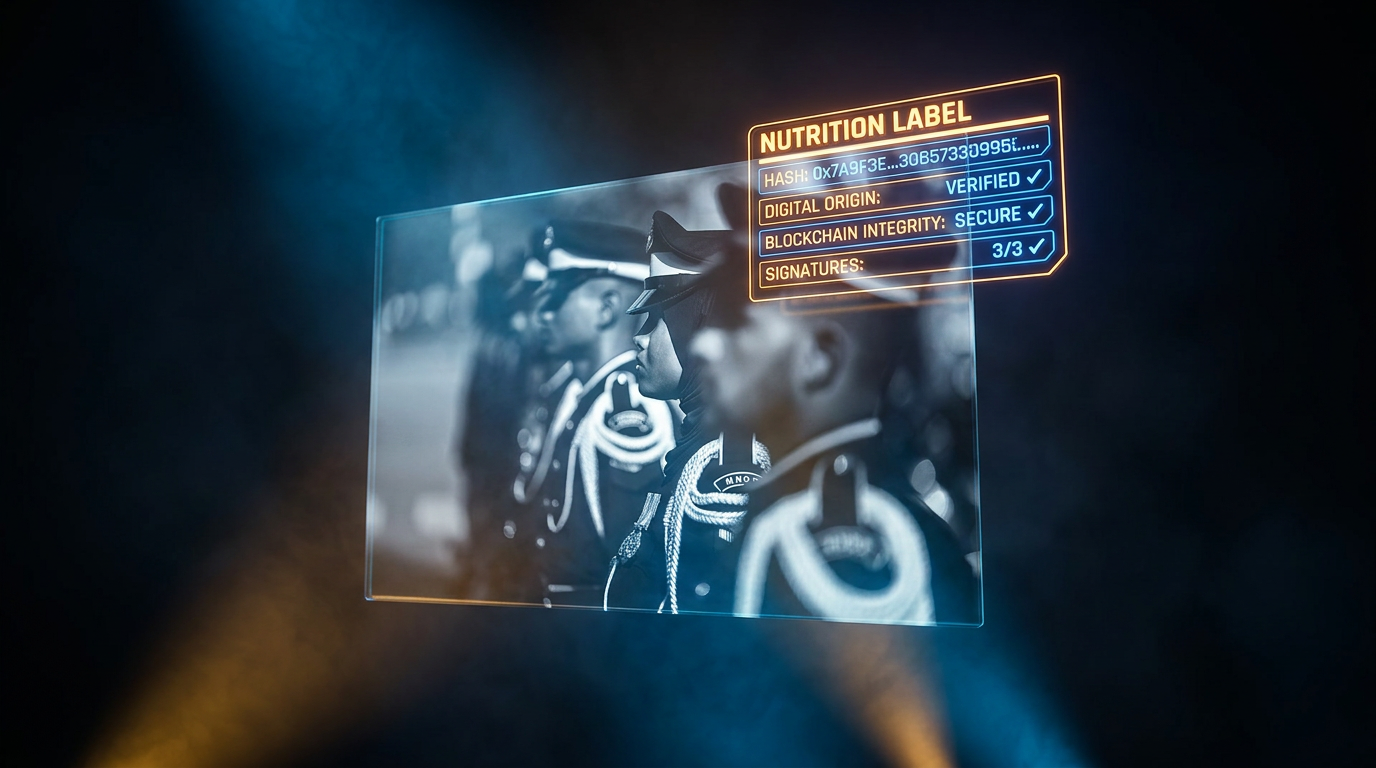
- The C2PA standard embeds a tamper-evident 'nutrition label' into media, detailing its origin and edit history.
- Over 6,000 organizations, including major camera makers and software giants, have adopted the standard by 2026.
- Because metadata can be stripped by screenshots, companies are also using invisible AI watermarks embedded in pixels.
- The EU AI Act and US government guidelines are pushing these provenance standards from voluntary to mandatory.
- These tools do not determine absolute truth, but provide the transparency needed for users to make informed judgments.
For the first half of the 2020s, the internet fought a losing battle against synthetic media. As generative AI models became capable of producing photorealistic images, cloned voices, and seamless video, the tech industry initially responded by building AI detectors—software designed to spot the subtle artifacts left behind by machines. But as the generators improved, the detectors failed. By 2025, identity security researchers tracked an estimated 8 million deepfake incidents globally, a staggering 900% increase in just two years.[3]
The fundamental flaw in the detection approach was that it treated authenticity as an adversarial guessing game. As deepfake generators improved, detectors had to improve in response, creating an endless and unwinnable arms race. In 2026, the digital ecosystem has largely abandoned this reactive strategy in favor of a proactive one: instead of trying to prove that a piece of content is fake, the new standard focuses on cryptographically proving that it is real.[3][7]

At the center of this shift is the Coalition for Content Provenance and Authenticity (C2PA), an open technical standard that functions like a tamper-evident nutrition label for digital media. Founded by a consortium of tech and media giants, the C2PA standard embeds a verifiable record of a file's origin and history directly into its metadata. This consumer-facing label, known as Content Credentials, tells viewers exactly where a photo, video, or audio file came from, what tools were used to create it, and whether generative AI was involved.[1][4]
The mechanism behind Content Credentials relies on public key cryptography. When a creator captures an image using a C2PA-enabled device, the hardware generates a cryptographic manifest. This manifest records the device details, location, and timestamp, and then digitally signs the entry using X.509 certificates. If the image is later opened in editing software like Adobe Photoshop, the software appends a new signed entry detailing the exact edits made. The result is an unbroken, tamper-evident chain of custody that travels with the file.[1][3]

Crucially, this verification happens entirely offline. The necessary certificates travel inside the manifest itself, allowing newsrooms, courts, and everyday users to verify a file's history without needing to 'phone home' to a central server. If a bad actor attempts to alter the image or tamper with the metadata, the cryptographic signature breaks, instantly alerting the viewer that the file can no longer be trusted.[1][3]
Adoption of the C2PA standard has accelerated dramatically. As of early 2026, the coalition boasts over 6,000 members and affiliates. Major hardware manufacturers, including Sony, Leica, Nikon, and Canon, have integrated C2PA signing directly into their professional camera bodies, utilizing hardware-backed key storage to ensure the signing keys cannot be extracted or cloned. On the software side, Adobe has woven Content Credentials throughout its Creative Cloud suite, while OpenAI and Google have integrated the standard into their generative AI outputs and search platforms.[2][4]

As of early 2026, the coalition boasts over 6,000 members and affiliates.
This industry momentum is being heavily reinforced by new global regulations. The European Union's AI Act, which takes full effect in August 2026, mandates strict transparency labeling for AI-generated content—a requirement that C2PA's AI assertion type directly satisfies. Similarly, the United States Cybersecurity and Infrastructure Security Agency (CISA) has explicitly recommended C2PA adoption for government and critical infrastructure media pipelines, moving the standard from a voluntary best practice to a regulatory baseline.[3][7]
However, Content Credentials are not a silver bullet. The system faces a fundamental vulnerability: metadata stripping. Because the C2PA manifest is attached to the file's metadata, it can be easily lost if a user takes a screenshot of an image, or if a social media platform aggressively compresses a video during upload. While the standard proves the history of compliant files, the vast majority of legacy content on the internet still carries no provenance data at all.[2][3][4]
To close this gap, the tech industry has deployed a second, complementary layer of defense: invisible AI watermarking. Unlike metadata, which sits alongside the file, digital watermarking embeds imperceptible signals directly into the content itself—altering the actual pixels of an image or the waveform of an audio clip. These markers are designed to be entirely invisible to the human eye or ear, but easily detectable by specialized verification tools.[5][6]

Google's SynthID is a prime example of this technology in 2026. By embedding the watermark into the algorithmic structure of the content during the generation process, the signal becomes highly resilient. It can survive common modifications like cropping, resizing, color adjustments, and heavy compression. Even if a user screenshots a SynthID-watermarked image, the invisible pixel patterns remain intact, allowing platforms to identify its synthetic origins.[2][6]
The emerging consensus among technologists is that neither C2PA nor watermarking can solve the deepfake crisis alone. Instead, they form a robust, layered architecture. C2PA provides the rich, detailed provenance information—the 'who, what, and how' of a file's history. Invisible watermarking provides the resilience, ensuring that even if the metadata is maliciously stripped or accidentally lost, the core synthetic identifier remains embedded in the media.[4][6][7]
It is important to understand what this technology does not do: it does not determine 'truth.' A photograph signed with pristine Content Credentials might prove it was captured on a specific camera without any AI alteration, but it cannot prove that the scene depicted wasn't staged. The standard provides transparency, not absolute truth. By giving users access to a file's verifiable history, the system empowers individuals to make their own informed judgments about what to trust.[1][4]
The transition to a fully authenticated internet will take years. It requires ubiquitous adoption across every major camera manufacturer, software tool, and social media platform. Yet, the progress made by 2026 represents a profound structural shift. By building a standardized, cryptographic trust layer directly into the fabric of digital media, the technology industry is finally providing the tools necessary to navigate an AI-generated world with confidence.[4][7]
How we got here
Feb 2021
The Coalition for Content Provenance and Authenticity (C2PA) is founded by Adobe, Arm, BBC, Intel, and Microsoft.
Jan 2022
C2PA releases version 1.0 of its technical specification, defining the structure for cryptographic manifests.
Nov 2023
Major updates introduce robust cloud signing workflows and time-stamp authority integration.
Jan 2025
The US Cybersecurity and Infrastructure Security Agency (CISA) officially recommends C2PA adoption for critical infrastructure.
May 2026
OpenAI and Google expand their integration of C2PA and invisible watermarking (SynthID) across their generative platforms.
Aug 2026
The EU AI Act takes effect, requiring strict transparency labeling for AI-generated content.
Viewpoints in depth
Content Provenance Advocates
Organizations focused on establishing an unbroken chain of trust from the moment of creation.
Groups like the C2PA, Adobe, and major news organizations argue that the only scalable way to fight misinformation is to verify reality at its source. They believe that cryptographic metadata is superior because it provides a rich, detailed history of a file—not just a binary 'real or fake' label. By establishing a tamper-evident chain of custody, they aim to create an internet where consumers expect to see verifiable credentials on all professional media, treating uncredentialed content with natural skepticism.
AI Watermarking Developers
Technologists focused on embedding resilient, imperceptible signals directly into synthetic media.
Companies developing generative AI models, such as Google and Resemble AI, emphasize that metadata standards like C2PA are structurally vulnerable to being stripped by screenshots, aggressive compression, or malicious actors. They argue that invisible watermarking—altering the actual pixels or audio waveforms—is a necessary baseline defense. Because the watermark survives common edits and format changes, it ensures that synthetic content can still be identified even after it has been laundered through multiple social media platforms.
Open-Source AI Community
Developers concerned about the centralization of trust and the practical limits of watermarking.
Advocates for open-source AI acknowledge the importance of transparency but point out significant hurdles. They note that while proprietary, closed-API models can easily enforce watermarking and C2PA signing, open-weight models can be modified by end-users to bypass these protections. Furthermore, some express concern that a strict C2PA ecosystem could centralize power among a few approved 'Certificate Authorities,' potentially marginalizing independent creators, whistleblowers, or activists who rely on anonymity and cannot access official cryptographic signing tools.
What we don't know
- How quickly social media platforms will fully integrate and display Content Credentials to end-users without breaking the metadata during upload compression.
- Whether open-source AI models can be effectively regulated to prevent users from stripping out mandatory watermarking protocols.
- How the general public will adapt to reading and interpreting cryptographic provenance data in their daily media consumption.
Key terms
- C2PA
- The Coalition for Content Provenance and Authenticity, an open technical standard that enables verifiable metadata to be embedded in digital files.
- Content Credentials
- The consumer-facing name for C2PA manifests; a digital 'nutrition label' showing a file's origin, edits, and AI involvement.
- Digital Watermarking
- The process of embedding imperceptible identifiers directly into the pixels or audio waveforms of a file to trace its origin.
- Cryptographic Manifest
- A secure, tamper-evident record attached to a file that uses public key cryptography to prove the file's history and origin.
- Metadata Stripping
- The intentional or accidental removal of a file's background data, often occurring when an image is screenshotted or uploaded to social media.
Frequently asked
Does C2PA tell me if an image is true?
No. C2PA provides transparency about a file's origin and edit history, but it cannot verify if the events depicted actually happened or were staged.
Can Content Credentials be faked?
It is cryptographically nearly impossible to fake the signature of a trusted entity (like a specific camera or news organization) without access to their private security keys.
What happens if I take a screenshot of a protected image?
Taking a screenshot creates a brand new file, which strips away the original C2PA metadata. This is why invisible watermarking is used as a backup layer.
Do I need special software to verify an image?
No. Verification is increasingly built directly into web browsers, search engines, and social media platforms, allowing users to check credentials with a simple click.
Sources
Source coverage
7 outlets
3 viewpoints surfaced







[1]C2PA SpecificationContent Provenance Advocates
C2PA Content Credentials Explainer
Read on C2PA Specification →[2]EyesiftAI Watermarking Developers
C2PA Adoption Status 2026: Content Credentials, OpenAI & Google
Read on Eyesift →[3]DeepIDVContent Provenance Advocates
How C2PA content provenance and digital watermarking fight deepfakes in 2026
Read on DeepIDV →[4]C2PA.ai ResearchContent Provenance Advocates
Everything you need to know about the open standard reshaping digital content
Read on C2PA.ai Research →[5]Resemble AIAI Watermarking Developers
What Is AI Watermarking and How Does It Work?
Read on Resemble AI →[6]Which One is AIAI Watermarking Developers
Digital Watermarking: A Proactive Approach to AI Detection
Read on Which One is AI →[7]Factlen Editorial TeamOpen-Source AI Community
Synthesis by Factlen editorial team
Read on Factlen Editorial Team →


Every angle. Every day.
Get meta stories with full source coverage and perspective breakdowns delivered to your inbox.