
The Neuroscience of 'Physical Chess': How Brazilian Jiu-Jitsu Rewires the Brain
Emerging neuroimaging and psychological research reveals that grappling martial arts like Brazilian Jiu-Jitsu trigger profound structural changes in the brain, enhancing cognitive flexibility, stress resilience, and long-term neuroprotection.
By Factlen Editorial Team
- Neuroscientists
- Focus on the measurable biological adaptations, such as increased cerebral blood flow, neurogenesis, and structural changes in the prefrontal cortex.
- Clinical Psychologists
- Emphasize the mental health benefits, particularly how controlled exposure to physical stress trains the nervous system to regulate anxiety and process trauma.
- Cognitive Researchers
- Highlight the executive function benefits, comparing the strategic demands of martial arts to complex problem-solving tasks that stave off cognitive decline.
What's not represented
- · Older adults beginning martial arts late in life
- · Neurologists studying traumatic brain injury risks in combat sports
Why this matters
As rates of cognitive decline and chronic anxiety rise, finding exercise modalities that simultaneously protect the brain and regulate the nervous system is critical. The science of martial arts proves that complex, problem-solving physical activities offer neurological benefits that traditional repetitive workouts cannot match.
Key points
- Neuroimaging shows that practicing BJJ increases tissue density in the brain's frontal lobe and Default Mode Network.
- The constant problem-solving required in grappling strengthens executive function, working memory, and cognitive flexibility.
- Controlled exposure to physical stress during sparring trains the nervous system to better regulate anxiety and fear.
- Elite BJJ athletes demonstrate significantly higher resting cerebral blood flow, offering potential protection against cognitive decline.
- The close physical contact of the sport triggers the release of oxytocin, fostering deep social bonds and empathy.
For decades, Brazilian Jiu-Jitsu (BJJ) has been colloquially referred to as "physical chess." Practitioners have long claimed that the grappling art—which focuses on leverage, timing, and submission holds rather than striking—sharpens the mind as much as it strengthens the body. Now, modern neuroscience is proving them right, revealing that the complex demands of martial arts literally rewire the brain's architecture.[6]
Unlike repetitive aerobic exercises such as running or cycling on a stationary bike, BJJ requires constant, high-stakes problem-solving. Every sparring session, known as "rolling," forces the brain to process a staggering amount of spatial and tactile information in real-time. This dynamic environment triggers profound neuroplasticity—the brain's ability to form and reorganize synaptic connections.[2][6]
Groundbreaking research utilizing advanced neuroimaging has begun to map these changes. Studies tracking novice practitioners over a 90-day period have observed significant increases in tissue density within the frontal lobe and regions linked to the Default Mode Network (DMN). The DMN acts as the brain's internal operating system, handling self-reflection and body perception. By forcing practitioners to remain intensely present, BJJ effectively upgrades this system.[3]
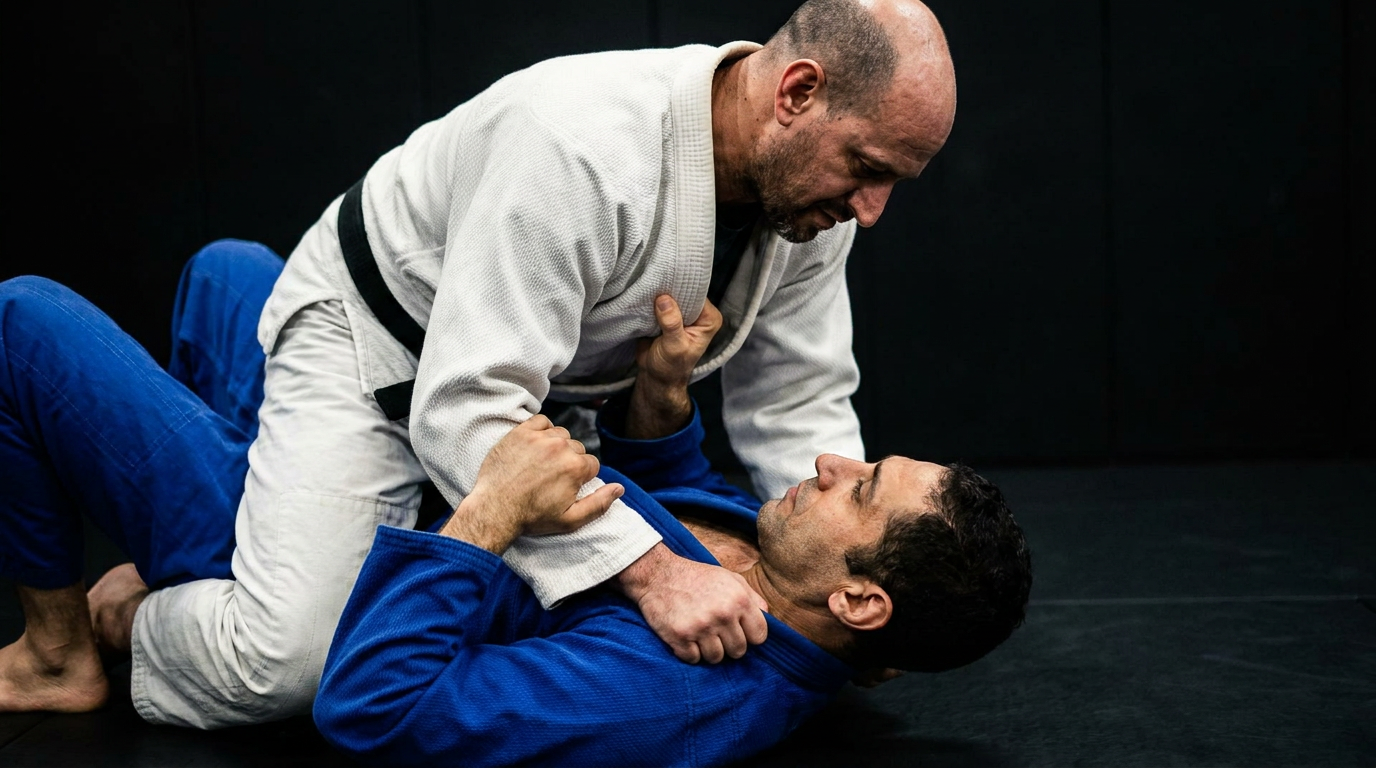
The cognitive demands of grappling heavily engage the prefrontal cortex, the brain's executive control center. When a practitioner is pinned beneath a heavier opponent, they cannot rely on brute strength. They must calculate leverage, anticipate their partner's reactions, and execute multi-step escape sequences. This constant strategic calculation strengthens neural networks involved in working memory, cognitive flexibility, and rapid decision-making.[2][6]

Beyond executive function, BJJ serves as a masterclass in emotional regulation and stress inoculation. During a roll, the body is subjected to intense physical pressure, triggering the amygdala—the brain's fear center—to initiate a fight-or-flight response. However, panicking in BJJ leads to rapid exhaustion and defeat. Practitioners must consciously override this primal instinct.[4][6]
By learning to control their breathing and systematically work their way out of uncomfortable, claustrophobic positions, students train their parasympathetic nervous system to remain calm under severe duress. Over time, this "comfort in discomfort" translates off the mats. Clinical psychologists note that this repeated, controlled exposure to stress makes practitioners significantly more resilient to everyday anxieties and emotional triggers.[4][5]
Over time, this "comfort in discomfort" translates off the mats.
The neurochemical cascade triggered by martial arts training further amplifies these mental health benefits. While most intense exercise releases endorphins and dopamine, BJJ uniquely stimulates the production of Brain-Derived Neurotrophic Factor (BDNF). Often described as "Miracle-Gro for the brain," BDNF is essential for neurogenesis—the creation of new neurons—and is a critical defense against age-related cognitive decline.[2][6]
Perhaps the most surprising neurochemical involved in BJJ is oxytocin, widely known as the "cuddle hormone" associated with empathy and bonding. Because grappling involves continuous, close physical contact, the brain releases significant amounts of oxytocin, even in the midst of simulated combat. This biological mechanism explains the intense camaraderie and rapid friendship development frequently observed in martial arts academies.[4]
The physical adaptations of the brain extend to its vascular system. A landmark 2021 study published in the Scandinavian Journal of Medicine & Science in Sports examined the cerebral blood flow of elite BJJ athletes compared to age-matched controls. The researchers discovered a remarkable physiological divergence.[1]
The elite grapplers exhibited a significantly elevated resting global cerebral blood flow (gCBF)—averaging 741 milliliters per minute compared to 573 milliliters per minute in the control group. This sustained elevation in cerebral perfusion provides crucial nutrients and oxygen to the brain, supporting memory and attention while offering a buffer against neurodegeneration.[1]

Researchers hypothesize that this increased blood flow is the result of "cerebral preconditioning." BJJ frequently involves the controlled application and defense of neck chokes. The study suggests that this intermittent, safe exposure to restricted blood flow forces the vascular system to adapt, ultimately making the brain's blood supply more robust and efficient.[1][6]
These neurological benefits have profound implications for aging populations. As cognitive decline and loss of motor control become pressing public health issues, the integration of complex motor learning with strategic thinking offers a dual-action defense. The balance, spatial awareness, and executive function required in martial arts provide neuroprotective effects that simple weightlifting or jogging cannot replicate.[2][6]

Furthermore, the therapeutic potential of BJJ is gaining traction in clinical psychology. Recent comparative data indicates that grappling arts have a higher correlation with reduced symptoms of PTSD and severe anxiety than traditional exercise modalities. The combination of somatic therapy (processing trauma through physical movement), community support, and enforced mindfulness creates a powerful healing environment.[4][5]
Ultimately, the science confirms what martial artists have felt intuitively for generations. Stepping onto the mats is not merely a physical pursuit; it is a comprehensive neurological workout. By demanding total presence, strategic calculation, and emotional control, Brazilian Jiu-Jitsu builds a brain that is as resilient and adaptable as the body that carries it.[6]
Viewpoints in depth
Neuroscientists
Focus on the measurable biological adaptations, such as increased cerebral blood flow and structural brain changes.
For neurobiologists, martial arts represent the ultimate real-world laboratory for studying motor learning. Researchers point to the measurable increases in Brain-Derived Neurotrophic Factor (BDNF) and the structural thickening of the prefrontal cortex as proof that complex movement is vital for brain health. They are particularly interested in the phenomenon of 'cerebral preconditioning,' suggesting that the unique physiological stressors of grappling—such as intermittent changes in blood flow—force the brain's vascular system to become more robust and efficient over time.
Clinical Psychologists
Emphasize the mental health benefits, particularly how controlled exposure to physical stress trains the nervous system.
Psychologists view the BJJ mat as a controlled environment for stress inoculation. By repeatedly triggering the body's fight-or-flight response in a safe, structured setting, practitioners learn to consciously override their amygdala. This process trains the parasympathetic nervous system to regain control faster. Clinicians note that this somatic approach to stress management is highly effective for individuals with anxiety or PTSD, as it teaches the brain to find safety and clarity in the midst of overwhelming physical and emotional pressure.
Cognitive Researchers
Highlight the executive function benefits, comparing the strategic demands of martial arts to complex problem-solving tasks.
Cognitive scientists focus on the 'physical chess' aspect of the sport. They argue that traditional aerobic exercise, while good for the heart, does not challenge the brain's executive functions. BJJ, however, requires constant spatial calculation, working memory updates, and rapid decision-making under fatigue. This intense cognitive load builds a cognitive reserve, which researchers believe is one of the most effective ways to delay the onset of age-related cognitive decline and maintain mental sharpness into old age.
What we don't know
- The exact threshold of training frequency required to trigger permanent structural changes in the brain.
- How the cognitive benefits of grappling arts compare longitudinally to striking arts like Muay Thai or Boxing.
- The long-term effects of 'cerebral preconditioning' over a multi-decade lifespan of training.
Key terms
- Neuroplasticity
- The brain's ability to reorganize itself by forming new neural connections throughout life in response to learning and experience.
- Executive Function
- A set of mental skills that include working memory, flexible thinking, and self-control, primarily managed by the prefrontal cortex.
- Brain-Derived Neurotrophic Factor (BDNF)
- A protein that promotes the survival of nerve cells and encourages the growth of new neurons and synapses, crucial for learning and memory.
- Default Mode Network (DMN)
- A network of interacting brain regions that is active when a person is not focused on the outside world, heavily involved in self-reflection and mind-wandering.
- Parasympathetic Nervous System
- The part of the nervous system responsible for the body's 'rest and digest' activities, helping to calm the body after a stressful event.
Frequently asked
How does BJJ differ from regular exercise for the brain?
While all exercise increases blood flow, BJJ requires constant, real-time problem-solving and spatial awareness. This cognitive load forces the brain to build new neural pathways, enhancing executive function and memory.
Can martial arts help with anxiety?
Yes. By repeatedly placing practitioners in stressful but safe physical situations, BJJ acts as stress inoculation. It trains the parasympathetic nervous system to remain calm under pressure, which translates to better emotional regulation in daily life.
What is cerebral preconditioning?
It is a biological adaptation where the brain becomes more resilient to oxygen deprivation. In BJJ, the safe, controlled application of neck chokes may force the vascular system to adapt, resulting in higher resting cerebral blood flow.
Is BJJ safe for older adults concerned about brain health?
When practiced safely with proper instruction, BJJ and other grappling arts are highly beneficial for older adults. They improve balance, spatial awareness, and cognitive flexibility, which are critical for preventing age-related decline.
Sources
Source coverage
6 outlets
3 viewpoints surfaced






[1]Scandinavian Journal of Medicine & Science in SportsNeuroscientists
Elevated cerebral perfusion and preserved cognition in elite Brazilian Jiu-Jitsu athletes: Evidence for neuroprotection
Read on Scandinavian Journal of Medicine & Science in Sports →[2]Frontiers in PsychologyCognitive Researchers
Martial arts training and executive functions: A neurocognitive perspective
Read on Frontiers in Psychology →[3]Yaniv Assaf LabNeuroscientists
Structural brain plasticity and motor learning in complex environments
Read on Yaniv Assaf Lab →[4]Psychology TodayClinical Psychologists
The Psychology of Brazilian Jiu-Jitsu
Read on Psychology Today →[5]Journal of Combat PsychologyClinical Psychologists
Anxiety and PTSD reduction in grappling arts versus traditional exercise
Read on Journal of Combat Psychology →[6]Factlen Editorial TeamCognitive Researchers
Synthesis by Factlen editorial team
Read on Factlen Editorial Team →


Every angle. Every day.
Get fitness stories with full source coverage and perspective breakdowns delivered to your inbox.