
How On-Device AI and NPUs Are Moving Intelligence Out of the Cloud
The rise of Neural Processing Units (NPUs) and Small Language Models is allowing smartphones and laptops to run powerful AI locally, prioritizing user privacy and offline access.
By Factlen Editorial Team
- Privacy and Security Advocates
- Argue that local AI is essential for data sovereignty, ensuring sensitive information never leaves the device.
- Hardware Manufacturers
- Focus on pushing the boundaries of NPU performance and TOPS metrics to drive the next upgrade cycle of AI PCs.
- Enterprise IT Leaders
- Value the hybrid approach, balancing the cost savings of local SLMs with the raw power of cloud computing for complex tasks.
- Open-Source Developers
- Champion the democratization of AI through quantized open-weight models and accessible tools that run on consumer hardware.
What's not represented
- · Cloud Service Providers who stand to lose API inference revenue
- · Consumers with older hardware who are priced out of the AI PC upgrade cycle
Why this matters
By running AI models directly on your personal hardware, you gain absolute privacy over your data, zero-latency response times, and the ability to use advanced AI tools entirely offline without paying recurring subscription fees.
Key points
- On-device AI allows smartphones and laptops to run machine learning models locally, without relying on cloud servers.
- Neural Processing Units (NPUs) are specialized chips that execute AI math efficiently, preserving battery life.
- Small Language Models (SLMs) are compressed via quantization to fit within the memory limits of consumer hardware.
- Local inference guarantees absolute data privacy, as sensitive prompts and documents never leave the device.
- A hybrid architecture is emerging, where simple tasks run locally and complex queries fall back to secure cloud servers.
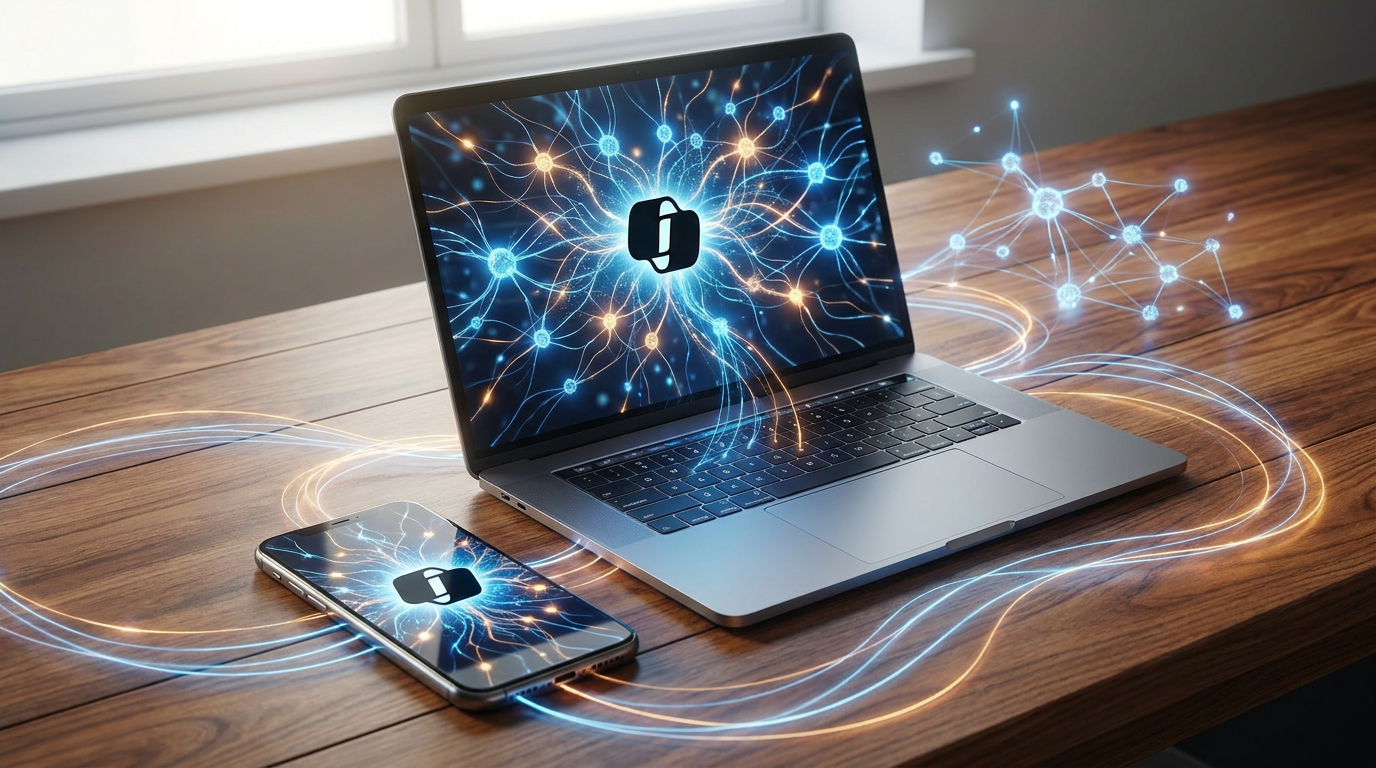
For the past three years, interacting with artificial intelligence meant sending your personal data to a distant server farm and waiting for a response. But in 2026, a quiet revolution has inverted that model. Artificial intelligence is leaving the cloud and taking up residence directly on personal devices. This shift, driven by a convergence of specialized hardware and highly compressed software, allows smartphones and laptops to generate text, summarize documents, and edit images entirely offline. By severing the reliance on internet connectivity, on-device AI is fundamentally changing how users interact with machine learning, prioritizing absolute privacy and zero-latency speed over sheer scale. It represents a democratization of compute power, moving the frontier of technology from massive data centers back to the personal computer on your desk.[1][3]
The engine driving this transformation is a specialized piece of silicon known as a Neural Processing Unit, or NPU. While traditional Central Processing Units (CPUs) handle general computing tasks and Graphics Processing Units (GPUs) render complex visuals, NPUs are purpose-built for the specific matrix mathematics that underpin neural networks. By dedicating a distinct processor to these AI workloads, modern devices can run continuous machine learning tasks—like real-time voice transcription or live video background blurring—without draining the battery or causing the system to overheat. This architectural shift trades general versatility for extreme performance-per-watt in a narrow domain, making always-on AI a practical reality for mobile devices.[2][5]
The raw power of an NPU is measured in Trillions of Operations Per Second, or TOPS. In 2026, TOPS has become the defining specification for computing hardware, replacing clock speed as the primary metric of a device's capability. Microsoft has established a strict baseline of 40 TOPS for its Copilot+ PC certification, a standard that ensures a laptop can handle advanced, on-device AI features without faltering. This threshold has forced the entire semiconductor industry to pivot, sparking a fierce race among chipmakers to deliver processors that can meet the demands of local inference while maintaining all-day battery life.[2][3][5]

The hardware landscape has rapidly consolidated around a few key players meeting this 40-TOPS threshold. AMD's Ryzen AI 300 series currently leads the Windows ecosystem with 50 TOPS, closely followed by Intel's Core Ultra 200V at 48 TOPS and Qualcomm's Snapdragon X Elite at 45 TOPS. Apple, which pioneered early on-device processing, utilizes a 38-TOPS Neural Engine in its M4 chips. While Apple's raw TOPS number appears slightly lower, the company relies on its tightly integrated unified memory architecture—where the NPU, CPU, and GPU share the same pool of high-speed memory—to achieve comparable, and sometimes superior, real-world inference performance.[4][5]
But hardware is only half of the equation. The software breakthrough enabling this shift is the rise of Small Language Models (SLMs). Unlike massive cloud-based models that boast over a trillion parameters and require clusters of industrial GPUs to run, SLMs typically range from 3 to 13 billion parameters. These compact models are meticulously designed to fit within the limited memory constraints of consumer hardware while still delivering robust reasoning, coding, and language generation capabilities. By training on highly curated, high-quality datasets rather than the entire unfiltered internet, SLMs punch far above their weight class.[2][7]
To squeeze these models onto laptops and phones, developers utilize a mathematical technique called quantization. This process compresses the weights of the AI model—often reducing them from standard 16-bit precision down to 4-bit or even lower—drastically shrinking the model's memory footprint with only a negligible loss in output quality. Tools like Ollama for desktop computers and PocketPal for mobile devices have democratized this process, allowing users to download and swap quantized open-weight models as easily as installing a standard application. This vibrant open-source ecosystem has made local AI accessible to anyone with a modern machine.[1][8]
To squeeze these models onto laptops and phones, developers utilize a mathematical technique called quantization.
The most immediate and profound benefit of running these compressed models locally is absolute data sovereignty. When an AI model runs on an NPU, the user's prompts, sensitive corporate documents, and personal photos never leave the physical device. For regulated industries like healthcare and finance, or for everyday users increasingly concerned about corporate data harvesting, this local-first philosophy eliminates the privacy risks associated with cloud API calls and third-party data processing agreements. The data simply cannot be intercepted or logged by a tech giant if it never connects to the internet in the first place.[3][6]
Beyond privacy, on-device AI eradicates the frustrating latency inherent in cloud computing. Cloud-based models typically suffer from hundreds of milliseconds of network lag before generating the first word of a response. Local inference drops this delay to near zero, enabling truly real-time applications like seamless voice assistants and instant code completion that feel like native extensions of the operating system. Furthermore, this capability persists entirely offline, allowing users to access sophisticated AI assistance on airplanes, in remote wilderness locations, or during widespread network outages.[1][7][8]

For enterprise organizations, the shift to local AI also represents a massive financial incentive. Cloud AI services typically charge per token processed, a cost structure that scales aggressively with high-volume usage. By shifting routine tasks like document summarization, internal search, and customer support ticketing to local SLMs running on employee hardware, organizations are realizing cost savings of up to 70 percent over an 18-month period. Eliminating recurring API fees for standard workloads allows IT departments to deploy AI much more broadly across their workforce without breaking the budget.[6][7]
However, local hardware still has its absolute limits. To bridge the gap between on-device efficiency and frontier-level intelligence, companies are adopting sophisticated hybrid architectures. Apple Intelligence, for example, processes the vast majority of user requests locally on the iPhone or Mac. But when a prompt requires complex reasoning that exceeds the device's capabilities, the system seamlessly hands the task off to Private Cloud Compute—a secure server environment built with Apple Silicon that cryptographically guarantees user data is never stored, logged, or used for training.[4]
This hybrid approach is rapidly becoming the blueprint for the broader technology industry. Simple, privacy-sensitive, and latency-critical tasks run locally on the NPU, while complex, resource-intensive workloads are routed to the cloud. This dynamic routing ensures a consistent, high-quality user experience while maintaining strict control over data security and operational costs. It represents a mature middle ground between the cloud-maximalist approach of 2023 and the hardware constraints of purely local execution, giving users the best of both worlds without compromising on their fundamental right to privacy.[1][4]

Despite the rapid maturation of on-device AI, several uncertainties remain for early adopters. The long-term impact of continuous NPU inference on laptop battery degradation is still being studied in real-world conditions. Additionally, the software ecosystem remains somewhat fragmented, with developers struggling to optimize their models equally across competing NPU architectures from Intel, AMD, and Qualcomm. Furthermore, the aggressive pace of hardware advancement raises valid questions about the longevity of first-generation AI PCs purchased just a year ago, as model sizes continue to grow.[2]
Ultimately, the transition to on-device AI represents a fundamental redistribution of computing power. By moving intelligence out of centralized server farms and directly into the hands of users, the technology industry is making artificial intelligence more private, more accessible, and more resilient. In 2026, the most powerful AI is no longer necessarily the one with the largest data center, but the one that lives securely in your pocket, ready to assist you regardless of where you are or who is watching.[1][3]
How we got here
2020
Apple transitions to custom silicon, laying the groundwork for unified memory and advanced Neural Engines.
Early 2024
Open-source developers popularize tools like Ollama, making it easy to run quantized models locally.
Mid 2024
Microsoft introduces the Copilot+ PC standard, mandating a minimum of 40 TOPS for Windows AI features.
June 2024
Apple unveils Apple Intelligence, heavily emphasizing on-device processing and Private Cloud Compute.
Early 2026
Next-generation NPUs from AMD, Intel, and Qualcomm push local AI performance beyond 45 TOPS.
Viewpoints in depth
Privacy and Security Advocates
This camp argues that the primary value of local AI is absolute data sovereignty.
For privacy advocates and regulators, the shift to on-device AI is a necessary corrective to the data-harvesting practices of the early generative AI boom. By ensuring that prompts, personal documents, and corporate data never leave the physical hardware, local inference inherently complies with strict data residency laws like the EU AI Act. This group emphasizes that true privacy cannot rely on corporate promises or cloud processing agreements, but must be cryptographically and physically guaranteed by processing data locally.
Hardware Manufacturers
Silicon vendors view the transition to local AI as the catalyst for a massive hardware upgrade cycle.
For companies like Intel, AMD, Qualcomm, and Apple, the demand for local AI capabilities represents the most significant opportunity to sell new hardware in a decade. This camp focuses heavily on the TOPS metric, pushing the narrative that legacy CPUs and GPUs are insufficient for modern computing. They argue that dedicated NPUs are essential for delivering always-on AI features without destroying battery life, framing the 'AI PC' not just as a luxury, but as the new baseline standard for consumer and enterprise computing.
Open-Source Developers
This community values the democratization and accessibility of AI technology.
Open-source advocates celebrate local AI because it wrests control away from massive tech monopolies and centralized cloud providers. By developing highly capable Small Language Models (SLMs) and user-friendly deployment tools, this camp ensures that anyone with a modern laptop can experiment with and deploy AI without paying recurring API fees. They prioritize model efficiency, quantization techniques, and open-weight licensing, arguing that the future of AI should be decentralized and accessible to all.
What we don't know
- The long-term impact of continuous NPU inference on laptop battery degradation in real-world conditions.
- Whether software developers will successfully optimize models across the fragmented NPU architectures of Intel, AMD, and Qualcomm.
- How quickly first-generation AI PCs will become obsolete as local models continue to grow in parameter size.
Key terms
- NPU (Neural Processing Unit)
- A specialized computer chip designed specifically to accelerate the complex mathematical operations required by artificial intelligence.
- SLM (Small Language Model)
- A compact artificial intelligence model, typically under 15 billion parameters, optimized to run efficiently on consumer devices rather than massive cloud servers.
- TOPS (Trillions of Operations Per Second)
- A standard measurement used to quantify the processing speed and capability of AI hardware.
- Quantization
- A compression technique that reduces the mathematical precision of an AI model's weights, allowing it to fit within the limited memory of a smartphone or laptop.
- Local Inference
- The process of running an artificial intelligence model directly on a user's personal device rather than sending data to a remote cloud server.
Frequently asked
What does TOPS mean in AI hardware?
TOPS stands for Trillions of Operations Per Second. It is a metric used to measure the raw processing speed of a Neural Processing Unit (NPU) when handling artificial intelligence tasks.
Can I run an AI model without the internet?
Yes. By using Small Language Models (SLMs) and local software tools like Ollama, modern devices can process AI tasks like text generation and summarization entirely offline.
How does Apple Intelligence protect my privacy?
Apple Intelligence primarily processes requests locally on your device's Neural Engine. For complex tasks, it uses Private Cloud Compute, a secure server environment that cryptographically ensures your data is never stored or logged.
Will running AI locally drain my laptop's battery?
While AI tasks are computationally heavy, dedicated NPUs are designed to handle these workloads much more efficiently than standard CPUs or GPUs, minimizing battery drain during continuous use.
Sources
Source coverage
8 outlets
4 viewpoints surfaced








[1]Factlen Editorial TeamOpen-Source Developers
Synthesis by Factlen editorial team
Read on Factlen Editorial Team →[2]JacarHardware Manufacturers
Next-generation NPUs: the hardware moving AI in 2026
Read on Jacar →[3]FenxiPrivacy and Security Advocates
Local-first: AI leaves the cloud and runs on your PC thanks to NPUs
Read on Fenxi →[4]Cloud Tek SpaceEnterprise IT Leaders
How Apple Intelligence Enhances Apple Device Functionality
Read on Cloud Tek Space →[5]Local AI MasterHardware Manufacturers
NPU Comparison 2026: Intel vs Qualcomm vs AMD vs Apple
Read on Local AI Master →[6]NCFA CanadaPrivacy and Security Advocates
Small Language Models Prioritize Privacy and Efficiency
Read on NCFA Canada →[7]OracleEnterprise IT Leaders
What Are Small Language Models (SLMs)?
Read on Oracle →[8]Hugging FaceOpen-Source Developers
Small Language Models (SLM): A Comprehensive Overview
Read on Hugging Face →
More in ai
See all 7 stories →Local AI
The Shift to Local AI: How Small Language Models Are Running Offline in 2026
6 sources
On-Device AI
How Small Language Models Are Putting Private, Offline AI on Your Phone
6 sources

On-Device AI
The 2026 Guide to Local AI: Running Powerful Models on Your Own Laptop
10 sources
Local AI
How Small Language Models Are Moving AI From the Cloud to Your Laptop
8 sources
Every angle. Every day.
Get ai stories with full source coverage and perspective breakdowns delivered to your inbox.