
The Physics-Defying Tech Taking Over Luxury Cars: How Active Suspension Finally Works
Automakers like Porsche, Ferrari, and NIO are ditching traditional anti-roll bars for high-voltage, motor-driven active suspension systems that can lean into corners and erase potholes in milliseconds.
By Factlen Editorial Team
- Automotive Engineers
- View active suspension as the ultimate triumph over the traditional compromise between ride comfort and handling.
- Luxury Consumers
- Value the technology for its ability to eliminate motion sickness and provide a perfectly isolated 'magic carpet' ride.
- Driving Purists
- Express skepticism over the synthetic feel, preferring the natural mechanical feedback of traditional passive setups.
What's not represented
- · Independent mechanics facing complex repair procedures
- · Mainstream automakers waiting for cost reductions
Why this matters
For decades, car design required a compromise between a plush, comfortable ride and stiff, sporty handling. New active suspension systems eliminate this trade-off entirely, paving the way for heavy EVs that handle like sports cars and ride like limousines.
Key points
- New active suspension systems use electric motors and hydraulic pumps to physically push and pull wheels over bumps.
- The technology completely eliminates the need for traditional anti-roll bars, freeing up packaging space.
- Porsche's system can lean into corners like a motorcycle to reduce lateral forces on passengers.
- High-voltage EV and PHEV battery architectures are making these power-hungry systems viable for the first time.
- Active suspension allows heavy electric vehicles to handle like sports cars while riding like luxury limousines.
The holy grail of automotive engineering has always been a car that rides like a limousine but corners like a race car. For over a century, physics dictated a strict compromise. Soft springs absorb bumps and isolate passengers from harsh roads, but they allow the car's body to roll wildly in corners and dive under braking. Conversely, stiff springs keep the car flat and responsive, but punish occupants by transmitting every pothole and expansion joint directly into the cabin. Engineers have spent decades trying to cheat this fundamental law of physics, but a true solution remained elusive.[7]
For decades, automakers relied on anti-roll bars to bridge the gap. These thick torsion springs connect the left and right wheels across an axle, resisting the body's urge to lean during a turn. While effective at keeping cars flat, anti-roll bars inherently compromise ride quality. Because the wheels are mechanically linked, a bump hit by the left tire is partially transmitted across the axle to the right tire, creating a jarring, side-to-side head toss for passengers. It was a necessary evil in the pursuit of handling.[1][7]
Now, a new generation of 'fully active' suspension systems is rewriting the rulebook. Led by high-end manufacturers like Porsche, Ferrari, and NIO, these systems are abandoning traditional anti-roll bars entirely. Instead of relying on passive springs and fluid-filled tubes that merely react to the road, active suspension uses powerful electric motors and hydraulic pumps at each wheel. These systems can actively push the tires down into potholes and pull them up over bumps in milliseconds, completely decoupling the movement of the wheels from the movement of the car's body.[4][5]
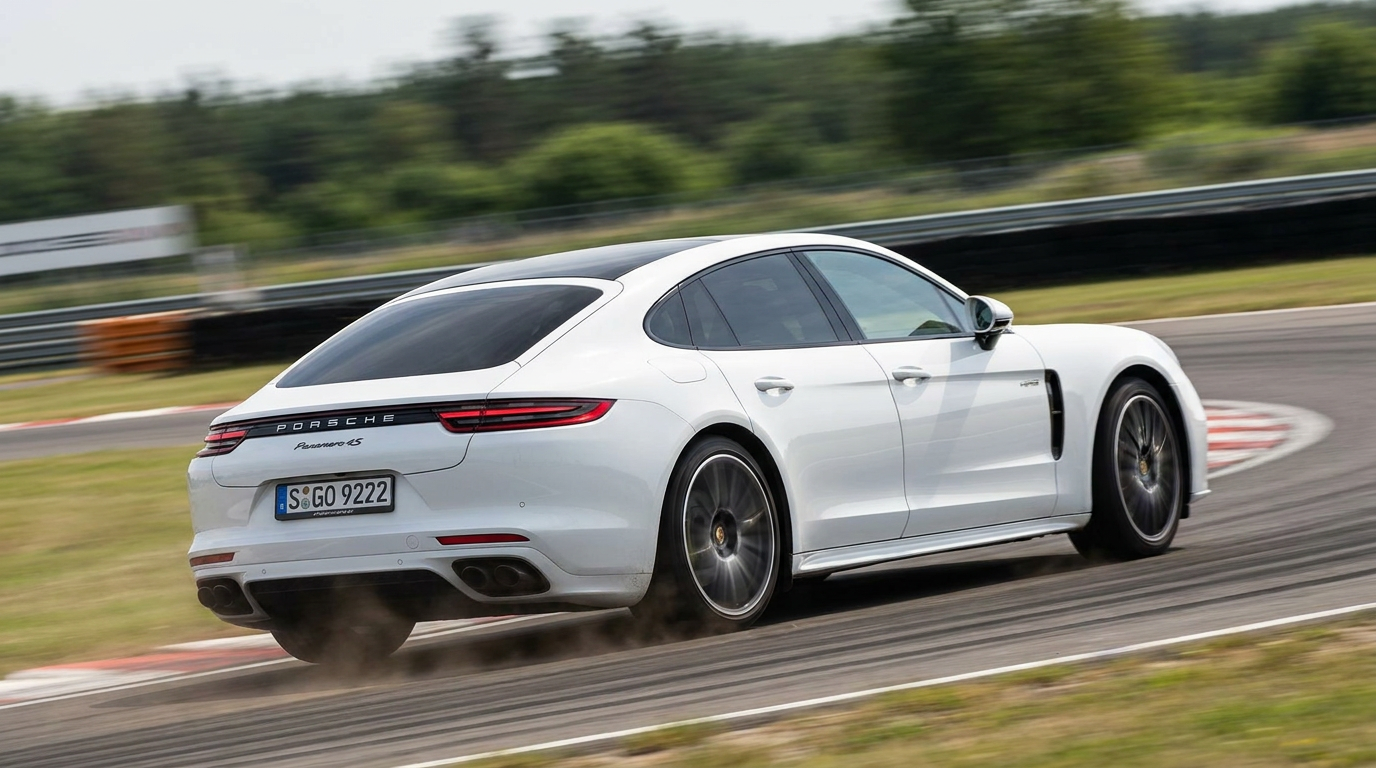
The result is a physics-defying driving experience. In the latest Porsche Panamera and Taycan models, the optional 'Porsche Active Ride' system utilizes a dedicated 400-volt motor-pump unit at each corner. Operating at a blistering 13 hertz—meaning it can adjust the damping force 13 times per second—the system completely isolates the cabin from road imperfections. The hydraulic pumps generate a volume flow that moves the damper piston up or down at lightning speed, allowing each wheel to actively extend or compress individually without disturbing the chassis.[1][4]

Porsche's system doesn't just react to bumps; it proactively manages the car's body dynamics. Under hard acceleration, traditional cars squat at the rear. Under heavy braking, they dive at the front. Porsche Active Ride counters these forces instantly, keeping the body perfectly level. It can even be programmed to lean into corners like a motorcycle, or pitch backward during braking like a helicopter. By artificially tilting the chassis against the natural G-forces, the system drastically reduces the lateral and longitudinal forces felt by passengers, virtually eliminating motion sickness.[4]
Ferrari took a different but equally radical approach for its first SUV, the Purosangue. Partnering with Canadian engineering firm Multimatic, Ferrari integrated the TrueActive Spool Valve (TASV) system. Inside each damper, a 48-volt liquid-cooled brushless electric motor drives a bespoke twin-lead ball screw connected directly to the damper shaft. This mechanical connection allows the system to exert massive, instantaneous force, supplementing the vehicle's traditional coil springs with parallel force actuation that can move the entire vehicle body on command.[5][6]
This level of control allows the Ferrari to exert enough force to move the entire vehicle body in anticipation of a road disturbance or a sudden steering input. The TASV system gives the high-riding, heavy Purosangue the agility, grip, and flat cornering characteristics of a low-slung, mid-engine supercar. By actively lowering the vehicle's center of gravity and controlling pitch and roll stiffness on the fly, the system maximizes tire traction. This engineering triumph earned the Purosangue widespread industry accolades, including major automotive chassis and technology awards.[2][6]
This level of control allows the Ferrari to exert enough force to move the entire vehicle body in anticipation of a road disturbance or a sudden steering input.
Meanwhile, in China, electric vehicle manufacturer NIO has pushed the theatrical limits of active suspension with its flagship ET9 luxury sedan. Equipped with the 'SkyRide' intelligent chassis system, the ET9 features dedicated hydraulic pumps that can process road information and respond within a single millisecond. NIO claims the system is the world's first fully integrated hydraulic fully active suspension, capable of making up to 1,000 torque adjustments per second to ensure the vehicle body remains entirely undisturbed regardless of the terrain below.[3]
NIO demonstrated the system's astonishing capabilities in a series of viral promotional videos. In one clip, a camouflaged ET9 prototype uses its independently controlled shock absorbers to literally shake a thick layer of snow off its roof, mimicking the rapid, oscillating movements of a wet dog. In another demonstration, the car drives over a series of harsh, staggered speed bumps while balancing a five-layer champagne tower on its hood. The wheels bounce violently, but the chassis remains so perfectly level that not a single drop of liquid is spilled.[3]

Why is this technology suddenly proliferating now, after decades of conceptual teasing? The answer lies entirely in the electrification of the automobile. Fully active suspension systems require immense amounts of energy to constantly pump high-pressure hydraulic fluid or drive heavy-duty ball screws against the weight of a car. In a traditional combustion-engine vehicle, generating that much electrical or hydraulic power would place an unacceptable parasitic drain on the engine, ruining fuel economy and sapping acceleration to the point of making the system unviable for daily driving.[7]
In the 1980s and 1990s, Formula 1 teams and automakers like Lotus experimented heavily with active suspension, but the systems were ultimately deemed too power-hungry and complex for mass-market passenger cars. Today's electric vehicles and plug-in hybrids, however, are equipped with massive 400-volt and 800-volt battery architectures. These high-voltage systems have power to spare. The vehicle's main traction battery acts as a massive energy reservoir, easily supplying the electrical current needed to run four heavy-duty suspension motors simultaneously without noticeably impacting the car's overall driving range.[1][7]
The implications for modern vehicle design are profound. As cars transition to battery power, they are becoming significantly heavier. A modern luxury EV can easily weigh well over 5,000 pounds. Managing that immense mass through corners using traditional steel springs and passive dampers inevitably results in a harsh, unforgiving ride. Active suspension effectively masks that weight, allowing heavy electric vehicles to feel light, nimble, and responsive, while still gliding over broken city pavement with the grace of a classic luxury barge.[7]

Furthermore, the elimination of traditional mechanical anti-roll bars frees up valuable packaging space underneath the vehicle. Without a thick steel torsion bar physically connecting the left and right wheels across the axle, engineers have significantly more freedom. They can utilize that newly available space to fit larger battery packs, optimize underbody aerodynamic airflow for better highway efficiency, or increase the steering angle of the front wheels to achieve a tighter turning radius. It simplifies the mechanical layout of the chassis while offloading the complex physics management entirely to software and electric motors.[5][7]
While currently restricted to six-figure flagship models like the Panamera, Purosangue, and ET9, the technology is widely expected to trickle down the automotive hierarchy over the next decade. Just as anti-lock brakes, electronic stability control, and adaptive cruise control began as expensive luxury novelties before becoming universal industry standards, active suspension could eventually redefine the baseline for automotive comfort and handling across all price points. As the underlying electric motors and hydraulic pumps become cheaper to manufacture at scale, the technology will naturally migrate to premium mid-size sedans and family SUVs.[7]
For now, the technology remains a defining, magical feature of the ultra-luxury segment. It represents a rare moment in automotive history where a fundamental physical compromise—the century-old battle between ride comfort and handling precision—has been entirely engineered away. By leveraging the massive power reserves of modern electric architectures, automakers have finally delivered the holy grail of chassis dynamics, leaving drivers and passengers with a surreal sensation that feels less like driving on a road, and more like gliding effortlessly above it.[7]
How we got here
1980s-1990s
Formula 1 teams and automakers experiment with active suspension, but high power demands limit viability.
Sept 2022
Ferrari debuts the Multimatic TrueActive Spool Valve (TASV) system on the Purosangue SUV.
Nov 2023
Porsche unveils the Active Ride system for the new Panamera E-Hybrid, utilizing 400-volt hydraulic pumps.
Feb 2024
NIO demonstrates its SkyRide system by having an ET9 prototype shake off snow like a dog.
2026
Active suspension becomes a defining battleground for ultra-luxury EVs, earning major industry chassis awards.
Viewpoints in depth
Automotive Engineers
Engineers view the technology as the ultimate solution to a century-old physics problem.
For chassis engineers, active suspension represents the ultimate triumph over the traditional 'magic triangle' of ride, handling, and NVH (noise, vibration, and harshness). By decoupling the wheels from the body and eliminating the anti-roll bar, engineers no longer have to compromise. They point to the packaging benefits—freeing up space for batteries and aerodynamics—as a secondary but crucial advantage that will drive adoption across the EV industry.
Luxury Consumers
High-end buyers are drawn to the total isolation and elimination of motion sickness.
For high-end buyers, the appeal lies entirely in the 'magic carpet' ride and the elimination of physical fatigue. Active suspension drastically reduces the high-frequency vibrations and side-to-side head toss that cause motion sickness. Features like the car automatically raising its ride height by two inches the moment a door opens to allow for easier entry and exit are seen as the ultimate expression of modern automotive luxury.
Driving Purists
Enthusiasts worry that the technology makes driving feel synthetic and disconnected from the road.
Despite the objective performance gains, driving enthusiasts and purists remain skeptical of the synthetic feel. Traditional passive suspension communicates the limits of grip through natural body roll and brake dive, giving the driver physical cues about the car's behavior. When a car corners perfectly flat and refuses to dive under heavy braking, purists argue it feels like a video game, isolating the driver from the mechanical reality of the road.
What we don't know
- How long it will take for the cost of 400V hydraulic pumps to drop enough for mainstream vehicle adoption.
- The long-term reliability and repair costs of these highly complex motor-driven damper units.
Key terms
- Active Suspension
- A suspension system that uses external power (like electric motors or hydraulic pumps) to actively control the vertical movement of the wheels relative to the chassis.
- Anti-roll bar
- A traditional mechanical torsion spring that connects opposite wheels to reduce body roll during fast cornering, often at the expense of ride comfort.
- Spool Valve
- A highly precise hydraulic valve used in advanced dampers to control fluid flow, allowing for exact tuning of suspension stiffness.
- Unsprung Mass
- The weight of the vehicle's components not supported by the suspension, such as the wheels, tires, and brakes.
Frequently asked
What is the difference between adaptive and active suspension?
Adaptive suspension only changes how stiff the shock absorbers are. Active suspension uses motors to physically push the wheels down or pull them up, completely controlling the car's body.
Why didn't cars have this technology before?
Fully active systems require massive amounts of electrical power. Only modern EVs and plug-in hybrids have the high-voltage battery architectures necessary to run them efficiently.
Does active suspension replace air springs?
Not entirely. While the active dampers handle body control and bump absorption, most systems still use a single-chamber air spring to support the vehicle's base weight and save energy.
Will this technology come to cheaper cars?
Eventually. Like most automotive innovations, it is debuting on six-figure luxury flagships but is expected to trickle down as the components become cheaper to manufacture.
Sources
Source coverage
7 outlets
3 viewpoints surfaced







[1]AutocarAutomotive Engineers
Under the skin: How Porsche's new Active Ride suspension works
Read on Autocar →[2]MotorTrendDriving Purists
Ferrari's Active Suspension Earns Our 2026 Best Tech Chassis Award
Read on MotorTrend →[3]CarScoopsLuxury Consumers
Nio ET9 Shows Off Its Active Suspension By Shaking Off Snow Like A Dog
Read on CarScoops →[4]Porsche NewsroomAutomotive Engineers
Porsche Active Ride: The new benchmark for suspension systems
Read on Porsche Newsroom →[5]MultimaticAutomotive Engineers
Multimatic's breakthrough TrueActive Damper technology featured on Ferrari Purosangue
Read on Multimatic →[6]Motor AuthorityLuxury Consumers
Ferrari Purosangue debuts Multimatic True Active Spool Valve damper
Read on Motor Authority →[7]Factlen Editorial TeamDriving Purists
Synthesis by Factlen editorial team
Read on Factlen Editorial Team →
Every angle. Every day.
Get automotive stories with full source coverage and perspective breakdowns delivered to your inbox.