
OLED vs. Mini-LED: Which TV Technology Wins in 2026?
As Tandem OLED and high-zone Mini-LED displays reach new performance peaks in 2026, the choice between the two premium TV technologies comes down to room lighting, screen size, and viewing habits.
By Factlen Editorial Team
- Cinematic Purists
- Argues that infinite contrast, perfect black levels, and instantaneous response times make OLED the undisputed king of picture quality.
- Bright-Room Maximizers
- Prioritizes sustained full-screen brightness, zero burn-in risk, and massive screen sizes, arguing Mini-LED is the more practical choice for most living rooms.
- Display Analysts
- Focuses on the engineering convergence of the two technologies, noting that Tandem OLED and high-zone Mini-LED are rapidly closing the performance gaps between them.
What's not represented
- · Budget-conscious buyers under $500
- · Commercial digital signage operators
Why this matters
A premium television is a multi-year investment that dictates how you experience entertainment, gaming, and news. Choosing the right panel technology for your specific room lighting and viewing habits ensures you get the best possible picture without overpaying for features you cannot see.
Key points
- OLED technology delivers perfect black levels and infinite contrast by turning individual pixels completely off.
- Mini-LED technology utilizes thousands of tiny backlight zones to achieve massive peak brightness exceeding 2,500 nits.
- Tandem OLED and QD-OLED advancements in 2026 have significantly narrowed the brightness gap between the two technologies.
- Mini-LED remains the most cost-effective way to purchase massive screen sizes between 85 and 115 inches.
- OLED is ideal for dark home theaters and gaming, while Mini-LED excels in sunlit living rooms and mixed-use spaces.
The 2026 television market is defined by a clash between two highly advanced, fundamentally different engineering frameworks: OLED and Mini-LED. While older LCD technologies have largely been relegated to budget models, the premium space is now a two-horse race. Consumers are no longer choosing between a good picture and a bad one; they are choosing between two specialized tools engineered to conquer specific physical environments.[1][5][7]
To understand the trade-offs, one must first understand the mechanisms. OLED, or organic light-emitting diode technology, relies on carbon-based molecules that emit their own localized light. Because there is no backlight, the television's processor can cut the voltage to an individual pixel down to zero, turning it off completely.[2][5]
When evaluating OLED technology, the argument for its adoption centers on perfect contrast and pixel-level precision. Because each pixel operates independently, the display achieves a mathematically infinite contrast ratio. Dark cinematic scenes maintain rich depth without the distracting background haze typical of older displays.[1][2]

The argument against OLED focuses on sustained brightness limitations and the slight, though heavily mitigated, risk of image retention. To protect the organic compounds from overheating, OLED panels employ an Automatic Brightness Limiter (ABL). When a bright scene—like a hockey game or a snow-covered landscape—fills the entire screen, the ABL aggressively dims the overall luminance to prevent damage.[5][8]
The evidence supporting OLED's premium status remains compelling for enthusiasts. Beyond perfect black uniformity, the lack of liquid crystals allows for near-instantaneous 0.03-millisecond response times. This effectively eliminates motion blur, making it the gold standard for competitive gaming and fast-action cinema.[2][8]
On the other side of the aisle sits Mini-LED, the ultimate evolution of traditional liquid crystal display design. Instead of organic pixels, Mini-LED uses a matrix of thousands of tiny, inorganic blue gallium-nitride diodes. These diodes shoot massive amounts of light through a quantum-dot layer and a liquid crystal matrix to create the image.[5][7]
When evaluating Mini-LED technology, the argument for its use relies on overwhelming brightness and long-term durability. These inorganic light engines can sustain massive full-field luminance without triggering an ABL, making them uniquely capable of overpowering the glare in sun-drenched living rooms.[1][3]
When evaluating Mini-LED technology, the argument for its use relies on overwhelming brightness and long-term durability.
The argument against Mini-LED points to backlight blooming and less precise light control. Because the television must dim "zones" of LEDs rather than individual pixels, bright objects on dark backgrounds—such as white subtitles over a black cinematic letterbox—often exhibit a faint halo of light bleed.[2][6]

The evidence backing Mini-LED's rise includes peak luminance measurements exceeding 2,500 nits and the complete elimination of burn-in risk. Because the diodes are inorganic, users can leave static news tickers, sports scores, or video game interfaces on the screen for hours without fear of permanent image retention.[3][6]
In 2026, both technologies have taken significant leaps to cover their respective weaknesses. OLED manufacturers have introduced Tandem OLED, which stacks multiple organic light-emitting layers, and QD-OLED, which utilizes quantum dots. These advancements have pushed OLED peak brightness to between 1,500 and 2,000 nits in small windows, closing the historical gap with LCDs.[7][8]
Simultaneously, Mini-LED manufacturers have exponentially increased their local dimming zone counts. By tightly clustering thousands of individually controlled zones and refining the algorithms that drive them, modern Mini-LEDs mimic the deep blacks of OLED much more convincingly than previous generations, significantly reducing the blooming effect.[4][7]

The economic landscape also heavily influences the decision, particularly as consumer appetite for massive screens grows. Mini-LED dominates the 85-inch to 115-inch market, offering surprisingly affordable prices per inch. Conversely, OLED manufacturing yields drop sharply at larger sizes, making 83-inch and 97-inch OLED models prohibitively expensive for most buyers.[1][4]
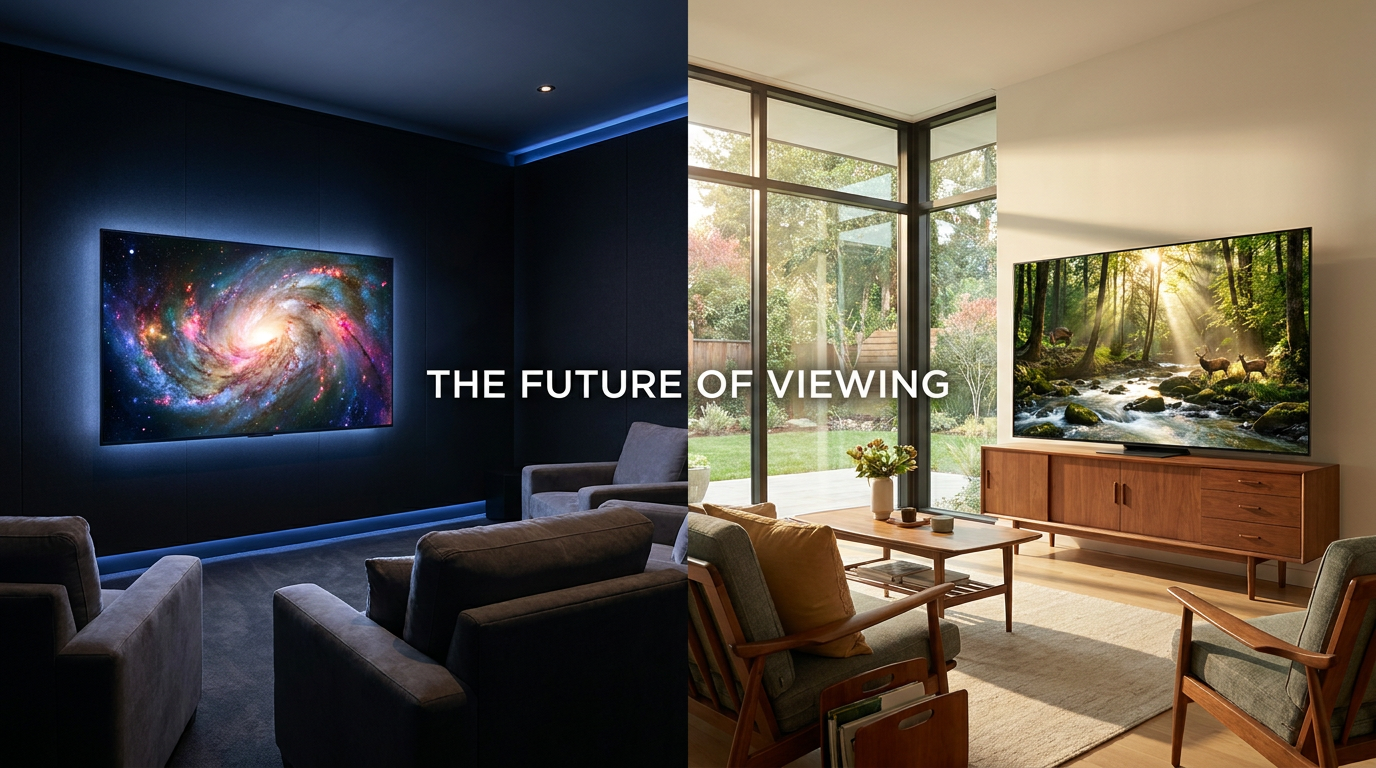
Ultimately, OLED fits well when the display is placed in a light-controlled room, when the user prioritizes cinematic black levels, or when competitive gamers demand zero motion blur. It is the definitive choice for dedicated home theaters where lighting can be managed to let the infinite contrast shine.[6][8]
However, OLED does not fit when the television sits in a sun-drenched living room with open curtains, or when the primary content involves static broadcast news channels left running all day. In these scenarios, the ABL will dim the picture, and the persistent static logos introduce unnecessary anxiety over panel longevity.[3][6]

Conversely, Mini-LED fits well when the viewing environment features large windows and heavy ambient light, when the buyer wants a massive screen without a luxury markup, or when the household leaves the television on continuously. Its sheer vibrancy ensures the picture pops regardless of the time of day.[3][7]
Mini-LED does not fit when the viewer is highly sensitive to light blooming around subtitles in a pitch-black room, or when off-angle viewing is critical, as some Mini-LED panels still suffer from color shift when viewed from the side. For those seeking absolute pixel-level perfection in the dark, the inorganic matrix still falls just short of organic perfection.[2][5]
How we got here
2013
The first consumer OLED TVs hit the market, introducing perfect black levels but struggling with low brightness and high prices.
2019
Mini-LED technology is introduced to consumer televisions, drastically increasing the number of local dimming zones compared to traditional LCDs.
2022
QD-OLED panels debut, combining OLED's self-emissive pixels with quantum dots to significantly boost color brightness and saturation.
2026
Tandem OLED architectures reach the consumer market, stacking emissive layers to push peak brightness to 2,000 nits while mitigating burn-in risks.
Viewpoints in depth
Cinematic Purists
The argument that infinite contrast and pixel-level precision make OLED the undisputed king of picture quality.
For home theater enthusiasts and competitive gamers, the conversation begins and ends with OLED. This camp emphasizes that no amount of backlight dimming zones can replicate the mathematical perfection of turning a pixel completely off. They point to the near-instantaneous 0.03-millisecond response times as proof that OLED is structurally superior for motion clarity. While they acknowledge the brightness advantages of Mini-LED, they argue that in a properly lit viewing environment, infinite contrast provides more perceived depth and HDR impact than sheer luminance.
Bright-Room Maximizers
The argument that sustained brightness, zero burn-in risk, and massive screen sizes make Mini-LED the more practical choice.
This perspective focuses on the realities of modern living spaces, which often feature large windows, open floor plans, and daytime viewing habits. Proponents argue that OLED's Automatic Brightness Limiter (ABL) artificially suppresses the vibrancy of bright scenes, making Mini-LED's ability to sustain 2,500+ nits far more valuable for everyday use. Furthermore, they highlight the economic reality of screen sizes: for buyers wanting a cinematic 85-inch or 98-inch display, Mini-LED offers premium performance at a fraction of the cost of a comparable OLED.
Display Analysts
The view that engineering advancements in 2026 are rapidly blurring the historical lines between the two technologies.
Industry analysts point out that the traditional trade-offs are becoming less severe. With the introduction of Tandem OLED and QD-OLED, organic panels are now hitting brightness levels that rival older LCDs, making them viable in brighter rooms. Conversely, the explosion of local dimming zones in modern Mini-LEDs has drastically reduced the blooming effect, allowing them to mimic OLED's black levels much more convincingly. This camp argues that the choice is no longer about 'good vs. bad' picture quality, but rather matching the specific panel architecture to the user's exact room lighting and workflow.
What we don't know
- How the long-term degradation curve of the new Tandem OLED panels will compare to traditional single-layer OLEDs after five to seven years of heavy use.
- Whether Micro-LED—a technology that combines OLED's self-emissive pixels with Mini-LED's inorganic brightness—will become affordable enough to replace both technologies by the end of the decade.
Key terms
- OLED (Organic Light-Emitting Diode)
- A display technology where each pixel generates its own light and can be turned off completely, resulting in perfect black levels.
- Mini-LED
- An advanced LCD backlight technology that uses thousands of tiny diodes grouped into zones to precisely dim dark areas of the screen.
- ABL (Automatic Brightness Limiter)
- A protective feature in OLED TVs that automatically dims the screen when a large portion of the image becomes very bright, preventing overheating.
- Blooming (or Haloing)
- A visual artifact in Mini-LED TVs where light bleeds into dark areas surrounding a bright object, such as white subtitles on a black background.
- Tandem OLED
- A newer OLED architecture that stacks multiple light-emitting layers to increase overall brightness and extend the lifespan of the panel.
Frequently asked
Is burn-in still a problem for OLED TVs in 2026?
While the risk still exists, it has been heavily mitigated by newer technologies like Tandem OLED, pixel shifting, and logo dimming. It is generally only a concern if you leave static elements, like news tickers, on the screen for many hours every day.
Which TV is better for a bright living room?
Mini-LED is the superior choice for bright rooms. Its ability to sustain high full-screen brightness without triggering an Automatic Brightness Limiter allows it to overpower glare from windows much better than OLED.
Which technology is better for gaming?
OLED is widely considered the gold standard for competitive gaming due to its near-instantaneous 0.03ms response time, which eliminates motion blur. However, Mini-LED is preferred for gamers who play games with static HUDs for 8+ hours a day due to zero burn-in risk.
Why are large OLED TVs so much more expensive?
Manufacturing large sheets of organic self-emissive pixels is highly complex, and the yield rate drops significantly at massive sizes. Mini-LEDs, which use inorganic backlights, are much easier and cheaper to scale up to 85, 98, or even 115 inches.
Sources
Source coverage
8 outlets
3 viewpoints surfaced








[1]CNETCinematic Purists
OLED vs. Mini-LED: Which TV technology is better?
Read on CNET →[2]RTINGSCinematic Purists
Mini LED vs OLED TVs: Which is better?
Read on RTINGS →[3]PCWorldBright-Room Maximizers
Why it's time to look beyond OLED to Mini-LED
Read on PCWorld →[4]What Hi-Fi?Bright-Room Maximizers
Best Mini LED TVs 2026: top models tested by our experts
Read on What Hi-Fi? →[5]TechStoryDisplay Analysts
A deep structural analysis of OLED vs Mini LED display technology
Read on TechStory →[6]EcoPicksGoDisplay Analysts
OLED vs Mini LED TVs: 2026 Buyer's Guide
Read on EcoPicksGo →[7]Data Wire SolutionsDisplay Analysts
Best TVs for 2026: 10 OLED and Mini-LED Picks
Read on Data Wire Solutions →[8]KTC PlayDisplay Analysts
Tandem OLED vs. Mini-LED: Choosing the Best HDR Panel in 2026
Read on KTC Play →

Every angle. Every day.
Get shopping stories with full source coverage and perspective breakdowns delivered to your inbox.