
How Deepfake Detection and Digital Provenance Finally Caught Up to AI in 2026
After years of playing catch-up, fact-checkers and cybersecurity teams are gaining the upper hand against synthetic media through 98%-accurate multi-modal detectors and the universal adoption of C2PA cryptographic watermarking.
By Factlen Editorial Team
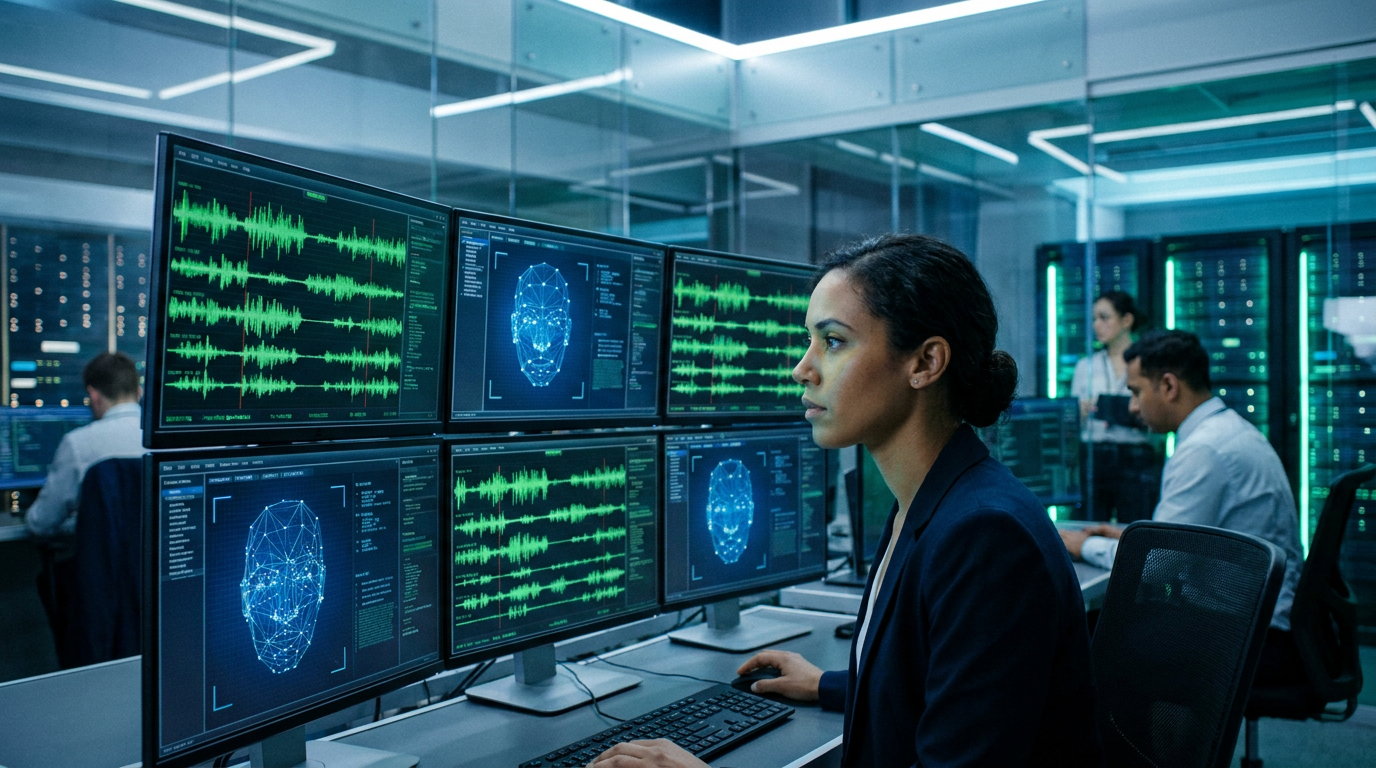
- Cybersecurity Analysts
- Argue that real-time, multi-modal detection is the only way to stop active fraud and deepfake injections.
- Provenance Advocates
- Believe the long-term solution is establishing an unbroken cryptographic chain of trust from the moment of creation.
- AI Developers
- Focus on embedding invisible, persistent watermarks directly into the media generation process to ensure transparency.
What's not represented
- · Open-source AI developers
- · Independent content creators
Why this matters
As generative AI becomes indistinguishable from reality, the ability to reliably detect synthetic media protects democratic elections, secures enterprise finances, and restores public trust in digital evidence.
Key points
- Multi-modal AI detectors are now achieving 98% accuracy by analyzing video, motion, and depth simultaneously.
- Audio deepfake detection has seen massive improvements, with commercial models correctly identifying voice clones 96% to 98% of the time.
- The C2PA provenance standard has become an ISO standard, with over 6,000 members embedding cryptographic history into media.
- Major AI generators now embed invisible watermarks and cryptographic credentials by default, shifting the ecosystem toward proactive transparency.
For years, the story of artificial intelligence and media manipulation was one of an unwinnable arms race. Every time fact-checkers and cybersecurity teams developed a new detection tool, synthetic media generators adapted to bypass it. But in 2026, the dynamic has fundamentally shifted.[6]
The defense is finally gaining the upper hand through a combination of multi-modal forensic detection and the universal adoption of cryptographic provenance. This evidence pack examines the breakthroughs that have pushed deepfake detection accuracy to unprecedented levels, giving institutions the tools they need to verify reality.[6]
Older detection models relied on single signals, analyzing isolated pixel inconsistencies or lip-sync mismatches. As generative AI evolved, modern deepfakes learned to perfectly align facial movements, voice modulation, and environmental lighting, easily bypassing these basic checks.[2]
In response, enterprise defense systems have moved to multi-modal analysis. Tools like Incode's Deepsight now analyze video, motion, and depth data simultaneously. By cross-referencing these signals, the system exposes subtle physical inconsistencies that synthetic media cannot reliably reproduce, achieving 98.3% accuracy in real-world deployments.[2]

Crucially, these multi-layered integrity checks are performed in under 100 milliseconds. This speed allows platforms to block virtual camera injections and synthetic identity attacks in real time without adding friction for legitimate users during live video calls or authentication sessions.[2]
Audio deepfakes have historically been one of the most difficult modalities to secure. Highly convincing voice clones have infiltrated call centers and bypassed traditional voice biometrics, creating a massive vulnerability for financial institutions.[3]
However, the latest independent benchmarks, such as the Podonos evaluation, demonstrate significant progress in this arena. Commercial models from developers like Aurigin AI and Resemble are now scoring between 96% and 98% accuracy in differentiating spoof attempts from real audio, with false positive rates dropping below 2.5%.[3]

However, the latest independent benchmarks, such as the Podonos evaluation, demonstrate significant progress in this arena.
While forensic detection catches unmarked deepfakes, the technology industry has simultaneously built a proactive trust layer. The Coalition for Content Provenance and Authenticity (C2PA) has officially graduated from an industry specification to an ISO standard (ISO/IEC 22144).[4]
This standardization has triggered massive global adoption. As of early 2026, the C2PA coalition boasts over 6,000 members and affiliates. More importantly, every major AI generator—including Midjourney, OpenAI's DALL-E, and Google's models—now embeds C2PA content credentials by default.[4]
These cryptographic manifests record the exact provenance of the content: what device captured it, what software processed it, and whether generative AI was involved. Because the entries are digitally signed using public key cryptography, any tampering immediately breaks the chain of trust.[4]

Because standard metadata can sometimes be stripped by bad actors or compressed by social media platforms, developers have also introduced persistent watermarking directly into the media signal. Google DeepMind's SynthID, for example, is now embedded in over 100 billion images and videos.[1]
SynthID is designed to survive common edits, including compression, resizing, cropping, and re-encoding. When a user uploads a video to a verification tool like Gemini, the system does not just give a generic confirmation; it highlights the specific timestamps where the embedded watermark is detected.[1][5]
This approach treats verification as a probabilistic signal rather than an absolute judgment. It surfaces concrete evidence of AI generation without overclaiming certainty in an environment where highly motivated actors might still attempt to degrade watermarks.[5]
Despite these massive breakthroughs, the ecosystem is not entirely secure. C2PA and SynthID only work when the content originates from a compliant device, camera, or software workflow.[4][5]
The vast majority of legacy digital content currently in circulation carries no provenance metadata. Furthermore, open-source AI models can still be modified by bad actors to generate synthetic media without embedding C2PA manifests or SynthID watermarks.[4][5]
For these reasons, the absence of a watermark or credential does not guarantee that a piece of media is authentic. Fact-checkers and security teams must continue to rely on a layered defense architecture, combining cryptographic provenance for compliant media with advanced multi-modal detection for everything else.[2][6]
How we got here
2021
The Coalition for Content Provenance and Authenticity (C2PA) is founded by Adobe, Arm, Intel, and Microsoft.
2024
Google DeepMind introduces SynthID for watermarking AI-generated images and audio.
2025
C2PA graduates to a formal ISO standard (ISO/IEC 22144), accelerating global adoption.
Early 2026
Major AI generators begin embedding C2PA credentials by default, while multi-modal detectors break the 98% accuracy barrier.
Viewpoints in depth
Cybersecurity Analysts
Argue that real-time, multi-modal detection is the only way to stop active fraud and deepfake injections.
Security professionals emphasize that provenance standards like C2PA, while valuable, cannot stop active attacks. When a fraudster injects a cloned voice or a real-time deepfake into a live video call, metadata is irrelevant. This camp argues that the true breakthrough of 2026 is the ability to perform multi-modal integrity checks—analyzing depth, motion, and video simultaneously—in under 100 milliseconds. They view adversarial forensic detection as the permanent frontline of digital defense.
Provenance Advocates
Believe the long-term solution is establishing an unbroken cryptographic chain of trust from the moment of creation.
Standards bodies and camera manufacturers argue that trying to detect deepfakes after the fact is an unwinnable arms race. Instead, they champion the C2PA model, which has now achieved ISO standardization. By embedding hardware-rooted cryptographic keys into cameras and forcing major AI generators to sign their outputs by default, this camp aims to flip the paradigm: rather than proving a file is fake, the ecosystem will increasingly demand cryptographic proof that a file is real.
AI Developers
Focus on embedding invisible, persistent watermarks directly into the media generation process to ensure transparency.
The teams building generative AI models advocate for solutions baked directly into the pixels and audio waves. Technologies like Google DeepMind's SynthID are designed to survive compression, cropping, and re-encoding—manipulations that often strip standard metadata. This camp views verification as a probabilistic signal, providing fact-checkers with contextual evidence (such as highlighting specific timestamps where AI was used) rather than binary 'real or fake' judgments.
What we don't know
- How quickly legacy social media platforms will fully integrate C2PA verification warnings into user feeds.
- Whether bad actors will find new ways to strip persistent watermarks like SynthID using advanced adversarial AI models.
Key terms
- C2PA
- The Coalition for Content Provenance and Authenticity, an initiative that created the standard for embedding cryptographic history into media files.
- SynthID
- A technology developed by Google DeepMind that embeds imperceptible digital watermarks directly into AI-generated text, audio, images, and video.
- Multi-modal detection
- AI defense systems that analyze multiple signals simultaneously—such as video, motion, and depth—to spot physical inconsistencies.
- False Negative Rate (FNR)
- The percentage of times a detection system fails to identify a deepfake, incorrectly labeling it as authentic.
Frequently asked
What is C2PA?
The Coalition for Content Provenance and Authenticity (C2PA) is an open technical standard, now recognized as ISO/IEC 22144, that embeds cryptographically signed metadata into digital files to track their origin and edit history.
How does SynthID differ from C2PA?
SynthID embeds an invisible watermark directly into the pixels or audio waves of a file, designed to survive compression and cropping. C2PA attaches a cryptographic manifest to the file's metadata.
Can humans still detect deepfakes by eye?
Studies in 2025 and 2026 show that human detection is only slightly better than random guessing against high-quality synthetic media, making algorithmic detection essential.
Does this mean the deepfake problem is solved?
No. Open-source models can still generate unmarked content, meaning forensic detection must work alongside provenance tools to catch media created by bad actors.
Sources
Source coverage
6 outlets
3 viewpoints surfaced






[1]Google DeepMindAI Developers
Detecting SynthID watermarks in Gemini
Read on Google DeepMind →[2]Cyber MagazineCybersecurity Analysts
Deepsight and the future of deepfake defence
Read on Cyber Magazine →[3]Biometric UpdateCybersecurity Analysts
Aurigin AI shows top-tier audio deepfake detection accuracy in new benchmark
Read on Biometric Update →[4]MetaStrip AnalysisProvenance Advocates
C2PA is now an ISO standard: Every major AI generator now embeds provenance by default
Read on MetaStrip Analysis →[5]Data StudiosAI Developers
SynthID video verification: The system reports evidence, not absolute authenticity
Read on Data Studios →[6]Factlen Editorial TeamAI Developers
Synthesis by Factlen editorial team
Read on Factlen Editorial Team →

More in news politics
See all 7 stories →Middle East Peace
US and Iran Establish 60-Day Roadmap and De-confliction Mechanisms in Swiss Peace Talks
8 sources

US-Iran Relations
US and Iran Agree to 60-Day Roadmap for Final Peace Deal Following Tense Switzerland Summit
7 sources

US-Iran Diplomacy
US and Iran Agree to 60-Day Peace Roadmap Following High-Level Swiss Summit
7 sources

US-Iran Diplomacy
US and Iran Agree to 60-Day Roadmap for Final Deal Following Switzerland Talks
8 sources

Every angle. Every day.
Get news politics stories with full source coverage and perspective breakdowns delivered to your inbox.