
The Multimillion-Dollar Science Keeping the 2026 World Cup on Natural Grass
To meet FIFA's strict natural-grass mandate across 16 North American stadiums, turfgrass scientists have engineered unprecedented methods to grow, transport, and sustain living pitches inside domed arenas.
By Factlen Editorial Team
- Agronomy Researchers
- Focused on advancing turf science and proving natural grass can thrive indoors.
- Players and Coaches
- Demand a consistent, safe, and natural playing surface that behaves predictably.
- Stadium Operators
- Tasked with the complex logistics of installing and maintaining temporary natural pitches.
What's not represented
- · Environmental advocates monitoring the water and energy usage of the temporary pitches
- · Sod farmers who scaled up operations to meet the massive demand
Why this matters
The 2026 World Cup represents the largest agronomic experiment in sports history. The innovations developed to keep grass alive indoors could eventually transform how local stadiums, golf courses, and urban green spaces are managed worldwide.
Key points
- FIFA mandates natural grass for all World Cup matches, posing a challenge for North America's domed and artificial-turf stadiums.
- Researchers spent six years developing methods to grow, transport, and sustain temporary grass pitches.
- Sod was grown on plastic sheets to create a stable, horizontally intertwined root system.
- Domed stadiums use massive artificial grow lights and ventilation systems to keep the grass alive without sunlight.
- Synthetic fibers are stitched into the natural grass to reinforce the pitch against the wear of elite athletes.
- The innovations could eventually encourage domestic sports leagues to replace artificial turf with natural grass.
As the 2026 World Cup unfolds across North America, billions of eyes are locked on the world's elite athletes navigating 104 matches across 16 host cities. Yet, beneath the spectacular goals and dramatic saves lies an unsung scientific marvel that makes the entire tournament possible: the ground the players are running on.[1][2]
FIFA, soccer's international governing body, maintains a strict mandate that all men's World Cup matches must be played on natural, living grass. While this is standard for the tournament, applying that rule to the United States, Canada, and Mexico presented an unprecedented logistical nightmare.[2][4]
Of the 16 selected host stadiums, eight normally utilize artificial turf for their domestic sports teams. Even more daunting, five of those venues are fully enclosed domes that block the plant-sustaining natural sunlight required to keep a grass pitch alive.[2]
To solve this seemingly impossible puzzle, FIFA invested over $5 million into a massive agronomic research initiative, tapping leading turfgrass experts like Dr. John Sorochan of the University of Tennessee and Dr. Trey Rogers of Michigan State University.[1][5]

Beginning in 2020, these research teams embarked on a six-year quest to engineer a playing surface that could be grown off-site, transported thousands of miles, and kept alive indoors for six weeks of intense, high-stakes competition.[2][4]
The first major hurdle was selecting the right species of grass. Because the tournament spans a massive continent with wildly varying weather patterns, the scientists realized a single grass type would not survive, eventually settling on two primary systems.[2][4]
For hot, humid outdoor environments like Miami and Monterrey, the researchers selected resilient Bermuda grass, a warm-season species capable of thriving under the intense summer sun.[2][3]
For cooler outdoor climates and, crucially, the climate-controlled indoor domes in cities like Atlanta, Dallas, and Houston, they engineered a specific cool-season blend of Kentucky bluegrass and perennial ryegrass.[2][4]

Growing the grass required a highly unconventional approach. Because the temporary pitches would be laid directly over concrete floors or existing artificial turf, the sod was cultivated on massive sheets of plastic at specialized farms, including a massive operation in Colorado.[2][3]
Growing the grass required a highly unconventional approach.
This "sod-on-plastic" method forces the root system to grow horizontally and intertwine rather than digging deep into the earth. The result is a highly stable, mature carpet of grass that does not rely on a deep soil profile to maintain its structural integrity.[3][4]
In the weeks leading up to the tournament's kickoff, the mature grass was harvested using giant cutters, rolled into 40-foot strips, and loaded into fleets of refrigerated trucks for journeys spanning up to 1,000 miles to their final stadium destinations.[2][3]
Once inside the stadiums, the installation process resembled building a complex, high-tech layer cake. Crews laid down protective geotextile fabrics, a drainage gravel layer, and specialized sand before carefully rolling out the sod.[3]

To ensure the grass could withstand the sheer force of elite athletes sprinting, stopping, and changing direction, synthetic fibers were stitched directly into the natural turf, anchoring the root system and preventing the pitch from tearing under pressure.[4]
The most daunting challenge, however, remained the domed stadiums. Without natural sunlight, a living pitch would quickly wither, lose its color, and die long before the tournament concluded.[2]
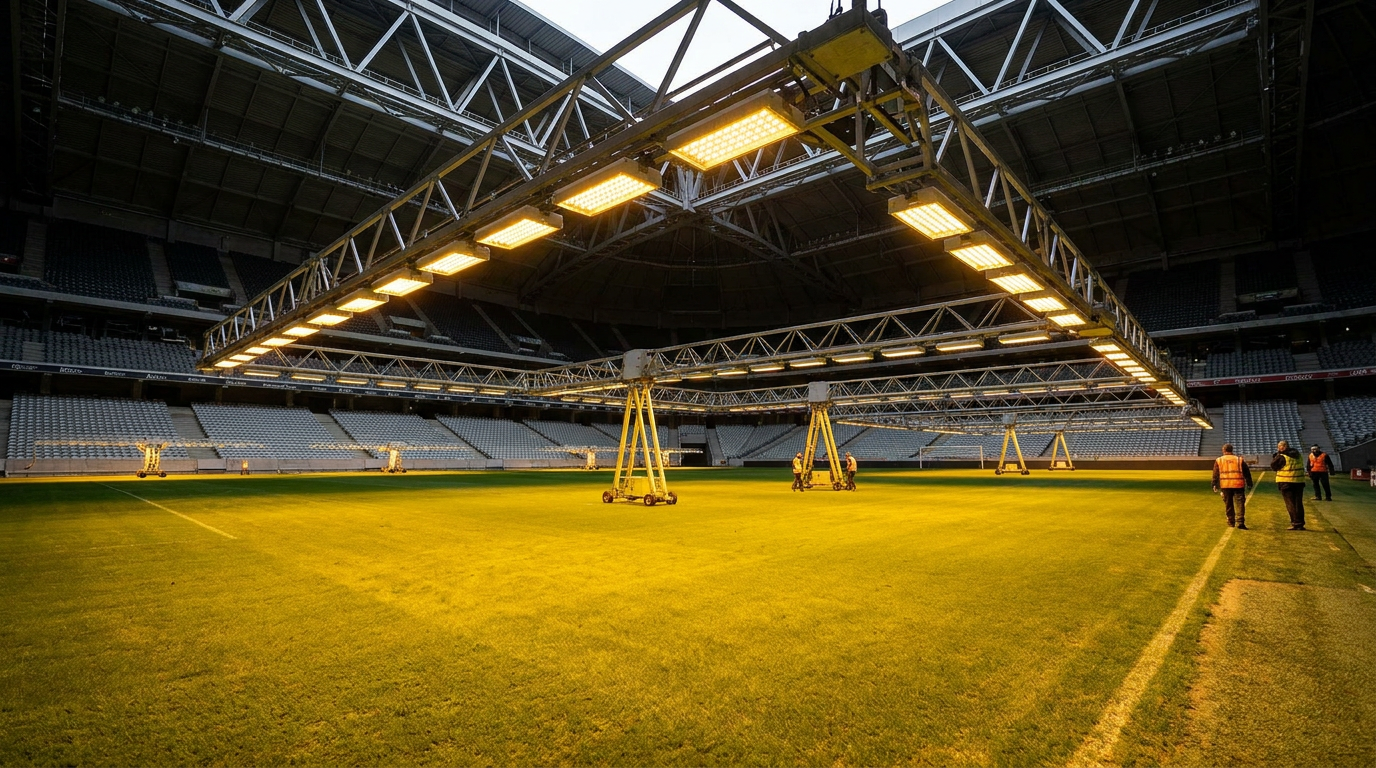
The solution involved deploying massive arrays of artificial grow lights—described by the researchers as looking like "big birds"—that are wheeled out onto the pitch during the days between matches.[2]
These lighting rigs, combined with advanced vacuum and ventilation pipes installed beneath the grass, provide a highly calibrated recipe of light hours and airflow to sustain the plant's energy and simulate a natural outdoor environment.[3]

To guarantee uniformity across all 16 venues, the scientists utilized advanced testing equipment, including a proprietary machine called the fLEX, which uses a 3D-printed foot wearing a soccer cleat to simulate player traction and measure the field's give.[3][4]
They also conducted rigorous ball-drop tests, ensuring that a pass played inside a climate-controlled dome in Houston bounces and rolls exactly the same way as a pass played in the high altitude of Mexico City.[2][3]
For the researchers, the ultimate metric of success is total invisibility. If the billions of fans watching the tournament and the players on the field never stop to think about the grass, the science has worked perfectly.[3]
How we got here
2018
FIFA begins initial consultations with turfgrass experts to address the unique challenges of the 2026 North American venues.
Late 2020
Formal research partnerships are established with the University of Tennessee and Michigan State University to develop the perfect pitch.
May 2026
Mature sod is harvested from specialized farms and transported via refrigerated trucks to the 16 host stadiums.
June 11, 2026
The 2026 World Cup kicks off, putting years of agronomic research to the ultimate test on the global stage.
Viewpoints in depth
Agronomy Researchers
Scientists view the tournament as an unprecedented opportunity to advance turfgrass technology.
For researchers at the University of Tennessee and Michigan State, the World Cup is the ultimate stress test. They argue that proving natural grass can survive and thrive in domed stadiums could revolutionize sports infrastructure, potentially convincing American football teams and municipal stadiums to abandon artificial turf in favor of safer, natural surfaces.
Players and Coaches
Elite athletes demand consistency and safety above all else.
Professional soccer players have spent their entire lives training on natural grass, which offers more 'give' than synthetic turf, reducing the stress on joints and ligaments. For players, the primary concern is that the ball rolls, bounces, and grips exactly the same way in a climate-controlled dome in Atlanta as it does in the open air of Mexico City.
Stadium Operators
Venue managers face the logistical and financial hurdles of temporary natural pitches.
For the operators of multi-use stadiums that typically rely on artificial turf, the World Cup mandate presents a massive logistical hurdle. They must balance the strict requirements of FIFA—which involve importing tons of sand, gravel, and sod—with the reality of returning the venue to its standard configuration once the tournament concludes.
What we don't know
- How the temporary grass pitches will hold up during the final weeks of the tournament after enduring dozens of high-intensity matches.
- Whether the success of these indoor natural pitches will convince NFL teams to permanently replace their artificial turf.
Key terms
- Turfgrass
- Specialized grass cultivated specifically for athletic fields, designed to withstand heavy wear and tear while providing a safe playing surface.
- Sod on plastic
- A growing technique where grass is cultivated over a plastic barrier, forcing the roots to intertwine horizontally to create a stable, mature surface that can be easily transported.
- Cool-season grass
- Grass species, like Kentucky bluegrass and perennial ryegrass, that thrive in temperate climates and are being used inside the climate-controlled domed stadiums.
- Warm-season grass
- Grass species, such as Bermuda grass, that are highly tolerant of heat and humidity, used for the outdoor stadiums in southern host cities.
Frequently asked
Why doesn't FIFA just use artificial turf?
FIFA mandates natural grass for the men's World Cup because it provides a safer, more consistent surface that elite players are accustomed to, reducing joint stress and ensuring predictable ball physics.
How do they keep grass alive inside dark domes?
Stadiums deploy massive arrays of artificial grow lights and specialized ventilation systems to simulate sunlight and airflow, providing the grass with the exact energy recipe it needs to survive indoors.
Where is the grass grown?
The sod is cultivated at specialized farms—such as a facility in Colorado that grew the cool-season grass for southern domed stadiums—before being rolled up and shipped in refrigerated trucks.
Sources
Source coverage
7 outlets
3 viewpoints surfaced







[1]The New York TimesPlayers and Coaches
The Secrets of a Soccer-Turf Master
Read on The New York Times →[2]CNNPlayers and Coaches
The grass guru responsible for the World Cup pitches
Read on CNN →[3]ForbesStadium Operators
Nuances Of World Cup Turfgrass
Read on Forbes →[4]Scientific AmericanAgronomy Researchers
Inside the 2026 World Cup's push to engineer the perfect pitch
Read on Scientific American →[5]University of TennesseeAgronomy Researchers
UT Turfgrass Research for FIFA World Cup 26 Earns Global Spotlight
Read on University of Tennessee →[6]Golf Course ManagementAgronomy Researchers
Turfgrass researchers' work will take center field at the FIFA World Cup
Read on Golf Course Management →[7]Factlen Editorial TeamAgronomy Researchers
Synthesis by Factlen editorial team
Read on Factlen Editorial Team →
Every angle. Every day.
Get science stories with full source coverage and perspective breakdowns delivered to your inbox.